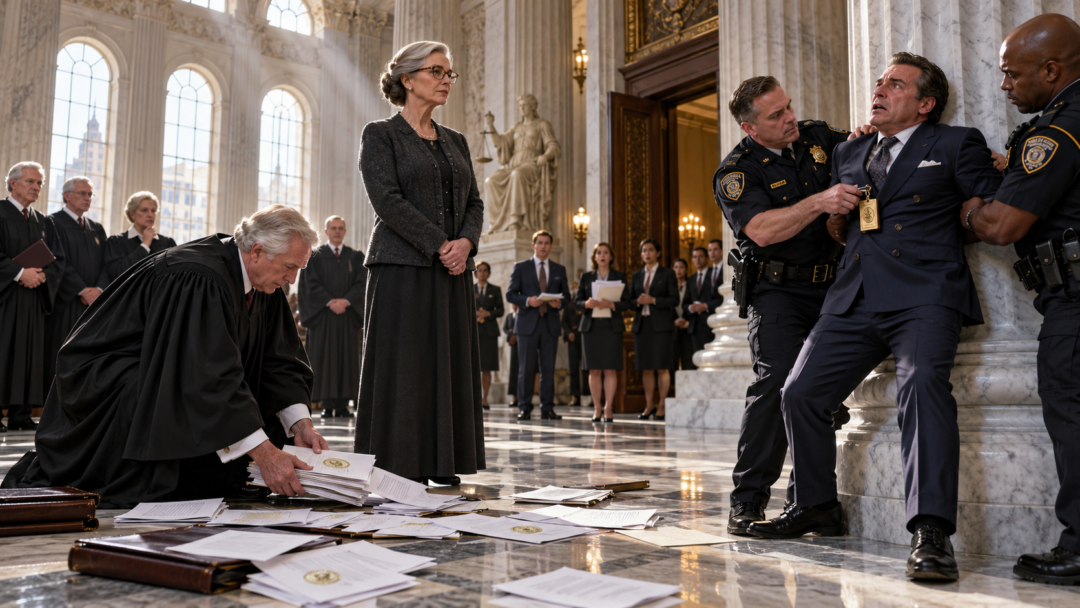
The Scattered Briefs In The Marble Colonnade And The Supreme Justice
CHAPTER 2: THE PEN IN THE LIBRARY SHADOWS
The silence that stretched between them in the marble colonnade was suffocating, but Douglas Sterling was far too intoxicated by his own arrogance to heed the warning. He gave a dismissive, mocking laugh, kicking the crushed document aside with the toe of his shoe, sending the blue-ink memorandum sliding across the stone toward the base of a marble pillar. He checked his watch once more, adjusted the lapels of his double-breasted jacket, and sneered at the quiet woman before striding toward the clerk’s registry down the northern wing, convinced that his threats had cowed yet another insignificant court employee.
Justice Evelyn Carter remained standing beside the scattered papers for several long moments. She did not rush. She did not betray a flicker of anger. Only when Sterling’s heavy footfalls had faded into the distant archway did she stoop down, gathering the documents with methodical precision. Her hands were steady as she aligned the edges of each linen sheet, smoothing the crease where his shoe had scarred the court’s embossed seal. She retrieved the blue-ink memorandum last, tucking it securely into the inner pocket of her cardigan.
Her mind traveled back three hours, to five-thirty that morning, when the courthouse was still shrouded in predawn darkness and only the maintenance staff walked the corridors. Evelyn had not arrived at the Supreme Court to perform routine administrative review. She had come because of an urgent, terrified whisper left on her private chambers’ encrypted voicemail at midnight.
That dawn meeting had taken place in the secluded third-tier stacks of the State Law Library, beneath green glass banker lamps that cast long, emerald shadows across thousands of leather-bound appellate reporters. Waiting for her among the dusty shelves of nineteenth-century maritime jurisprudence had been Clara Bennett.
At twenty-nine, Clara possessed one of the sharpest analytical minds of her law school class, having graduated summa cum laude before being recruited directly into the litigation department of Sterling, Vance and Croft. But that morning, sitting in the dim library alcove with dark circles beneath her hollow eyes and trembling hands clutched around a paper cup of black coffee, Clara looked like a survivor fleeing an active disaster. Six months earlier, Clara had been assigned to review the discovery production in the Tri-County aquifer litigation. What she discovered in the firm’s confidential digital archives was not a defense strategy, but an active corporate conspiracy. Apex Petrochemical had known since 2018 that their underground storage tanks were leaching industrial benzene directly into the local aquifer. When Clara refused to sign a fraudulent affidavit attesting that no internal environmental audits existed, Douglas Sterling had destroyed her.
Within seventy-two hours, Clara had been summoned to the executive boardroom on the fiftieth floor. Sterling had presented her with fabricated disciplinary write-ups alleging she had stolen client retainers. When she threatened to notify the state bar, Sterling had used his firm’s immense political leverage with the regional character and fitness committee to initiate an emergency disciplinary suspension. Clara was evicted from her apartment, blacklisted by every law firm in three states, and forced to take night shifts at a nonprofit legal aid clinic just to afford groceries.
“They’re watching my apartment, Justice Carter,” Clara had whispered in the library shadows, her voice trembling as she reached into her worn canvas satchel. “Two private security contractors from Apex have been parked outside my building for three weeks. They tapped my phone. They threatened my younger brother’s medical residency. But I couldn’t let them bury this. If Douglas Sterling files his emergency sealing motion at nine o’clock, the settlement becomes final, and the protective order will seal the lab results for fifty years. Forty thousand people will keep drinking poisoned water, and the courts will have given it their official blessing.”
Clara had produced a heavy vintage brass fountain pen, unscrewing the barrel to reveal a high-density, encrypted micro-flash drive hidden within the ink reservoir.
“Everything is on this drive,” Clara had said, her voice cracking with exhaustion and raw courage. “Sterling’s personal email correspondence with Apex’s board of directors, the original unredacted soil sampling reports showing benzene levels eight hundred times above the legal limit, and the financial paper trail proving Sterling paid off the municipal water inspector. But it won’t matter unless it reaches the appellate bench before Sterling’s motion is logged into the system. If he files first, procedural rules will lock the record.”
Evelyn had taken the heavy brass pen into her hands, feeling the weight of the young woman’s sacrifice. She had looked into Clara’s terrified, determined eyes and promised her that the law had not abandoned her.
Now, standing in the bright morning light of the colonnade, Evelyn held the physical proof that Sterling had accidentally dragged into the open with his own arrogance. The blue-ink memorandum on the floor was the internal transmittal sheet referencing the very files stored on Clara’s flash drive. Sterling had brought it with him to cross-reference his emergency sealing filings, entirely unaware that in his haste to brutalize an perceived subordinate, he had handed the Senior Associate Justice the exact evidentiary linchpin needed to shatter his defense.
Yet as Evelyn slid the drive and the document into her leather dossier, her eyes caught something else written in small, cramped handwriting at the very bottom of the memorandum’s second page. It was an internal docket reference code: Commonwealth v. Apex – Case Record 94-B-Vault.
Evelyn’s breath hitched slightly. The 1994 archival prefix did not belong to the current civil docket. It pointed directly to a sealed thirty-year-old closed file buried in the court’s subterranean basement vaults—a case presided over decades ago by Douglas Sterling’s father, the late presiding judge Marcus Sterling.
Evelyn closed the dossier, turned on her heel, and headed not toward the courtroom, but toward the service elevator leading eighty feet beneath the marble floor.