The Presidential Sleeper Car And The Silent Rail Chairman
CHAPTER 1: THE SCRAPS ON THE MAROON CARPET
The five o’clock rush at Chicago Union Station was an overwhelming cathedral of sound and motion. Beneath the soaring, barrel-vaulted skylights of the Great Hall, two hundred feet above the polished travertine limestone floor, the late-afternoon autumn sunlight slanted down in vast, dusty golden beams through the fluted Corinthian columns. Tens of thousands of commuters surged between the suburban turnstiles and the long-distance boarding tracks, their footsteps merging into a ceaseless, echoing roar that sounded like ocean breakers crashing against a rocky coast.
Down on Track Nineteen, isolated from the crowded concourse behind heavy brass-and-frosted-glass security gates, lay the executive boarding vestibule for the Pacific Starlight—the nation’s premier transcontinental high-speed express. The train was a magnificent triumph of modern American engineering: sixteen streamlined passenger cars clad in fluted, brushed stainless steel, resting on heavy multi-axle bogies that could cruise at one hundred and forty miles an hour across the open Midwest prairie.
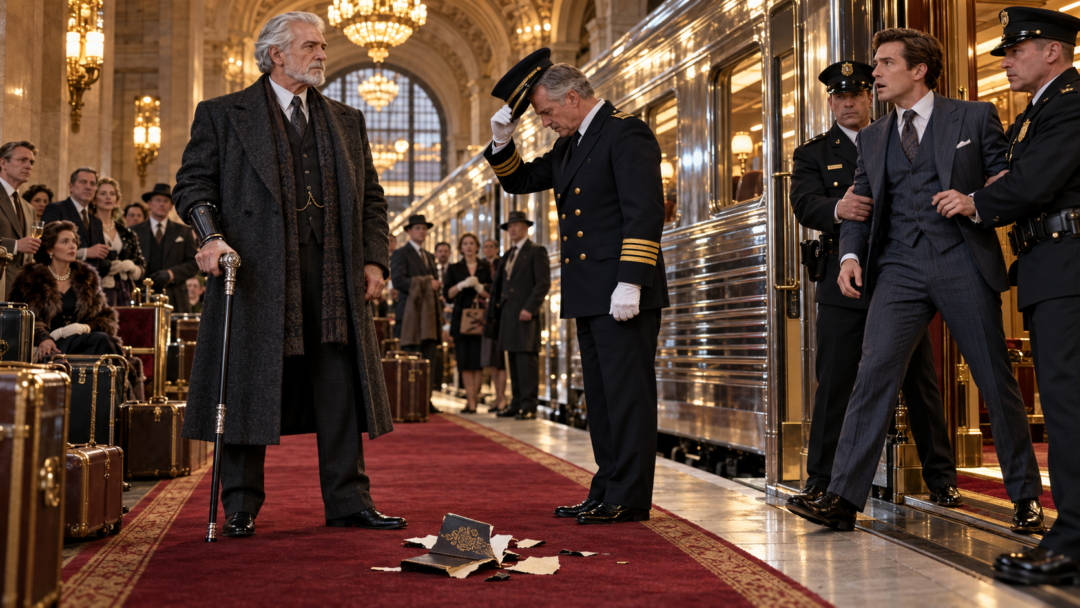
Standing on the plush maroon wool carpet of the private boarding lounge, waiting patiently before the polished brass double doors of Suite One, was an elderly gentleman. He was sixty-eight years old, his silver hair thick and neatly combed above a weathered, dignified face with deep, thoughtful lines etched around his gray eyes. He wore an immaculate, dark charcoal wool tweed overcoat over a tailored flannel suit, and in his right hand he leaned upon a walking cane fashioned from blackthorn with an ornate, silver-plated eagle’s-head pommel. His left arm was absent from the elbow down, fitted with a dark, carbon-composite prosthetic forearm whose articulated mechanical fingers held a leather passport wallet and a gold-embossed paper ticket folder with quiet, effortless grace.
The heavy brass gate swung open with an arrogant clatter.
Striding down the vestibule with rapid, aggressive momentum came Julian Croft. He was thirty-nine years old, slender and athletic, wearing a bespoke double-breasted navy Italian silk suit, a lavender Hermès tie, and polished black oxfords that clicked sharply against the stone borders of the carpet. In his right hand, he carried an expensive alligator-skin attaché case, while an encrypted smartphone was pressed tightly to his ear. His jaw was set in an expression of sharp, predatory entitlement—the look of a venture capital partner who was accustomed to buying companies, liquidating workforces, and ordering private jets on five minutes’ notice.
Behind him hurried the junior lounge attendant, a young college student in a red railway vest who looked terrified, clutching a passenger manifest to her chest.
“I don’t care what the computer system says, Simpson!” Croft barked into his phone, completely ignoring the people around him as his voice echoed off the brass paneling. “Tell the syndicate that Croft Logistics is closing the bond issue before the markets open tomorrow. The public rail network is hemorrhaging sixty million a quarter. When we privatize the Midwest mainline, the first thing we do is scrap sixty percent of the low-yield regional passenger stops!”
Croft lowered his phone, his cold, impatient gaze landing squarely upon the elderly gentleman standing before the door to Suite One—the Presidential Sleeper Compartment.
“Excuse me, old-timer,” Croft snapped, marching directly into the gentleman’s path and stopping three inches from his shoulder, his body language deliberately invasive. “You’re blocking the private boarding gate for Suite One. Move your luggage to the coach boarding line on Track Fourteen. Some of us have cross-country executive meetings that actually matter.”
The elderly gentleman did not move. He stood with his feet planted firmly upon the maroon carpet, his silver-headed cane resting lightly against his shoe, his posture straight as a naval mast. He turned his head slowly, looking at Croft through calm, intelligent eyes that showed not the slightest trace of anger or intimidation.
“The boarding gate is open for all reserved passengers, young man,” the gentleman said softly. His voice was low, deep, and measured, carrying the resonant clarity of a cathedral bell. “And this is Suite One.”
Croft let out an ugly, incredulous laugh, shaking his head with bitter amusement. “Suite One? Are you out of your mind? The Presidential Sleeper Compartment is an eight-thousand-dollar transcontinental private suite. It’s chartered exclusively for Fortune 100 executives and institutional partners who invest in this corridor. They don’t give charity upgrades to broken veterans traveling on subsidized military vouchers!”
“Sir, please,” the young lounge attendant stammered, stepping forward with her tablet. “Mr. Croft, the gentleman has an authorized executive ticket issued directly from the central dispatch office—”
“I don’t give a damn about a clerical error by a ticket clerk!” Croft snarled, cutting the attendant off with a savage gesture of his hand.
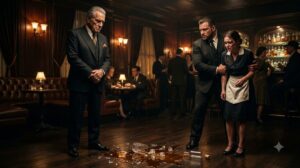
Without warning, Croft lunged forward. His hand clamped around the gold-embossed paper ticket folder resting in the gentleman’s prosthetic fingers. With a sharp, aggressive jerk of his arm, he wrenched the folder away.
The paper tore. Croft didn’t merely inspect it—he gripped the document in both hands, deliberately tearing the boarding pass across its center with a violent, theatrical rip. He tore it once, twice, and then dropped his hands, letting the shredded scraps of gold and white paper flutter through the air, scattering across the dark maroon carpet like autumn leaves.
“There’s your boarding pass, grandpa,” Croft sneered, leaning into the gentleman’s face, his finger jabbing within an inch of his tweed lapel. “Now pick up your trash and walk your cane down to the third-class coach before I call the terminal superintendent and have your veteran pension audited for fraud!”
The elderly gentleman looked down at the torn scraps of paper resting upon the wool carpet. He did not yell. He did not raise his silver-headed cane. His breathing remained deep, slow, and completely rhythmic. Only the faint twitch of a muscle along his jaw indicated that an internal line had been crossed—a boundary far older and more dangerous than Julian Croft could ever comprehend.
“You have very poor manners, Counselor,” the gentleman said softly.
“I have fifty million dollars in transit equity bonds, you old relic!” Croft barked, turning to the attendant. “Attendant! Call security right now! Have this man escorted off my platform!”
Before the trembling attendant could reach for the wall-mounted call box, the heavy, polished brass double doors at the head of Track Nineteen swung open with a slow, majestic, and authoritative glide.
Marching onto the platform, moving in synchronized, heavy footsteps that resonated through the concrete foundation of the railyard, came Chief Rail Conductor Arthur Vance. He was sixty-two years old, a towering, broad-chested figure in a formal, midnight-blue railway uniform adorned with four gleaming gold service stripes on each sleeve. His peaked conductor’s cap with its polished black visor sat square upon his brow, and his white-gloved hands were clasped securely behind his back.
Flanking him on either side were two uniformed officers of the Regional Transit Security Division, wearing crisp dark uniforms with silver star badges and tactical communications harnesses.
Julian Croft let out an arrogant sigh of relief, smoothing the lapels of his Italian silk suit with a dismissive smirk. “Well, finally! Conductor! Thank goodness you’re here! I have an unauthorized passenger refusing to vacate the entrance to Suite One! Take him off my platform immediately!”
Chief Conductor Arthur Vance walked straight down the center of the maroon carpet. He did not look at Julian Croft. He did not slow his stride, nor did he acknowledge Croft’s voice with so much as the blink of an eye.
He walked directly past the hedge fund manager, stopping eighteen inches before the elderly gentleman with the blackthorn cane.
With slow, solemn, and breathtaking formality, the four-stripe Chief Conductor removed his white-gloved cap, tucked it beneath his left arm, and snapped his right hand to his brow in a rigid, emotional, and immaculately executed military hand salute.