The Secluded Alpine River And The Senior Wildlife Director
CHAPTER 1: THE DISTURBED WATER ON THE GRAVEL BAR
The crisp, thinning autumn air of the high Rocky Mountains carried the sharp, invigorating fragrance of sun-cured sagebrush, subalpine fir, and the dry, sweet scent of golden quaking aspens shedding their leaves along the upper Gros Ventre River basin. Towering above the jagged timberline, the cathedral granite spires of the Grand Tetons rose against an immaculate, cloudless sky of deep Wyoming cobalt, their northern couloirs dusted with the first pristine snows of October. Down in the valley, the river wound like a ribbon of molten turquoise and liquid ice through wide braided gravel flats, cutting beneath ancient stands of black cottonwood whose amber canopies fluttered like gold coins in the gentle mountain breeze. For centuries, this remote river canyon had existed in majestic, unbroken isolation—a sacred alpine corridor where grizzly bears foraged on late-season berries, moose grazed in the willow bogs, and native cutthroat trout returned to breed in the glacial gravels.
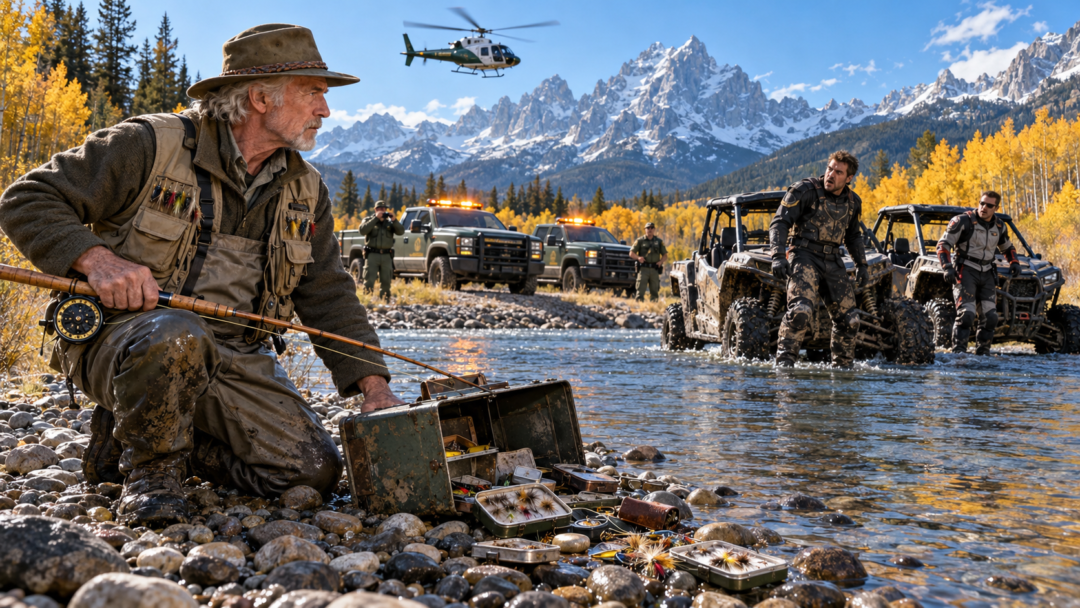
Standing knee-deep in the cold, crystalline current of a quiet eddy was Dr. Arthur Vance. He was sixty-eight years old, tall, lean, and weathered by five decades of mountain field research, his thick silver hair peeking out from beneath a battered, canvas-brimmed fishing hat adorned with dozens of hand-tied mayfly and caddis imitations. He wore faded olive-drab neoprene chest waders patched at the knees with vulcanized rubber, a heavy wool buffalo-plaid shirt beneath a well-worn khaki tackle vest, and polarized amber glasses resting on his sharp nose. In his right hand, moving with fluid, rhythmic grace born of half a century of practice, he held an eight-and-a-half-foot split-cane bamboo fly rod crafted in 1952 by legendary master rodsmith H.L. Leonard. The rod had belonged to his father, a pioneer field naturalist who had taught Arthur to read the river currents when the valley was still wild and roadless. With barely a flick of his wrist, the silk fly line looped through the air in a graceful, silent arc, depositing a tiny dry fly onto the seam of the current with the feather-light touch of a falling leaf. To Arthur, fly-fishing was not merely a pastime; it was an act of quiet scientific devotion—a way to read the pulse of the river he had dedicated his life to protecting.
The tranquil hush of the wilderness was abruptly shattered by the violent, high-decibel roar of twin internal combustion engines echoing off the canyon walls.
Tearing out from the dense willow thicket on the eastern bank came two massive, heavily customized four-wheel-drive off-road utility vehicles. Their wide, deep-treaded mud tires threw rooster-tails of black silt, crushed river stones, and ripped clods of fragile alpine turf into the air as they accelerated directly across the shallow riverbed. The vehicles disregarded the prominent wooden marker planted twenty yards upstream: PROTECTED RIPARIAN WILDLIFE REFUGE — SPAWNING SANCTUARY — MOTORIZED VEHICLES STRICTLY PROHIBITED. These multi-ton recreational machines were built like military assault vehicles, equipped with high-output V-twin engines, external steel roll cages, and high-intensity LED light arrays designed to illuminate nighttime trails.
The lead vehicle—a supercharged black-and-silver utility rig equipped with external roll cages, roof-mounted LED light bars, and aggressive bull bars—slid sideways onto the gravel bar, sending a spray of icy river water soaking across Arthur Vance’s waders. The heavy knobby tires gouged six-inch trenches through the river bottom, churning up clouds of choking sediment that drifted downstream into the calm pools.
The driver killed the ignition with a dismissive rev, kicked open the lightweight tubular door, and hopped down onto the river stones. He was Garrett Stone, forty-two years old, square-jawed, with an athletic build and styled stubble, wearing expensive tactical outdoor apparel, polarized mirror sunglasses, and high-top combat boots. He pulled off his leather driving gloves and looked at Arthur Vance with smug, condescending amusement. In the passenger seat sat his seventeen-year-old son, Carter, who looked around the pristine valley with nervous curiosity while recording the scene on a smartphone.
“Hey, old-timer!” Garrett yelled over the idling rumble of the second vehicle behind him. “You’re in our crossing lane! We’re running this trail up to the high ridge to scout terrain for our backcountry safari line. We’ve got twenty private members in our adventure club paying top dollar to ride these ridges. Pack up your gear and move downriver!”
Dr. Arthur Vance did not shout, nor did he pull his line from the water in a hurry. He gathered his fly line in smooth, measured loops, tucked the cork handle of his bamboo rod beneath his arm, and turned his slate-gray eyes upon the trespassing driver with the quiet, penetrating gravity of an ancient mountain oak.
“Good afternoon, sir,” Arthur said softly. His voice was remarkably deep, resonant, and calm, carrying an unhurried dignity that seemed to belong to the landscape itself. “You are three miles inside the designated Upper Gros Ventre Riparian Sanctuary. Motorized travel in this basin is a federal class-one violation under the Wilderness Act. This gravel bar you just drove across is the primary spawning bed for the rare Snake River fine-spotted cutthroat trout. The eggs laid in these gravels are in their most fragile incubation stage. The silt you just churned up coats those redds and suffocates the developing embryos. For forty years, the state and the people of this valley have worked to preserve this waterway from mechanical intrusion so that the natural migratory cycle remains unbroken. You need to switch off that other engine and remain on the trail.”
Garrett Stone laughed loudly, tossing his head with arrogant, dismissive contempt as he walked across the pebble bank toward the angler.
“Don’t lecture me about trout, old man,” Garrett sneered, stopping less than four feet away, looking down from his physical height. “My company, Stone Alpine Developments, just acquired twelve hundred acres of private timber land bordering this national forest. We have the capital, the resources, and the legal team to develop these backcountry routes however we see fit. We’re planning a five-star luxury eco-lodge on the bluff, complete with helicopter pads, private off-road circuits, and championship shooting ranges. A few wild fish aren’t going to stop eighty-thousand-dollar machinery. This state was built on rugged individualism and private enterprise, not bureaucratic permits issued by desk clerks in Cheyenne who have never spent a night in the woods. Out here, ownership belongs to those who have the courage to take the land and turn it into capital.”
“The land is not capital, Mr. Stone,” Arthur replied gently, his voice like the steady hum of a granite riverbed. “It is a trust. When you tear through a riverbed with three-ton machines, you are not exercising freedom—you are consuming a heritage that belongs to every child in this nation. True courage lies in restraint, in knowing when to leave an ancient place untouched by your ambition.”
Garrett scoffed, shaking his head with bitter amusement. “Save the poetry for Sunday school, old-timer. Out here, might makes right. My investors are billionaires who build private airports in Aspen and Sun Valley. They don’t take orders from men in rubber boots standing in a creek.”
Garrett looked down at the smooth river stone beside Arthur’s feet. Resting upon the boulder was a vintage, fifty-year-old green metal tackle box, its brass latch open, revealing trays of delicate hand-tied flies, brass spinners, and antique wooden reels inherited from Arthur’s father.
With a deliberate, arrogant smirk, Garrett raised his heavy, mud-caked boot and nudged the metal tackle box off the boulder.
The tackle box tipped sideways, tumbling onto the wet river pebbles with a sharp metallic clatter, spilling its delicate contents across the gravel. Several antique balsa-wood floats cracked against the stones, and hand-tied feather lures were swept into the swirling current.
“There’s your answer, fisherman,” Garrett gloated, crossing his arms and grinning down at the fallen tackle. “Public land belongs to whoever has the horsepower to take it. Pack up your toys and get out of our way before we drive right over your bamboo stick.”
Arthur Vance looked down at the spilled lures floating away in the turquoise water, his weathered face an impenetrable mask of granite calm. There was no anger in his eyes, no flinching, no tremor of wounded pride—only the profound, sorrowful patience of a man who understood that those who mock the laws of nature inevitably reap the consequences of their hubris.
Slowly, deliberately, he waded out of the river onto the pebble bar. He reached into the interior breast pocket of his fishing vest, withdrawing a rugged, rectangular satellite emergency transponder encased in matte-black titanium. He flipped open the protective red safety toggle and pressed the recessed primary activation switch.
A tiny amber LED on the unit began to pulse with a rapid, rhythmic beat, transmitting an encrypted military-grade coordinates burst directly to the regional forestry command network.
Arthur looked directly into Garrett Stone’s mirrored sunglasses, his baritone voice dropping into a chilling, absolute register of sovereign authority that seemed to freeze the autumn air:
“Mr. Stone, you have five minutes to reflect upon the sanctity of this wilderness. You are speaking with Dr. Arthur Vance, Senior Director of Wildlife Resources and Sovereign Conservation Trustee. Every meter of your tire tracks is now an official environmental crime scene.”