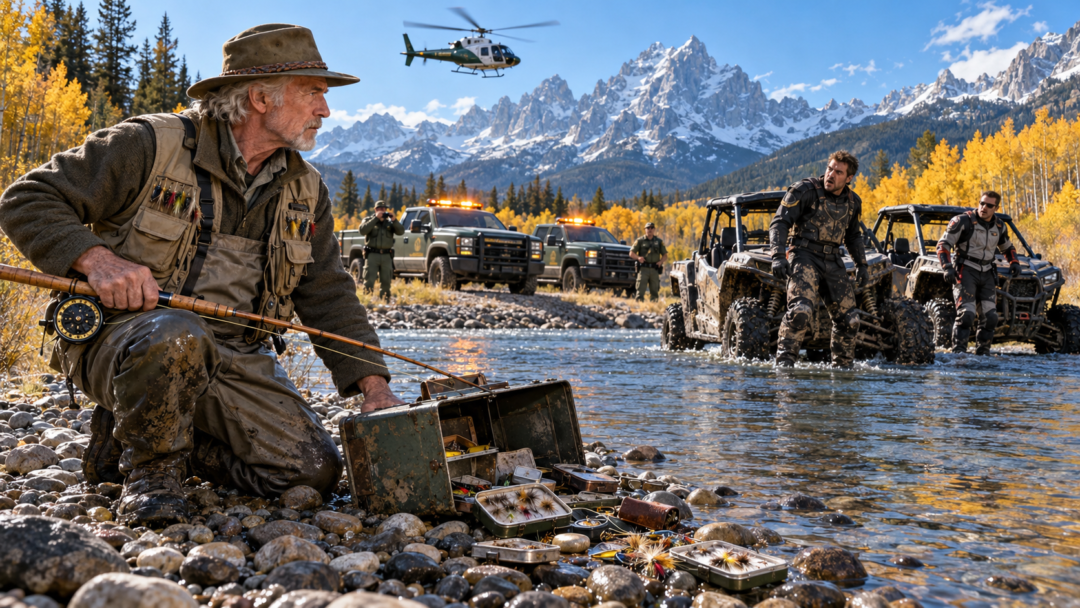
The Secluded Alpine River And The Senior Wildlife Director
CHAPTER 2: THE BIOLOGIST ON THE RIVERBANK
The silence that settled over the river gravels following Arthur Vance’s declaration was sudden, oppressive, and heavy with unspoken peril.
The gentle babble of the turquoise current rushing over polished granite stones seemed to grow louder, filling the canyon like a steady, rhythmic drumbeat. Overhead, a red-tailed hawk cried out from the upper boughs of a dead pine, its shrill call echoing off the jagged cliffs of the canyon wall.
Garrett Stone’s smug grin faltered for a fraction of a second, his mirrored sunglasses reflecting the steady amber pulse of the satellite transponder. But his deeply ingrained corporate arrogance, bolstered by decades of circumventing local municipal zoning boards and intimidating small-town officials, quickly reasserted itself with venomous hostility.
“Dr. Vance? Senior Director?” Garrett scoffed, forcing a harsh, mocking laugh as he gestured toward Arthur’s patched waders and battered canvas hat. “You expect me to believe an old man in thrift-store fishing gear is a state director? Anyone can buy a satellite beacon at an outdoor retailer and make up a fancy government title! Carter, keep recording this clown! We’ll post this lunatic on social media tonight and show our followers what happens when tree-huggers try to block private exploration!”
From the passenger seat of the lead vehicle, seventeen-year-old Carter Stone lowered his smartphone, his face pale, his eyes darting uncomfortably between his father and the calm, imposing elderly gentleman. “Dad… look at the serial numbers on that radio unit,” Carter whispered nervously, leaning out the window. “That’s not consumer gear. That’s a sovereign encrypted transponder with an emergency satellite uplink. My environmental science teacher showed us one during our field seminar at the university. Only cabinet-level state trustees have those devices. The serial number starts with Alpha-Tango-Seven…”
“Quiet, Carter!” Garrett snapped, his voice sharp with irritation. “I don’t care if he found it in an army surplus bin! He’s an unauthorized civilian harassing legal recreationists on public forest trails! We have every right to be here!”
Before Garrett could take another step, the sound of breaking twigs and hurried footsteps rustled through the dense willow thicket downstream.
Bursting through the golden autumn foliage, her chest heaving with exertion, came Emma Morales. She was twenty-eight years old, athletic and determined, wearing a dark-green conservation field jacket, mud-splattered tactical hiking boots, and a heavy backpack carrying water-sampling instruments and a digital wildlife telemetry receiver. Her face was flushed with anger, her dark eyes flashing with fierce indignation as she held up a professional waterproof camera.
“Stop right there!” Emma shouted, marching directly onto the gravel bar, her boots crunching over the river stones. “I documented everything! I’ve been tracking your vehicles since you breached the boundary gate at Cottonwood Creek three miles back!”
Garrett whipped around, scowling at the young biologist. “And who invited you to this party, little girl?”
“My name is Emma Morales, junior field research biologist for the Wildlife Resources Division,” Emma announced, stepping fearlessly between Garrett’s vehicle and the river. “You drove directly through three marked research transects downriver! You smashed our water-temperature sensors, crushed forty yards of documented spawning gravels, and nearly ran down my field assistant on the trail! We have your license plates, your vehicle identification numbers, and your GPS trail breadcrumbs logged on state servers!”
Emma held up her digital telemetry monitor, displaying live ecological maps showing the exact migratory routes of the fine-spotted cutthroat trout. “These gravels represent eighty percent of the surviving natural reproductive habitat for this subspecies in the entire upper basin. The sediment you churned up has raised the turbidity by four hundred percent in less than ten minutes. The dissolved oxygen levels in the nursery gravels have dropped from eleven parts per million to less than four. You have committed catastrophic ecological vandalism!”
Garrett took an aggressive step toward Emma, his fists clenching at his sides, his face turning red with fury. “Listen to me, you little bureaucrat! My development company funds thirty percent of the county recreation tax base! I have personal meetings with the county commissioners twice a month! If you file one single complaint against my vehicles, I will have your university funding pulled and your research permits permanently revoked before Monday morning! You’ll be counting pigeons in a city park!”
“You will do no such thing, Mr. Stone,” Dr. Arthur Vance’s deep baritone cut through the canyon like the sound of an iron gate closing.
Arthur stepped forward, placing himself gently beside Emma. He rested a warm, reassuring hand upon the young biologist’s shoulder, nodding to her with profound, paternal respect. “Excellent field work, Emma. Your telemetry data is safe, your sensors are insured, and your courage is noted. You have performed your duty with distinction.”
Emma looked up at Arthur Vance, her eyes widening in immediate recognition. “Director Vance! You’re… you were personally inspecting the spawning grounds today?”
“I was,” Arthur replied softly, his gray eyes turning back to Garrett Stone with absolute, unyielding resolve. “And what I have witnessed here today is not merely administrative trespass. It is intentional, predatory destruction of a sovereign ecological refuge.”
Arthur pointed with his bamboo rod toward the undercarriage of Garrett’s supercharged rig. Beneath the front axle, a steady, rhythmic drip of dark amber fluid was splashing onto the river pebbles, forming an iridescent rainbow sheen that spread out into the crystal-clear current.
“Your high-pressure steering line has ruptured from impacting the river boulders,” Arthur said, his voice dropping into a razor-sharp warning. “Synthetic hydraulic fluid is pouring directly into the primary spawning pool. If those engines run for another sixty seconds, that chemical plume will reach the regional fish hatchery intake two miles downriver, suffocating two hundred thousand incubating cutthroat fry. Switch off that engine immediately, or I will authorize immediate physical immobilization.”