The Cut Extension Cord And The Locked Iron Entrance Gate
CHAPTER 1: THE SNAPPED COPPER CORE
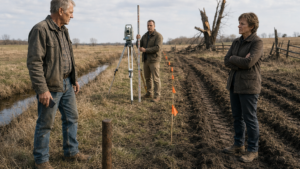
A cold, wind-driven October drizzle swept across the steep, forested bluffs of Highcrest Ridge in Westchester County, New York, drumming against the dark asphalt of the private entrance boulevard. At five-forty-five on a blustery Tuesday twilight, the Hudson River valley below was swallowed in a murky blue mist. Standing at the end of his crushed-bluestone driveway, seventy-six-year-old Patrick “Pat” Gallagher watched the rain beads glisten against the heavy waxed canvas of his Carhartt work coat.
Pat was a retired fifty-year master electrician with IBEW Local 3 in New York City, a Navy veteran who had wired nuclear submarine engine rooms at Groton and high-voltage transmission switchyards across Manhattan. He possessed the slow, granite-like balance of an old lineman who had spent half his life forty feet in the air in gale-force winds. His silver hair was cropped close, his calloused hands were scarred with old solder burns, and his weathered fingers held a calibrated Fluke 87-V industrial digital multimeter with casual familiarity.
Standing three feet away on the wet grass curb, blocking the public utility right-of-way easement, was Julian Sterling-Cross.
Julian was forty-eight, a wealthy hedge-fund managing partner, the president of the Highcrest Ridge Homeowners Association, and a man who treated the public roads as his personal corporate boardroom. He wore a tailored charcoal wool overcoat, an Italian silk scarf, and polished oxfords that were sinking into the damp clay. In his gloved hands, Julian held a pair of heavy, drop-forged eighteen-inch Klein insulated cable-cutters, their hardened steel jaws opened wide.
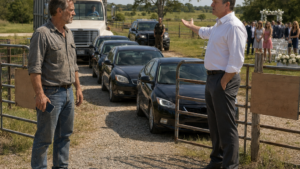
Parked just ten feet behind Julian, on the exterior street side of the subdivision’s massive entrance, sat his luxury black Mercedes S-Class sedan. The luxury car was idling smoothly, its twin exhaust pipes puffing white vapor into the cold rain. Its driver door was closed, the headlights illuminated the road, and its high-end leather interior was warm—parked squarely along a curb painted in bright municipal fire-lane red, directly beneath a town sign reading: NO PARKING — FIRE APPARATUS ACCESS ROUTE — TOW-AWAY ZONE.
Between Pat’s driveway apron and the green Consolidated Edison utility pedestal on the curb lay a heavy, oil-resistant industrial twelve-gauge orange extension cord, its neoprene jacket glistening in the rain.
“I warned you three times this month, Gallagher!” Julian barked, stepping onto the verge with his chest puffed out. His voice was sharp, arrogant, and accustomed to commanding boardrooms. “Section 9, Paragraph 2 of the Highcrest Ridge Architectural Covenant clearly mandates that all exterior porch and carriage lighting shall not exceed a maximum cumulative load of sixty watts! Your front porch lantern is blazing like a commercial lighthouse! It creates visual pollution, it disrupts the architectural aesthetic of this ridge, and I am putting an end to it right now!”
Pat glanced up at his covered front porch thirty feet away. Hanging beside the front door was a handcrafted copper carriage lantern, casting a warm, steady, golden incandescent glow across the flagstone steps.
“Julian,” Pat said, his voice a calm, resonant Irish-American gravel that barely rose above the rustle of the wet oak leaves. “That lantern is pulling twenty-four volts DC from a rooftop monocrystalline solar array tied to a lithium-iron-phosphate battery bank inside my basement. It’s completely off the grid. It doesn’t draw a single milliamp of ConEd utility power.”
“Don’t lie to me with your union fairy tales, old man!” Julian sneered, shaking the heavy cable-cutters in Pat’s face. “I saw this orange cord running from your driveway right to the utility pedestal fifteen minutes ago! You’re stealing power from the common easement to light up your tacky antique lamp! Well, the party is over!”
Julian stepped forward, kicked the orange cord with his polished leather shoe, and wedged the heavy neoprene cable between the hardened steel cutter jaws.
“Julian,” Pat warned, not shifting his boots an inch. “I wouldn’t cut that conductor if I were you. You don’t know what circuit that line is feeding.”
“I know it’s non-compliant, unauthorized garbage on my association easement!” Julian laughed triumphantly. “Lights out, old man!”
Julian brought both hands together with all his strength.
The drop-forged jaws snapped shut. The three insulated copper conductors inside the twelve-gauge cord severed with a loud, mechanical crunch. A sharp, brilliant blue arc of electrical fire flashed through the rain, accompanied by a concussive, acoustic pop that smelled intensely of ozone and vaporized PVC plastic.
Julian tossed the severed cord ends onto the gravel with a gloved flick of his wrist, turning toward Pat with a self-satisfied grin.
“There! Go sit in the dark and think about association bylaws!” Julian gloated, adjusting his damp cashmere scarf.
Pat didn’t move. He didn’t even blink. He slowly pointed his thumb toward the porch behind him.
The handcrafted copper carriage lantern was still shining with absolute, unwavering golden brilliance.
Julian’s grin froze. His eyes darted to the brightly lit porch, then down to the severed orange cable at his feet. “Wait… what? Why is that light still on?!”
“Look up, Julian,” Pat said quietly. “My porch light is solar. I told you that five minutes ago.”
“Then… then what did I just cut?!” Julian stammered, his eyes widening with sudden, visceral unease.
“That pedestal isn’t a residential tap,” Pat explained, stepping forward and tapping the yellow metal tag clipped to the green transformer housing. “That is the auxiliary emergency power bypass feeding the commercial step-down rectifier for the Highcrest Ridge main entrance gate and private security booth ten feet behind you.”
Julian spun around in pure terror.
Ten feet behind them, the digital LED keypad on the stone gate pillar went pitch black. The massive, twelve-hundred-pound electromagnet mounted to the top lintel de-energized with a heavy, concussive clunk.
Deprived of electrical holding current, the gate’s internal mechanical counterweight springs instantly took over.
The twenty-foot-wide, ornamental wrought-iron security gate swung inward with terrifying, unstoppable momentum. The heavy steel pickets hissed through the cold rain, accelerating across the asphalt before slamming squarely into the granite receiver post with a deafening, bone-jarring crash.
The heavy spring-loaded mechanical deadbolt dropped into the steel floor socket with a final, unyielding metallic thud.
The gate was completely, immovably locked shut.
Julian stood frozen on the inside of the locked iron bars, staring through the pickets in absolute horror. Outside the gate, on the dark, rain-swept public township road, his black Mercedes sat idling smoothly, its headlights illuminating the heavy iron bars that separated him from the steering wheel.
“The gate!” Julian screamed, sprinting to the bars and rattling the heavy wrought iron with both hands. “Open the gate! My car is outside! The engine is running! Where is the emergency override key?!”
Pat walked slowly down his driveway, stepping to the edge of the stone curb, his digital multimeter resting in his hand.
“The emergency manual key is a bronze cylinder key, Julian,” Pat said evenly, his gaze piercing through the rain. “And you left it on the key ring sitting in the ignition of your running car.”
Down at the bottom of the winding mountain road, the familiar acoustic groan of heavy pneumatic brakes sounded through the autumn trees.
A heavy commercial flatbed recovery truck from the Town of Ossining Police Department turned the corner, its massive amber LED roof bar flashing silent, rhythmic pulses through the downpour as it accelerated directly toward the idling black Mercedes blocking the municipal fire lane.