The Secluded Alpine River And The Senior Wildlife Director
CHAPTER 3: THE WARDEN’S BADGE IN THE PINES
The warning hung in the thin mountain air like a thunderclap.
The driver of the second off-road vehicle—a hired expedition guide named Bradley—took one look at the rainbow slick spreading across the river, reached over to his dashboard, and instantly killed his ignition. The sudden silence that followed the engine’s death was broken only by the cold wind rushing through the cottonwoods and the steady, toxic drip of hydraulic fluid on the stones.
“Hey! Bradley, what the hell are you doing?” Garrett shouted, spinning around in fury. “Keep that engine running! We’re turning around and heading back down the ridge!”
“I’m not risking a federal environmental pollution felony, Garrett!” Bradley yelled back from his cab, holding his hands off the steering wheel. “Look at the water! That’s hydraulic oil in an active spawning zone! That’s a hundred thousand dollars a day in cleanup fines, plus mandatory forfeiture of the vehicle! I’m shutting down!”
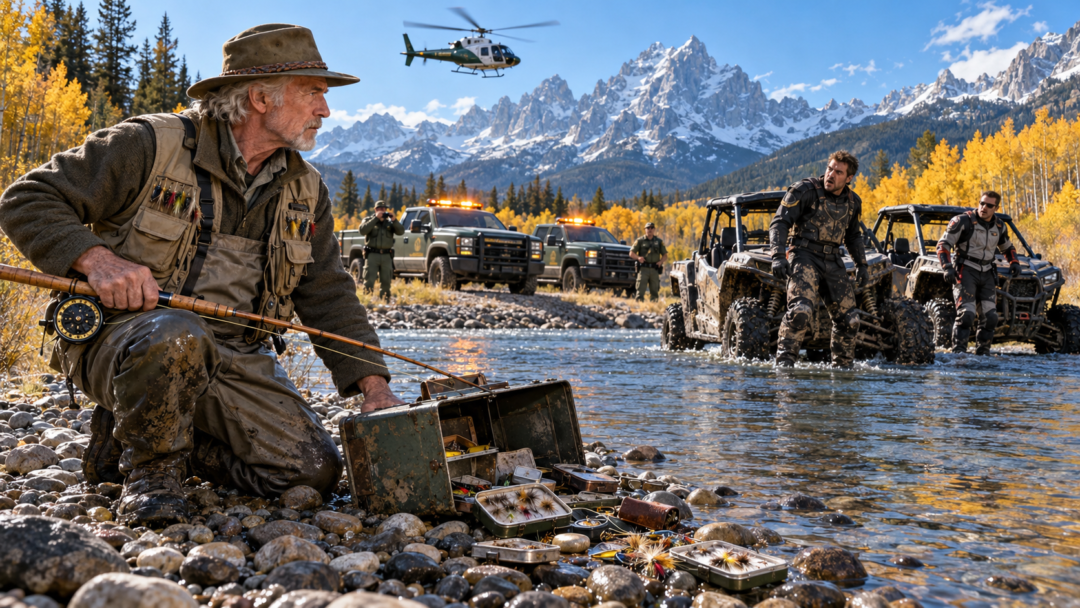
High above the timberline, the distant, rhythmic thumping of heavy rotor blades began to reverberate off the granite face of the Grand Tetons. The mechanical pulse grew louder, echoing down through the narrow canyon with concussive force, bending the tops of the golden aspens and sending flocks of mountain bluebirds scattering into the sky.
Dropping down through the gap in the ridge, banking steeply over the riverbed, came a sleek, forest-green and white Bell 407 helicopter. Painted in crisp gold lettering along its fuselage were the words: REGIONAL CONSERVATION PATROL — EMERGENCY WILDLIFE ENFORCEMENT.
The aircraft circled thirty feet above the river bar, the violent downdraft from its composite rotors whipping up clouds of dry leaves and sending spray cascading across the rocks. Mounted beneath the helicopter’s nose, a high-definition gyro-stabilized thermal camera swiveled smoothly, locking its optical lens onto Garrett Stone, his son, and the two immobilized off-road vehicles. Pilot Mark Evans established a hovering orbit, streaming live high-definition video directly into the state attorney general’s crisis center and recording the exact GPS coordinates of the hydraulic oil plume.
Simultaneously, the deep, mechanical growl of heavy diesel engines echoed up the narrow canyon access trail.
Breaking through the pine shadows at high speed came two massive, dark-green heavy-duty tactical patrol trucks, their heavy steel brush guards and high-clearance suspension built for extreme backcountry terrain. Mounted to their roof racks were dual amber-and-white emergency strobe bars, flashing in blinding cadence against the dark evergreen forest.
The lead truck locked its brakes, sliding to a halt across the dirt trail to completely seal off the canyon exit, while the second truck pulled directly onto the dry upper gravel bar, boxing Garrett’s vehicles against the sheer granite riverbank.
Stepping down from the lead truck’s cab was Chief Conservation Warden Lucas Hayes. He was fifty-two years old, broad-shouldered and imposing, wearing a crisp olive field uniform, a wide-brimmed felt campaign hat, and a heavy tactical duty belt. He had spent three decades patrolling the high backcountry of Wyoming, earning a reputation as an incorruptible guardian of the Rocky Mountain wilderness who had personally put dozens of commercial poaching rings behind bars.
Warden Hayes adjusted his sidearm holster, stepped onto the pebble bar, and marched directly past Garrett Stone as if the developer were made of glass.
Stopping three paces in front of Dr. Arthur Vance, Warden Hayes removed his campaign hat with solemn, unhesitating reverence, standing at rigid attention.
“Good afternoon, Director Vance,” Warden Hayes announced, his voice carrying clearly over the roar of the idling patrol truck and the overhead thrum of the helicopter. “Regional Conservation Patrol responding to your priority satellite beacon. Sector Seven is completely locked down, aerial surveillance is recording all telemetry, and tactical units have sealed the highway junctions. We are at your command, sir.”
Garrett Stone stood frozen on the river stones. His jaw hung slack, his sunglasses slipping down his sweat-slicked nose, his face draining of all color until he looked like a ghost standing in the autumn sun.
“C-Chief Hayes?” Garrett stammered, his voice trembling with sudden, nauseating panic. “You’re… you’re answering to him? But he’s… he’s just a fisherman…”
Warden Hayes turned his head slowly, his eyes narrowing into cold slits of pure, unadulterated contempt as he glared at the luxury developer.
“You are addressing Dr. Arthur Vance,” Warden Hayes said, each word landing like an anvil. “He is the Senior Director of Wildlife Resources, author of the Wilderness Preservation Act, and the Sovereign Conservation Trustee appointed by the state legislature to protect this ecosystem. And you, Mr. Stone, are standing in the middle of a class-one ecological crime scene.”