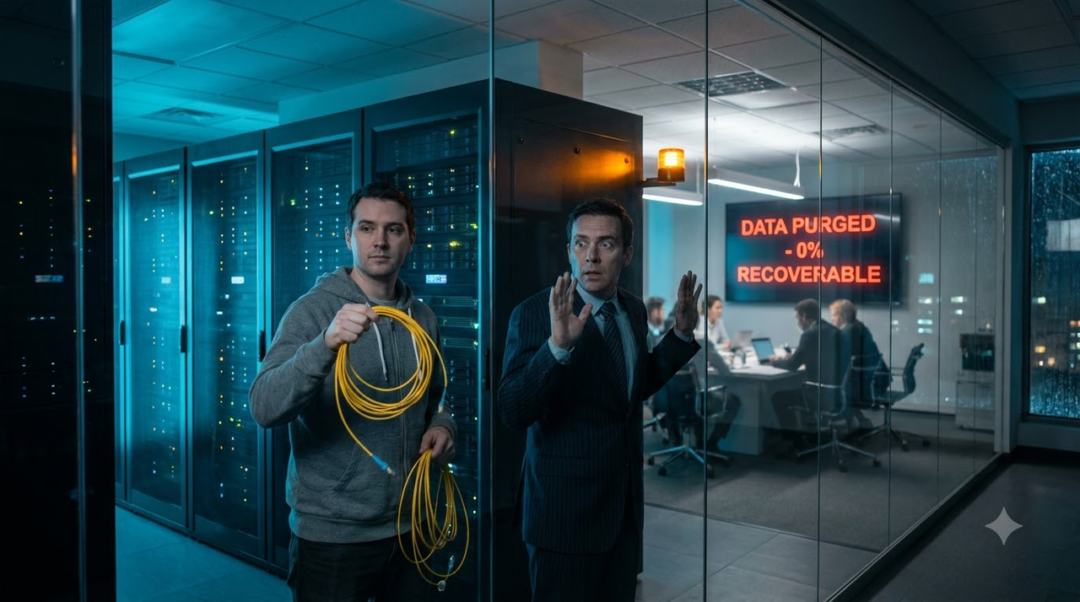
The Yellow Fiber Cable And The Red Boardroom Crash Screen
CHAPTER 1: THE SNAP OF THE FIBER CORE
The central data center on the forty-second floor of OmniCorp’s glass-and-steel headquarters in downtown Austin hummed with the sterile, relentless roar of eighty thousand micro-fans pushing chilled nitrogen-cooled air through perforated raised floor tiles. Bathed in the ethereal, deep cyan glow of towering server racks that stretched in clean parallel corridors across ten thousand square feet of anti-static flooring, the room was a temple of pure computational power. Held at a constant sixty-two degrees Fahrenheit and forty percent relative humidity, the atmosphere smelled faintly of dry ionized air, warm copper heatsinks, and clean silicone.
In Bay Four, sitting on an aluminum crash cart parked in front of an open forty-two-unit server rack, twenty-six-year-old Marcus Cole leaned over the matte-black keyboard of a ruggedized ThinkPad. His dark curls were tucked beneath the hood of a faded gray heather fleece hoodie, his wire-rimmed glasses reflecting cascading green lines of Linux kernel debugging code and terminal network telemetry. On the screen, a high-priority hardware diagnostic script was actively bridging two isolated network segments through a bright yellow single-mode LC-fiber-optic patch cable that snaked from the diagnostic port of the top-of-rack Arista switch into a staging drive on his cart.
The pressurized airlock door of the server vault hissed open with a violent pneumatic blast.
“Kill your little background process, code monkey! You’re throttling the primary upstream pipe for my keynote!”
Derek Vance stormed into the freezing room like a Category 5 hurricane in Italian wool. At thirty-six, Vance was the Vice President of Global Marketing at OmniCorp—a slick, hyper-caffeinated executive whose rapid rise had been fueled by buzzwords, venture capital networking, and an absolute, towering ignorance of how computer software actually worked. He wore a bespoke charcoal pinstripe suit with razor-sharp lapels, monogrammed French cuffs secured by platinum links, and leather loafers that clicked with aggressive arrogance against the raised floor tiles. In his right hand, he clutched a wireless presentation clicker; his left was jammed with an iced double-espresso.
Marcus did not turn around. His fingers continued their rapid, rhythmic dance across the mechanical keyboard, his voice low, deadpan, and calm as winter granite.
“The core marketing cluster is currently experiencing an un-throttled packet flood originating from the executive presentation podium, Mr. Vance. I am running an emergency block-level clone of your presentation server before the sector allocation table becomes unreadable. If I interrupt this process, your data will corrupt.”
“I don’t care about your little sector tables!” Vance shouted, his face contorting into an ugly, mottled mask of rage as he lunged past the yellow warning stanchion. “I have sixty thousand global clients, thirty institutional venture funds, and the entire board of directors sitting in the main boardroom right on the other side of that glass! My livestream kicks off in precisely four minutes! My video playback was stuttering at ten-eighty-p, and our network operations director told me someone in the data vault was running an unauthorized heavy transfer!”
“The transfer is isolating an active memory injection on your slide deck—” Marcus began, turning his head slightly.
“I said kill it!” Vance roared.
Before Marcus could reach out to protect his machine, Vance’s left hand slammed down with vicious, brutal force onto the open magnesium lid of the diagnostic laptop.
SLAM!
The laptop screen cracked against the aluminum keyboard tray with a sickening, plastic crunch, the display instantly dying into a chaotic spiderweb of fractured liquid crystal and dead black pixels. The delicate internal backlight inverter sputtered with a tiny, acrid puff of white smoke that rose into the laminar cooling draft, carrying the sharp, bitter stench of scorched printed circuit board substrate.
On the aluminum tray, the magnesium chassis of the machine bent under the concussive blow, pinning the internal cooling fan against its copper shroud in a shrill, dying mechanical whine. For Marcus, who had spent four years customizing the specialized diagnostic firmware on that machine—calibrating its network interfaces to capture microscopic nanosecond packet jitter across high-density fiber channels—the sound was not merely the destruction of silicon. It was an assault on the quiet sanctuary of the data vault itself.
Simultaneously, Vance reached down into the server rack’s patch bay, grabbed the bright yellow single-mode fiber-optic patch cable with his manicured fingers, and yanked it straight backward with all of his strength.
SNAP!
The delicate ceramic ferrule inside the duplex LC-connector shattered cleanly with a sharp, high-pitched mechanical pop. The yellow jacket tore free, exposing microscopic strands of pure glass fiber that glinted in the blue light like severed spiderwebs.
Instantly, across the entire forty-two-unit rack, the steady, rhythmic green status LEDs died away, replaced by an apocalyptic, cascading ripple of flashing crimson fault indicators. An automated, low-frequency audio tone began to pulse from the ceiling speakers: CRITICAL HARDWARE FAULT – BUS DISCONNECT DETECTED.
Marcus Cole slowly let his hands drop to his lap. He did not flinch. He did not scream. He merely looked at the frayed, shattered end of the yellow cable hanging from the switch, then turned his gaze up toward Vance.
“You should not have pulled that line,” Marcus said softly.
“I outrank you, kid!” Vance sneered, tossing his wireless clicker from hand to hand with an arrogant, triumphant smirk. “I don’t need your permission to manage corporate resources! Stay off my network, pack your little backpack, and wait for human resources to clear your locker!”
Across the data center floor, the double glass security doors slid open with a desperate hydraulic hiss.
Dr. Aris Thorne, the fifty-eight-year-old Chief Technology Officer of OmniCorp, sprinted onto the anti-static floor. A legendary computer scientist with wild gray hair, wearing a rumpled tweed jacket and running shoes, Thorne was breathless with panic, his hands gesturing frantically toward the towering glass wall that separated the server vault from the adjacent executive boardroom.
Through the transparent plate glass, twenty members of the board of directors and executive leadership—including sixty-two-year-old CEO Victoria Sterling—sat around a forty-foot walnut conference table, staring in frozen, horrified disbelief at a massive, one-hundred-inch wall monitor.
“Marcus!” Dr. Thorne gasped, skidding to a halt beside the crash cart. “Tell me the mirror held! The automated intrusion telemetry just flagged an unauthorized root wipe on the primary presentation cluster! Tell me you isolated the presentation drive before the sector overwrite hit!”
Marcus Cole did not raise his voice. He reached down with his right hand, lifted the severed, dangling yellow fiber-optic cable between two fingers, and held it up to the cold blue light.
Behind the glass wall, in the silent, horrified boardroom, the massive one-hundred-inch monitor suddenly flashed bright white.
With a deep, resonant digital hum that vibrated through the floorboards, the screen exploded into a stark, blood-red graphic displaying an unrecoverable system crash notice:
SYSTEM FAULT 0x000000E9 – UNRECOVERABLE HARDWARE INTERRUPT.
PRIMARY PRESENTATION SECTOR PURGED.
DATA RECOVERY: 0.0% AVAILABLE.
Marcus looked past Vance’s shoulder directly into the executive boardroom, where CEO Victoria Sterling stood up from her chair, her face carved from solid ice, her finger pointing straight through the glass at the Marketing VP.
“The mirror held until three seconds ago, Dr. Thorne,” Marcus said with complete, deadpan composure. “Then Mr. Vance walked in and unplugged his own backup drive.”