The Cedar Wheelchair Ramp And The Federal Approval Seal
CHAPTER 1: THE SCREWS ON THE RED BRICK
The mid-afternoon Georgia sun beat down relentlessly against the red-brick facade of the split-level ranch home on Magnolia Ridge Lane in Briarwood Glen. The air smelled of freshly sawn Western red cedar, mineral spirits, and curing polyurethane. Cicadas hummed a steady, hypnotic rhythm from the branches of the loblolly pines that framed the manicured bermuda lawns of the suburban cul-de-sac.
Lucas Mercer knelt on the concrete apron of his front porch, an eighteen-volt cordless impact driver resting in the right holster of his oiled-leather tool belt. He was twenty-eight years old, lean and muscular, with sun-bleached brown hair and calm, observant hazel eyes. He wore a faded olive-drab military physical training t-shirt, heavy canvas work trousers, and steel-toed boots that bore the scuffs of three years serving as an Army combat engineering specialist with the 101st Airborne Division.
With steady, surgical precision, Lucas set a three-inch brass deck screw against the beveled cedar handrail and squeezed the trigger.
WHINE-CHUG-CHUG-CHUG.
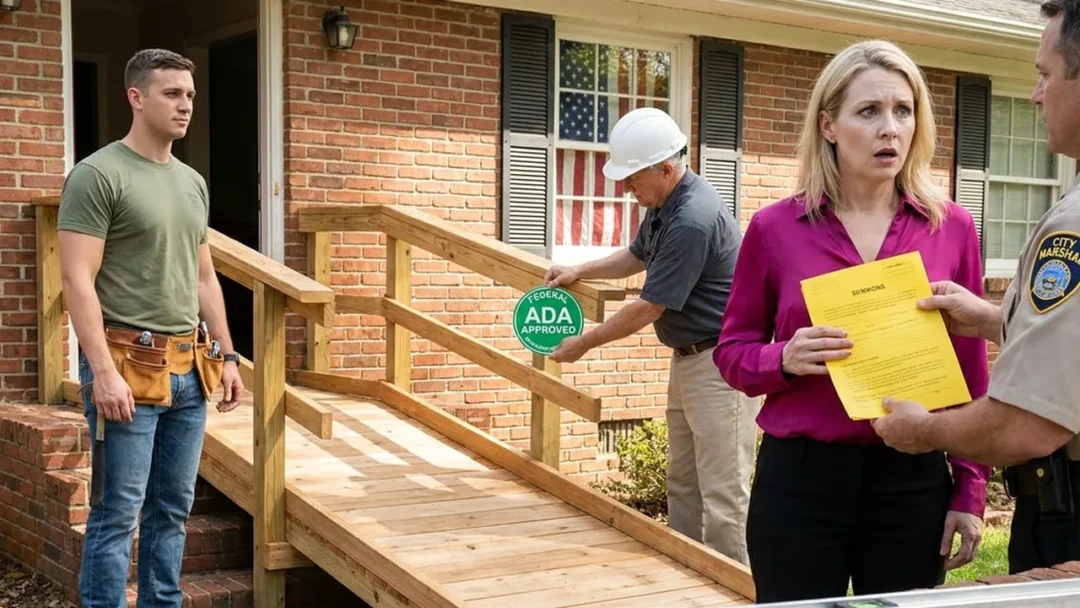
The screw sank flush into the grain, drawing the clear-heart cedar joist tight against the pressure-treated stringers. Lucas ran his bare thumb along the beveled timber joint, checking for any rough fiber that could snag a wheel or a palm. Beneath the ramp, three wide red-brick steps led up to the front door; over them, Lucas had engineered a flawless, low-incline wooden transit ramp, its slope set at an exact one-to-twelve ratio to meet the strict specifications of the Americans with Disabilities Act.
In the front bay window behind him, resting on a polished walnut side table, sat a triangular mahogany shadow box displaying a folded American flag and a Purple Heart medallion. In seventy-two hours, his father, Master Sergeant David Mercer, would be discharged from the polytrauma rehabilitation unit at the Walter Reed Military Medical Annex in Augusta, returning to civilian life in a motorized titanium wheelchair after thirty years of active service.
“Stop building that hideous structure this instant! Put that drill down!”
The voice was piercing, sharp, and laden with the rehearsed indignation of an unyielding suburban autocrat.
Lucas didn’t flinch. He set the impact driver back into its holster, took a clean shop rag from his pocket, and wiped a speck of sawdust from the cedar rail before turning slowly to face the yard.
Standing on the flagstone walkway three feet from the porch was Pamela Sterling. She was forty-six years old, the elected Vice-President of the Briarwood Glen Homeowners Association and the wife of regional commercial developer Gregory Sterling. Pamela was dressed in a tailored magenta silk blouse, three strands of cultured pearls that bounced against her collarbone, crisp white designer trousers, and oversized tortoise-shell sunglasses. Clutched under her left arm was a thick, gold-embossed three-ring binder labeled BRIARWOOD GLEN ARCHITECTURAL CONTROL COMMITTEE.
“Good afternoon, Mrs. Sterling,” Lucas said in his quiet, respectful cadence. “Can I help you with something?”
“You can help by dismantling this wooden monstrosity before my eyes!” Pamela snapped, her voice carrying sharply across the cul-de-sac. Two neighbors washing luxury sport utility vehicles down the street turned their heads to watch. “The Architectural Review Committee unanimously rejected your application on Tuesday! Our master covenants strictly mandate uniform red-brick elevations and matched masonry steps on all front facades! Having an unapproved, rustic lumber ramp protruding into the front setback completely ruins the luxury aesthetic of our enclave! It looks like an industrial handicap loading dock!”
Lucas stood to his full six-foot height, his hands resting on his tool belt. “Mrs. Sterling, my father is a paralyzed combat veteran arriving home on Monday. He cannot climb three brick steps. The federal Fair Housing Act and the Americans with Disabilities Act grant an automatic statutory exemption for reasonable accessibility modifications.”
“I don’t give a damn about your federal acronyms!” Pamela shrieked, taking an aggressive step onto the lower porch step. “This is a private planned unit development governed by Georgia contract law! You agreed to the architectural covenants when you bought this home! If your father cannot navigate standard architectural steps, you should have placed him in a specialized assisted-living facility rather than devaluing our neighborhood home prices by twenty percent!”
A cold, dangerous stillness settled over Lucas’s face. “My father gave thirty years of his life and both of his legs to this country, ma’am. He is living in his own home. And he is coming up this ramp.”
“Not on my watch, he isn’t!”
With a sudden, violent sweep of her designer leather flat, Pamela kicked the heavy, twenty-four-inch aluminum carpenter’s level that was resting on the cedar deck boards.
CLANG!
The precision aluminum level flew off the edge of the porch, bouncing off the brick steps and clattering onto the flagstones.
In the same spiteful motion, Pamela swung her leather handbag, knocking a full, open plastic container of five hundred golden brass deck screws off the timber railing.
SHOWER!
The container shattered on the stones, sending hundreds of gleaming brass screws raining across the dark red brick walkway in a sparkling, metallic cascade. Brass fasteners rolled into the grass, clattered against the stone retaining wall, and scattered across the driveway apron like spent cartridge casings.
“Oops!” Pamela sneered, a cruel, mocking smirk curling her painted lips. “Now that’s a hazardous construction debris violation, too! Let’s see how much your drill helps you when the city code officials arrive! Because I called the City Building Inspector and the municipal marshal twenty minutes ago to condemn this unpermitted structure and issue a stop-work injunction!”
Down the oak-lined street, a white municipal Ford F-250 utility truck bearing the gold door crest of the Gwinnett County Building and Safety Department pulled up to the curb, accompanied by a black-and-gold cruiser from the City Marshal’s Office.
Stepping out of the municipal truck was Senior City Building Inspector Frank Caldwell. He was fifty-eight, broad-shouldered and weathered, wearing a white hard hat with a bronze 1st Cavalry Division combat engineer pin pinned to the strap, carrying an official leather-bound inspection ledger. Stepping from the cruiser was City Marshal Marcus Vance, his duty belt creaking softly as he walked up the driveway.
Pamela’s face lit up in triumphant, vicious delight. She hurried down the walkway, waving her architectural binder toward the porch.
“Inspector Caldwell! Perfect timing!” Pamela proclaimed, her voice ringing out for all the watching neighbors to hear. “This young man is constructing an unauthorized timber ramp in direct defiance of HOA architectural covenants! Order him to demolish this eyesore and clear this debris immediately!”