The Neon Racing Bicycle Beyond Barnaby’s Electric Fence
CHAPTER 1: CARBON IN THE COMPOST
The autumn dawn broke cold across the Blue Ridge foothills of northern Virginia, turning the mist in the hollows into drifting bands of silver gauze. Along the narrow curve of State Route 618 where the asphalt skirted the boundary of Juniper Vale Ranch, thirty-five-year-old Mae Turner worked with a hickory-handled pitchfork, laying clean golden winter wheat straw into the gravel runoff swale. The heavy rain two nights prior had scoured the roadside embankment down to raw red clay, threatening to wash silt into the lower creek where forty registered Spanish-Boer meat goats watered every morning. Beside her, an iron-wheeled yard barrow sat half-full of fresh baled oat straw, smelling of sun-cured grass and dry grain.
A hundred yards down the pasture fence, fifteen-year-old Jonah Bell checked the galvanized tension wire with an insulated handheld multimeter. At the corner post, Barnaby, a two-hundred-pound breeding buck with swept-back horns the thickness of axe handles, rubbed his broad forehead against a seasoned locust post. Barnaby was a stubborn, territorial animal, calm with the farm hands but fiercely protective of the pasture perimeter. He paused his cud, turned his square-pupiled yellow eyes toward the winding mountain road, and let out a low, rumbling huff.
The silence of the mountain morning shattered with the harsh, mechanical clicking of an oversized ceramic bicycle freewheel and the high-pitched hum of high-pressure racing tires slicing through cold air.
Rounding the blind limestone bluff at thirty miles an hour came a cyclist clad in an eye-searing, neon-yellow aerodynamic skinsuit, matching aerodynamic shoe covers, and a mirrored visor that concealed his eyes like polished chrome insect wings. He rode a custom matte-black carbon-fiber racing machine with electronic shift pods and deep-section aerodynamic wheels. Skidding sideways onto the narrow shoulder, the rider locked his hydraulic rear disc brake, throwing up a shower of crushed river stone that rattled against the metal basin of Mae’s wheelbarrow and peppered her leather work boots.
The cyclist unclipped his carbon-soled shoes with two sharp, aggressive snaps, stepped off the bicycle, and stomped toward her across the grass verge. His chest heaved with theatrical fury, his breath rising in white plumes against the chill air.
“Sweep this garbage off the pavement right now, farm girl!” Adrian Cross snarled, his voice a shrill, condescending rasp that cut through the valley quiet. He jabbed a gloved finger at three stray stalks of wheat that had drifted across the white shoulder line onto the asphalt. “My front tubular tire costs four hundred dollars, and this custom Italian frame is worth twelve thousand dollars! I am doing my final qualifying reconnaissance for the Blue Ridge Gran Fondo, and I am not taking a puncture or ruining my line because of your filthy hillbilly barnyard!”
Mae did not flinch, nor did she lean back from the aggressive stranger. She planted the tines of her hickory pitchfork firmly into the wet bank, resting both calloused hands on the smooth ash handle, and met his mirrored visor with steady, unblinking gray eyes. She had spent ten years restoring Juniper Vale after her father’s death, defending its seventy acres against suburban sprawl and predatory land syndicates. An arrogant weekend athlete in neon spandex was not about to shake her composure.
“You’ve got twelve feet of clear state asphalt on the other side of the white fog line, mister,” Mae said, her voice slow, dry, and even as a carpenter’s level. “The straw stays in the drainage ditch to catch road silt before it fouls my watering creek. If you can’t hold your line on twelve feet of dry blacktop, you’ve got no business racing at thirty miles an hour.”
“I ride the apex of the curve, not where some uneducated peasant chooses to dump agricultural waste!” Adrian barked, his face flushing crimson beneath his aerodynamic chin strap.
With sudden, venomous petulance, Adrian took two lunging strides forward, seized the welded tubular steel handles of Mae’s iron wheelbarrow, and heaved upward with all the strength in his wiry shoulders. The heavy yard cart flipped completely upside down with a violent metallic clang, dumping fifty pounds of clean golden straw, wet loam, and crushed stone into the muddy drainage ditch.
“Now pick that up with your bare hands while I stand here and watch,” Adrian sneered, shaking his finger within inches of her nose. “Or I will have the county code enforcement division out here before noon to condemn this entire run-down roadside eyesore.”
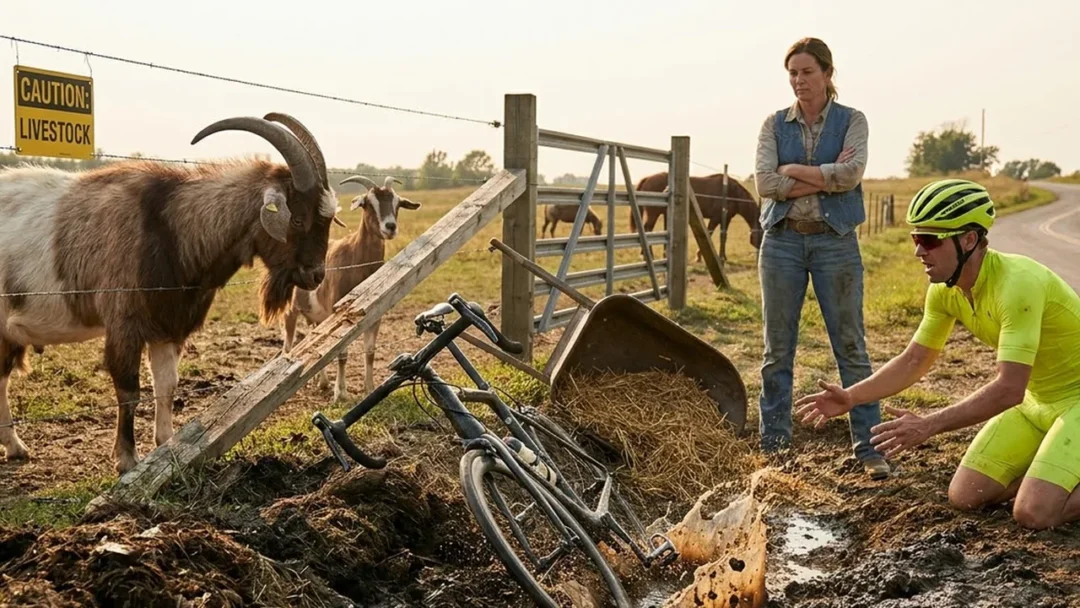
Without waiting for an answer, Adrian wheeled his featherlight neon-accented racing machine directly toward the ranch’s boundary fence. Arrogantly propping the bicycle against the weathered cedar rail, he rested the bare carbon-fiber top tube and the alloy pedal spindles flat against the taut galvanized perimeter wire, right beneath an eight-inch weather-resistant yellow plastic placard that read in bold black letters: WARNING: LIVESTOCK RUNWAY & SOLAR-PULSED ELECTRIC WIRE.
Mae did not shout. She did not reach for her pitchfork. She simply stepped two paces back onto the firm sod of the upper bank, crossed her denim-clad arms across her chest, and gave a faint, slow shake of her head.
“I wouldn’t lean a twelve-thousand-dollar toy on Barnaby’s fence rail, mister,” Mae remarked in a quiet, deadpan drawl. “He’s very particular about his perimeter, and he takes personal offense to neon yellow.”
Adrian threw his head back and laughed—a harsh, barking snort full of urban contempt. “It’s a stupid farm animal behind a piece of rotten wood. What is a goat going to do, bleat at my sponsors?”
Behind Adrian’s back, Barnaby had trotted along the inside fence line, his heavy hooves cutting sharp semicircles into the frosty turf. The big buck lowered his broad, armored forehead, his sweeping horns gleaming in the morning sun. At that exact microsecond, the fence’s solar-powered Gallagher pulse charger mounted to the corner locust post gave its rhythmic, mechanical click, sending a harmless, low-amperage static pulse down the high-tensile wire. The tiny tingle jumped through the bicycle’s alloy spindle into the metal cleat clip.
Barnaby snorted loudly. The strange neon monstrosity leaning into his territory had buzzed.
Backing three measured paces into the clover, the two-hundred-pound goat lowered his crown, tucked his chin against his chest, and launched forward in a dead sprint. With the thunderous, echoing crack of an iron maul striking green timber, Barnaby’s skull drove squarely into the center of the top cedar fence rail right behind the bicycle saddle.
The violent shockwave bowed the rail and launched the featherlight carbon bicycle clean off the wire. The twelve-thousand-dollar machine somersaulted backward through the frosty air, flipped end over end in an arc of gleaming composite tubing, and plunged handlebars-first straight into the four-foot-deep, wet roadside compost and manure pit Mae had excavated that spring.
A massive, wet, sickening geyser of dark brown liquefied manure, fermented silage, and rotting leaves exploded skyward, raining black muck across the ditch and completely submerging the carbon fork, the computerized electronic derailleurs, and the imported ceramic bottom bracket.
Adrian spun around in sheer, unadulterated horror. His mouth fell open so wide his chin strap cut into his throat. He dropped to his knees on the gravel, clawing frantically at the edge of the slimy trench, where only two inches of a mud-drenched neon yellow handlebar protruded from the bubbling brown slime.
“My custom carbon frame!” Adrian shrieked, his voice fracturing into hysterical, high-pitched agony. “My ceramic drivetrain! It’s sinking in the manure pit! Get in there and pull it out! Help me pull it out, you backwoods psycho!”
Mae picked up her overturned wheelbarrow, stood it upright with one effortless motion, and smiled faintly as Barnaby let out a loud, resonant bleat of territorial satisfaction from the other side of the cedar rail.
“Told you,” Mae said calmly, resting a boot on the wheelbarrow rim. “Barnaby’s got strict rules about property lines.”
Adrian scrambled to his feet, trembling with uncontrollable fury, his pristine yellow skinsuit spattered from knees to collar with brown flecks of manure. He whipped a high-end smartphone from his jersey pocket and thrust it toward her face like a weapon. “You trained that beast to attack me! Your fence electrocuted my pedals! You’ll pay for every bolt on this machine, or the county will take this entire farm to satisfy my judgment!”
He reached into the muck, hauled the dripping, foul-smelling wreckage out of the trench, and threw it into the cargo bay of a black support van that had just skidded onto the shoulder behind him.
Jonah Bell walked up to Mae’s side, holding a small digital camera detached from the low sycamore branch above the ditch. “Mae, I didn’t turn off the wildlife camera this morning when I checked the batteries. It caught everything in 4K.”
Mae nodded slowly, watching the support van accelerate away toward the county seat in a haze of blue exhaust. But Jonah’s thumb suddenly froze on the camera’s playback screen. He zoomed in on the bike’s handlebar computer, which had dislodged and landed face-up on the grass verge before the frame sank into the mire.
“Mae,” Jonah whispered, his voice trembling as he pointed to the magnified LCD screen. “Look at the active GPS track on his bike computer. He wasn’t training for the state road race. His screen shows the private boundary gates of our rear pastures—with waypoints marked Condemnation Strip.“