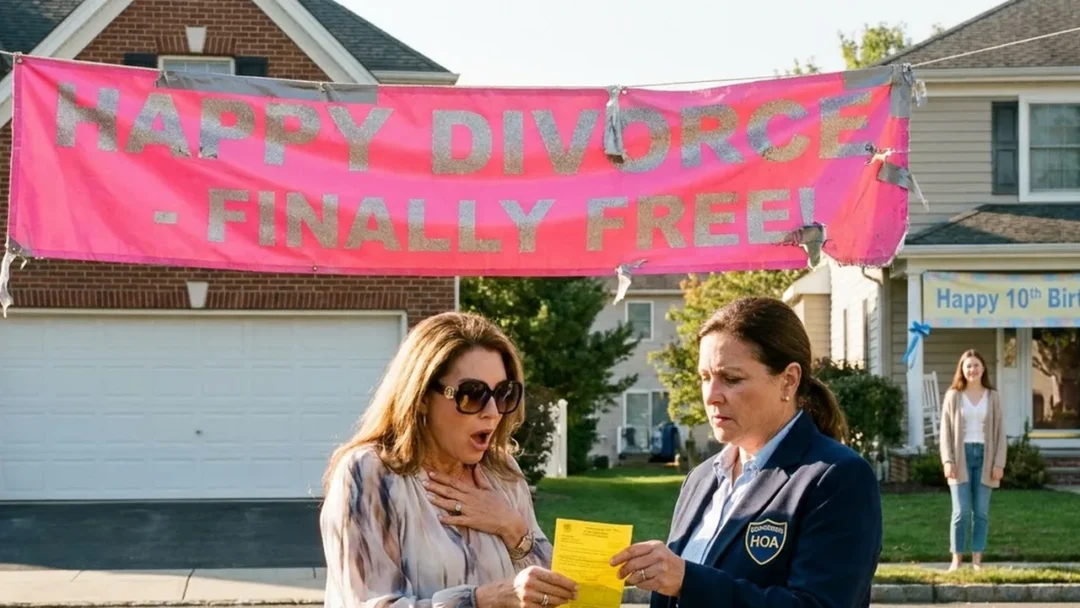
The Tattered Divorce Banner And The Twenty Four Hour Sign Rule
CHAPTER 1: THE SATIN RIBBONS ON THE RAILING
The crisp October morning sun rose over the slate roofs of Scarsdale, casting long, sharp shadows across the dew-silvered lawns of Whispering Oaks. In this affluent enclave of Westchester County, the turning leaves of century-old sugar maples were treated less like seasonal foliage and more like a high-value architectural endowment, their blazing crimson and burnt-amber canopies meticulously framing red-brick Georgian colonials and copper-trimmed mansard roofs. Lauren Miller stood on the bottom riser of her white-painted porch steps, carefully and lovingly tying a final cornflower-blue satin bow to the carved balustrade. Suspended neatly between the two classical wooden pillars was a modest, hand-lettered banner made of organic cream-colored linen, measuring exactly four feet in length: Happy 10th Birthday, Leo! The letters were rendered in clean, dark blue fabric paint, bordered by tiny pressed clover leaves. Beside her, ten-year-old Leo adjusted his round wire-rimmed glasses, clutching a cardboard box of paper napkins and watching his mother’s fingers with quiet, patient anticipation. Since the tragic commuter rail accident that had taken his father three years earlier, the small family had learned to celebrate milestones with careful, hard-won joy, guarding their domestic peace with quiet dignity.
Lauren had lived in Scarsdale for eight years, working as an eighth-grade earth science teacher at the local middle school. Her modest salary, combined with her late husband’s modest life insurance annuity, was just enough to maintain the mortgage on the pre-war colonial cottage her husband had renovated with his own hands. Every shingle, every window pane, and every brick on the walkway carried the memory of his quiet labor, his enduring devotion, and the unyielding foundation of their family life. To Lauren, keeping the property pristine was an act of remembrance, a daily testament that love and resilience could withstand loss. She smoothed the ribbon tails, stepped back onto the lawn, and smiled down at her son.
The peace of the autumn morning dissolved under the sharp, rhythmic clatter of four-inch designer heels echoing across the asphalt cul-de-sac. Candace Sterling-Price strode down the center of the lane with the aggressive, unyielding momentum of an invading monarch inspecting a conquered province. She wore a tailored houndstooth wool cape draped over black cashmere leggings, her oversized diamond-framed sunglasses catching the sharp morning sun and reflecting it back in blinding flashes. Beside her walked Officer Gregory Shaw, the senior zoning compliance and covenants enforcement inspector for the Village of Scarsdale. Shaw was a broad-shouldered man in his late forties, wearing a neatly pressed charcoal municipal uniform, a polished silver shield, and a heavy leather duty belt. Under his left arm, he carried an aluminum field clipboard equipped with zoning statutes, digital angle finders, and laser distance gauges. His weathered face wore the stoic, patient mask of a career civil servant who had spent twenty-five years arbitrating the venomous, petty territorial disputes of Westchester’s hyper-wealthy elite.
“Take it down, Lauren. Take it down right now,” Candace commanded, her voice cutting through the quiet morning air with the icy precision of a diamond glass-cutter. “Look at this carnival display, Officer Shaw. Ribbon streamers, commercial cloth hanging from primary structural columns, visible directly from the public thoroughfare without prior architectural review. It degrades the historic character of this avenue, creates an intolerable aesthetic nuisance, and lowers the appraisal valuation of every home on this street. My interior designer and my private luncheon guests are arriving at noon, and I will not have my guests subjected to a low-rent festival midway across the street. Cite her for an unapproved exterior sign violation under Section Nine, and issue a mandatory sixty-minute removal order.”
Lauren stepped down from the flagstone path, resting a steady hand on her son’s shoulder. She smoothed Leo’s jacket collar, keeping her voice level, measured, and completely devoid of fear, though her pulse thudded against her ribs. “Good morning, Officer Shaw. Good morning, Candace. It’s Leo’s tenth birthday today. The banner was hung fifteen minutes ago.”
Officer Shaw stepped onto the brick walkway, his heavy work shoes crunching softly on the fallen maple leaves. He looked up at the linen banner, adjusted his spectacles, and pulled a laminated reference card from beneath the metal clip of his board. “Section 9.4 of the Scarsdale Municipal Code and Section Twelve of the Whispering Oaks Master Declaration of Covenants: Temporary Celebratory Displays. Residents are explicitly permitted to erect non-illuminated, non-commercial event banners on primary residential facades for a period not to exceed twenty-four continuous hours, provided the total surface area remains under fifteen square feet. Mrs. Miller’s banner is seven-point-eight square feet, secured with non-invasive satin ribbon that causes zero fastener damage to the trim, and was placed this morning. It is completely compliant, fully permitted, and lawful under village code.”
Candace’s painted eyebrows shot up behind her dark lenses, her crimson mouth twisting into an indignant sneer of pure contempt. “Twenty-four hours? Under whose authority? This covenants board has absolute discretionary jurisdiction over neighborhood sightlines! That banner is visible from my morning breakfast terrace! It ruins the entire streetscape!”
Lauren turned slowly, lifting her arm and pointing directly across the two-lane asphalt street toward Candace’s sprawling brick colonial compound. “If we’re discussing streetscapes, neighborhood sightlines, and sign compliance, Candace, let’s talk about your garage.”
Officer Shaw turned his head. Across the street, spanning the entire twenty-two-foot width of Candace’s double-wide carriage garage door, hung a colossal, garish neon pink vinyl banner. It was held up by sagging strips of industrial silver duct tape, heavy steel eyelets, and frayed synthetic rope, blaring across the historic neighborhood in four-foot-tall glitter letters: HAPPY DIVORCE – FINALLY FREE! The autumn wind caught the bottom hem of the banner, flapping the heavy vinyl with the loud, rhythmic thud of an unlatched awning. The neon pink color had faded to a sickly, sun-bleached chalky hue, the edges were frayed into long gray threads, and two of the central grommets had torn away, leaving the heavy vinyl drooping across the carriage windows like a derelict billboard.
Officer Shaw stared at the massive pink banner, his pen pausing in mid-air. “How long has that vinyl installation been up, Mrs. Price?”
“Hers has been flapping across her garage for three solid weeks,” Lauren said calmly. “Twenty-one days, to be exact. It went up the first of October.”
Candace took a sharp step backward, clutching her houndstooth cape across her throat as if shielding herself from physical blow. “That is completely different! That is not a birthday party sign! That is a major life transition announcement! It is an inspirational milestone for empowered women everywhere! People walking this street need hope, Officer! They need to know that divorce is liberating!”
Officer Shaw didn’t answer. He walked across the asphalt, his heavy steps deliberate, and stood directly in front of Candace’s garage door. He reached up with the tip of his metal pen, lifting the frayed bottom corner of the banner where a black Sharpie date was clearly scrawled in the reinforced border: INSTALLED: 10/01 – COMPLIANCE EXEMPT.
“Twenty-four hours, Candace. Not twenty-one days,” Shaw said, his voice flat and unyielding. “The sign code does not contain an exemption for inspirational milestones or matrimonial liberation. Any banner exceeding fifteen square feet left up past seventy-two hours is classified as an unpermitted permanent commercial billboard.”
Shaw uncapped his pen and began writing rapidly on a yellow carbon citation pad. But as he pulled the peeling duct tape back from the brick mortar to inspect the fastening mechanism, his eyes narrowed. Bolted directly through the masonry joints were four heavy-duty steel sleeve anchors—and running directly beneath the banner was a fresh, deep structural saw cut slicing through the load-bearing brick facade of the garage wall.
Leo gripped his mother’s hand, his small fingers warm and steady. He had watched Mrs. Price stalk across the cul-de-sac many times before, each visit heralded by the sharp click of her heels and the scent of expensive French perfume that masked a bitter, predatory restlessness. Over the past year, Candace had filed formal grievances against four other families on the lane—citing children’s chalk drawings on driveways, solar landscape lights that she claimed disrupted migratory owl flight paths, and copper downspouts that had acquired a natural green patina she deemed unapproved. But Lauren had taught Leo that bullies thrived on theatrical indignation and folded before quiet, unyielding facts. Standing on their porch, surrounded by the sweet scent of dried hay and cinnamon apples, they watched Officer Shaw complete his measurements, knowing that the law was an instrument of balance, not a weapon for petty domestic tyranny.