The House That Wouldn’t Let Her In
Part I — The Door
Mary held her brown handbag against her ribs like it could keep her heart from falling out.
The white house stood at the end of the walk, perfect and cold beneath the winter sun. Black shutters. Polished brass knocker. Trimmed boxwoods. A wreath on the door that someone had chosen to look welcoming.
Mary had once believed she would die in that house.
Not in a morbid way. In the soft way older women think of endings when they are tired. A bedroom near the back. Her blue scarf folded over a chair. Her son’s voice down the hall. Maybe a grandchild’s little socks in the laundry.
Now she walked toward it like a criminal.
The sidewalk was clean. Too clean. No leaves. No cracks. No place for an old woman’s fear to hide.
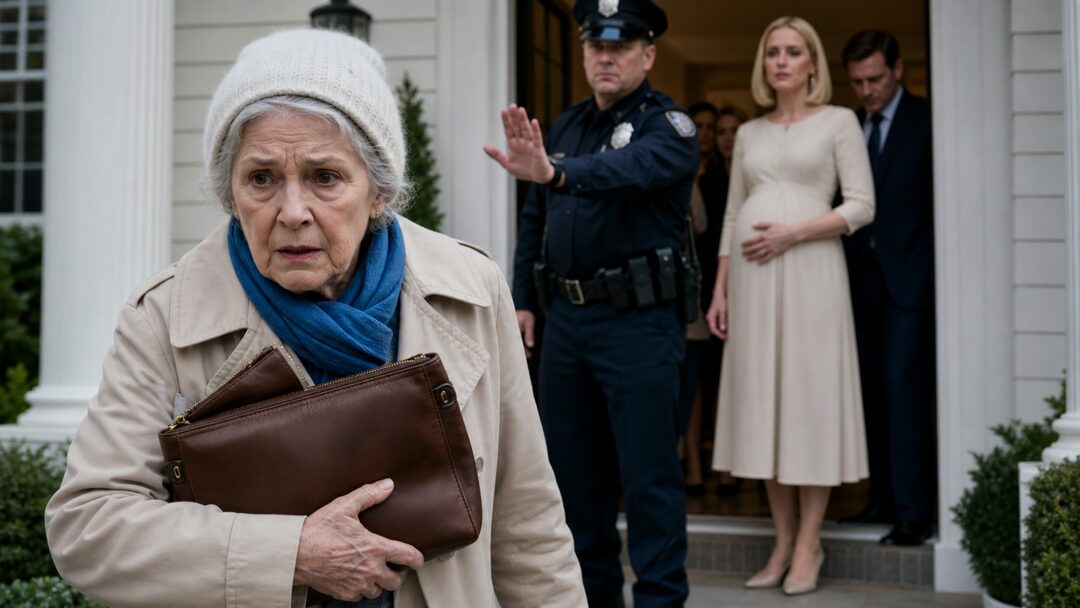
Mary had dressed carefully that morning: cream trench coat, white knit hat, lipstick applied twice because the first time her hand shook. She wore the blue scarf Michael had bought her ten Christmases ago, back when gifts from him still came with cards he wrote himself.
She had told herself she only wanted her photo albums.
That was almost true.
The front curtain moved.
Mary stopped for half a second.
Then she kept walking.
The door opened before she reached the first step.
A police officer stood in the doorway.
He was broad-shouldered, dark uniform pressed flat, cap shadowing tired eyes. He did not look angry. That made it worse. Anger might have belonged to a person. This was procedure.
“Ma’am,” he said.
Mary’s fingers tightened around the handbag strap.
“Are you Mary?” he asked.
She could not make herself answer quickly. Her name sounded strange in his mouth, official and stripped of everything that had once come after it.
Mom. Mrs. Parker. Grandma someday.
“Yes,” she said.
“I need you to stay where you are.”
She looked past him.
Inside, the foyer glowed with warm light. There was the long runner Elizabeth had ordered from Italy. The round table with white roses. The staircase Mary had polished once with a dish towel because Elizabeth’s housekeeper had been away and guests were coming.
At the top of that staircase, an upstairs curtain shifted.
Elizabeth’s face appeared for one second.
Blonde bob. Pearl earrings. One hand resting on the curve of her stomach.
Then the curtain fell back.
Mary’s knees almost gave.
The officer came down one step, not threatening, just blocking.
“There’s an order in place,” he said. “You can’t enter the property.”
“This is my son’s house,” Mary said.
The officer’s eyes softened so slightly she might have imagined it.
“Not according to the complaint I have here.”
Complaint.
The word hit harder than an insult because it wore clean shoes.
Mary looked at the black front door. She looked at the brass knocker shaped like a lion’s head. She looked at the upstairs window where Elizabeth had already disappeared.
“I’m only here for my things,” Mary said. “My albums. My husband’s watch. There’s a box in the guest room closet.”
“I understand,” the officer said, in a voice that meant he did not understand anything he was allowed to say. “You’ll need to arrange that through counsel or through the complainant.”
“The complainant,” Mary repeated.
A car slowed at the curb.
Across the street, a blind bent open.
Mary felt herself become visible in the worst possible way: an old woman on a rich sidewalk, being turned away from a beautiful house by a man with a badge.
She had spent her life teaching children not to run in hallways. She had spent thirty-one years answering phones in an elementary school office, knowing which mothers cried in the parking lot and which fathers needed coffee before bad news. She had written thank-you notes. She had baked lemon bars for funerals. She had raised one son after her husband died.
And now she was being told to stay back from a door she had helped save.
“Ma’am,” the officer said quietly. “Please don’t make this harder.”
Mary’s mouth opened.
Nothing came out.
For one terrible second, she thought Michael might appear behind the officer. He would come down the stairs fast, shirt sleeves rolled, tired eyes pleading. He would say, Wait. This is my mother.
He did not.
The house stayed still.
Mary turned.
Her handbag swung against her hip as she hurried down the sidewalk. She heard her own breath in short, ugly bursts. She did not look back until she reached the corner.
The white house looked as calm as ever.
That was its cruelty.
It could ruin a woman and still look ready for guests.
Part II — The Guest Room
Three months earlier, Michael had cried at her kitchen table.
That was how it began.
Not with lawyers. Not with police. Not with Elizabeth watching from windows.
With Mary’s son sitting in her two-bedroom condo at nine o’clock on a rainy Tuesday, holding a mug of tea he had not touched, saying, “Mom, I messed up.”
Mary had not heard him say “Mom” like that since he was seventeen and had backed her station wagon into the neighbor’s mailbox.
He was forty-three now. Expensive suit. Expensive watch. Face too pale under the kitchen light. He looked like a boy dressed for a job interview no one wanted to give him.
“How bad?” Mary asked.
He rubbed both hands over his face.
“Bad.”
Michael was a real estate broker. He sold houses with wine cellars and heated driveways to people who said “summer” as a verb. He had married into that world five years earlier when he married Elizabeth.
Elizabeth had never been rude to Mary at first.
Rudeness would have been easier.
She sent handwritten thank-you notes. She remembered Mary’s birthday. She kissed Mary’s cheek with the dry precision of someone sealing an envelope.
But Mary had always felt Elizabeth taking inventory.
The condo. The old plates. The framed school photos. Mary’s shoes from the discount rack.
That night Michael said there had been investments. A bad partner. A deal that collapsed. Then gambling, though he said it softly, like the word might break the cup.
“Sports stuff,” he said. “It was stupid. I thought I could get ahead of it.”
Mary sat still.
Outside, rain tapped the window over the sink. The condo smelled faintly of lemon cleaner and the chicken soup she had made because Michael said he might come by.
“Does Elizabeth know?”
His silence answered first.
“She knows enough,” he said.
“How much do you need?”
He looked at her then, and she saw the shame. Not the full truth, but enough of it.
“Mom, no.”
“How much?”
He lowered his head.
Mary sold the condo in twelve days.
Michael said it would be temporary. He said he would put everything back. He said she could stay with him and Elizabeth until things settled.
“You shouldn’t be alone anyway,” he said, and kissed her forehead.
Mary wanted to believe that was love, not convenience.
The white house had a guest room on the second floor, facing the maple tree. Elizabeth called it “Mary’s room” for exactly one week.
“You’ll be comfortable here,” Elizabeth said the day Mary arrived with three suitcases, two boxes of photographs, and her husband’s watch wrapped in tissue. “We want you to feel at home.”
The word want carried more weight than feel.
Michael carried her boxes upstairs himself. When he opened the closet, Mary noticed it was already half-full of folded table linens and spare decorative pillows.
“I’ll clear that,” he said quickly.
“It’s fine,” Mary said.
She had said that too often in her life.
At dinner that first night, Elizabeth served salmon on square white plates.
Mary complimented the house.
Elizabeth smiled. “It is a lot to maintain. But Michael loves it.”
Michael stared at his plate.
Mary waited for him to say, We love it. Or, Mom helped us keep it.
He said, “The salmon’s great.”
Elizabeth’s hand moved under the table. Michael straightened slightly, as if touched by a command.
That was the first time Mary saw it clearly: Elizabeth did not need to raise her voice because Michael was already listening for it.
After dinner, when Elizabeth went upstairs, Michael found Mary rinsing dishes.
“You don’t have to do that,” he said.
“I know.”
He leaned against the counter. “I’m going to fix this.”
Mary dried a plate.
“I know,” she said again.
He came behind her and put his arms around her shoulders, awkwardly, like he was too old to be a son but too frightened to be anything else.
“Thank you,” he whispered. “I don’t deserve you.”
Mary closed her eyes.
A mother should have heard danger in that sentence.
She heard only need.
Part III — Staying With Us
The humiliations did not arrive all at once.
They came folded in linen.
Elizabeth moved Mary’s coffee mug from the cabinet by the stove to a lower shelf near the pantry.
“I thought it would be easier for you,” she said.
She changed the dinner time from six-thirty to eight because “Michael and I eat later when we entertain.” She began referring to Mary’s room as “the guest room” again. She had the housekeeper ask Mary which laundry items were hers, as though Mary had become one more category of fabric.
Michael noticed.
That was the worst part.
He noticed, and then he chose not to notice out loud.
One Thursday, Elizabeth hosted two couples for dinner. Mary had assumed she would eat with them. She had made lemon bars in the afternoon, using the old recipe Michael loved.
At six, Elizabeth appeared in the kitchen wearing pearl earrings and a gray dress that made pregnancy look like an accessory.
“Oh, Mary,” she said. “That was kind of you.”
“They’re Michael’s favorite.”
Elizabeth looked at the pan.
“How sweet. I’ll have Karen plate them.”
Mary wiped her hands on a towel. “Should I change?”
Elizabeth’s face did not move much. That was one of her talents.
“Oh. I thought you’d probably prefer a quiet evening upstairs. These dinners can run late.”
Mary felt heat crawl up her neck.
“Of course.”
Michael walked in as she said it.
He looked from Mary to Elizabeth to the pan of lemon bars.
“Mom, you’re not joining?”
Elizabeth gave him a small smile.
“I told Mary she shouldn’t feel obligated.”
There it was. The door left open just wide enough for Michael to walk through correctly.
He did.
“Right,” he said. “Yeah. You hate these long dinners anyway.”
Mary almost laughed. She had answered phones at a school while three children vomited in the nurse’s office and a parent screamed about parking. She could survive a dinner.
But she said, “I do get tired.”
Michael’s eyes flashed with gratitude and shame.
Later that night, he came to the guest room with a plate.
Two lemon bars. A fork. A napkin folded into a triangle.
“Saved you the corner piece,” he said.
Mary was sitting on the edge of the bed, still wearing her day clothes.
Downstairs, laughter rose through the floor.
Michael held out the plate like an apology.
She took it because he looked so miserable.
He sat beside her.
“You know how Elizabeth is,” he said.
Mary looked at the lemon bars.
“No,” she said. “I know how you are.”
He flinched.
For a moment she thought he might argue. Instead he took her hand.
“It’s temporary,” he said.
Everything was temporary with Michael. Temporary debt. Temporary shame. Temporary silence. Temporary cruelty.
Only Mary’s sacrifices seemed permanent.
The charity luncheon came two weeks later.
Elizabeth called it “small,” which meant thirty women in silk blouses standing around the dining room with champagne glasses and opinions.
Mary was not invited, exactly. She was asked to “be around” because Elizabeth wanted the house to feel “family-centered.”
Mary wore her navy dress and the blue scarf, though Elizabeth glanced at the scarf and said, “That’s cheerful.”
Not pretty. Not lovely.
Cheerful.
At noon, the house filled with perfume and polished laughter. Women praised the staircase. The roses. Elizabeth’s glow.
Michael came late, wearing a navy suit. He kissed Elizabeth on the cheek and Mary on the forehead.
The order mattered.
A woman named Sandra asked, “And this is?”
Elizabeth turned with her perfect smile.
“This is Mary. Michael’s mother. She’s staying with us while she gets back on her feet.”
The room did not go silent.
That would have been kinder.
Instead it continued exactly as before. Tiny nods. Soft smiles. A brief warm murmur of approval, as if Elizabeth had just announced she was fostering a rescue dog.
Mary felt herself shrink in a room where she had paid, invisibly, for the roof.
Michael heard it. She knew he did.
He looked down at his glass.
Mary waited.
One second.
Two.
Three.
Michael said nothing.
Elizabeth touched her stomach.
“We’re very blessed to be able to help,” she added.
That was when Mary understood the genius of Elizabeth’s cruelty.
She never pushed Mary down.
She simply described her as already beneath them.
After the luncheon, Mary went upstairs. Her hands were steady until she opened the closet.
One of her boxes had been moved.
The box with the old family documents. Insurance papers. Condo sale papers. Receipts. Bank folders.
It was not gone. Just shifted.
But Mary had worked in school offices for thirty-one years. She knew the difference between clutter and disturbance.
That night, while Michael and Elizabeth argued in their bedroom in voices too low to quote, Mary opened the folder from the sale of her condo. She read every page again. Then she looked for the repayment agreement Michael had promised to draft.
There was none.
She found emails instead. Printed by Michael, forgotten under a stack of house appraisals.
Elizabeth’s father’s name appeared on three of them.
Lien.
Transfer.
Security interest.
Mary sat on the floor of the guest room until her hip hurt.
The house had not been saved by her money.
It had been bought with her silence.
Part IV — The Complaint
Michael found her in the kitchen at 5:40 the next morning.
Mary had not slept.
The documents lay in front of her beside a cold cup of coffee. Dawn had turned the windows gray.
Michael stopped in the doorway.
“Mom.”
She looked up.
His face told her he knew which papers they were.
“Sit down,” she said.
“I can explain.”
“That’s what people say when they know they should have told the truth earlier.”
He sat.
For a few seconds, he looked almost angry. Then his face collapsed.
“It started before I came to you,” he said.
Mary waited.
“The investment was real. Then it wasn’t. I borrowed to cover it. Then I bet to cover the borrowing.” He laughed once, a dead sound. “That sounds insane when I say it out loud.”
“It was insane when you did it quietly, too.”
He took that without defending himself.
“Elizabeth’s father found out. He said he could make calls. He said people would know. Clients. The firm. Everyone.”
“So you came to me.”
“I panicked.”
“You came to me.”
His eyes filled.
“I thought I could use the money to buy time.”
Mary pushed one of the papers toward him.
“You used my home to buy yourself a better cage.”
He covered his mouth with his hand.
The line hurt him. She saw it land. A small, shameful part of her was glad.
Then he said the thing that trapped her.
“Elizabeth’s pregnant.”
Mary went still.
He looked at her like a drowning man who had found a rope and hated himself for pulling.
“It’s early. We weren’t telling people yet.”
Mary’s first feeling was joy.
That was the cruelty of love. It arrived even when it should have waited outside.
A grandchild.
A small hand. A new voice in the house. Someone who might call her Grandma without knowing what had been traded before she arrived.
Michael saw the joy on her face and used it before he meant to.
“Please,” he whispered. “Don’t make this public. I know I’m asking too much. I know. But if this blows up, Elizabeth’s father will destroy me. Elizabeth will leave. The baby—”
“Don’t put the baby between us.”
“I’m not.”
“You are.”
He cried then. Quietly. Badly.
Mary had seen him cry when his father died. He had been fifteen, all elbows and rage, refusing to let anyone hug him until Mary found him in the garage holding Richard’s old baseball glove.
She had held him then.
That memory betrayed her.
She reached across the table and touched his hand.
Michael gripped her fingers like a boy.
“I’ll fix it,” he said.
Mary closed her eyes.
There it was again.
The promise that had already cost her a home.
For a week, things improved.
Elizabeth spoke softly. Michael ate breakfast with Mary twice. The housekeeper stopped asking which towels were hers. Mary let herself believe shame had frightened them into decency.
Then a letter arrived.
It was not addressed in Elizabeth’s handwriting. It came from an attorney’s office with cream paper and a sentence that made Mary read it three times before the meaning hardened.
Her continued presence in the residence was no longer appropriate.
Her personal items could be retrieved by appointment.
She was requested not to contact Elizabeth directly.
Mary called Michael.
He did not answer.
She called again.
At 7:12 that evening, he called back from his car.
“I didn’t know she sent it.”
“Didn’t know,” Mary repeated.
“Mom, please. I’m trying to calm things down.”
“By letting your wife evict me?”
“It’s not like that.”
“It is exactly like that.”
His breathing changed.
“Elizabeth says you threatened her.”
Mary stood in the small extended-stay hotel room she had rented two days earlier because Elizabeth had said she needed “space.” Her suitcase lay open on the bed. Her blue scarf was folded on the chair.
“I said I wanted people to know what happened.”
“She has a voicemail.”
Mary remembered it immediately.
The luncheon. The shame. The way Michael looked at his glass. Mary sitting in her car afterward, crying so hard she could barely see the phone screen.
I swear I’ll come to that house and make everyone hear what you did.
She had said it.
Not as a threat.
As a wound looking for air.
“She’s using that?” Mary asked.
Michael did not answer.
The silence changed shape.
“You told her where to find it,” Mary said.
“Mom—”
“You told her.”
“She asked if there was anything. I didn’t think she would—”
Mary laughed once, and it frightened them both.
“You didn’t think,” she said. “That has become the most expensive thing about you.”
“Please don’t say that.”
“I sold my home because you said please.”
He went quiet.
Then, softly, he said, “I love you.”
Mary sat on the edge of the hotel bed.
For the first time in her life, those words from him did not comfort her.
They asked for something.
Part V — The Second Walk
The baby shower invitation was not sent to Mary.
She saw it on Facebook.
Elizabeth stood in the white house foyer, one hand on her stomach, smiling beside a tower of pale green gifts. The caption read: So grateful to celebrate our little blessing at home, surrounded by family.
Mary stared at the word family until the letters blurred.
Two days later, another notice arrived.
Her belongings would be available for pickup the following Saturday between 2:00 and 2:30 p.m. She was not to enter the residence. Items would be brought to the porch.
At the bottom, in Michael’s handwriting, someone had added:
Mom, I’ll meet you after. We can talk quietly.
Quietly.
Mary folded the notice and placed it in her handbag beside the bank records, emails, lien notice, and screenshots of Michael’s messages.
Then she added a photograph.
Michael at six years old, missing both front teeth, sitting on his father’s shoulders in front of a much smaller house. Mary had written on the back: My two boys, July.
She did not know why she brought it.
Maybe because proof was not always financial.
Saturday came cold and bright.
Mary dressed as she had before. Cream trench coat. White knit hat. Blue scarf. Lipstick.
The hotel mirror showed her an old woman trying not to tremble.
“No,” she said to the reflection.
Not trying.
Choosing.
She took a cab two blocks from the house and walked the rest of the way.
Cars lined the street. White balloons bobbed near the mailbox. Through the windows came the soft blur of voices, feminine laughter, cutlery, celebration.
The white house looked even more beautiful when it was betraying her.
Mary started up the sidewalk.
Halfway there, the front door opened.
Officer David stepped out again.
For one suspended second, the story tried to repeat itself exactly.
The dark uniform. The blocked door. The public sidewalk. The old woman with the handbag.
His face changed when he recognized her.
“Mary,” he said.
Behind him, in the foyer, Elizabeth appeared in a cream dress that made her look almost bridal. Her hand rested on her stomach. Her smile was small and ready.
Michael stood behind her.
He looked sick.
Mary stopped at the bottom step.
“Ma’am,” Officer David said, formal again because people were watching now. “You know you’re not supposed to be here without prior arrangement.”
“I have prior arrangement.” Mary took out the notice and held it up. “Two to two-thirty.”
Elizabeth moved forward.
“Her belongings are being gathered,” she said. “There’s no need for this.”
No need for this.
Mary almost admired her. Elizabeth could make even theft sound like a hostess problem.
“I’m not here to come inside,” Mary said.
“Then what are you here for?” Elizabeth asked.
A few guests had drifted into the foyer behind her. Sandra from the luncheon. Another woman holding a little gift bag. Someone’s husband near the dining room arch, pretending not to listen.
Michael whispered, “Mom, please.”
Mary looked at him.
That one word had ruled her life.
Please.
Please help me. Please understand. Please don’t make this public. Please wait. Please be quiet. Please let me love you where no one else has to see.
Mary opened her handbag.
Officer David shifted, alert but not aggressive.
Mary pulled out the folder.
“I’d like to give these to you,” she said to him.
“I can’t take evidence for a civil dispute,” he said carefully.
“I’m not asking you to solve it. I’m asking you to witness that I tried to hand over documents related to the complaint being used to keep me from my property.”
Elizabeth’s smile thinned.
“This is harassment.”
“No,” Mary said. “This is me speaking in front of the people you lied to.”
The foyer went quiet.
Michael closed his eyes.
Mary took the top page from the folder.
“My condo sale. The wire transfer. Emails about the lien. Messages from my son telling me I would be repaid when the bridge loan cleared.” She looked at Elizabeth. “There was no bridge loan, was there?”
Elizabeth’s face hardened.
“This is not the time.”
“That’s what people say when the time belongs to them.”
A woman behind Elizabeth lowered her gift bag.
Officer David did not move.
Mary held up the notice.
“I was told I could collect my belongings today. Instead, there’s an officer waiting at the door again because Elizabeth filed a complaint using a voicemail I left after she introduced me in this house as a charity case.”
Sandra’s face changed.
Mary saw the memory land.
Michael stepped forward.
“Mom, we can talk about this somewhere else.”
Mary turned to him fully.
The whole house seemed to lean in.
“No, Michael. Somewhere else is where you love me.”
His face went white.
She had not planned to say it that way.
But once it was out, she knew it was the truest sentence she had left.
Elizabeth touched his arm. Not comfort. Claim.
Mary saw him feel it.
She saw the boy he had been, the man he had become, and the space between them where her money, her silence, and his shame had been placed like furniture no one wanted to name.
“I never wanted to hurt you,” Michael said.
“You wanted not to be seen hurting me.”
A sound moved through the guests. Not a gasp. Something smaller. The sound of people realizing politeness had carried them into a room where truth was already seated.
Elizabeth’s voice sharpened.
“Michael, don’t engage with this.”
Mary almost smiled.
This.
Not her.
Not your mother.
This.
Michael looked at his wife. Then at Mary. Then at the officer, the guests, the balloons tied to the banister, the gifts stacked under a sign that said Welcome Baby.
His mouth opened.
For a second, Mary thought he might cross the floor.
He did not.
That was the final answer.
Not Elizabeth’s complaint. Not the officer. Not the legal notice.
Michael standing ten feet away, unable to choose her where anyone could see.
Mary reached into the folder and pulled out the photograph.
She looked at it once before holding it out to him.
Michael took it with shaking fingers.
His father on the lawn. Michael on his shoulders. Mary behind the camera, laughing so hard the picture tilted.
“I don’t need you to stop loving her,” Mary said quietly. “I needed you to stop hiding that you loved me.”
His face broke.
Elizabeth whispered, “Michael.”
He looked down at the photograph.
Mary turned to Officer David.
“My boxes?”
The officer glanced past Elizabeth.
No one moved.
Then he said, “I’ll wait while they’re brought out.”
It was not rescue.
It was not justice.
But it was enough space for Mary to breathe.
Elizabeth’s mask cracked then. Not dramatically. Only around the mouth.
“Fine,” she said.
The word fell ugly in the beautiful foyer.
Part VI — The Sidewalk
They brought her things out in three boxes.
Not all of them.
Mary knew immediately.
The box with the photo albums was there. The folder of old school papers. Her husband’s watch, still wrapped in tissue. Some clothes folded too neatly by hands that did not love them.
The small ceramic bird from her condo window was missing.
So were the lemon bar pan and the quilt her mother had made.
Maybe they would turn up later.
Maybe not.
Mary did not ask.
There were losses too small for court and too large for forgiveness.
Officer David carried one box to the curb. Michael carried the second. A young man Mary did not know brought the third and avoided her eyes.
Elizabeth stayed in the doorway, one hand on her stomach, surrounded by the guests who now did not know where to look.
The balloons moved in the cold.
Michael set the box down beside Mary.
“Mom,” he said.
She lifted her handbag onto her shoulder.
He held the photograph still. His thumb covered his own six-year-old face.
“I’ll fix this,” he said.
Mary looked at him for a long moment.
The same words. The same hunger in them. The same request that she let him stay unfinished while she paid for the damage.
“No,” she said softly. “You’ll live with it.”
He flinched as if she had slapped him.
She did not enjoy that.
That was how she knew she was still his mother.
Michael glanced back at the house.
Elizabeth stood framed in the doorway. Her face was calm again, but not untouched. She looked less like a woman in control and more like someone guarding a room where everyone had seen the stain under the rug.
“Come with me,” Mary said.
The words surprised them both.
Michael’s eyes filled.
For one second, he leaned forward.
Then his gaze moved to the house, to Elizabeth, to the guests, to the life that still held his name on invitations and his body at dinner tables.
He did not move.
Mary nodded.
It was a small nod. Almost polite.
But it closed something.
She picked up the lightest box. Officer David reached for it.
“I’ve got it,” she said.
He stepped back.
A cab waited at the curb. The driver opened the trunk without asking questions. Mary placed the box inside, then the next, then the last. Her handbag stayed on her shoulder.
Michael followed her to the sidewalk but stopped at the edge of the lawn.
There it was again.
The border.
The house behind him. The street before her.
He could have crossed it. It was only grass.
But some distances are built out of money, shame, marriage, fear, and all the times a person chooses almost.
“I do love you,” he said.
Mary looked at her son.
She believed him.
That was the ache.
“I know,” she said.
His relief came too quickly.
So she gave him the rest.
“But being loved in secret is still a kind of loneliness.”
Michael lowered his head.
Behind him, Elizabeth turned away from the door. The guests shifted back into the house because people can survive almost anything if there are enough pastries and a reason to pretend.
Mary got into the cab.
As it pulled away, she looked once at the white house.
The first time she had left that sidewalk, she had run because she thought the house still had the power to reject her.
This time, she sat upright.
Her blue scarf brightened against the cream coat. Her husband’s watch rested in the box beside her. Her handbag lay in her lap, lighter now and heavier in all the ways that mattered.
She had not won the house.
She had not won back the son she remembered.
But she had taken back her name from the story they had written around her silence.
At the corner, the cab slowed.
Mary did not look back again.