The Boy in the Rain
Part I — The Phone in His Hand
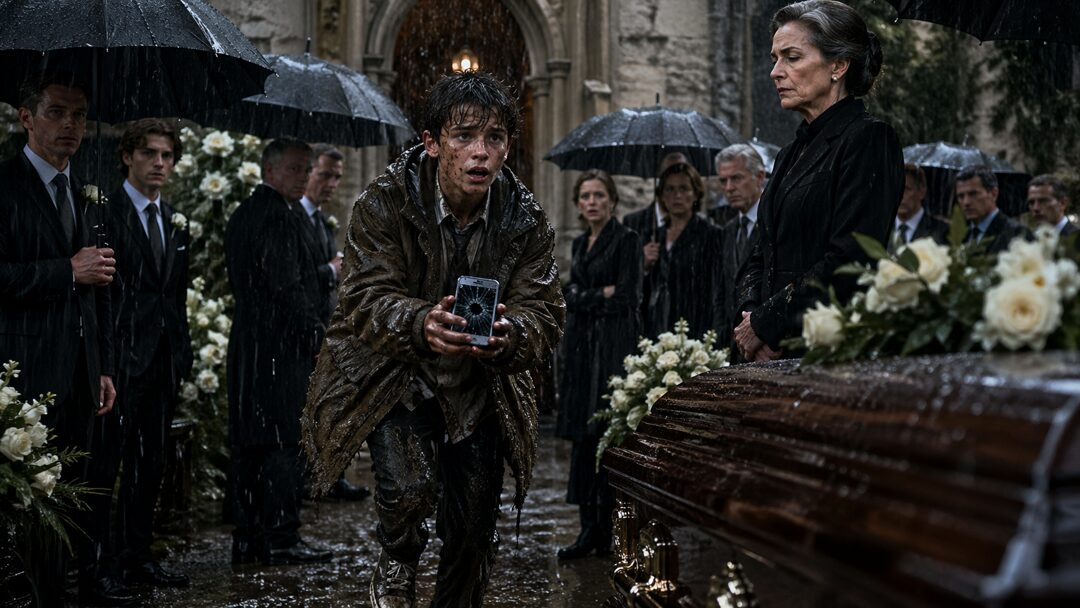
The boy came through the black umbrellas like something the rain had dragged from a ditch.
At first, Evelyn Whitcomb thought he was one of the groundskeeper’s children. Twelve, perhaps. Small for it. Mud up to his shins. Hair plastered to his forehead. An oversized jacket hanging from his shoulders as if it belonged to a man who had left in a hurry and never come back.
He reached the coffin just as Evelyn lifted the white rose.
Security moved.
The mourners went still.
And the boy, breathing hard, held out a cracked phone with both hands.
“She told me to bring this to you.”
Rain struck the coffin lid in quick silver bursts. The old stone church rose behind them, gray and solemn, as if it too had paid for silence. Around Evelyn, donors, cousins, board members, and old family friends stood in polished shoes sinking delicately into wet grass. Everyone was grieving correctly.
Until him.
Evelyn stared at the mud on the boy’s sneakers, then at the phone.
“Take him away,” she said.
Her voice was soft enough to be elegant. Sharp enough to cut.
The boy tightened his grip. “No.”
A whisper moved through the umbrellas.
Evelyn felt it before she heard it. Not sympathy. Not concern.
Interest.
There were few things worse, in Evelyn Whitcomb’s world, than becoming interesting at your own daughter’s funeral.
A guard put a hand on the boy’s shoulder. The boy jerked away so fast the phone slipped. It hit the wet stone path beside the grave, bounced once, and lit up.
A broken screen glowed blue-white in the rain.
Then Lena’s voice came out of it.
Thin. Crackling. Alive.
“Mom…”
Evelyn’s fingers opened. The white rose fell at her feet.
Every umbrella seemed to tilt closer.
The voice sputtered through water damage and static.
“Don’t send him away.”
The boy sank to one knee, scrambling for the phone. “Please,” he whispered, though no one knew whom he was begging.
The recording jumped.
“He’s not lying…”
Evelyn could not move.
Lena had been dead for three days, and still her voice found a way to disobey her.
The phone crackled again.
“His name is Noah.”
The boy’s face twisted, but he did not cry.
“He deserves my name more than anyone standing there.”
The sound cut out.
Rain filled the silence.
Across the grave, Julian Marsh, Lena’s fiancé, lowered his umbrella just enough for Evelyn to see his face. Not grief. Not shock.
Fear.
Evelyn saw it clearly because she had seen that expression before, on people who thought the door to the past had been locked.
The boy looked up at her.
His lips were pale. His hands were dirty. His eyes were not.
“She told me to bring it to you,” he said again.
This time, Evelyn heard what was beneath the words.
Not a request.
A charge.
Part II — Beneath the Portico
Evelyn did not let the mourners see her panic.
That was the first thing she did wrong after hearing her dead daughter’s voice.
She turned to the priest and said, “A moment, Father.”
Then she took the boy by the elbow. Not cruelly. Not kindly. Firmly enough to remind him that she still owned the ground under his feet.
Noah let himself be led beneath the church portico, where rain spilled from the roof in clean vertical sheets. Two security men stood nearby. Close enough to intervene. Far enough to pretend they were not listening.
“Where did you get that phone?” Evelyn asked.
Noah hugged it to his chest.
“She gave it to me.”
“My daughter was trapped in her car when they found her.”
“She was awake before that.”
Evelyn’s breath caught, but she did not let it show.
The police had told her Lena died on impact. Then they had amended it. Then they had softened the amendment. There had been words like likely, briefly conscious, no indication of suffering.
Rich families paid people to make horror sound administrative.
Noah swallowed. “I was there.”
“Why?”
He looked at the coffin through the rain.
“Because she called me.”
Evelyn’s grief turned colder. “My daughter did not know you.”
The boy flinched as if she had slapped him.
Then he said, “Caleb Reyes did.”
Evelyn’s face went still.
The name did not fall between them. It rose.
Caleb Reyes.
Eleven years buried, and still it came up breathing.
The driver’s son. The boy with oil on his sleeves and a scholarship letter in his pocket. The boy Lena had once looked at like the house had windows only when he entered it.
The thief.
That was the word Evelyn had used.
She had said it in the front hall of the Whitcomb estate, in front of staff, family, and two police officers she had not needed but had called anyway. She had said a bracelet was missing. She had said cash was gone from her husband’s study. She had said Caleb had taken advantage of their kindness.
Lena had stood on the stairs in a blue dress, one hand pressed to her stomach, her face drained white.
Caleb had not shouted.
That was what Evelyn remembered most.
He had looked at Lena once. Just once.
Then he had let them lead him out.
“You do not know that name,” Evelyn said.
Noah’s gaze sharpened. “He was my father.”
The rain sounded louder.
Behind Evelyn, the funeral continued without moving. A hundred people pretending not to watch. A hundred people hearing nothing and understanding everything.
Evelyn stepped closer. “Who sent you?”
Noah laughed once, but it had no humor in it. “Nobody sends kids like me.”
The phone shivered in his hand. The screen, still wet, flickered again.
Evelyn saw Lena’s name at the top of the memo.
LENA — FINAL.
Her knees almost failed.
Noah saw it and did not look away.
“She said you would try to make me leave,” he said. “She said I had to stay.”
“Lena said many things,” Evelyn replied.
“No,” Noah said. “She didn’t.”
That landed harder than accusation.
Evelyn remembered Thursday afternoons.
Not because she had noticed them.
Because she had not.
Lena had been thirty-two and still lived in rooms chosen by her mother, wore dresses approved by her mother, attended fundraisers as if she were part of the floral arrangements. She had always had reasons to be absent on Thursdays. Yoga. Volunteer work. Migraines. Errands.
Evelyn had believed what was convenient.
That was the kind of belief that built families like hers.
A car door slammed near the church drive.
Julian Marsh approached beneath a black umbrella held by someone else. His suit was immaculate. His shoes, somehow, were dry.
“Evelyn,” he said softly. “People are concerned.”
“Let them be.”
His eyes moved to Noah.
For one second, his expression cracked.
Noah saw it.
So did Evelyn.
Julian recovered first. “Who is this?”
Noah answered before Evelyn could.
“You know.”
The politeness around Julian’s mouth hardened.
Evelyn looked from one to the other. “Julian?”
He smiled, but only for the world beyond them. “This is not the place.”
Noah’s grip tightened around the phone.
“That’s what everybody keeps saying,” he said. “Not the place. Not the time. Not the room. Not the family.”
Julian’s eyes cooled. “Someone should get him warm.”
It sounded kind.
It was an order.
Evelyn recognized the shape of it because she had used the same one all her life.
A polite sentence that put a person in a smaller place.
She glanced back at the coffin. Her daughter lay under white roses and rain, surrounded by people who had loved her best when she was decorative.
Then she looked at Noah.
He was shaking now. From cold. From fear. From being asked to prove the dead.
Evelyn took off one white glove.
“Come with me,” she said.
Noah did not move.
“To my house,” she clarified. “You can dry yourself there.”
Julian’s smile vanished.
“Evelyn,” he said, quiet enough to be private and public at once, “that would be unwise.”
Noah looked at Evelyn.
He was not grateful.
He was measuring the cage before entering it.
Part III — A Room for Secrets
The Whitcomb estate had rooms for every purpose except truth.
There was a morning room for coffee, a blue room for receiving women one did not like, a library where no one read, a dining room long enough to make intimacy impossible, and a sunroom filled with plants maintained by employees who were never invited inside.
Evelyn placed Noah in a side sitting room near the kitchen, not among the guests.
That was the second thing she did wrong.
She sent for towels, soup, dry clothes from a gardener’s son, and a charger.
Noah accepted the towel. He refused the soup.
“I’m not hungry.”
“You’re soaked.”
“I said I’m not hungry.”
Evelyn looked at him in the borrowed chair, his muddy sneakers tucked under him as if he were afraid to leave prints. He had Lena’s mouth. She noticed it now and wished she had not. The same stubborn line when wounded. The same refusal to ask for comfort if comfort came with terms.
“Where have you been living?” she asked.
“With Mrs. Alvarez.”
“Your guardian?”
“My foster guardian.”
The word opened another door Evelyn did not want to enter.
“Where is Caleb?”
Noah’s face closed.
“I don’t know.”
Evelyn turned toward the window.
Outside, guests arrived from the cemetery in black cars. Their umbrellas moved across the driveway like beetles. Inside, silver trays appeared. Tea was poured. The house absorbed grief and converted it into manners.
In the hallway, someone said, “Poor Julian.”
Noah heard it.
His jaw tightened.
Evelyn said, “You will stay here until I understand what this is.”
Noah lifted the cracked phone. “This is what she told me to give you.”
“And who else has heard it?”
He stared at her.
There it was. The insult hidden inside the question.
Not: Are you alone?
Not: Did you see my daughter suffer?
Not: What did she say to you before she died?
Who else knows?
Noah’s voice went flat. “Nobody.”
“Good.”
The word escaped before Evelyn could dress it.
Noah stood.
“I knew it.”
“Noah—”
“You don’t want to hear her. You want to stop her.”
Evelyn felt anger rise because anger was easier than shame. “You are a child standing in my house making accusations you cannot possibly understand.”
“I understand hiding.”
That silenced her.
The charger arrived. Evelyn plugged the phone in herself, her hands steadier than she felt. The screen flickered, went black, then woke again.
For a moment, Lena’s wallpaper appeared: a blurry photo of a laundromat window at night, rain reflected in neon, a small boy’s hand against the glass.
Noah saw Evelyn see it.
He looked away first.
“She came every Thursday,” he said.
Evelyn did not ask who. She knew.
“At first she said she was a friend of my dad’s. Then she said she knew my mother. Then she just came.” His voice roughened. “She brought quarters for the machines even when we didn’t need them. She folded towels badly. She bought me vending-machine hot chocolate. She asked about school like she had a right to know.”
Evelyn gripped the edge of the table.
Noah kept going because now that the wound had opened, it wanted air.
“I used to think maybe she was lonely. Rich people get lonely too, I guess.” He glanced up. “Then last week she told me.”
Evelyn’s throat tightened. “Told you what?”
His face changed.
For the first time, he looked his age.
“That she was my mother.”
The room did not move, but Evelyn felt it tilt.
Noah pressed his dirty sleeve against his nose and breathed through it. “She said she was sorry. She said she was going to fix it. She said she found my dad and she was going to bring him back if he would come. She said she was leaving Julian.”
The door opened behind them.
Julian stood there.
He had entered without knocking.
“How touching,” he said.
Noah’s face hardened again, childhood gone like a match blown out.
Evelyn turned. “Leave us.”
Julian stepped inside. “No.”
It was the first honest word he had spoken all day.
He looked at the phone on the table.
Then at Evelyn.
“If that boy is what I think he is,” Julian said, “you cannot let him walk into that room.”
Noah’s voice came from the chair.
“What am I?”
Julian smiled at him. “A very sad mistake.”
Evelyn’s hand struck the table.
The sound cracked through the room.
Julian looked surprised. Not frightened. Merely surprised that she had wasted force on a child.
Evelyn surprised herself more.
But not enough.
“Go back to the guests,” she said.
Julian leaned closer, speaking only to her now. “Listen carefully. Lena is dead. Caleb is gone. That boy has no proof except a damaged phone that may or may not survive the hour. You can help him quietly. You can provide money, school, whatever makes you feel humane. But if you let him become public, you will not be honoring Lena.”
His eyes slid toward the hallway, where laughter rose faintly, soft and inappropriate.
“You will be feeding her to them.”
Evelyn hated that it made sense.
That was the ugliest part.
Julian saw it and pressed.
“My family has protected yours through far worse than gossip. Don’t confuse guilt with strategy.”
The word protected carried its own threat.
The Whitcomb estate was older than its money. The money had been bleeding for years. Bad investments. Legal disputes. A dead husband who had left elegance and debt in equal measure. Julian’s family had promised partnership, rescue, continuation.
Lena had been the ribbon around the arrangement.
Evelyn looked at Noah.
He was listening. Of course he was listening.
Children without power learned adult language quickly. Not the words. The meaning beneath them.
He stood and reached for the phone.
Julian moved first.
Evelyn stepped between them.
“No,” she said.
Julian’s face went still.
For a moment, Evelyn thought she had chosen.
Then she ruined it.
“No one touches it until I decide what to do.”
Noah let out a small sound.
Not anger.
Recognition.
Part IV — What the Recording Knew
The next fragment played in the upstairs study, behind a locked door.
Evelyn had moved them there because the reception was growing louder below. Crystal glasses. Low voices. Rain tapping the windows. All of it obscene.
Noah sat on a leather chair too large for him. Julian stood by the mantel. Evelyn stood beside the desk where her husband used to sign checks he did not always have funds to cover.
The phone lay between them.
Its battery crawled upward by single percentages.
When the memo resumed, Lena’s voice came through clearer.
“I was going to tell everyone after Dad’s service. I should have done it then. I had the words. I had Noah’s picture in my coat pocket. I kept touching it like that would make me brave.”
Static.
Then Lena again, crying now but trying not to.
“Julian said if I did, he would tell them I invented Noah because I couldn’t handle grief. He said he would make sure Caleb’s name came up again. Theft. Manipulation. Instability. All the clean words people use when they want to ruin someone dirty.”
Noah’s fingers dug into his knees.
Julian’s expression did not change.
That made it worse.
Lena’s voice broke.
“I let him scare me because it had worked before.”
The recording jumped.
Evelyn saw Caleb in the foyer again.
Not as she had described him to herself for eleven years. Not arrogant. Not guilty. Not dangerous.
Young.
He had been twenty-one. Maybe twenty-two. Barely older than a boy. He had stood under the chandelier with two officers behind him and rainwater dripping from his jacket because no one had offered to take it.
Lena had whispered, “Mom, please.”
Evelyn had not looked at her.
Because if she looked, she would have seen the hand on her daughter’s stomach.
And if she saw that, she would have had to choose between a child and a name.
So she chose the name and called it protection.
Noah’s voice cut through the memory.
“Did you do it?”
Evelyn looked at him.
“Did you lie about my dad?”
Julian inhaled, annoyed. “This is absurd.”
Noah did not look at him. “I asked her.”
Evelyn’s mouth opened.
There were so many answers available to women like her.
It was complicated.
I did what I thought was best.
Your father was not right for her.
We were all under pressure.
Instead she saw Lena’s coffin. White roses. Muddy shoes. A child holding a broken phone like it was the last door in the world.
“Yes,” Evelyn said.
Noah went very still.
A single honest word can be crueler than a hundred lies when it arrives late.
Evelyn took a step toward him. “I thought—”
“No.”
His voice was quiet.
That stopped her.
He did not want the decoration around the truth.
Julian laughed under his breath. “Well. Now we’re all confessing to ancient history. Very moving.”
The phone crackled again.
Lena’s voice returned, lower now, as if she had been holding the device close to her mouth.
“Mom, you always said you were saving me from shame.”
Evelyn’s body locked.
“But you taught me to be ashamed of the only honest love I ever had.”
The room seemed to empty of oxygen.
Noah covered his mouth.
Evelyn closed her eyes, but the voice continued anyway.
“I don’t know if Caleb will forgive me. I don’t know if Noah should. I just know I can’t die with him thinking I hid him because he was hard to love.”
A sound came from Noah then.
Not a sob.
A wound trying not to become one.
The recording cut out again.
The phone screen froze.
Julian moved first. He reached into his jacket and took out a handkerchief, dabbing at nothing near his cuff.
“She was distressed,” he said. “Clearly. That will be obvious to anyone who hears it.”
Evelyn turned slowly.
“What did you do?”
Julian’s eyes sharpened. “Careful.”
“What did you do to my daughter?”
“I tried to prevent exactly this.”
“This?”
He gestured toward Noah. Toward the phone. Toward the house beneath them full of guests eating cucumber sandwiches under portraits of dead Whitcombs.
“A public degradation.”
Noah stood. “She was driving to meet my dad.”
Julian looked at him then.
Really looked.
For the first time all day, he seemed to understand Noah was not mud. Not rumor. Not inconvenience.
He was witness.
“How would you know?”
“She told me in the laundromat. She found him. She said he was in Hartford. She said she was going to bring him to me if he wanted to come.” Noah’s voice shook, but he did not stop. “She left me a voicemail before the crash. Mrs. Alvarez has it. She said Julian kept calling.”
Evelyn stared at Julian.
He did not deny it.
“She was hysterical,” he said. “She was about to destroy multiple families, including yours. I told her to come back and speak rationally.”
“What did you threaten?”
Julian’s smile returned, thin as wire. “Truth is only threatening to people who cannot survive it.”
Noah’s eyes filled.
“You called her a liar.”
“I called her unstable.”
The boy flinched.
Julian looked at Evelyn. “And if this goes downstairs, that is still what people will believe. A grieving daughter. A dead fiancé’s embarrassment. A child coached by someone. A damaged recording. Think.”
That was Julian’s gift.
He knew how to make cruelty sound like reason.
Below them, a servant knocked softly.
“Mrs. Whitcomb? Mr. Marsh is expected to speak.”
Julian straightened his cuffs.
His calm returned fully now that there was an audience waiting.
“Let me handle the room,” he said. “For Lena.”
Noah laughed.
This time, it sounded like Caleb’s silence breaking after eleven years.
“For Lena?” he said. “You don’t even know where she went on Thursdays.”
Julian opened the door.
Before leaving, he looked at Evelyn.
“If you love what remains of your daughter,” he said, “do not let that boy become her legacy.”
Then he went downstairs to praise a woman he had helped trap.
Part V — The Toast
Noah changed because Evelyn asked him to, and because the wet jacket had begun to steam in the heated study.
The borrowed clothes were too large. A white shirt bunched at his wrists. Dark trousers gathered around his ankles. Someone had combed his hair badly, or perhaps he had done it himself with his fingers and given up.
He looked less like an intruder now.
That made the cruelty subtler.
Worse.
When Evelyn brought him to the edge of the reception hall, the room reacted in layers.
First confusion.
Then recognition from those who had seen him at the grave.
Then calculation.
The Whitcomb reception hall glittered with old chandeliers and newer debt. Portraits watched from the walls. White roses stood in tall vases. Lena’s engagement photograph rested near the fireplace: Lena in ivory silk, Julian beside her, his hand at the small of her back. On Lena’s wrist, a pearl bracelet gleamed.
Evelyn remembered buying it.
Not for Lena’s birthday.
For the engagement announcement.
A cuff disguised as jewelry.
Julian stood at the front of the room with a glass of untouched champagne.
He was magnificent in grief.
That was the word someone would use later, Evelyn thought. Magnificent. Composed. Devoted.
He turned as Evelyn entered.
His eyes flicked to Noah.
The room followed.
Noah stopped walking.
Evelyn felt him beside her, suddenly small again.
Julian smiled.
“This is a family gathering,” he said.
The sentence landed softly.
It did exactly what it was meant to do.
It told everyone the boy was outside the circle. It told Noah his presence required permission. It told Evelyn she still had one last chance to behave.
Noah took one step back.
And Evelyn saw Caleb.
Not the memory she had polished. The real one.
Caleb standing in this same hall, rain on his jacket, accused beneath the chandelier while Lena gripped the stair rail so tightly her knuckles blanched. Evelyn had stood where Julian stood now. Calm. Correct. Surrounded by people willing to believe her because believing her kept the room clean.
Lena had made one sound then.
A tiny broken inhale.
Evelyn had ignored it.
Now Noah made the same sound.
That was the moment Evelyn understood the past had not returned for punishment.
It had returned for repetition.
And it was waiting to see if she would perform the same sin twice.
Julian lifted his glass.
“We are gathered,” he began, “not merely to mourn Lena Whitcomb, but to honor the rare purity of her spirit.”
Noah’s face changed.
Purity.
The word erased Caleb. Erased Thursdays. Erased the laundromat, the hot chocolate, the badly folded towels. Erased a boy who had waited every week for a woman who smelled like rain and expensive soap and almost-motherhood.
Julian continued, smooth as polished stone.
“Lena was the purest woman I ever knew.”
Evelyn heard herself say, “No.”
It was not loud.
But it had weight.
The room turned.
Julian paused with perfect control. “Evelyn?”
“No.”
This time, the word reached the chandeliers.
Julian’s smile tightened. “Perhaps you should sit.”
“I have sat long enough.”
A murmur moved through the guests.
Evelyn looked at Noah.
He was staring at her with terror and suspicion, as if hope itself were another trap.
“Play it,” she said.
He did not move.
Julian lowered his glass.
“Evelyn, don’t be grotesque.”
She ignored him.
“Noah,” she said, softer now. “Please.”
The boy’s eyes hardened.
“Are you asking because I’m useful,” he said, “or because I’m hers?”
There it was.
The question all her money could not buy an answer to.
Evelyn felt every person in the room waiting. Not for morality. For spectacle.
Her throat ached.
For one last moment, she wanted the old escape. Privacy. Management. A sealed trust. A school paid for anonymously. A quiet lawyer. A quiet lie.
Then she looked at Lena’s engagement photograph.
Her daughter’s smile had always looked beautiful from a distance.
Up close, it looked like surrender.
Evelyn turned to the room.
“This is Noah Reyes Whitcomb,” she said.
A sharp breath traveled through the guests.
Julian’s face went blank.
Evelyn kept her eyes forward.
“He is Lena’s son.”
Somebody gasped. Someone else whispered, “Impossible.”
Evelyn did not raise her voice.
That made it worse.
“And I sent his father away because I was afraid people like you would think less of us.”
Silence struck the room harder than thunder.
Noah’s hand shook around the phone.
Evelyn looked at him and did not reach for it.
The choice had to be his.
After a long moment, he stepped forward.
He placed the phone on the small table beside Lena’s photograph.
For a terrible second, it would not play.
Then Lena’s voice entered the room.
Not clean. Not whole.
But undeniable.
“Mom…”
People froze at the sound of the dead speaking through a shattered screen.
The memo played from the beginning now, recovered from Lena’s old email account with a password Evelyn had known because she had known too much and understood too little.
“Don’t send him away. He’s not lying. His name is Noah.”
Noah stared at the floor.
“He deserves my name more than anyone standing there.”
A woman covered her mouth.
The recording moved through Lena’s confession. Caleb. The false accusation. The pregnancy. The Thursdays. Julian’s calls. His threats. Evelyn’s silence. The bankruptcy that had made Lena’s engagement useful.
Julian stood very still as his own name appeared in Lena’s voice.
Then he set down his glass.
No one stopped him when he walked toward the door.
That was his final confession.
He could not stay in a room where Lena was more real than the woman he had tried to own.
The recording continued after he left.
“I was afraid of everyone. That is the ugliest thing. Not that I didn’t love them enough. That I loved them and still let fear make me cruel.”
Evelyn closed her eyes.
Noah did not.
He listened like a child at a locked door hearing his name inside.
Lena’s voice softened.
“Tell Caleb I’m sorry if you ever find him. Tell him I kept the bus pass from the first Thursday because I thought if I kept proof of one brave thing, it might teach me how to do another.”
Noah wiped his face roughly with his sleeve.
Then came the final words.
The room seemed to lean toward them.
“Tell Noah I was his mother every day, even on the days I was too much of a coward to say it.”
Noah broke then.
Not loudly.
He folded inward, one hand over his mouth, shoulders shaking as if he could still keep grief from being seen if he held it tightly enough.
No one moved.
Not because they were kind.
Because shame had finally entered the room, and no one knew where to stand.
Evelyn went to him.
She did not embrace him.
She had no right to take comfort from his body.
Instead, she stood beside him while Lena’s final silence filled the hall.
For the first time in her life, Evelyn Whitcomb let the room look at what she had done.
Part VI — Thursday
By dusk, the estate had emptied.
No one said goodbye properly.
They slipped out in clusters, carrying wet coats and fresh gossip, lowering their voices as if volume had been the problem. The white roses remained. The tea went cold. Lena’s engagement photograph still stood near the fireplace, but no one looked at it now.
Julian did not return.
Evelyn did not ask after him.
There would be calls later. Lawyers. Statements. Consequences dressed in official language. But for now, the house was quiet in a way it had never been when Lena was alive.
Noah had gone outside.
Evelyn found him beneath the front awning, watching rain fall over the driveway. He had changed back into his own jacket. Still damp. Still muddy. His choice.
The cracked phone was in his pocket.
Evelyn carried a small velvet box.
Noah looked at it and said nothing.
“It was Lena’s,” Evelyn said.
She opened the box.
The pearl bracelet lay inside, pale and perfect, each pearl catching the porch light.
“She wore it in the engagement photograph,” Evelyn said, then hated herself for choosing the worst possible proof of love.
Noah looked at the bracelet for a long time.
Then he shook his head.
“No.”
Evelyn closed the box slowly.
For once, she did not argue.
“What do you want?” she asked.
The question sounded strange in her mouth. Not because she had never asked it before, but because she had so rarely meant it without already deciding the answer.
Noah stared into the rain.
“Her wallet.”
Evelyn’s chest tightened.
“It’s with her things.”
“She had a bus pass.”
Evelyn understood before he finished.
Thursday.
The laundromat.
The record of every ordinary trip Lena had made into the life she was too afraid to claim publicly.
Not pearls.
Proof.
“I’ll get it,” Evelyn said.
Noah waited under the awning while she went upstairs to Lena’s room.
The room was too neat. Someone had made the bed after Lena died, which felt like a violence. On the dresser sat perfume, a silver brush, two unopened sympathy cards, and a framed photograph of Lena at eight years old on a pony she had hated but smiled beside because Evelyn told her to.
Her wallet was in the top drawer.
Inside were cards, cash, a folded receipt, and a worn city bus pass with softened corners.
Evelyn held it in her palm.
Such a small thing.
So cheap.
So much more faithful than pearls.
When she returned, Noah took it carefully.
His thumb moved over the faded print.
“She was late sometimes,” he said.
Evelyn listened.
“She said traffic. Or meetings. Or rain.” His mouth trembled. “I used to get mad and tell myself I didn’t care if she came.”
He swallowed hard.
“But I always watched the door.”
Evelyn had no defense against that.
“I’m sorry,” she said.
Noah kept looking at the bus pass.
“Don’t say it so I have to make you feel better.”
The words struck clean.
Evelyn nodded.
They stood beneath the awning until the rain softened.
Then Noah said, “I want to go there.”
Evelyn knew what he meant.
She called for the car, then stopped herself.
“No,” she said.
Noah looked up.
Evelyn reached for the old umbrella by the stand. The plain black one her staff used.
“We’ll take the bus.”
He studied her, suspicious of every gesture.
Good, Evelyn thought.
Let him be.
Trust given too quickly could become another theft.
The bus ride took forty minutes.
No one recognized Evelyn Whitcomb, or if they did, they pretended not to. Her coat brushed wet plastic seats. Noah sat beside the window, Lena’s bus pass clutched in one hand, the cracked phone in the other.
Neither spoke.
At the laundromat, fluorescent lights buzzed overhead. Machines churned and thumped. A vending machine hummed near the back. Rain ran down the glass in crooked lines.
Noah went to the third washer from the left and sat on the orange plastic chair beside it.
“This one,” he said.
Evelyn sat two chairs away.
Not beside him.
Not far enough to leave.
For a while, they listened to clothes tumble.
Then Noah took out the phone.
The screen was worse now. A black line cut through Lena’s name. The speaker crackled when he pressed play.
Lena’s voice filled the laundromat softly.
Not as evidence this time.
Not as accusation.
As the only piece of her that still knew how to enter a room.
Noah leaned forward, elbows on knees, eyes fixed on the spinning washer.
Evelyn watched the reflection of his face in the glass.
There was Lena’s mouth again.
Caleb’s stillness.
His own stubborn dignity.
A child made from every truth the Whitcombs had tried to bury.
When the recording ended, Noah did not cry.
Evelyn did.
Quietly. Without covering her face. Without asking anyone to forgive the sight of it.
After a while, Noah reached into his pocket and placed something on the chair between them.
The bus pass.
Not giving it back.
Not giving it away.
Just placing it where both of them could see it.
Outside, rain kept falling over the dark street, washing nothing clean.
Inside, under the hard white lights, they sat with the small proof of every Thursday Lena had managed to come, and every day she had failed to be brave enough.
Noah picked up the cracked phone again.
“Play it once more,” Evelyn said.
He looked at her.
For a moment, she thought he would refuse.
Then he pressed the screen.
Lena’s voice returned, broken and beloved, and neither of them moved toward the other.
They only listened.
And for that night, in that ordinary place where Lena’s hidden love had once folded towels badly and bought vending-machine hot chocolate, truth was not enough to heal them.
But it was enough to stay.