The Song They Tried to Bury
Part I — The Back Door
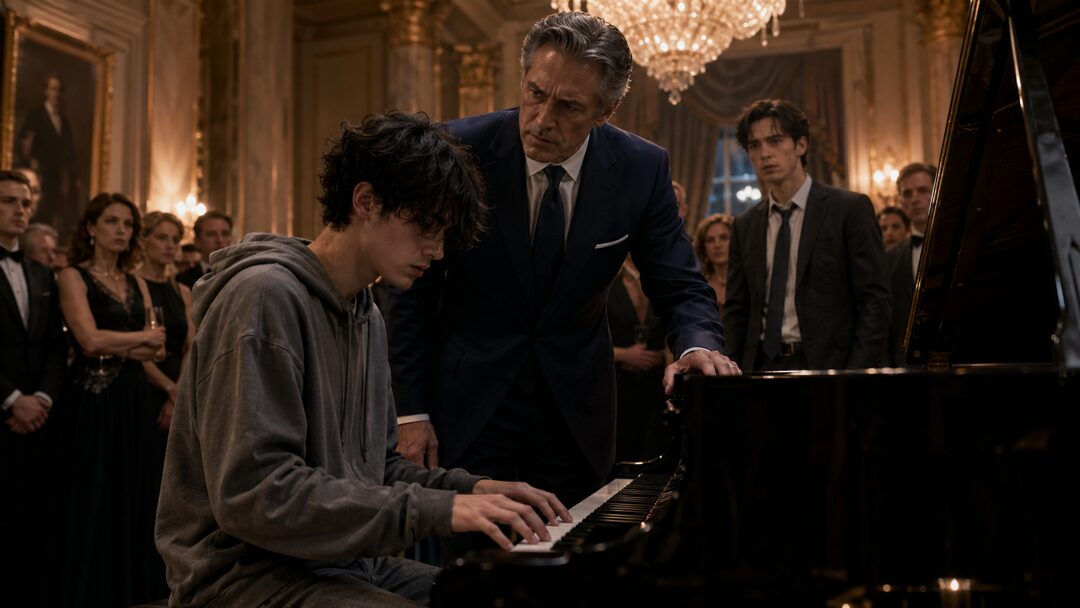
Noah Vale sat at the black grand piano in a gray hoodie while a hundred people in silk, wool, and diamonds waited to see whether he would embarrass himself.
The chandelier above him was so bright it made the keys look surgical. His worn sneakers barely touched the polished floor. Behind him, waiters froze with trays in their hands. Donors turned their bodies toward him with the careful curiosity people gave to accidents they were too polite to admit they wanted to watch.
Adrian Vale stood at Noah’s right shoulder in a navy suit, close enough that Noah could smell his cedar cologne.
“Play something short,” Adrian said, without moving his mouth much. “Then leave through the back.”
Noah kept his hands above the keys.
For seventeen years, he had wondered what his father’s voice would sound like when it finally said something meant only for him.
Now he knew.
It sounded like a door being closed quietly.
Across the salon, Celia Vale smiled from beside a tower of white flowers, one hand resting on the arm of her fiancé, Julian Mercer. Her ivory dress made her look almost bridal already. Her diamonds caught the light every time she tilted her head.
Julian did not smile.
He looked at Noah once, then looked away, like even his eyes had signed a nondisclosure agreement.
Noah lowered his fingers to the keys.
The room waited.
Nobody knew what they were really watching.
Not the donors who had come to celebrate the new Vale Memorial Arts Foundation. Not the old family friends who knew which fork to use and which rumors to ignore. Not the senator’s wife whispering behind her champagne flute.
They thought the boy at the piano was scholarship entertainment.
They thought his hoodie was bad manners.
They thought Adrian Vale was being generous by allowing him to play.
Noah pressed one note.
It rang through the mansion like a question nobody wanted asked.
Three hours earlier, he had stood outside the servants’ entrance with his mother’s warning folded inside his chest.
Don’t go there looking for love, she had said.
Not after Celia’s message.
Not after all this time.
The message had come from an unknown number two nights before.
My father wants to meet you privately before the gala announcement. Use the side entrance at eight. Please don’t make this difficult.
Celia Vale.
His half-sister.
The legitimate one.
Noah had read it so many times the words stopped looking real. Then he showed it to his mother, and watched her face lose color in a way that made him feel cruel for hoping.
“They don’t invite people like us,” she said.
“He’s my father.”
“He was that before you were born.”
Her hands had been damp around the mug she never drank from. She was a piano teacher who trimmed coupons, paid rent late, and never said Adrian’s name unless pain had left her no choice.
“He wants to meet me,” Noah said, because if he said it with enough steadiness, it might become less humiliating to need it.
His mother looked at him for a long moment.
Then she touched his hair the way she did when he was small and sick.
“Wear something decent,” she said.
He wore the gray hoodie anyway.
Not out of rebellion.
Out of fear that if he dressed like he belonged, the mansion would prove more cleanly that he didn’t.
The Vale mansion sat behind iron gates at the top of a hill, the kind of place that made arriving feel like trespassing even when someone had given you the address. Warm light glowed from tall windows. Cars slid up the curved drive and released people who already knew how to enter rooms.
Noah came through the side.
A housekeeper asked his name. He gave his mother’s surname first, then swallowed and said, “Vale.”
She looked at her clipboard.
There was a pause.
Then a woman’s voice said, “He’s with the scholarship group.”
Noah turned.
Celia stood in the service corridor as if she had been waiting to catch him becoming real.
In person, she was sharper than in photographs. Her beauty did not soften her. It polished the danger.
“Noah,” she said warmly.
He hated that his heart leapt.
“You said Adrian wanted to meet me.”
A flash crossed her face. Too quick to call surprise. Too clean to be confusion.
“My father is very busy tonight,” she said. “But I’m glad you came.”
“You invited me.”
Her smile held.
“Of course. We’re always happy to welcome young artists.”
The housekeeper glanced between them.
Noah felt the sentence tighten around his neck.
Young artists.
Not brother.
Not family.
Not son.
Celia stepped closer and lowered her voice.
“Don’t correct me in front of staff.”
It was the first honest thing she said to him.
Part II — Where No One Could See
Julian found Noah near the coatroom ten minutes later.
Not by accident.
Noah knew the difference between being found and being cornered.
Julian came through the narrow hallway with his tie loosened, his dark hair slightly disordered in a way that looked expensive instead of careless. He had the soft, ruined elegance of a man raised near money and terrified of falling out of its weather.
“Noah,” he said.
Noah’s name sounded different in Julian’s mouth.
Not public. Not safe.
“You shouldn’t be here.”
Noah laughed once. It came out thin. “Funny. That seems to be tonight’s theme.”
Julian moved closer, then stopped himself. “I mean it. Leave before Adrian sees you.”
“He asked me to come.”
Julian’s eyes flicked toward the open doorway behind them.
“No, he didn’t.”
Something in Noah’s stomach dropped.
Celia had lied.
Or Julian was lying.
Worse, maybe neither of them had to.
Julian reached into his jacket and pulled out a folded stack of bills. Not a huge amount. Not enough to insult a person openly. Just enough to make the insult intimate.
“Take a cab,” he said. “Go home.”
Noah stared at the money.
“You’re paying me to disappear?”
“I’m trying to help you.”
“You people always call it that.”
Julian flinched, and the smallness of that flinch hurt Noah more than the money. Because Julian did feel something. That was the trap. Cruel people were easier to survive when they did not also look wounded by their cruelty.
Julian reached up and straightened the edge of Noah’s hoodie.
The gesture was gentle.
It was also unbearable.
“You don’t know what this room can do to you,” Julian said.
Noah looked at his hand. “Then stop touching me like I belong to you.”
Julian withdrew.
For a moment, neither of them moved.
The noise of the gala drifted from the salon: laughter, glass, a woman praising the orchids. Somewhere beyond the walls, Celia’s world was continuing beautifully.
Julian’s voice dropped.
“I told you not to come after the audition.”
That was the other door Noah should never have opened.
Six months earlier, at a conservatory scholarship audition, Julian had sat in the second row as a guest judge, his name on the program beside donors twice his age. After Noah played, Julian found him outside by the vending machines and said, “You don’t perform like someone asking permission.”
Noah remembered the way he had said it.
Not flirtatious at first.
Worse.
As if he had seen him.
A month of messages followed. Then one coffee. Then one night after a student recital when Julian kissed him in a stairwell and said, “This can’t become complicated.”
It already had.
Noah was seventeen. Not stupid. Not innocent in the way adults found convenient. But he was young enough to mistake secrecy for intensity, and lonely enough to think being hidden meant being precious.
Now Julian stood in Adrian Vale’s mansion, asking him to vanish for everyone’s convenience.
“Did Celia find out?” Noah asked.
Julian’s silence answered before he did.
“She suspects things,” he said.
“Things.”
“Noah.”
“You mean me.”
Julian looked sick. “I mean us.”
The word struck where it was meant to.
Us.
Small enough to fit in a hallway. Too fragile for a ballroom.
Noah stepped back. “There is no us if I only exist in the dark.”
Julian’s face changed then, not into anger, but fear.
That was when Noah understood Julian did not fear hurting him.
He feared being seen hurting him.
Julian caught his wrist. “Please. Don’t make this harder.”
Noah looked down at the hand around him.
Then at the light spilling from the salon.
“How much easier do I have to be before one of you calls it love?”
Julian let go.
For one suspended second, his control broke. He leaned in and kissed Noah quickly, desperately, in the gap between the coatroom and the corridor, where nobody important could see.
Noah did not kiss him back at first.
Then he did.
Because humiliation did not cure wanting.
Because a starving person could still hate the hand that fed him and open his mouth anyway.
Julian pulled away first.
Of course he did.
Then he stepped back into the light beside Celia.
And Noah was alone again.
Part III — The Wrong Name
Celia waited until the donors had finished admiring the foundation plaque before she struck.
Adrian stood near the fireplace, accepting congratulations with the stillness of a man trained not to be surprised by praise. He had silver at his temples, the same long fingers as Noah, the same left eyebrow that rose before he judged something.
Noah saw the resemblance and hated his own face for carrying proof nobody wanted.
Celia lifted a glass.
“If I may have everyone’s attention.”
The room obeyed her instantly.
That was what legitimacy looked like.
A hundred conversations lowered into silence. Guests turned toward her with fond expectation. Julian stood half a step behind her, handsome and pale. Adrian watched his daughter with public tenderness.
Noah remained near the side corridor, where a young server had already mistaken him for hired help.
“As many of you know,” Celia said, “tonight’s performance was meant to honor my late mother’s love of music.”
A soft murmur moved through the room.
The dead were useful at events like this. They made wealth look holy.
“Unfortunately, our pianist has been taken ill.”
Noah saw Julian’s jaw tighten.
Celia’s eyes found Noah.
“Fortunately,” she continued, “we have one of the young scholarship hopefuls with us tonight.”
Noah’s mouth went dry.
No.
“Mr. Noah Reed,” Celia said, using his mother’s name, “would you be kind enough to give us something?”
Every face turned.
There were moments when humiliation did not arrive as heat.
It arrived as cold.
Noah felt it start in his hands.
He could refuse. He could say, No, I’m not your entertainment. He could say, I’m Adrian Vale’s son. He could ruin the room before it ruined him.
But standing in a mansion full of people who already believed they were generous for tolerating him, refusal would not look like dignity.
It would look like bad breeding.
Celia knew that.
She had given him a choice between performing and proving he did not belong.
Adrian turned then.
The moment he saw Noah fully, all expression left his face.
Recognition did not soften him.
It locked him down.
For one brief second, Noah saw the private man behind the public one. Not a father. Not yet. A man doing arithmetic in a burning room.
Celia walked toward Noah and held out one elegant hand, not to help him, but to display him.
“Don’t be shy,” she said.
A few guests smiled.
Someone whispered, “Isn’t that sweet?”
Noah walked to the piano.
Each step felt louder than the last.
The black grand sat beneath the chandelier like an altar. Its polished lid reflected the ceiling, the flowers, the faces, the whole room upside down.
Noah sat.
His hoodie bunched awkwardly under his arms. His sneakers looked dirty against the gleaming pedal. He could feel guests noticing everything wrong with him and believing they were noticing nothing.
Adrian moved to his side.
Too close.
The room thought he was supervising.
Noah knew he was containing.
“Play something short,” Adrian murmured. “Then leave through the back.”
Noah did not look at him.
He placed his fingers on the keys.
At first, he played what they expected.
A bright, clean piece from his audition repertoire. Technical enough to impress. Harmless enough to end. Music that said: yes, I am grateful; yes, I know my place; yes, you may applaud without feeling responsible for anything.
The room relaxed.
A woman near the fireplace whispered, “Talented boy.”
Boy.
Not son.
Not brother.
Not threat.
Noah played faster.
Adrian watched him with a face carved out of caution. Celia smiled like the evening was going exactly as planned. Julian stood near a column, his arms folded tight, looking anywhere except at Noah’s hands.
Then Noah saw the phone.
Celia had set it on the edge of the piano when she came to “encourage” him. Its screen had not gone dark. A message thread glowed under the chandelier.
Julian: Don’t use him for this.
Celia: You used him first.
Below that, a line from Adrian.
Keep it contained. No scene before the announcement.
Noah missed one note.
Only Adrian heard it.
His eyes sharpened.
The world narrowed.
Not to the room.
Not to the guests.
To that one sentence.
Keep it contained.
Adrian had known.
Not everything, maybe. Not the shape of Julian’s hands in dark hallways. But enough. Enough to know Noah had been invited into a trap. Enough to decide the proper response was management.
A contained humiliation.
A controlled wound.
Noah let the cheerful piece die under his fingers.
The room began to clap.
Celia clapped first.
Too soon.
Her applause was bright, quick, commanding. The guests followed, grateful for instructions.
Noah did not stand.
The applause faltered.
He turned one page on the empty music stand.
There was no sheet music there.
Then he began to play his mother’s lullaby.
Part IV — The Song Without a Name
The first notes were simple.
Almost too simple for that room.
They moved softly, one hand answering the other, like a question asked every night and never fully answered. Noah had known the melody before he knew where it came from. His mother used to hum it while washing dishes, while folding laundry, while counting rent money under her breath.
When he was twelve, he asked who wrote it.
She said, “Someone who was kinder before he became important.”
At fifteen, he found the old recording.
Not a proper recording. A voicemail his mother had saved on an ancient phone wrapped in a scarf at the back of her drawer. The audio was broken by static, but he heard a younger Adrian Vale laughing softly and saying, “It isn’t finished yet.”
Then the piano.
Then his mother, younger too, whispering, “What will you call it?”
And Adrian answering, “I’ll know when the child hears it.”
Noah never told her he had listened.
But he learned every note.
Now he played it in Adrian’s grand salon.
The room did not understand.
Adrian did.
His mouth opened slightly, as if the sound had touched a bruise he had forgotten how to hide. His eyes moved from Noah’s hands to Noah’s face. For the first time that night, he did not look like a host, a patron, or a man protecting a name.
He looked afraid.
Noah kept playing.
The guests stilled. Something in the music made them quiet even without context. It did not ask to be admired. It asked to be remembered.
Adrian’s hand gripped the edge of the piano.
Celia’s smile faded.
Julian moved.
For one foolish second, Noah thought he was coming toward him.
Then Julian angled his body between the piano and a woman raising her phone.
Not to protect Noah.
To block the recording.
The realization landed so cleanly it almost did not hurt.
Julian loved him in the spaces where love cost nothing.
In public, he protected the people who could still protect him.
Celia began clapping again.
This time there was no mistake about it.
“Well,” she said brightly, cutting across the music, “how moving.”
A few guests joined, uncertain, relieved to be rescued from discomfort.
Noah played through it.
The applause thinned.
Celia’s clapping slowed, then stopped.
For the first time all evening, she looked angry enough to be honest.
Adrian leaned down.
“Noah,” he said, and the sound of his name in his father’s voice nearly broke him. “Enough.”
The room heard only a patron correcting a boy.
Noah heard seventeen years of strategy.
Enough wanting.
Enough showing up.
Enough being inconveniently alive.
His mother’s warning returned to him.
Don’t go there looking for love.
But she had also taught him the song.
Not because she wanted revenge. Noah knew that now. She had given him the melody because she had not wanted him to inherit only Adrian’s absence. She had wanted him to know that once, before money and death and reputation made cowards of everyone, his father had imagined him.
That was almost worse.
A father who had never loved him would have been easier to bury than one who had once made music for him and still chose silence.
Noah finished the lullaby.
The final note trembled into the chandelier light and vanished.
No one moved.
Adrian’s face had changed.
Not enough for apology.
Enough for recognition.
The kind people gave to ruins of something they had built themselves.
Noah lifted his hands.
Celia exhaled, ready to reclaim the room.
Then Noah began again.
This time, the lullaby came back wounded.
He broke its sweetness open. The left hand darkened. The right hand sharpened. The melody returned and returned, each time less like comfort and more like accusation. It was still beautiful. That was the cruelest part.
The guests stopped pretending not to be disturbed.
Adrian straightened, but he could not interrupt now. Not without explaining why a scholarship boy playing a nameless piece had undone him.
Celia moved toward the piano.
Julian whispered, “Noah.”
Once, that would have been enough.
In a hallway.
In a stairwell.
In the dark.
Noah did not look at him.
Celia reached for her phone on the piano ledge.
Noah’s hand struck a low chord so hard several guests startled.
Her fingers froze.
He had seen enough of the messages.
So had she, from his face.
A room could be controlled only if everyone agreed where not to look.
Noah was done agreeing.
Part V — Where People Can See
He stopped mid-phrase.
The silence that followed was not empty.
It was violent.
Noah looked up at Adrian. His heart was beating so hard he could feel it in his wrists.
The guests waited with open faces, hungry and frightened. They knew now that they had been invited into something private. They did not yet know whether to pretend otherwise.
Noah asked, clearly enough for the back of the room to hear, “Do you want me to leave as your charity case or your son?”
A woman gasped.
A glass touched a table too hard.
Celia’s face went white, then calm. Calm was her weapon.
“My God,” she said lightly, turning toward the guests. “I’m so sorry. He’s confused.”
The word was chosen perfectly.
Not lying.
Not cruel.
Worse.
Social.
Confused made Noah unstable. Confused made Adrian generous. Confused turned truth into symptoms.
Julian stepped toward him. “Noah, don’t.”
Noah laughed.
It sounded almost like a sob, but not enough to give them that satisfaction.
“Don’t what?”
Julian lowered his voice. “Come with me.”
“Through the back?”
Julian stopped.
There it was.
The whole story in one pause.
He reached for Noah’s shoulder anyway, because men like Julian believed tenderness could still work after courage had failed.
Noah pulled away.
“Don’t touch me where people can see.”
The room changed again.
Not loudly.
Worse.
Precisely.
Celia looked at Julian.
Julian looked down.
Adrian closed his eyes once, as if the sentence had struck more than one target.
Noah stood from the bench. His legs shook, but he stood.
He was aware of everything: his hoodie, his sneakers, his hands, the guests, the piano, the silver-haired man who had given him blood but not a place to put it.
Celia recovered first.
“This is a family matter,” she said.
“No,” Noah said. “You made it entertainment.”
Adrian’s voice came at last.
“That is enough, Celia.”
It was not a defense.
It was a correction of tactics.
Still, it silenced her.
Adrian turned to the room. He had addressed thousands of donors, boards, committees. His voice was built for public trust. But this time, it did not hold steady.
“Noah is my son.”
Nobody moved.
Noah had imagined that sentence all his life.
He had imagined it in offices, in letters, at school concerts, outside hospitals, over the phone. He had imagined it angrily, tenderly, carelessly. He had imagined it would rearrange the air inside him.
It did.
But not into joy.
Into grief.
Because the words had come only after he had dragged them out in front of strangers.
Adrian continued, “This is a private matter, and I ask everyone to respect—”
“It became public when you made me perform,” Noah said.
Adrian stopped.
That was the first time Noah had ever interrupted his father.
It felt less like rebellion than breathing.
Celia’s hand curled around Julian’s sleeve.
Possession disguised as balance.
Julian did not pull away.
Noah saw that too.
Some truths did not need to be shouted. They stood there wearing expensive watches and looking sorry.
Adrian took one step toward him.
“Noah.”
The room leaned in.
For one dangerous second, Noah wanted to let him finish. Wanted the apology that might come. Wanted the hand on his shoulder, the public rescue, the father arriving late but arriving.
Then he saw Celia’s phone still glowing on the piano.
Keep it contained.
Noah looked at Adrian’s face and finally understood.
His father was not a man who had never loved him.
He was a man who had weighed love against reputation and called the result protection.
That was worse than absence.
“You don’t get to name me only when silence stops working,” Noah said.
Adrian’s expression broke.
Just a crack.
Enough for Noah to see the sorrow there.
Not enough to live on.
Noah stepped away from the piano.
The guests parted for him without being asked. That was new. Earlier, they had watched him cross the room as an object. Now they moved like he carried a flame.
Celia whispered something to Julian.
Julian did not answer.
Noah walked past them both.
Julian followed three steps.
“Noah,” he said.
Noah stopped but did not turn.
“Please.”
There it was again.
The word that asked for mercy without offering sacrifice.
Noah looked back.
Julian stood beneath the archway between the salon and the front hall. Behind him were Celia, Adrian, the donors, the chandelier, everything he was too afraid to lose.
In front of him was Noah.
The distance was not large.
Only a threshold.
Julian could not cross it.
Noah nodded once, not in forgiveness.
In understanding.
Then he walked to the front doors.
Not the side corridor.
Not the servants’ entrance.
Not the back.
A footman, uncertain and pale, opened the door for him.
Cold air struck Noah’s face.
For the first time that night, nobody told him where to leave.
Part VI — The Music That Stayed
Adrian remained beside the piano long after the room began pretending to recover.
Celia moved quickly among the guests, repairing what could be repaired. Her voice was low, apologetic, graceful. She made ruin sound like weather.
Julian stood near the archway with one hand at his side, the hand that had reached for Noah too late and too publicly.
People whispered because people always whispered.
But Adrian heard none of it clearly.
He touched the keys Noah had last played.
Not pressing.
Just resting his fingers there.
The piano was his. The mansion was his. The foundation carried his dead wife’s name. The room was full of people who had trusted him to decide what was respectable.
And still, for the first time in years, Adrian Vale looked small inside his own house.
On the drive outside, Noah did not cry until he reached the gate.
Even then, it was not the kind of crying that made sound.
It simply took his breath and would not give it back.
He pulled his hood up and kept walking.
His phone buzzed twelve times before he reached the bus stop.
Unknown numbers.
Then Julian.
Then Celia.
Then one message from Adrian.
Please let me speak with you.
Noah read it under the yellow streetlight.
He waited for his heart to leap.
It did not.
That was its own kind of mercy.
He turned the phone off.
When he got home, his mother was awake at the kitchen table.
She took one look at him and stood.
Neither of them spoke at first.
Then Noah said, “He admitted it.”
Her face folded.
Not with happiness.
With the old pain of a woman who had once imagined that sentence would come sooner, kinder, privately, before it had to become a weapon.
Noah stepped into her arms.
For a long time, they held each other in the small kitchen, surrounded by unpaid bills, chipped mugs, and the only love in his life that had never required him to use the back door.
Three weeks later, the envelope arrived.
Cream paper.
No return address.
His name written in careful, formal ink.
Noah almost threw it away.
His mother saw it on the table and said nothing. That was her gift to him now. Not advice. Not warning. Space.
He opened it alone after midnight.
Inside was sheet music, yellowed at the edges.
The handwriting was Adrian’s. Younger, looser, less controlled than the signature Noah had seen on foundation brochures.
At the top of the first page was the title.
For the Child We Did Not Keep.
There was no letter.
No apology.
No explanation.
Only the song.
Noah sat on the edge of his bed with the pages in his lap.
For a moment, anger came. Then tenderness. Then anger again because tenderness had come.
He hated that the music was beautiful.
He hated that it had been written before he was born.
He hated that part of him wanted to press the pages to his chest like proof.
Instead, he stood and took his conservatory folder from his desk.
He slid the sheet music inside, between audition forms and scholarship notices and pieces by composers who had never known his name and therefore had never failed to speak it.
Then he closed the folder.
The piano in the corner waited.
His mother’s old upright, slightly out of tune.
Noah sat before it.
He placed his hands on the keys.
For a long time, he did not play Adrian’s song.
Then he played something else.
Something unfinished.
Something that began with the lullaby’s first interval and moved away from it almost immediately.
His own hands shook at first.
Then steadied.
Outside, the city went on being indifferent. Inside, the small apartment filled with music that owed Adrian something, but not everything.
Noah did not know whether he would ever answer his father.
He did not know whether Julian would marry Celia.
He did not know whether the Vale name would open doors or close around him like a trap.
But he knew this.
Being seen was not the same as being saved.
And that night, for the first time, he did not play to be chosen.
He played because the song had survived them.
And so had he.