The Letter She Couldn’t Open
Part I — The Room Went Quiet
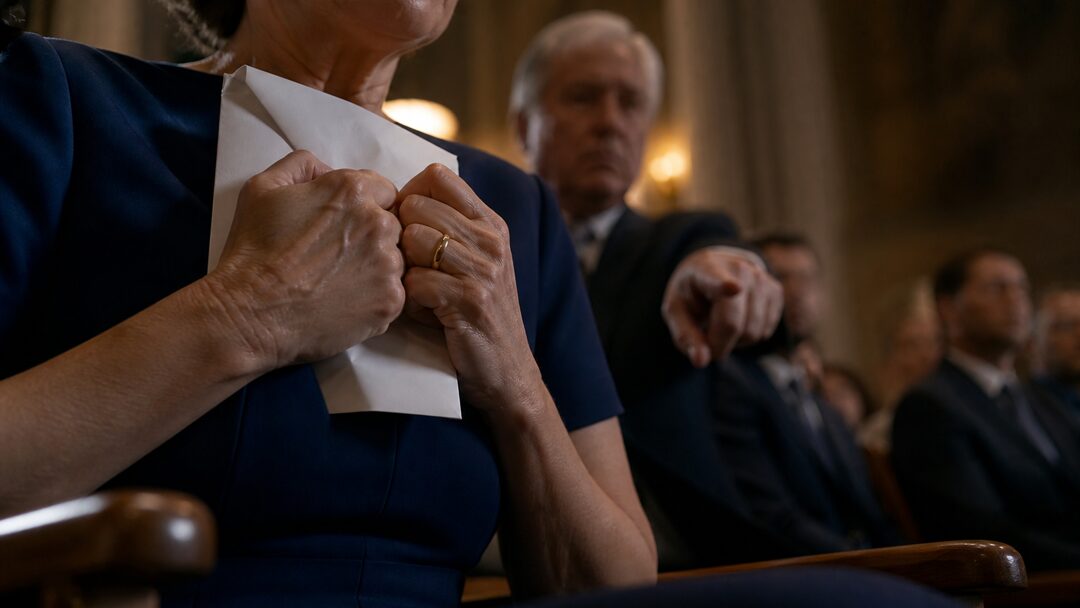
Susan Miller tightened both hands around the white envelope on her lap and whispered, “I can’t do this.”
Retired Captain Robert Hayes was already rising beside her.
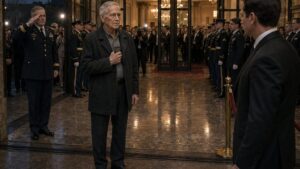
Not fully. Just enough that the people behind them could see his dark suit lift from the chair, just enough for Susan to feel the room notice. His right hand came up slowly, not dramatic, not commanding, but unmistakable.
He pointed toward the stage.
“Susan,” he said under his breath. “Look.”
She hated him for saying it so gently.
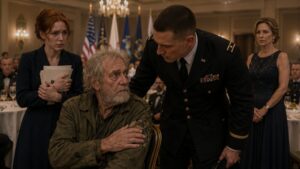
The auditorium was full. Rows of families, officers, graduates, polished shoes, pressed jackets, white caps held in careful laps. Flags stood at both sides of the stage. Brass fixtures shone under the overhead lights. Every sound seemed disciplined: the soft shifting of programs, the restrained coughs, the small hush that settles over people who have agreed to call pain by prettier names.
Susan had promised herself she would sit through the ceremony without crying.
She had made the promise in the hotel bathroom that morning while pinning her silvering brown hair too tightly at the back of her head. She had made it again in the passenger seat of Robert’s car, while the Naval Academy gates rose ahead of them and her throat began to close. She had made it a third time when Robert handed her the white envelope in the lobby and said, “This belongs to you.”
She had not opened it.
Now the announcer at the podium was saying her son’s name.
“Lieutenant Mark Miller.”
The words moved through the room with clean, official weight. They did not sound like the boy who used to leave cereal bowls in the sink. They did not sound like the nineteen-year-old who had called from his first summer training and admitted, only after making her promise not to laugh, that he missed her lasagna. They did not sound like the man in the last photo she had of him, squinting into sunlight in his dress whites, one hand raised as if he had been caught mid-joke.
They sounded polished.
Susan had learned to distrust polished things.
“The annual Lieutenant Mark Miller Memorial Leadership Award,” the announcer continued, “is given to an officer whose service reflects courage, judgment, and devotion to others under extraordinary pressure.”
Beside her, Robert’s hand stayed lifted.
Susan did not want to follow it.
She looked anyway.
A young man in a white dress uniform was standing near the front row, not onstage yet, not seated anymore. He was tall, dark-haired, impossibly straight-backed. The kind of young man people called composed because they did not see the effort it took.
His cap was tucked under one arm. His other hand hung at his side, fingers pressed hard against his trouser seam.
He looked toward Susan.
For one second, the room disappeared.
Not because she knew him.
Because something in him knew her.
The young man’s face was unfamiliar, but not entirely. A thin pale line cut through his eyebrow. It caught the stage light when he turned his head.
Susan stopped breathing.
She had seen that mark before.
Not in person. Not in any official file they meant for her to understand. She had seen it in a grainy evacuation photograph she was never supposed to receive, attached by mistake to one of the many careful reports sent after Mark did not come home.
A blurred young sailor on a stretcher.
Blood-dark bandage near the temple.
One eye swollen shut.
A cut through the eyebrow.
Susan looked down at the envelope.
Her thumb had bent one corner soft.
Robert lowered himself slowly into the chair beside her.
“You knew,” she said.
It came out so quietly he could have pretended not to hear.
Robert did not pretend.
“Yes,” he said.
The announcer continued, unaware or choosing not to see the small disaster in the front row.
“This year’s recipient is Lieutenant Junior Grade Daniel Carter.”
The young man took one step toward the stage.
Then another.
The scar moved with him.
Susan pressed the envelope to her chest so hard the paper creased.
For seven years, people had told her Mark’s life meant something.
For seven years, no one had brought her the person who might prove it.
Part II — A Name Under Glass
Susan had been invited to memorial ceremonies before.
At first, she went because she thought a good mother should. She stood when they asked her to stand. She let strangers shake her hand with both of theirs. She accepted plaques, framed citations, folded programs, photographs of buildings with Mark’s name engraved somewhere near the entrance.
Every time, someone said, “You must be so proud.”
And every time, Susan wanted to ask, Proud of which part?
The part where he was brave?
Or the part where he was gone?
She never asked. People could not survive that kind of honesty in public. So she smiled the small stiff smile she had learned for ceremonies and went home with another object she had not asked for.
After the third year, she stopped going.
Robert never pushed her. That was one of the reasons she kept answering his calls.
He called on Mark’s birthday, never on the anniversary of his death. He mailed a card every Christmas, never with a printed message, always with just one line in blue ink: Thinking of him today. Thinking of you too.
Sometimes he visited when he was passing through Maryland. He would sit in her kitchen in the same chair Mark used to lean back in, both hands around a coffee mug he rarely drank from.
The first time he came, three months after the officers had appeared at her door, Susan had asked him the question that lived in every room of her house.
“Was he alone?”
Robert had looked down at his untouched coffee.
“No,” he said. “Your son did not die alone.”
She had waited for more.
He gave her nothing else.
For seven years, that sentence had sat inside her like a locked box.
Now Robert was beside her in a packed auditorium, his face still enough to fool anyone who had not watched him age under restraint.
“You should have told me,” Susan said.
“I know.”
“No. Don’t say it like that.” Her voice sharpened, still low enough not to carry beyond the first row. “Don’t make it sound simple.”
Robert’s jaw moved once.
“It wasn’t simple.”
“You brought me here.”
“Yes.”
“You handed me this.” She lifted the envelope half an inch.
“Yes.”
“And you let me sit here not knowing he would be in the room.”
Robert looked toward Daniel Carter, who had reached the stairs below the stage and stopped while the announcer read from a program.
“He asked for you,” Robert said.
The words struck harder than Susan expected.
Daniel had asked for her.
Not the academy. Not the committee. Not Robert. The young man with the scar had asked for Mark’s mother to sit in the front row and watch him receive an award named after the man who had not come home.
Susan’s first feeling was not tenderness.
It was anger.
“So this is for him?” she whispered. “I’m here so he can feel better?”
Robert turned to her then. His eyes were tired in a way no ceremony could polish.
“No,” he said. “You’re here because the truth should not have to live in separate rooms anymore.”
That was almost enough to break her.
Almost.
Onstage, Daniel Carter reached the podium. He did not smile the way award recipients were supposed to smile. He did not look proud or surprised or humbly pleased. He looked like a man who had been ordered to step into a memory and had obeyed because discipline was easier than choice.
The announcer finished reading.
Applause rose.
Daniel did not move until it ended.
Susan studied him because looking away felt worse. His uniform was immaculate. His hair was cropped close. His shoes caught the light. But his hands gave him away. He had them folded behind his back now, and the knuckles of one were white.
He looked young.
That offended her.
It was unreasonable, and she knew it. But grief did not care about reason. Mark would have been thirty-six. Mark would have had lines at his eyes by now, maybe a wife, maybe a child, maybe a bad knee he complained about on the phone. Mark would have been older than this man.
Instead Daniel Carter stood onstage at twenty-seven, breathing air Mark had not reached.
Susan touched the little gold cross at her throat.
Robert saw.
“You don’t have to open it yet,” he said.
The envelope seemed to grow heavier.
“What is it?”
He looked at it, then away.
“Something recovered with Mark’s gear.”
Her fingers went cold.
“Recovered when?”
Robert did not answer fast enough.
Susan turned fully toward him.
“When, Robert?”
“It was held as part of the investigation.”
“For seven years?”
His silence changed shape.
Susan understood before he spoke.
“Not all seven,” she said.
Robert closed his eyes briefly.
“No.”
The applause had faded. The room waited for Daniel Carter to speak.
Susan no longer heard the audience.
She heard only her own pulse and the soft, terrible scrape of paper against her dress as her hands tightened around the envelope.
“You decided I couldn’t have it.”
Robert’s voice was rough. “I decided wrong.”
Onstage, Daniel leaned toward the microphone.
His eyes found Susan again.
And then, in front of a room full of people who expected gratitude, he forgot how to speak.
Part III — The Speech He Couldn’t Give
The silence lasted long enough to become visible.
An officer in the front row shifted. Someone in the back lowered a program. The academy president’s smile held, but only because it had been trained for moments like this.
Daniel Carter looked down at the speech in his hands.
Three folded pages.
He stared at them as if they belonged to someone else.
Then he set them aside.
A small movement. Almost nothing.
But Susan felt the room lean forward.
“I wrote this three times,” Daniel said.
His voice was steady at first. Too steady.
“The first version sounded like what you’re supposed to say at a ceremony like this. The second sounded better. The third sounded honest for about half a page.”
A few people gave a faint, uncertain laugh.
Daniel did not.
“So I’m not going to read any of them.”
Susan’s grip loosened on the envelope.
Beside her, Robert breathed in through his nose and did not let it out.
Daniel looked at the plaque on the small table beside the podium. Mark’s name was engraved there beneath the academy seal. Susan could not see the letters from where she sat, but she knew what they looked like. She had seen her son’s name under glass too many times.
“Lieutenant Miller gave me an order,” Daniel said, “that I have spent seven years trying to obey.”
No one moved.
“He told me to make it count.”
Susan’s eyes burned.
Daniel swallowed.
“I thought that meant I had to earn it. Every day. Every hour. Every promotion. Every breath.” His hand tightened on the edge of the podium. “I thought if I became good enough, disciplined enough, useful enough, maybe one day I could stand in front of his mother and not feel like I had stolen something.”
A sound moved through the auditorium. Not a gasp. Smaller. A collective failure to stay untouched.
Susan turned on Robert.
“Is he the one?”
Robert’s face collapsed by a fraction. Only a fraction, but she saw it.
“Yes.”
The word entered her without mercy.
The young man onstage was the wounded sailor.
The blurred face from the photograph.
The body carried out while Mark stayed behind.
The name missing from the careful report.
Daniel Carter.
Susan looked at him and saw, all at once, the impossible cruelty of survival. He was not Mark. He was not guilty because he had lived. She knew that in the clean, moral part of her mind.
But the mother in her had no clean part left.
She thought: You came home.
Then hated herself for thinking it.
Daniel seemed to hear the thought anyway. Maybe he had been hearing it for seven years from every doorway, every mirror, every morning he woke up still breathing.
“I asked Captain Hayes if Mrs. Miller would be here today,” Daniel said. “He told me she might not want to be.”
A flicker moved across Robert’s face.
Daniel continued. “He was right.”
Susan’s throat tightened.
“I wouldn’t want to be here either.”
No one applauded. No one coughed. Even the building seemed to hold still.
Susan slid one finger under the envelope flap.
The adhesive gave with a soft tear that sounded too loud to her.
Inside was a folded sheet of paper, smaller than she expected. Not clean. Not ceremonial. It had been creased hard, then flattened. The edges were worn soft. A faint brown tide mark crossed one corner.
Her son’s handwriting sat on the outside.
Mom.
That was all.
Not Mother. Not Mrs. Miller. Not To be delivered upon notification.
Mom.
Susan’s vision blurred so fast she nearly shut the envelope again.
Robert’s hand moved, then stopped before touching her.
“Don’t,” she said.
He withdrew it.
She opened the paper halfway.
The handwriting inside was uneven. Not sloppy. Mark had never been sloppy. But rushed. Pressed too hard in places. The first lines were blocked by her own shaking fingers.
She could not read it yet.
If she read it, the seven years between her and Mark would change. She knew that. Whatever was on the paper would become part of him, and part of her, and part of the room.
She looked at Robert.
“How long have you had this?”
He did not hide this time.
“Personally? Eleven months.”
The number was small enough to be unforgivable.
Susan stared at him.
“Eleven months.”
“Yes.”
“You came to my house in December.”
“Yes.”
“You sat at my kitchen table.”
“Yes.”
“You looked at the empty chair where he used to sit.”
Robert’s mouth tightened.
“Yes.”
“And you had this?”
His eyes shone, but he did not look away.
“Yes.”
Susan folded the paper closed.
Not because she was done.
Because if she kept it open, she might not survive what she said next.
“You don’t get to decide when my son is too heavy for me.”
Robert bowed his head.
“No,” he said. “I don’t.”
Onstage, Daniel Carter looked at Susan as if the whole ceremony had narrowed to the paper in her hands.
“I was supposed to be on the second transport,” he said. “That was the plan.”
The word plan made several officers in the room go still.
Robert’s hand closed over his knee.
Daniel saw it.
Then he kept going.
Part IV — What the Paper Changed
Daniel did not describe the mission like a man telling a war story.
He gave only what the room needed.
A coastal observation post. A withdrawal under pressure. Communications failing. Smoke thick enough to turn daylight gray. A transport schedule that left no room for mercy. Men and women moving by touch, by shouted names, by the stubborn belief that orders could hold the world together for ten more minutes.
Susan heard fragments, not scenes.
Mark checking names.
Daniel pinned under a collapsed section of wall.
A standing order to leave no later than 0410.
Robert’s order.
Robert’s face did not change when Daniel said it, but his right hand trembled once against his knee.
Susan noticed.
She wondered how many nights Robert had spent replaying a time on a clock.
“Lieutenant Miller was told to move,” Daniel said. “He was told the last route would close.”
His voice thinned.
“He came back anyway.”
Susan looked down at the paper.
The first lines swam into focus.
Mom, if this gets to you, don’t let them clean it up too much.
Her breath caught.
Not I love you first. Not goodbye.
That.
Don’t let them clean it up too much.
It was so Mark that it hurt differently.
He had always distrusted speeches. At his high school graduation, he had leaned down from the stage after receiving his diploma and whispered, “That was a lot of words for please move your tassel.”
Susan made a sound too small to be a laugh and too broken to be anything else.
Robert heard it.
Daniel heard it.
The room did not understand it, but it understood enough to stay quiet.
Susan read another line.
I was scared.
Her thumb covered the rest.
She shut her eyes.
There it was. The thing no plaque had ever said. The thing no officer at her door had offered. The thing every citation had removed to make courage look clean.
I was scared.
Not less brave.
More alive.
Daniel continued. “For seven years, I believed Lieutenant Miller died because he chose me over the order.”
A long breath moved through him.
“I built my life around that. I thought if I wasted one hour, I was wasting him. If I laughed too much, slept too well, loved anyone badly, failed at anything, I was proving I should have been left there.”
Susan looked at him sharply.
There was no self-pity in the sentence.
That made it worse.
He had turned guilt into discipline so cleanly that people had applauded it. They had promoted it. They had pinned ribbons near it. They had called it character.
Daniel touched the scar at his eyebrow without seeming to know he was doing it.
“Then Captain Hayes showed me the full recovery notes last winter,” he said. “And Mrs. Miller’s letter.”
Susan’s head lifted.
“My what?”
Robert looked stricken.
Daniel’s eyes moved to Robert, then back to Susan.
“The letter you wrote to the review board,” he said. “Asking where the route changed.”
Susan remembered.
Of course she remembered.
It had been two years after Mark died. She had sat at her kitchen table at 2:13 in the morning and written six pages no one answered properly. Why did the route change? Who authorized the second extraction path? Why was the timeline inconsistent? Why did one report say Mark returned for a wounded sailor and another say his team diverted before the final contact?
She had been told, in clean administrative language, that operational conditions were complex.
She had wanted to break every plate in the house.
Robert spoke at her side.
“Your question was right.”
Susan turned to him slowly.
He looked older than he had ten minutes ago.
“Mark saw the first route was compromised,” Robert said. “We didn’t know it then. Not fully. He did.”
The paper in Susan’s hands seemed to pulse.
Daniel said, “If he had followed the timing order, the remaining team would have taken that route.”
Robert’s voice lowered. “They likely wouldn’t have made it.”
No one in the room breathed normally now.
The story everyone had carried shifted under them.
Susan had lived seven years with a version of Mark’s final minutes shaped like a closed door: her son went back for one man and did not return.
Daniel had lived seven years trapped inside the same version from the other side: one man went back for him, and therefore he owed the world a perfect life.
But Mark’s paper said something larger.
And smaller.
Larger, because his choice had saved more than Daniel.
Smaller, because he had not been a statue making a glorious decision beneath a flag. He had been her son. Scared. Thinking fast. Breaking an order because conscience and judgment had met in the same terrible second.
Susan opened the note fully.
The lower corner was blank.
Her eyes moved down.
Tell Captain Hayes I know what he ordered. Tell him I heard him. Tell him I’m sorry.
Robert made a sound beside her.
Susan did not look at him yet.
She read on.
Carter’s alive when I’m writing this. He’s mad at me. Tell him that’s good. Angry people keep breathing.
Susan pressed the page to her mouth.
The room blurred.
There were more words, but Daniel was speaking again.
“I have asked Mrs. Miller for permission to read the last line,” he said.
Susan froze.
She had not given permission. She had not even known the request had been coming.
The room turned toward her without turning.
That was the worst of public attention. It could touch without moving.
Daniel stepped back from the microphone.
“I won’t read it if she says no.”
Every person in the auditorium waited.
Susan looked at Robert.
His eyes were wet now. He did not point immediately. He did not command. He did not even plead.
Then, slowly, he lifted his hand again toward Daniel.
The same gesture as before.
But this time, Susan understood.
Not look at him.
See him.
See what Mark left moving in the world.
Susan looked down at the last line.
If Carter makes it, tell my mom I did my job. Tell her not to let them make me a statue. Tell her I was scared, and I went anyway.
The words did not heal her.
They did something more painful.
They gave Mark back his human face.
Part V — The Blank Corner
Susan stood.
The movement was not graceful. The envelope slid from her lap to the floor. Someone behind her bent to retrieve it, then thought better of touching anything that belonged to this moment.
Robert started to rise with her.
She stopped him with one glance.
This was not his to carry.
Onstage, Daniel Carter went still.
Susan’s knees felt unreliable. Her dress pulled at the waist. Her fingers held Mark’s note so tightly she worried the paper might tear in the wrong place. She had imagined, many times, what she would say if she ever met the person Mark had saved.
In the cruel years, she had imagined saying nothing.
In the angry years, she had imagined asking why.
In the lonely years, she had imagined being better than she was.
Now she was simply there.
A woman in the front row with a dead son’s handwriting in her hands and a living man looking at her like she had the power to sentence him.
“Come down here,” Susan said.
Her voice carried farther than she expected.
A small uncertainty moved through the officials near the stage. Protocol did not know what to do with a mother who would not stay seated.
Daniel did.
He left the podium.
No one applauded. Thank God, no one applauded.
He descended the steps slowly, his white uniform bright against the dark suits and dresses around him. Up close, he looked even younger. Not boy-young. Burden-young. The kind of young that comes from having aged in one direction too fast and not enough in another.
He stopped two feet from Susan.
“Ma’am,” he said.
The word nearly undid her.
Mark had said ma’am when he was joking. Ma’am, step away from the lasagna. Ma’am, I’m going to need you to surrender the remote. Ma’am, this is a Navy matter, and the Navy says no raisins in cookies.
Susan swallowed hard.
“Don’t call me that right now.”
Daniel nodded once.
“Susan,” he said, and the name shook in his mouth.
She looked at the scar through his eyebrow.
“Does it hurt?”
He blinked, confused.
“The scar.”
His fingers twitched but did not rise.
“No.”
“Good.”
She did not know why she said it. Maybe because she needed one part of him that did not hurt. Maybe because asking anything larger would break both of them open.
Daniel’s eyes dropped to the note.
“I’m sorry,” he said.
Susan shook her head.
“No.”
His face tightened.
“I am.”
“I know you are.” Her voice almost failed. “But no.”
He looked at her then with something close to fear.
“I wake up every morning because he doesn’t.”
The sentence struck the room so hard even Robert closed his eyes.
Susan took one step closer.
“You wake up every morning because he told you to.”
Daniel’s jaw worked.
“I don’t know how to make that enough.”
“You can’t make it enough.”
That was the truth. It came out sharp, and she let it.
Daniel flinched.
Susan did not soften it.
“You can’t balance it. You can’t earn it. You can’t become so good that my son walks back into my kitchen.”
His eyes shone.
“I know.”
“No,” she said. “You don’t. Not yet.”
She held out the note.
Daniel looked at it as if she had offered him fire.
“I can’t take that.”
“I’m not giving it to you.”
For the first time, something like confusion broke through his composure.
Susan looked down at the page. Mark’s handwriting filled the upper portion. The bottom corner was blank, empty except for the crease of time and the faint mark of water.
She folded the paper carefully along the edge of that blank space.
The auditorium watched.
Her hands shook, but she did not stop.
She tore the lower corner away.
The sound was small.
It still reached everyone.
Daniel’s face changed. Pain first. Then protest. Then something more fragile.
Susan kept the written part against her chest.
The blank corner she pressed into his palm.
Daniel stared down at it.
“You don’t owe me your life,” she said.
His fingers closed around the piece of paper.
“Ma’am—”
“Susan.”
“Susan.” His voice broke. He swallowed and tried again. “I don’t know how not to.”
Susan nodded, because she believed him.
That was the hardest part.
“Then start with this,” she said. “Live one day that belongs to you.”
Daniel’s shoulders moved as if the sentence had found a place no armor covered.
“I don’t know what that looks like.”
“Neither do I.”
The honesty surprised them both.
Susan glanced back at Robert, then at the officers, the families, the rows of strangers pretending not to cry.
“I don’t know what any of this is supposed to look like,” she said. “I just know my son asked me not to let them make him a statue.”
Daniel closed his eyes.
Susan looked at Mark’s handwriting.
“He was scared,” she said.
Her voice shook now. Let it.
“He went anyway.”
Daniel bowed his head.
Not dramatically. Not for the room.
For Mark.
For her.
For the boy under debris who had been angry enough to keep breathing.
For the commander who had given an order and spent seven years living with the fact that the right thing had disobeyed him.
For every person in that auditorium who had mistaken silence for strength.
Susan wanted, suddenly and fiercely, to touch Daniel’s face. Not as a mother claiming him. Not as a woman forgiving him. Just to prove he was real.
She did not.
Some lines mattered because they were not crossed.
Instead she reached down, picked up the fallen envelope, and tucked Mark’s note back inside.
Daniel kept the blank corner.
His hand trembled around it.
The ceremony did not resume in any normal way after that.
Someone at the podium said a few words. The academy president thanked people for coming. A prayer was offered, though Susan heard only pieces of it. The audience stood when it was supposed to stand. Chairs folded up. Programs were collected. A few people approached Susan, then stopped when they saw her face.
For once, nobody told her she must be proud.
That was a mercy.
Part VI — What Remained in the Room
When the auditorium began to empty, Susan stayed seated.
Daniel stood near the aisle, close enough to remain present, far enough not to ask anything more of her. The torn corner of paper was tucked behind his ribbon bar. Not displayed. Not hidden. Held.
Robert sat two seats away at first.
Then, after a long while, he said, “May I?”
Susan did not answer.
He sat beside her anyway, but carefully, leaving space.
For several minutes, neither of them spoke.
The stage crew moved quietly. A microphone clicked off. Somewhere near the back, a family laughed too loudly and then hushed itself, embarrassed by joy in the wrong room.
Susan looked at the envelope in her lap.
“Eleven months,” she said.
Robert folded his hands.
“Yes.”
“I don’t forgive that today.”
“I know.”
She expected him to explain. To say classified, procedure, timing, concern. To build a wall of reasonable words.
He did not.
“I was afraid,” Robert said.
Susan turned.
His face was not the face of a captain now. It was the face of an old man who had outlived too many people who trusted his voice.
“I told myself I was waiting for the right time,” he said. “Then I told myself there was no right time. Then I told myself you had learned how to stand, and I had no right to knock you down again.”
Susan looked toward Daniel.
“And him?”
Robert followed her gaze.
“I told myself discipline was helping him.”
“Was it?”
“No.”
The answer came fast.
Too fast to be anything but old.
Susan held the envelope tighter.
“Mark said he heard your order.”
Robert nodded.
“He always did.”
“He disobeyed you.”
“Yes.”
“Was he wrong?”
Robert looked at the stage where Mark’s name still caught the light.
“No.”
The word carried seven years.
Susan let it sit between them.
Daniel approached then, stopping at the row in front of her.
“I should go,” he said. “I don’t want to make this harder.”
Susan almost laughed. Not because it was funny. Because harder had become such a useless measurement.
“Daniel.”
He went still at his name.
“Do you have somewhere to be?”
“No.”
“Then wait.”
He nodded.
He did not sit. She liked him for that. He seemed to understand that staying was not the same as entering.
Susan rose with the envelope in one hand.
Her legs felt steadier now, though nothing inside her did.
She walked toward the front of the auditorium. Robert did not follow. Daniel did not either. That mattered.
The plaque was still on the small table beside the podium.
Lieutenant Mark Miller.
Courage. Judgment. Devotion.
The words had always bothered her. Not because they were false. Because they were incomplete.
Susan touched the engraved name with two fingers.
For the first time, she did not imagine the letters sealing him away.
She imagined his uneven handwriting beneath them.
Mom, don’t let them clean it up too much.
A breath moved through her, painful and almost gentle.
“You were scared,” she whispered.
The room did not answer.
It did not need to.
Behind her, Robert remained seated, head bowed. Daniel waited at the aisle in his white uniform, one hand resting lightly near the hidden paper corner. He did not look like Mark. He never would.
That was the relief and the ache of it.
Susan turned back.
For seven years, she had thought memory was a room with one door, and that if she opened it too often, she might never get out.
Now she saw Daniel standing in the aisle, alive under the weight of a choice he had misunderstood. She saw Robert, diminished but still there, no longer holding the truth where she could not reach it. She saw the empty chairs, the flags, the polished floor, the place where her son’s name had been spoken too smoothly and then, at last, with fear left in it.
Daniel straightened when she looked at him.
Not because he owed her.
Because he was waiting.
Susan put the envelope against her chest, not as a shield this time.
As something warm.
Then she walked toward the aisle where the young officer stood, carrying the part of Mark that remained hers, and leaving him with the blank corner where a life could begin.