The Room That Remembered
Part I — The Red Booth
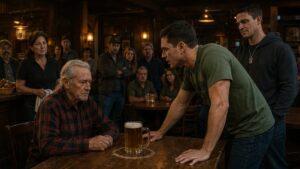
The diner went quiet before anyone saw the photograph.
At first, all they noticed was the girl.
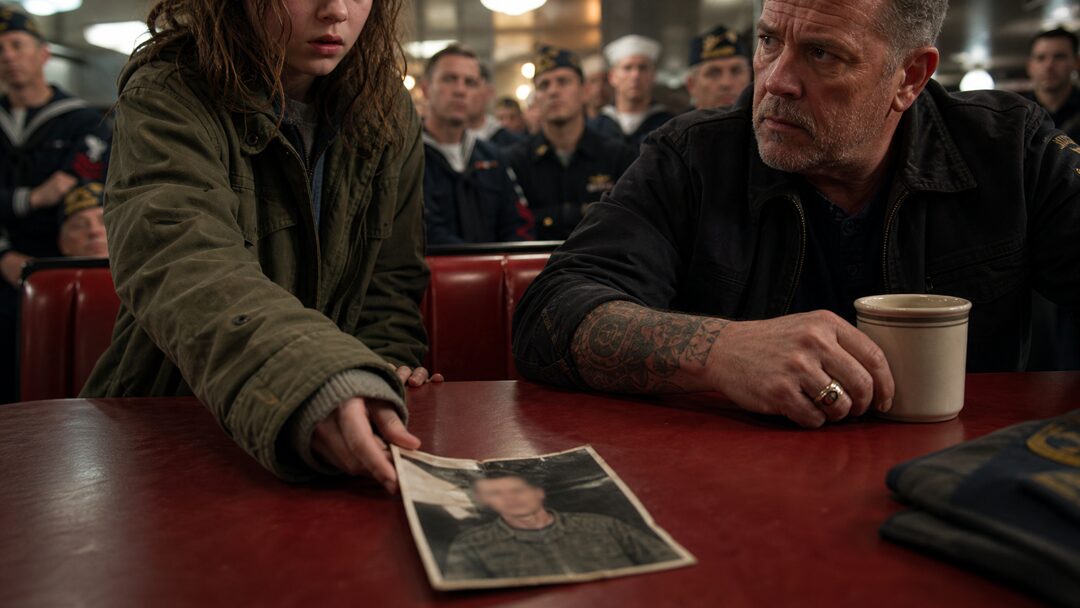
She came through the glass door alone, too small for the heavy olive jacket hanging off her shoulders, its sleeves folded twice and still covering her hands. The bell above the door gave one soft ring, and every man in the room turned like the sound had been an order.
No one spoke.
The place had been loud a second earlier. Forks striking plates. Coffee being poured. Old men in ball caps arguing over a game on the television. Younger sailors in dress blues sitting too straight in booths after the memorial service down the road.
Then the girl walked in, and all of that stopped.
She looked eight, maybe younger. Her hair had been brushed once that morning and forgotten. Her sneakers were scuffed white at the toes. She held one hand flat against the inside of her jacket like she was protecting something from the weather, though the day outside was dry and bright.
Mark noticed the jacket first.
Not because it was too big.
Because he had seen that shade of green in worse places.
He was sitting in the red booth at the back, the one beneath the framed photograph of the old pier. He had chosen it because he always chose it. Men like him pretended habit was not memory, but habit was sometimes just memory with its uniform off.
Across from him sat a half-finished coffee and a plate he had barely touched.
Behind him, Richard was talking to someone from the veterans’ office in that careful voice he used when he wanted a room to believe everything was fine.
Mark had almost made it through the day.
The memorial had been short. The speeches had been polished. The names had been read. No one had said the one name Mark still heard at night.
Then the girl stopped beside his booth.
She did not look at anyone else.
She looked directly at him.
“Are you Mark?” she asked.
Her voice was small but steady enough to make the room lean in.
Mark stared at her. His first instinct was irritation. Not at her. At whoever had let her walk into a room like this alone.
“Who are you here with?” he asked.
She did not answer.
“Are you Mark?” she repeated.
A few men turned farther in their seats. A waitress froze with a coffee pot in her hand. Richard stopped talking behind him.
Mark lowered his cup.
“Yes,” he said carefully. “I’m Mark.”
The girl swallowed.
Then she reached inside the oversized jacket and pulled out a folded photograph.
She opened it with both hands. Slowly. Carefully. Like it was not paper but something alive.
“Do you know her?”
The photograph slid onto the table.
Mark looked down.
For one second, his face did nothing.
Then everything inside him moved.
The woman in the photograph was younger than memory should have allowed. Desert fatigues. Hair pulled back. A tired smile aimed at whoever had taken the picture. Beside her hip hung a medical aid bag with a strip of red tape wrapped around the handle.
Mark did not touch the photograph.
He did not have to.
He knew her.
Sarah Walker.
Nine years gone, according to the report.
Nine years not gone at all, according to the way his hand closed around the edge of the table.
The girl watched him with a child’s terrible patience.
“You know her,” she said.
It was not a question anymore.
Richard stood up behind him.
“Mark,” he said.
That one word carried warning, command, and old fear.
Mark did not look back.
The girl’s eyes flicked toward Richard, then returned to Mark.
“She was my mom,” she said. “And I think somebody lied to me.”
No one in the diner moved.
Not even the waitress.
The coffee pot steamed in her hand.
Mark finally looked at the girl properly. Her face was pale, but she was not crying. That made it worse. Children who had cried enough sometimes learned there was no use doing it in front of strangers.
“What’s your name?” Mark asked.
“Emily.”
The name landed softly.
Mark looked back at the photograph. Sarah’s smile still had that sideways challenge in it, as if she had known even then that orders were things men wrote down when they were afraid of people.
He heard himself say, “I knew her a long time ago.”
Emily’s shoulders dropped, just a little. Not with relief. With confirmation.
Behind him, Richard stepped closer.
“She should go to base security,” Richard said. “This isn’t the place.”
Emily clutched the edge of the table.
“My grandmother said this was exactly the place.”
Mark lifted his eyes.
Richard went still.
Emily reached into her jacket again and pulled out a small plastic bag. Inside it was a faded receipt from the diner, a cloth patch, and a strip of paper folded into a square.
“My grandmother died three weeks ago,” Emily said. “She left me a box. Your name was written inside the lid.”
Mark stared at the patch.
It was his old unit insignia.
Not one like his.
His.
He could tell because of the small fray near the corner where Sarah had once caught it on the door of a transport truck and laughed while he cursed.
Richard said, quieter now, “Emily, you don’t understand what you’re asking.”
Emily looked at him.
“That’s why I came.”
Part II — The Box
Mark got her out of the diner because the room had become too full of eyes.
He did not touch Emily’s shoulder. He only stood, took the photograph, then thought better of it and placed it back in front of her.
“Bring that,” he said.
She slid it into the plastic bag with the other items and followed him toward the side door.
Men watched them pass. No one spoke. A few looked at Richard, waiting for him to explain what kind of child walked into a diner after a memorial service carrying old military ghosts in a sandwich bag.
Richard gave them nothing.
He followed Mark outside.
The side lot smelled like hot asphalt and fryer oil. Beyond the diner, the base fence ran along the road, gray and ordinary. Cars passed like nothing in the world had changed.
Emily stood in the narrow shade beside the building.
The jacket made her look smaller outside.
Mark faced her, then looked at Richard.
“Go back in,” Mark said.
Richard’s expression barely shifted. “No.”
“This isn’t yours.”
Richard stepped closer. “It became mine the day you stopped asking questions.”
Mark’s jaw tightened.
Emily looked from one man to the other.
“My grandmother’s name was Linda,” she said, as if names could make adults behave better. “She raised me. She said my mom was gone before I was born. She said people don’t always leave because they want to.”
Mark closed his eyes for one moment.
When he opened them, the side lot was still there. So was Emily. So was Richard.
“What was in the box?” Mark asked.
Emily opened the plastic bag.
“The picture. The patch. The receipt. A letter.” Her fingers hesitated over the folded square. “And something burned.”
Richard looked sharply at the bag.
Mark saw it.
So did Emily.
She pulled the folded paper out first.
“It was from my grandmother. Not my mom.” Emily smoothed it against the wall. “She wrote that if anything happened to her before I was old enough, I should find the man who drank coffee at the red booth and never forgave himself.”
Mark went cold.
Richard looked away.
Emily watched Mark’s face.
“Is that you?”
“No,” Mark said.
It came out too fast.
Emily did not argue. She just looked at him with the quiet disappointment children saved for adults who lied badly.
Mark turned toward the lot.
The red booth. The coffee. The years he had sat there because sitting somewhere else felt like pretending.
He heard Sarah’s voice from nine years before, sharp with exhaustion.
You ever notice men only say “orders” when somebody’s about to pay for them?
He had told her to shut up.
She had smiled.
He had not forgiven himself for that either.
Richard took a breath. “This needs to stop here.”
Emily turned to him. “Why?”
“Because there are people involved you don’t know. Families. Names. Things that don’t get better because a box turns up.”
“My grandmother said my mother was listed as gone before I was born,” Emily said. “But the letter in the box was written after that.”
Mark’s eyes snapped back to her.
“What letter?”
Emily’s hand went inside the jacket again.
Not to the plastic bag this time.
To an inner pocket.
She pulled out a piece of envelope, soft from being handled. The letter itself was not there, only the corner of it, with handwriting on the torn edge.
“I don’t have all of it,” she said. “Grandma wrote that she burned part of it because she got scared. But she kept this.”
Mark took it before he could stop himself.
The handwriting was faded.
Not much remained.
A few words.
Tell her—
Not forgotten—
Red booth—
M.
Mark felt the wall at his back.
Richard reached for the paper. “Give me that.”
Mark moved it out of his reach.
Emily’s voice dropped. “Was my mom alive after they said she wasn’t?”
No one answered.
That was the answer children learned fastest.
Richard looked down at her, and for the first time his controlled face cracked. Not with guilt exactly. With fear.
“Some truths only make people orphans twice,” he said.
Emily’s hand closed into the sleeve of her jacket.
“I’m already an orphan,” she said. “I just want to know if she was forgotten.”
The side lot seemed to shrink around them.
Mark looked at Richard.
“Harbor Light,” he said.
Richard’s mouth hardened.
“Don’t.”
Mark looked back at Emily. “Your mother was with us on an evacuation. She was a medic.”
Richard said, “Mark.”
“And a liaison,” Mark continued, ignoring him. “She helped identify people who needed to get out.”
Emily listened like every word was a plank over water.
“She was brave?” Emily asked.
Mark gave one short, humorless breath.
“She was impossible.”
Emily’s brow furrowed.
“She didn’t do what people told her?”
“She did,” Mark said. “Until people needed her more than orders did.”
Richard said, “That is enough.”
But Emily was staring at Mark now.
Not afraid of him.
Afraid of what he had not said yet.
“What happened to her?”
Mark looked toward the diner windows. Men inside were pretending not to watch.
“She went back,” he said.
Emily blinked. “Back where?”
Mark’s voice went rough. “Where we were told not to go.”
Part III — What Was Missing
They returned to the diner because Emily asked to sit in the red booth.
Mark almost said no.
Then he understood that he had lost the right to choose the room for her.
So he sat where he always sat. Emily sat across from him with the plastic bag between them. Richard remained standing for a while, then took the edge of the next booth as if sitting would admit this was happening.
The diner did not return to normal.
It only pretended.
Forks moved quietly. Men lowered their voices. The waitress refilled cups no one drank.
Mark kept his hands flat on the table.
“We were pulling people out,” he said. “Civilians, informants, local staff. People who had trusted us because we told them trust meant something.”
Richard stared at the wall.
Emily’s eyes did not leave Mark.
“Your mother found out two people were missing from the last convoy. A pregnant woman and an interpreter who’d taken shrapnel. We had minutes. Maybe less.”
The words came in pieces. Not because Mark wanted drama. Because the memory still had locked doors.
“She was ordered to stay with the convoy,” he said. “She didn’t.”
“She went for them,” Emily whispered.
Mark nodded once.
“I went after her. Richard was coordinating the withdrawal. The landing zone was falling apart. We had wounded. Smoke. Bad reports. No clear line.”
He stopped.
Richard said, “No need for detail.”
Mark looked at him. “There’s every need.”
Emily pressed her knees together under the table.
“Did you find her?”
Mark’s fingers flexed.
“I saw her across the road. She had the interpreter’s arm over her shoulder. The woman was behind her. Sarah was waving them forward.”
For one second, he was not in the diner.
He was back in heat so bright it felt white. Sarah shouting without sound. His radio screaming in his ear. Richard’s voice ordering the convoy to move.
“Then the order came,” Mark said. “We had to leave.”
Emily did not understand military orders. Not really. But she understood adults abandoning sentences.
“You left her?”
The words were not cruel.
That made them worse.
Mark swallowed.
“Yes.”
The diner heard it.
Not loudly. But enough.
Richard stood fully. “You obeyed extraction command. That is what happened.”
Mark looked up. “I obeyed.”
Richard leaned in. “And because you obeyed, twenty-three people got out.”
“And one didn’t.”
“You do not know that.”
Mark stared at him.
Richard’s face shut again.
Emily reached into the plastic bag and took out the burned thing.
It was a cassette label, blackened at one corner, laminated with yellowing tape. She placed it beside the photograph.
Mark saw the numbers first.
His service number.
Then the words beneath it.
Not dead when you left.
The red booth vanished.
Mark could hear his own pulse.
Richard reached for it, but Mark’s hand came down over the label.
“Where did you get this?”
Emily looked startled for the first time. “The box.”
“Who wrote it?”
“I don’t know.”
Richard’s voice was low. “It’s garbage. Old field rumors. Half-burned trash.”
Mark turned on him.
“You’ve seen this before.”
Richard said nothing.
“You’ve seen this before,” Mark repeated.
Richard’s eyes moved once toward the photograph.
That was enough.
Mark stood so abruptly the coffee cup rattled.
Men turned openly now.
“Tell me,” Mark said.
Richard’s voice stayed controlled, but his neck had gone red. “Not here.”
“Here is exactly where.”
Emily held the jacket closed at her throat.
The waitress whispered, “Should I call someone?”
“No,” Mark and Richard said at the same time.
That made the room colder.
Mark picked up the photograph. He pointed to the red tape on Sarah’s medical bag.
“This bag came back in her effects.”
Richard’s jaw tightened.
Mark’s voice changed. It lost volume and gained force.
“It came back clean. Tagged. Sealed. Handle removed.”
Richard looked down.
Mark remembered the box now. The way it had sat in the office under fluorescent lights. The official sympathy. The inventory sheet. One pair gloves. One notebook. One field scarf. One aid bag.
No handle.
He had asked about it.
Richard had said, Don’t do this to yourself. Her family has been notified.
And Mark, exhausted by grief and discipline, had obeyed again.
He looked at Richard.
“You had it.”
Richard sat down slowly.
Emily looked between them.
“Had what?”
Richard rubbed both hands over his face. When he lowered them, he looked older than forty-five.
“Her field pouch came to me,” he said.
Mark’s face hardened.
“You told me there was nothing.”
“There were names in it,” Richard said. “Local contacts. Families. Safe routes. People who would have been hunted if any of it went public.”
“So you buried it.”
“I protected them.”
“You hid her.”
Richard’s eyes flashed. “Do not make this simple because a child is in the room.”
Emily flinched, but she did not look away.
Mark leaned closer. “Did you destroy it?”
Richard’s silence stretched too long.
Mark whispered, “Richard.”
Richard looked at Emily then.
Not at Mark.
At Emily.
“I destroyed most of it,” he said.
The word most entered the room like another person.
Emily’s fingers tightened around the sleeve of the jacket.
“What did you keep?”
Richard closed his eyes.
“The handle.”
Mark’s body went still.
Richard opened his eyes again. “The red-taped handle from the aid bag. There was a micro-card stitched inside. I couldn’t make myself burn it.”
Emily breathed once, sharply.
“Where is it?”
Richard stood.
“No.”
Mark stepped out from the booth.
“Where is it?”
“In storage,” Richard said. “With my deployment papers. Locked away, where it belongs.”
Emily looked at him as if he had just taken the photograph from her hands.
“Why didn’t you give it to my grandmother?”
Richard’s face changed.
That question struck where Mark’s anger had not.
“I thought I was sparing her,” Richard said.
Emily’s voice was small again.
“You weren’t.”
Part IV — The Handle
Richard walked out of the diner first.
Mark followed him to the side lot, with Emily close behind.
This time no one pretended not to watch.
The late light had shifted. The shadows were longer. The air felt cooler, though Mark could feel heat running beneath his skin.
Richard stopped beside a dark pickup truck and turned.
“I will not open this in front of her.”
Emily stepped around Mark.
“You don’t get to decide that anymore.”
Richard looked down at her.
For a second, he seemed angry.
Then he seemed tired.
“You think one note will give you your mother back?” he asked.
Emily’s mouth trembled, but her voice did not.
“No. I think it will give her back to me.”
Mark felt something in his chest give way.
Richard looked at him. “You know what happens if this gets pulled apart.”
“No,” Mark said. “I know what happened because it didn’t.”
Richard’s hand went to his pocket, then stopped.
“I built a life out of keeping people alive,” he said. “You think that’s cowardice?”
“I think you started there,” Mark said. “I don’t know where you ended.”
The words hurt Richard. Mark could see it.
Good, he thought, then hated himself for it.
Richard opened the truck door and reached under the passenger seat. He pulled out a small metal lockbox.
Mark stared at it.
“You keep it in your truck?”
Richard gave a humorless laugh. “I moved it from storage this morning.”
“Why?”
Richard looked toward the diner.
“Because memorial days make old men stupid.”
He unlocked the box with a key from his chain.
Inside were papers bound with rubber bands, an old compass, two tarnished pins, and a strip of red tape wrapped around a stiff piece of canvas handle.
Emily took one step forward, then stopped.
Richard lifted the handle like it weighed more than metal and cloth.
The red tape was faded almost pink at the edges.
Mark remembered Sarah wrapping that tape herself because everyone kept grabbing the wrong bag in the dark.
Now you’ll know mine, she had said.
As if anyone who knew her could mistake it.
Richard turned the handle over. Along one seam, careful stitches had been cut and repaired. His hands shook as he opened it.
The micro-card was no bigger than a thumbnail.
Mark looked at it and hated how small truth could be.
Richard said, “It may not even read anymore.”
“It read once,” Emily said.
Richard glanced at her.
That ended the argument.
They went back inside because the diner had the only old card reader Richard claimed might work. It belonged to the owner, a retired communications tech who had been listening from behind the counter with his face set like stone.
He brought it out without being asked.
No one ate now.
No one pretended.
The red booth waited for them.
Emily sat first.
Mark sat beside her this time, not across from her.
Richard stood at the end of the table.
The owner connected the reader to an old laptop near the register. The screen flickered. Failed once. Failed twice.
Emily’s face stayed fixed.
On the third try, a small folder appeared.
There was no video. No grand archive. No full report that would make the past clean.
Only one text file.
The filename was plain.
For my daughter.
Emily stopped breathing.
Richard turned away.
Mark put one hand flat on the table and kept it there.
The owner looked at Emily. “Do you want me to print it?”
Emily shook her head.
“Read it,” she said.
No one moved.
She looked at Mark.
“You read it.”
Mark looked at the screen.
He could have refused.
He had spent nine years refusing in smaller ways.
He leaned forward.
The note was short.
To whoever gets my daughter home,
Her name may not be Emily yet. Linda will know what to call her. Tell her I knew. Tell her I wanted her. Tell her I was afraid, but not of being her mother.
I am going back because there are people behind me who will not survive being left as paperwork. If Mark made it out, tell him this was not his order to carry alone.
Tell my girl I chose people, not death.
Tell her love can be a door, even when it does not open for the person who built it.
Sarah
Mark could not speak after the last word.
No one asked him to.
Emily stared at the screen.
Then she lifted the photograph from the plastic bag and placed it beside the laptop, aligning Sarah’s face with Sarah’s words.
Her hands were very small.
Richard made a sound that almost became an apology.
It did not reach her.
Emily turned toward him.
“Did my grandmother see this?”
Richard closed his eyes.
“No.”
“Why?”
He opened them.
“Because I was afraid that if one piece came out, everything would. Names. Routes. People who trusted us. Men who made choices. Men who made mistakes.”
Emily waited.
Richard’s face tightened.
“And because I was afraid she would look at me the way you are looking at me now.”
There it was.
Not all of it.
Enough.
Emily looked back at the note.
“You made her carry a blank space,” she said.
Richard did not defend himself.
Mark stood.
The room shifted with him.
He turned to Richard, but when he spoke, he spoke loudly enough for every booth to hear.
“Bring the rest.”
Richard’s head came up.
“No.”
Mark’s voice was calm.
“Bring the rest.”
“You do not know what you are asking.”
“I know exactly what I’m asking.”
Richard’s eyes sharpened. “Do you?”
Mark looked around the diner.
At the men from the memorial.
At the sailors young enough to still believe orders and truth would always face the same direction.
At the old ones who knew better.
Then he looked at Emily.
“I left Sarah because I obeyed an order,” Mark said. “And I have hidden behind that order ever since.”
The room did not breathe.
Richard whispered, “Mark.”
“No,” Mark said. “She deserves more than the version that lets us sleep.”
Emily’s eyes filled, but no tears fell.
Mark continued, “If your mother died that day, she died doing what the rest of us were too ordered to do. If she lived one hour longer than the report said, you deserve that hour. If she left one sentence, you deserve every word.”
Richard looked as if the floor had moved under him.
Mark stepped closer.
“Bring the rest.”
Richard stared at him.
Then at Emily.
Then at the photograph of Sarah in desert fatigues, smiling like she had never accepted a world where silence got the final say.
Richard picked up the lockbox.
“I’ll bring it,” he said.
No one applauded.
That would have been wrong.
Some moments do not want noise.
They want witnesses.
Part V — Every Word
Richard did not leave for storage.
He went back to the truck and returned with a sealed folder from beneath the back seat.
Mark almost laughed, but nothing in him was light enough.
“All of it was here?” he asked.
Richard held the folder against his chest.
“Not all,” he said. “Enough.”
He laid it on the red booth table.
No one reached for it.
Emily looked at Mark.
“Will this tell me how she—”
She stopped herself.
She did not finish the sentence.
Mark answered the question she did not ask.
“Maybe not.”
Emily nodded.
The answer hurt her, but it did not insult her.
Richard sat across from them and opened the folder.
There were photocopied pages with lines blacked out. Coordinates removed. Names reduced to initials. A handwritten inventory. A field note in Sarah’s hand about two civilians missing from transport. A list of medical supplies. A final notation entered six hours after the withdrawal, not by Mark’s unit.
Unknown female medic observed moving east with two civilians. Status unconfirmed.
Mark put his fist against his mouth.
Six hours.
For nine years, the official story had ended at the withdrawal.
Six hours had existed outside his grief.
Emily leaned over the page.
“What does that mean?”
Mark forced himself to answer.
“It means she was seen after we left.”
“Alive?”
Richard said quietly, “Likely.”
Emily took that in.
There are truths children should not have to carry. But there are also truths they are already carrying without names.
Emily touched the edge of the page.
“She had time,” she said.
Mark nodded.
“Yes.”
“She knew about me.”
“Yes.”
“She didn’t just disappear.”
Mark looked at Sarah’s photograph.
“No,” he said. “She didn’t.”
Richard looked smaller now. Not forgiven. Not ruined. Simply seen.
“I can take these to someone,” he said. “A legal advocate. Someone who knows how to handle old files without putting people at risk.”
Mark watched him.
“Not alone.”
Richard accepted that with a nod.
Emily gathered the photograph, the note, and the old receipt. She did not take the photocopied pages. Not yet. They were too large for her hands and too heavy for one afternoon.
Mark reached into the inside pocket of his jacket.
For years, he had carried his old unit patch there without knowing why. A habit. A punishment. A scrap of cloth that had outlived better men and braver women.
He held it out to Emily.
She looked at it, then at him.
“I already have one.”
“I know,” Mark said. “That one was proof. This one is a promise.”
Emily did not take it right away.
“What promise?”
Mark’s voice nearly broke.
“That when you ask, somebody answers.”
Emily accepted the patch.
Her fingers closed around it.
The diner began to breathe again, slowly, unevenly. Someone wiped his face with the heel of his hand. Someone else turned away. The waitress set a glass of water in front of Emily without a word.
Emily drank half of it.
Then she stood.
The jacket still hung too large on her, but it no longer seemed to swallow her whole. It looked like something she had not chosen but might one day understand how to carry.
Mark walked her to the door.
Richard stayed at the booth, gathering the pages with care that came too late and still mattered.
At the door, Emily paused beneath the bell.
“Did she ever talk about me?” she asked.
Mark did not rush the answer.
He thought of Sarah’s note.
Tell her I wanted her.
“She didn’t know your name,” he said. “But she knew you were coming.”
Emily looked down at the patch in her hand.
Then she looked back at the red booth, at the photograph still lying there beside the printed note.
“Can I come back?” she asked.
Mark looked at the room behind him.
The men who had watched her enter now looked away with respect, not avoidance.
“Yes,” he said. “Anytime.”
Emily nodded once.
Then she stepped outside.
The bell rang above her.
This time, no one turned away from the sound.
Mark stood in the doorway until she crossed the lot and climbed into the waiting car of a family friend who had been too afraid to come inside with her. Emily looked back once through the window.
Mark raised his hand.
She raised the patch.
Then the car pulled away.
When Mark returned to the booth, Richard had placed Sarah’s photograph in the center of the table.
Not hidden. Not folded. Not tucked into a file.
There.
Mark sat where he had sat for nine years, but the booth was not the same place anymore.
Richard pushed the folder toward him.
“I thought silence was the cost,” Richard said.
Mark looked at Sarah’s face.
“No,” he said. “It was the bill.”
Richard did not answer.
Outside, the evening settled over the road to the base. Inside, coffee cooled in cups. Men who had once believed the past could be contained sat quietly with the knowledge that it had a child’s face, a woman’s handwriting, and a red strip of tape that had waited nine years to be opened.
Mark stayed at the booth long after everyone else had gone.
The photograph lay before him.
For the first time, he did not look away.