The Seat Across From Her
Part I — The Table by the Coffee Urn
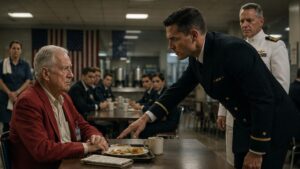
Private Daniel Miller put his tray down hard enough to make the woman’s coffee tremble.
The dining facility went quiet in the way rooms only go quiet when everyone is pretending not to listen. Daniel felt the pause ripple across the long metal tables. He liked it. He liked being noticed. He liked the way the younger guys from his squad glanced over, waiting to see how far he would take it.
Across from him, the woman did not look up right away.
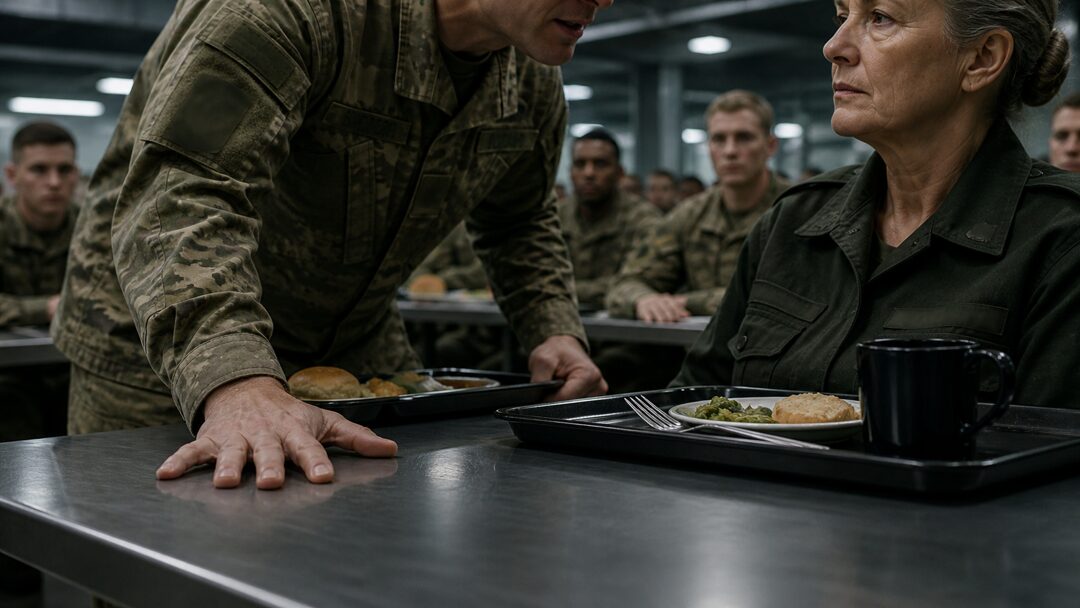
She sat alone at the end of the table, gray-streaked hair pulled tight at the back of her head, dark green uniform plain and sharp, sleeves neat, shoulders square. Her tray held powdered eggs, toast, and coffee gone nearly black. She ate slowly, like she had nowhere to be and no one to impress.
That bothered Daniel most.
Everyone else in the room looked wired. Boots tapping. Knees bouncing. Forks scraping too fast against trays. The unit was moving before dawn, and even the men pretending not to be nervous had that bright, brittle look in their eyes.
But she sat like the morning belonged to her.
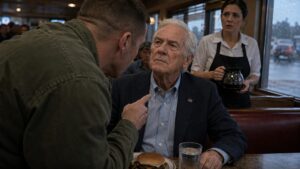
Daniel leaned over her tray, one hand planted beside her coffee.
“Ma’am,” he said, loud enough for the tables nearby to hear, “this table’s for active personnel heading out. You sure you’re in the right place?”
A couple of soldiers exhaled laughter through their noses.
Sergeant Brian Cole looked up from two seats down. His scarred eyebrow tightened.
“Private,” he warned.
Daniel ignored him. He kept his eyes on the woman.
She lifted her gaze.
There was no heat in it. No panic. No wounded pride. Just a tired steadiness that made Daniel feel, for half a second, like he had placed his hand on something that was not his.
He pushed the feeling away.
“I’m just saying,” Daniel added, smiling now because the room had given him an audience. “Busy morning. Some of us have work.”
The woman set her fork down.
Not dropped. Not slammed.
Set.
The small sound carried.
“What’s your name?” she asked.
Her voice was quiet. That made it worse. Daniel had expected anger, rank, some sharp correction he could laugh about later.
He straightened a little. “Private Daniel Miller. Second platoon.”
Something changed in her face.
It was small enough that most people would have missed it. A pause behind the eyes. A breath she almost took and then didn’t. Her hand remained beside the tray, fingers still.
“Miller,” she repeated.
“Yes, ma’am.”
“Your unit?”
He gave it.
She looked down at his tray, at the eggs sliding into the corner, at the coffee he had not touched.
Then she looked back at him.
“Eat before the eggs get cold,” she said. “You’ll need more than your mouth tomorrow.”
No one laughed.
Daniel felt heat climb his neck. The words had not been loud. They had not even been cruel. But they landed cleanly, like she had taken the room away from him without standing.
Brian Cole lowered his eyes to his tray, hiding the smallest hint of satisfaction.
Daniel picked up his fork, though he suddenly had no appetite.
The woman returned to her breakfast.
That was what irritated him. Not the line. Not the quiet. Not even the way everyone had heard it.
It was that she had dismissed him without moving.
And somehow he felt like the one who had been told to leave.
Part II — The Adviser
By 0600, Daniel had told himself the whole thing was funny.
By 0615, he had told two other privates the woman was probably some headquarters relic who had wandered into the wrong room.
By 0630, Sergeant Cole had told him to shut up.
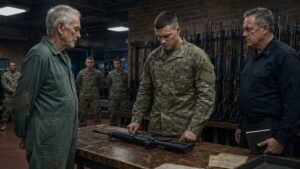
They were in the briefing room by then, standing around a projected map with too many red zones and not enough good options. Captain Emily Ross stood at the front with a tablet tucked against her ribs and a stylus in her hand. She looked like someone who measured time in seconds and judged anyone who wasted them.
“Grayline crossing remains unstable,” she said. “Ceasefire terms collapsed at 0210. We have an aid convoy stalled east of the service road and nine interpreters sheltering in the old customs annex. Current window is four hours, maybe less.”
The room tightened.
Daniel stopped smiling.
He had heard the basics. Everyone had. A border extraction. Civilians trapped after negotiations failed. The kind of mission that sounded simple until it became the story nobody wanted to tell.
Ross tapped the map. “Primary route is Border Road Twelve. Fastest approach, clearest exit. We move before first light, pick up the interpreters, collect the aid staff, and return through Gate Three before local command can seal the corridor.”
“Clean,” someone murmured.
Ross nodded. “Clean if we don’t hesitate.”
Daniel liked that. Clean. Fast. Certain.
Then Ross glanced toward the door.
“We’ll have an outside senior adviser attached for final review.”
Daniel leaned toward the soldier beside him. “Let me guess. Someone from a desk who wants to tell us how walking works.”
Brian Cole heard him. “Miller.”
“What?”
“Try silence. Just once.”
The door opened.
The woman from the dining facility walked in.
Daniel felt every muscle in his face go stiff.
She wore the same plain uniform, but now the rank on her chest seemed impossible to ignore. Colonel Patricia Hayes. The name moved through the room without anyone saying it. Men and women straightened. Ross’s posture changed too, just slightly, from command to professional attention.
Patricia Hayes did not look at Daniel first.
That was worse than if she had.
She walked to the map, accepted no greeting beyond a nod, and studied the projected route. Her face gave nothing away. She looked at the border road, the annex, the service road, the timing marks.
Ross waited.
The room waited.
Daniel stared at the floor.
Patricia pointed to Border Road Twelve.
“Too clean,” she said.
Ross blinked. “Ma’am?”
“This route. It’s too open, too quiet, and too available.”
Ross kept her voice controlled. “It’s the only road that gets us in and out before the crossing seals.”
“The only obvious road,” Patricia said.
Daniel felt the old irritation return, grateful for something to hold onto.
Ross pulled up another layer of imagery. “We’ve had limited movement along the route for three hours.”
“That is my concern.”
A few people shifted.
Patricia did not raise her voice. “A road that useful does not stay empty by accident.”
Ross’s jaw flexed. “With respect, ma’am, delay costs us the window.”
“Rushing may cost you the people inside it.”
That line settled over the room.
Daniel wanted to reject it. He wanted to call it fear, old caution, the kind of slow thinking that got people stranded. But nobody else moved. Even Ross did not answer right away.
Brian Cole asked, “Alternative?”
Patricia looked at him, and something in her face acknowledged the question as useful.
“There’s an abandoned service corridor behind the customs annex,” she said. “Narrow. Slow. Harder to move through. Harder to watch. Use a visible decoy on Border Road Twelve. Make anyone waiting for a clean target reveal what they are waiting with.”
Ross’s eyes moved over the map. “That adds thirty minutes.”
“It may return nine people you do not have to name later.”
Nobody spoke.
Daniel hated how quiet the room had become around her.
He hated more that he could not find the weakness in what she had said.
Ross finally nodded. “We’ll review the corridor.”
Patricia stepped back from the map.
Only then did her eyes meet Daniel’s.
There was no triumph in them.
That made his embarrassment harder to survive.
Part III — Crossing Nine
Daniel found her in the dining facility two hours later.
He had not meant to look for her. That was what he told himself as he crossed the room with coffee he did not want. But the room was almost empty now, breakfast cleared, lunch not yet served, the long tables wiped down to a dull shine.
Patricia Hayes sat at the same end table.
Same posture.
Same plain tray.
He stopped three steps away.
She did not look up. “Private Miller.”
Of course she knew.
Daniel swallowed. “Ma’am.”
“If you’re here to apologize, do it quickly. If you’re here to argue, sit down. Standing over people seems to be a habit of yours.”
He stood there, caught between shame and anger.
Then he sat.
The chair legs scraped too loudly.
“I wasn’t trying to—”
“Yes, you were.”
The words cut clean.
Daniel looked at her.
Patricia lifted her coffee. “Don’t waste both our time pretending you accidentally performed disrespect in front of an audience.”
He felt the heat again, but there was no squad around to make it useful.
“I don’t like people slowing things down when lives are on the line,” he said.
“That your professional assessment?”
“It’s common sense.”
“Common sense is what people call instinct when they haven’t buried enough consequences.”
He leaned back. “You always talk like that?”
“Only when someone mistakes impatience for courage.”
Daniel’s fingers tightened around the coffee cup.
There it was again. The calm. The precision. The refusal to get loud enough for him to fight back.
“You don’t know me,” he said.
“No,” Patricia said. “But I knew a Miller once.”
The room seemed to lose air.
Daniel stared at her.
She set her cup down. “Did your father ever tell you about Crossing Nine?”
For a moment, Daniel was not in the dining facility anymore.
He was twelve years old, standing in a hallway while his father sat in the living room with the lights off, boots still on, hands folded so tightly the knuckles looked white. He was sixteen, watching Robert Miller flinch at a car backfiring and then pretend he had not. He was twenty, holding a box of folded papers after the funeral, all of them praising service and none of them explaining the silence that had lived in the house for years.
“My father didn’t talk much,” Daniel said.
“No,” Patricia answered. “He wouldn’t have.”
The softness in her voice made him angry.
“You served with him?”
“I commanded the evacuation.”
Daniel went still.
Crossing Nine had been one of those names adults lowered their voices around. His mother said his father came back different after it. His uncle said Robert had been a hero there. His father said nothing at all.
“What happened?” Daniel asked.
Patricia looked at the tray in front of her as if weighing what a young man deserved against what a son could carry.
“Your father disobeyed an order,” she said.
Daniel’s chair scraped backward an inch.
Patricia did not stop. “We were withdrawing under a narrowing window. Three wounded men were still outside the line. I ordered the convoy to move.”
Daniel’s throat tightened.
“He went back?” he asked.
“Yes.”
“He saved them.”
“He did.”
“Then why say it like that?”
Patricia’s eyes came up.
“Because saving them cost time. Time cost cover. Cover cost other people.”
Daniel felt something hard close inside him.
“So you blame him.”
“I signed the report that kept his career intact.”
“That’s not what I asked.”
“No,” she said. “It’s what you need to hear before you decide which version of him you can survive.”
Daniel stood.
His coffee sat untouched.
“My father was a good man,” he said.
“I know.”
“You don’t get to turn him into a mistake.”
For the first time, something like pain moved across Patricia’s face. It vanished almost as soon as it appeared.
“Private Miller,” she said, “good men can still leave damage behind.”
Daniel walked away before she could say anything else.
At the door, he almost turned back.
He didn’t.
Because part of him had wanted her to deny it.
Part of him had wanted her to say his father had been flawless, the way dead men were supposed to be when sons were still trying to become them.
Part IV — The Road That Waited
The new imagery came in at 1440.
Daniel was in the equipment bay checking straps he had already checked twice when Ross entered fast enough that every conversation stopped.
“Briefing room. Now.”
No one asked why.
They gathered around the map again. Patricia was already there. So was Brian Cole, arms folded, expression flat in the way it got when bad news had arrived and needed to be treated like weather.
Ross pulled up the feed.
Border Road Twelve lay pale and empty under the drone’s eye.
At first, Daniel saw nothing.
Then Patricia pointed.
“Here.”
Ross zoomed in.
A roofline. A shadow. A shape that did not belong.
Then another.
Then another.
The empty road was not empty. It was being watched.
Ross stared at the screen for two full seconds before speaking. “They were waiting for us.”
Patricia said nothing.
She did not look pleased. She did not look vindicated. She looked older.
That made Daniel feel worse than if she had smiled.
Ross inhaled. “We shift to the corridor and run the decoy?”
Patricia nodded. “If command approves.”
“They will if I make the case.”
“Then make it clean.”
Ross glanced at her. Something changed between them in that glance. Not surrender. Not embarrassment. Adjustment.
The kind Daniel had not known how to make.
Brian Cole stepped beside Daniel as the room broke into movement.
“You good?” Brian asked.
“Yes, Sergeant.”
“That answer came too fast.”
Daniel checked the strap on his vest again.
Brian lowered his voice. “Whatever happened between you and Hayes, leave it here. We need your hands, not your pride.”
Daniel almost snapped back.
Instead, he looked at the map.
The road had waited for them.
If Patricia had been wrong, they would have lost thirty minutes.
If Patricia had been ignored, they might have lost everything.
Daniel remembered his hand beside her coffee. The way he had leaned over her tray like he owned the table. The way she had looked at his name before looking at him.
“Did you know my father?” Daniel asked.
Brian looked at him carefully. “No.”
“She did.”
“That why you’ve been walking around like someone stepped on your shadow?”
Daniel gave a humorless breath. “She said he disobeyed an order.”
Brian’s face did not change much. “Maybe he did.”
Daniel turned.
Brian held his gaze.
“Men you admire can do things that scare you,” Brian said. “Doesn’t mean they weren’t worth admiring.”
Daniel looked away first.
That line stayed with him through final gear checks, through Ross’s tightened orders, through Patricia’s voice on comms assigning timing marks with unnerving calm.
It stayed with him when the convoy engines started.
It stayed with him when the base gate opened to a gray afternoon and the world outside seemed to be holding its breath.
Part V — The Quiet Order
The service corridor smelled of dust, old concrete, and trapped heat.
Daniel moved third in line behind Brian Cole. The walls pressed close. Pipes ran overhead. Somewhere beyond the corridor, beyond the broken customs annex, beyond the visible decoy moving along Border Road Twelve, people were watching the wrong target and waiting to be rewarded for it.
Patricia’s voice came through the comms in clipped intervals.
“Hold at Marker Two.”
“Decoy continuing.”
“Ross, slow your lead vehicle by ten seconds.”
“Cole, report.”
Brian keyed his mic. “Moving. No contact.”
The first group of interpreters appeared in a storage chamber behind the annex: six adults, faces tight with exhaustion, one old man clutching a canvas bag to his chest, two aid workers in dust-streaked vests, and a little girl with one hand wrapped in her mother’s sleeve.
Nine people, Daniel thought.
Nine people who had become marks on a map, then faces in front of him.
“Let’s move,” Brian said softly.
They turned back into the corridor.
That was when the first blast of sound rolled through the concrete.
Not near them.
Near enough.
The little girl froze.
Her mother tugged her once. Then again. The girl did not move. Her eyes went wide, fixed on nothing.
“Pick her up,” Daniel said, already stepping forward.
Brian caught his arm. “Wait.”
“We don’t have time.”
“Wait.”
Another sound cracked in the distance. The corridor trembled. Dust fell from the seam overhead.
The girl started to cry without making noise.
Daniel’s body knew what to do. Move. Grab her. Run. Be useful. Be brave. Be first.
His hand was already reaching.
Then Patricia’s voice came through.
“Cole, hold position.”
Daniel stared at Brian. “We can carry her.”
Brian’s jaw worked. He wanted to move too. Daniel could see it. That made the order harder.
“Hold,” Brian said.
The corridor seemed to shrink around them.
The mother whispered something to the child. One of the interpreters looked toward the far exit. Ross’s voice came over comms, tight and fast, then cut out in static.
Daniel keyed his mic before he could stop himself. “Ma’am, we have a frozen civilian. We can move now if we carry—”
“No,” Patricia said.
One word.
Calm.
Infuriating.
Terrifying.
Daniel shut his eyes for half a second.
In the dark behind his eyelids, he saw his father standing from a convoy seat and going back for three men. He saw a report signed by a woman who had saved him and judged him and maybe never forgiven herself for either.
“Private Miller,” Patricia said. “Listen to me.”
He opened his eyes.
“Decoy has not drawn full attention yet. If you move now, you give them the corridor. Hold until I give the window.”
The little girl’s silent crying broke into a sound.
Daniel’s chest hurt.
Every part of him screamed to move.
Brian looked at him. Not commanding now. Asking.
Could he hold?
Daniel lowered his hand.
He crouched slowly in front of the girl, staying where he was.
“Hey,” he said, voice rougher than he wanted. “Look at me.”
She didn’t.
He touched the floor with two fingers, then tapped his own chest. Not grabbing. Not forcing.
“My name’s Daniel,” he said. “I’m scared too.”
Her eyes flicked to him.
Behind him, Brian whispered, “Good.”
The comms crackled.
Patricia’s voice returned.
“Ten seconds.”
Ten seconds became a room.
Daniel stayed crouched. The child stared at him. He did not tell her it was fine. He did not tell her not to be afraid.
He had been raised on stories that left fear out because fear made the pictures harder to frame.
Now he understood that leaving fear out was a kind of lie.
“Five seconds.”
Daniel held out his arms.
Not taking.
Waiting.
The girl moved first.
She stepped into him.
“Move,” Patricia said.
Daniel lifted her and ran.
The corridor erupted into motion. Boots struck concrete. Someone stumbled and was caught. Brian pushed the line forward, body angled between the civilians and the rear. The far door opened to a slice of fading light and the waiting transport.
They made it through.
All of them.
Then the decoy vehicle took the hit meant for the road everyone had wanted to use.
The sound arrived a heartbeat before the news.
Brian Cole was down.
Not gone. Not dead. But down, his side darkening beneath the hands of the medic, his face pale and furious because he hated being carried.
Daniel stood with the little girl still clinging to his neck and watched Brian force a grin through clenched teeth.
“Don’t look so proud, Miller,” Brian rasped. “You followed instructions.”
Daniel tried to smile.
It broke before it formed.
Part VI — The Seat Across From Her
The dining facility looked almost the same that night.
That was the cruel part.
Same fluorescent lights. Same long metal tables. Same coffee urn humming near the wall. Same trays stacked by the serving line, as if the day had not taken anything from anyone except time and blood and certain easy beliefs Daniel had carried too long.
Brian was in the medical bay, stable and furious.
Ross was still in operations, rewriting reports with the strained focus of someone who had learned something expensive and intended not to waste it.
Daniel had washed his hands three times and still felt concrete dust under his nails.
He saw Patricia Hayes at the end table.
Alone again.
Tray in front of her.
Coffee beside it.
For a moment, he stood where he had stood that morning.
He remembered the room listening. His palm beside her cup. His voice, too loud. His certainty, too cheap.
She looked up before he moved.
He almost apologized from where he stood.
The old Daniel would have made it public. Big enough to be seen. Clean enough to let him feel forgiven.
Instead, he picked up a tray.
He took eggs he did not want, toast he barely noticed, and coffee he would not drink.
Then he walked to her table.
He did not drop the tray.
He did not sit first.
He stood across from her, hands at his sides.
“Ma’am,” he said, “is this seat taken?”
Patricia studied him for a long moment.
The room had not gone quiet this time. Or maybe Daniel no longer needed it to.
“Only if you’re here to talk over your food,” she said.
He sat.
For a while, neither of them spoke.
That silence was different from the morning’s. It did not burn. It asked him to stay inside it.
Daniel looked at her tray. Same plain meal. Same black coffee. He wondered how many rooms she had sat in alone because people respected legends more easily than living women with tired eyes.
“I’m sorry,” he said.
Patricia broke a corner off her toast. “For what?”
He frowned.
“For this morning.”
“What part?”
The question was not cruel. That made it harder.
Daniel looked down at his tray.
“For standing over you,” he said. “For making it a show. For thinking quiet meant weak.”
Patricia nodded once.
She did not absolve him. He found he respected that more.
After a moment, he said, “Sergeant Cole’s going to be okay.”
“I know.”
“You saved us.”
“No,” she said. “You held.”
The words hit him in a place he had no armor for.
He swallowed.
“My father,” he said, then stopped.
Patricia waited.
Daniel forced himself to continue. “What was he really like at Crossing Nine?”
The coffee urn hummed. Trays clattered at the far end of the room. Somewhere, someone laughed too loudly at something that probably wasn’t funny.
Patricia’s face changed, but only by degrees.
“He was scared,” she said.
Daniel looked at her.
“He was stubborn,” she continued. “Useful. Human.”
The words did not shine.
They did not build a statue.
They gave him back a man.
Daniel sat very still.
For years, he had tried to become a version of his father that maybe never existed. A fearless man. A clean hero. Someone who always moved first because the story required him to.
But his father had been scared.
His father had been stubborn.
His father had saved people and cost time. He had carried bodies and silence. He had come home loved and damaged and impossible to fully know.
Daniel looked at Patricia.
“Did he regret it?”
She took a long breath.
“I never asked him.”
“Why not?”
“Because I was afraid he’d ask me the same thing.”
Daniel had no answer for that.
He looked down at his tray. The eggs had gone cold.
This time, he ate anyway.
Across from him, Patricia lifted her coffee.
Neither of them smiled.
But when Daniel’s hand moved near the center of the table, he noticed it stop short of her tray.
A small thing.
A border respected.
Patricia noticed too.
She said nothing.
And that was enough.