The Voice That Remained
Part I — The Empty Screen
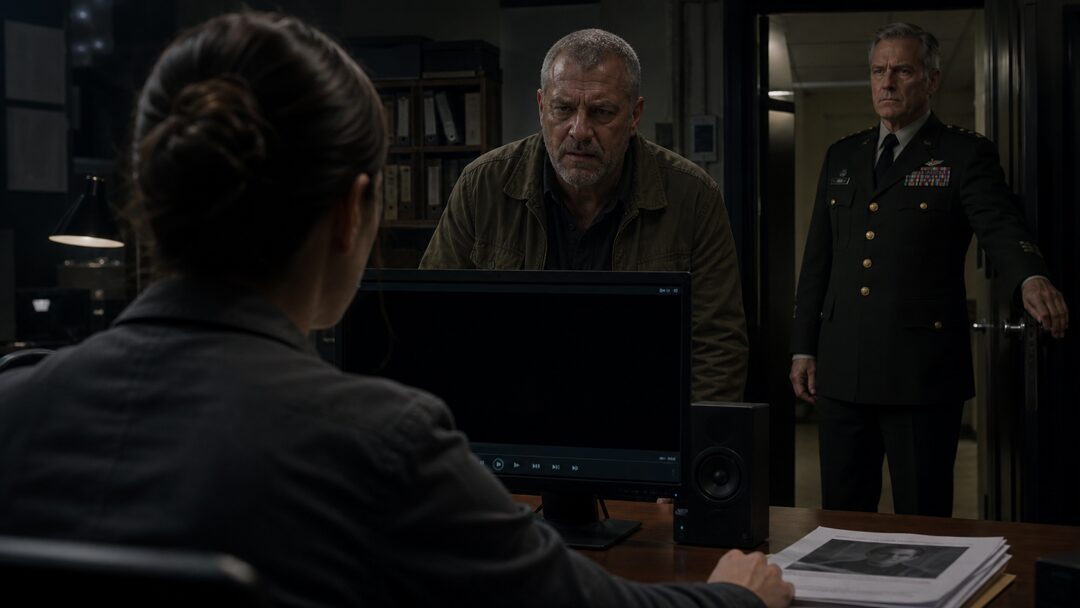
Jennifer Miller knew something was wrong before the file finished loading.
The monitor stayed black.
Not dark because the camera had been covered. Not dark because the lens had failed. Black because there was nothing there at all. No frame data. No timestamps burned into the corner. No motion blur. No ruined image trying to become a picture.
Just a blank window and fifteen point zero nine seconds of sound.
She sat forward.
The speakers gave her three seconds of wind. Then breathing. Too close to the microphone. Ragged, controlled, fighting not to break.
A low impact rolled underneath it.
Then a man’s voice, young and strained, said, “Don’t send it up yet.”
Jennifer stopped the playback.
In the reflection of the black screen, she saw her own face staring back at her: dark hair pinned tight, eyes rimmed with the kind of tired that sleep did not fix, uniform jacket pressed even though her sleeves were rolled to the elbow.
The file name sat beneath the player.
PATROL_CAM_7714_RECOVERED.MP4
Recovered.
That word was always doing too much work.
She ran the file again.
Wind. Breath. Impact.
“Don’t send it up yet.”
Behind the voice, beneath the static, something else scraped through the audio. A second voice, lower, clipped by distortion.
An order, maybe.
Or a warning.
Jennifer opened the metadata panel. Duration: 15.09 seconds. Audio stream intact. Video stream absent.
Absent was not the same as damaged.
Absent meant gone.
Her office door opened without a knock.
Colonel Mark Ellis stepped inside like he had already been there for five minutes and was only now allowing the room to notice him. His uniform was immaculate. Silver showed at his temples. His face had the polished calm of men who had learned that stillness could outrank shouting.
“Miller,” he said. “You reviewed the file?”
“I opened it.”
“That wasn’t my question.”
Jennifer looked back at the black screen. “There’s no video stream.”
“Corrupted?”
“No, sir.”
Mark’s eyes did not move, but something in the room tightened.
Jennifer turned the monitor slightly so he could see the readout. “Corruption leaves damage. Fragments. Bad headers. Failed frames. This is cleaner than that.”
“Meaning?”
“Meaning the audio survived, but the entire video track is missing.”
“Archive it as unusable.”
The words came too quickly.
Jennifer glanced at him.
Mark’s voice stayed level. “File a technical note. Recovery failed. No evidentiary value.”
“There is evidentiary value in the audio.”
“There is no visual record.”
“That doesn’t make it nothing.”
His gaze settled on her then. Not angry. Worse. Expectant.
“Miller,” he said, “some things don’t become clearer because we stare at them longer.”
Jennifer remembered another file.
Another quick clearance.
Another report signed because procedure allowed it.
A driver who had been called reckless in a document Jennifer had not challenged. A month later, a second recording had surfaced and proved he had swerved to avoid a child. By then, his widow had already been handed the first version of the truth.
Jennifer had told herself she had followed protocol.
That had been the problem.
She closed the metadata window but did not close the file.
“With respect, sir,” she said, “this was altered after upload.”
Mark’s expression barely changed.
“Archive it,” he said again. “By seventeen hundred.”
Then he left.
The black screen remained.
Jennifer pressed play one more time, softer now, as if the file might tell her something different if she did not scare it.
Wind.
Breath.
The distant roll.
“Don’t send it up yet.”
This time, after the words, she heard something she had missed before.
A small sound.
Not an order.
Not static.
A name.
Part II — The Man in the Field Jacket
The man waiting outside her office looked too large for the chair.
Broad shoulders. Gray buzz cut. Worn field jacket despite the building’s strict dress culture. His hands rested on his knees, open and still, but Jennifer knew controlled force when she saw it. The man was holding himself together by muscle memory.
Her assistant stood nearby, uncomfortable.
“He said he won’t leave,” she whispered.
Jennifer looked at the visitor badge clipped to his jacket.
DAVID CARTER.
She knew the surname before he spoke. It was in the file request packet. Carter, Matthew. Patrol team attached to the recovered device. Status pending. Family notification incomplete.
Incomplete was another word that did too much work.
Jennifer opened her office door. “Mr. Carter.”
He stood.
“Sergeant,” he said.
She paused.
“Retired,” he added. “But not that retired.”
Jennifer let that pass. “You shouldn’t be in this wing.”
“I know.”
“Then you know I can’t discuss active evidence with you.”
His jaw flexed once. “Evidence. That’s what you’re calling it?”
“That’s what it is.”
“That’s my son’s voice.”
The hallway went still.
Jennifer’s assistant looked down.
Jennifer stepped into the office and gestured for David to follow. She closed the door behind them but did not sit.
“How did you hear the file?”
David did not answer immediately.
His eyes had gone to the monitor. To the black playback window still open like a sealed room.
“I was in Ellis’s office yesterday,” he said. “He played three seconds by accident. Or maybe not by accident. Men like him don’t make many accidents.” His voice roughened, then steadied. “I heard Matthew breathing.”
Jennifer kept her face neutral. “A lot of voices can sound similar under distortion.”
“Not to his father.”
“That isn’t something I can verify emotionally.”
“No,” David said. “That’s something you verify by doing your job.”
The line landed harder than it should have.
Jennifer moved behind her desk. “Mr. Carter, I’m sorry, but—”
“Don’t do that.”
She stopped.
“Don’t give me the sentence people use before they take away the only thing I asked for.”
His grief did not spill. It stood at attention.
Jennifer looked at the screen again.
David followed her gaze. “There’s no picture?”
“No.”
His face changed then. Not much. Just enough.
He had prepared himself for something terrible. He had not prepared himself for nothing.
“What do you mean, no picture?”
“The file contains audio only.”
“But it was a camera.”
“Yes.”
“So where did the rest go?”
Jennifer did not answer.
David stepped closer to the desk. “Did he sound afraid?”
The question broke something open in the room.
Not loudly. Not dramatically.
Just enough for Jennifer to understand that this was not about evidence to him. Not first.
“Sergeant Carter,” she said carefully, “I can’t give you conclusions I don’t have.”
“I didn’t ask for a conclusion. I asked if my boy sounded afraid.”
Jennifer had spent years learning the difference between fact and interpretation. The difference protected her. It let her sleep when sleep was possible. It kept grief on the other side of glass.
But David Carter was looking at her as if glass was just another thing people hid behind.
“I heard breathing,” she said. “Pressure. Movement. One clear sentence.”
“What sentence?”
She should have refused.
Instead, she heard herself say, “He said, ‘Don’t send it up yet.’”
David closed his eyes.
For a moment, his face did not look like a veteran’s face or a father’s face. It looked like a door after someone had knocked from the other side.
“That sounds like him,” he said.
Jennifer waited.
“He never wanted the first version of anything to leave the room,” David said. “School essays. Apology notes. Reports. He’d say, ‘Not yet. It isn’t right yet.’”
His mouth tightened.
“I trained that out of him.”
Jennifer said nothing.
“In my house, you did not hesitate after an order. You understood, then moved. That was how I raised him.” David looked at the black screen. “Now all I have is fifteen seconds, and he’s saying not yet.”
Jennifer felt the old pressure behind her ribs. The one that came before a choice.
“I’ll review the file,” she said.
David opened his eyes.
“I can’t promise access,” she added. “I can’t promise answers.”
“I’m not asking you to make him a hero.”
“That’s not my role.”
“I’m asking you not to let them make him nothing.”
A knock struck the door once.
Colonel Ellis entered before Jennifer could respond.
His eyes moved from David to the open file to Jennifer.
“Sergeant Carter,” Mark said. “This area is restricted.”
“So is the truth, apparently.”
Mark’s expression remained composed. “You need to leave.”
David did not move.
Jennifer expected anger. Instead, David reached into his jacket pocket and pulled out a folded photograph. He placed it on Jennifer’s desk.
A young man in a baseball cap stood beside David in front of a truck, both of them squinting into sun. The son had his father’s shoulders but not his guarded mouth. He was smiling as if the world had not yet taught him to ration it.
“That’s Matthew,” David said to Jennifer, not Mark. “If you hear him again, remember he had a face.”
Then he walked out.
The door shut.
Mark picked up the photograph, looked at it for half a second, and set it back down.
“Archive the file,” he said.
Jennifer looked at Matthew Carter’s smile.
“No,” she said.
It was barely more than a breath.
Mark turned.
Jennifer lifted her eyes. “Not yet.”
Part III — What Was Missing
Jennifer did not reopen the file on the main system.
She waited until the building thinned after hours, until the corridors quieted and the motion sensors clicked on one by one like nervous thoughts. Then she pulled the recovered packet into an isolated workstation that had not been updated in six months because everyone hated using it.
Old systems remembered things new ones cleaned away.
She loaded the container structure.
The first answer came fast.
Too fast.
The MP4 had not failed. It had been emptied.
The video track header was gone, not broken. The audio indexing remained intact. The export trail showed a secondary write operation after intake and before formal review.
Someone had taken the picture out and left the sound behind.
Jennifer leaned back.
In the black reflection of the monitor, Matthew Carter’s photograph sat on the corner of her desk. David had not taken it back.
She should have reported the anomaly immediately.
Instead, she put on headphones.
The sound changed when it entered her skull.
Wind became sharper. Breath became human. The distant impact became less like noise and more like distance. There were layers beneath the sentence. Metal rattle. A strained inhale. A voice buried under clipping.
She isolated the band around the second voice.
At first, it was only a shape.
Then consonants.
Then something like, “Move.”
She marked it.
Again.
“Move out.”
Then another voice. Matthew’s, closer to the microphone.
“Not without him.”
Jennifer froze.
She replayed it.
Wind. Breath. Impact. “Don’t send it up yet.” A clipped command. Matthew again, beneath static.
Not without him.
Him.
Not it. Not them.
Him.
At 23:14, an email notification appeared on the corner of her screen.
FROM: ELLIS, MARK
SUBJECT: STOP REVIEW
No greeting.
Miller,
You are not authorized to continue independent recovery. The file is to be certified unusable by 0900. This matter concerns operational integrity beyond your clearance.
— Ellis
Jennifer read it twice.
Operational integrity was what people called a locked door when they did not want to describe the room behind it.
She saved her working copy to an encrypted drive and removed the headphones.
Behind her, someone said, “You always this bad at following orders?”
Jennifer turned.
Sarah Carter stood in the doorway, plain hoodie under a rain jacket, hair pulled back carelessly, eyes sharp enough to cut through procedure. She looked nothing like her father except in the way she did not ask permission to occupy space.
“You can’t be here,” Jennifer said.
“Apparently that runs in my family.”
Jennifer stood. “How did you get in?”
“My dad still knows people. And people still feel bad for him, which he hates, so please don’t mention it.”
Jennifer moved toward the door. “You need to leave.”
Sarah looked past her to the monitor. To the paused waveform.
“You found something.”
“No.”
“You paused like someone caught you holding a match.”
Jennifer hated that she was right.
Sarah stepped into the office and set a hand on the back of the visitor chair but did not sit. “My father thinks one sentence can save him.”
“I don’t know what it can do.”
“It can ruin him, too.”
Jennifer waited.
Sarah’s voice tightened. “You don’t understand what he’s like when he has a mission. He stops being a person. He becomes a hallway with one locked door at the end.”
“That’s one way to survive.”
“It’s one way to disappear while still answering your phone.”
Jennifer looked at Matthew’s photograph. Sarah noticed.
Her face changed.
“He gave you that?”
“Yes.”
“He carries three copies. Wallet, truck, jacket.” Sarah swallowed. “As if one version might not be enough to prove Matthew was here.”
Jennifer’s hand drifted near the encrypted drive.
Sarah saw that too.
“Was it him?” she asked. “On the recording?”
Jennifer should have returned to policy. She should have said nothing.
Instead, she said, “Yes.”
Sarah’s eyes closed hard.
Then opened.
“And?”
Jennifer hesitated.
Sarah gave a humorless laugh. “Everyone always thinks families want the noble version. We don’t. We want the version that stops changing when people in clean rooms talk about it.”
Jennifer heard herself ask, “Do you want to know?”
Sarah did not answer quickly.
That made Jennifer respect her.
“I want my dad back,” Sarah said. “But I don’t think I get both.”
The hallway lights dimmed and brightened outside, triggered by no one.
Jennifer turned back to the screen.
“I heard Matthew say, ‘Not without him.’”
Sarah’s lips parted.
“Who?”
“I don’t know yet.”
But that was not entirely true.
Jennifer had found a name in the supplemental witness fragments attached to the patrol packet. Not a soldier. Not listed in the official team manifest.
A local interpreter.
Anthony Reed.
Civilian attachment. Injured during extraction. Status sealed.
Jennifer did not say the name yet.
Some truths needed a floor beneath them before they were dropped.
Sarah looked at the black monitor.
“So the picture is gone,” she said.
“Yes.”
“But the part that hurts stayed.”
Jennifer had no answer for that.
Part IV — The Man Who Chose Silence
Colonel Ellis summoned Jennifer at 0610.
Not requested. Summoned.
His office faced east, and the early light made everything look cleaner than it was. Plaques on the wall. Framed certificates. A flag folded in a triangular case. A row of photographs in which Mark stood beside men who had learned how to smile without relaxing.
Jennifer stood in front of his desk with her encrypted drive in her pocket.
Mark did not offer a chair.
“You accessed restricted material last night,” he said.
“I reviewed assigned evidence.”
“You exceeded scope.”
“The file was altered.”
Mark’s eyes lifted.
Jennifer placed a printed page on his desk. Not the full report. Just the container history.
His gaze moved over it once.
“You don’t understand what you’re touching.”
“Then explain it.”
“That is not how this works.”
“It should be.”
For the first time, the calm cracked. Not into anger. Into exhaustion.
Mark sat back.
“Five people came back because I made a call,” he said. “Three did not because I made it too late. Or too early. Depending on who tells the story.”
Jennifer stayed still.
“The patrol was compromised,” Mark continued. “Visibility poor. Communications unstable. They had an injured civilian asset and a narrowing extraction window. I ordered movement. Carter delayed.”
“Matthew refused to leave the interpreter.”
Mark’s jaw tightened.
“So you knew.”
“I knew enough.”
“You removed the video.”
He looked toward the window. “I prevented a fragment from becoming a verdict.”
Jennifer let the sentence sit between them.
Mark turned back. “That footage, without full context, would reduce a bad decision to a villain. Maybe me. Maybe Carter. Maybe the men who moved. Maybe the ones who didn’t. Families would use it to punish each other forever.”
“That wasn’t your choice to make.”
“It was exactly my choice to make.”
“No,” Jennifer said. “It was your power to make. That isn’t the same thing.”
Mark’s face hardened, but something in his eyes took the hit.
“You think truth is clean because you work with files,” he said. “Truth in the field comes torn. It arrives missing pieces. Sometimes all a commander can do is decide which damage spreads.”
Jennifer thought of the driver’s widow. The first report. The second recording. The apology that had changed nothing because the ground had already hardened around the lie.
“Silence spreads too,” she said.
Mark looked at her for a long moment.
Then he opened a drawer and removed a sealed envelope. He did not hand it to her.
“I erased the visuals,” he said quietly. “I did not erase the audio.”
“Why leave any of it?”
His fingers rested on the envelope.
“Because I’m not as certain as I pretend to be.”
That was the first honest thing he had said.
Jennifer’s phone buzzed once.
A message from an unknown number.
It was a photo.
David Carter sitting in the parking lot outside the facility, hands on the steering wheel, staring through the windshield at nothing.
Then a text from Sarah.
He knows you found something. Please don’t let him break himself against another closed door.
Jennifer slipped the phone away.
Mark watched her.
“Carter will hear what he wants to hear,” he said.
“No,” Jennifer said. “He’s afraid he’ll hear what he deserves.”
Mark looked down.
For a second, his command presence had nowhere to stand.
Jennifer said, “I need the witness fragments.”
“You have no authority.”
“I have enough to file an alteration notice.”
“That would open a review.”
“Yes.”
“That review will not give them the video back.”
“I know.”
“It will not bring clarity.”
“It may bring honesty.”
Mark smiled faintly, without warmth. “People say that word when they’re not the ones who have to live under it.”
Jennifer stepped closer to the desk.
“You don’t get to call silence mercy just because truth has consequences.”
The office went still.
Mark looked at the sealed envelope.
Then he pushed it across the desk.
Jennifer did not thank him.
Inside were three pages of field statements, each redacted almost into nonsense. But not completely.
She read standing there.
A patrol separated by smoke and collapsed communication. A wounded interpreter pinned near a broken wall. A command to move. A delay. Matthew Carter’s camera running from his chest mount.
One witness line survived the black bars:
Carter said he could hear Reed breathing and would not leave while he was still answering.
Jennifer read it again.
Would not leave while he was still answering.
There are sentences that do not need decoration.
Mark spoke softly. “If you file this, do it precisely.”
Jennifer looked up.
“Is that permission?”
“No.” His mouth tightened. “It’s advice.”
Part V — What Could Be Known
David Carter did not come into Jennifer’s office like a man seeking comfort.
He came in like a man reporting for the hardest inspection of his life.
Sarah came with him, arms folded, jaw set. She stood near the door, close enough to leave and close enough to stop him from falling if he did.
Jennifer had placed three things on the desk: Matthew’s photograph, a printed reconstruction, and a small speaker.
No monitor this time.
She had decided that the black screen had done enough.
David looked at the speaker.
“Is that it?”
“Yes.”
“All of it?”
“All that can be heard clearly.”
His throat moved.
Sarah said, “Dad.”
“I’m fine.”
“You’re not.”
“No,” he said, eyes still on the speaker. “But I’m here.”
Jennifer did not soften the report before handing it over.
“I cannot restore the missing visuals,” she said. “I can prove the video stream was removed after intake. I can prove the audio remained intact. I can identify three voices with varying confidence. Matthew’s is the clearest.”
David took the paper but did not read it.
“Was he ordered to leave?”
“Yes.”
His grip tightened.
“Did he disobey?”
Jennifer chose the next sentence carefully.
“He stayed with an injured interpreter who was still alive at the time of the recording.”
David looked up.
For a moment his face emptied of everything except listening.
Sarah covered her mouth with one hand.
Jennifer continued. “I can’t tell you what happened after the clip ends. I won’t invent that.”
“Thank you,” David said.
It was not gratitude. It was relief that someone had refused to dress absence as certainty.
Jennifer reached for the speaker.
“There is one line I think you should hear.”
David closed his eyes.
“No,” Sarah said suddenly.
Both of them turned.
Her voice shook, but she did not step back. “No, not like this. Not with you standing like you’re waiting to be sentenced.”
David looked at his daughter.
“I need to know.”
“You need to stop making Matthew’s last seconds a test you think you failed.”
The words struck him harder than any accusation.
Sarah’s eyes filled, but she kept going.
“You taught him to obey. Fine. You also taught him not to leave people. You don’t get to claim only the part that hurts you.”
David stared at her.
Jennifer saw it then: the second grief in the room. Not Matthew’s absence. David’s slow disappearance into it.
David looked down at the report.
“I told him once,” he said, voice low, “that hesitation gets people killed.”
Sarah whispered, “Maybe staying gets people loved.”
No one moved.
Jennifer pressed play.
The first seconds were cleaner now. Still rough. Still incomplete. But human.
Breathing.
Wind.
A far-off impact rolling beneath the sound.
A clipped voice: “Move out.”
Matthew, closer to the microphone: “Don’t send it up yet.”
Static.
Then the buried line Jennifer had carved out of the noise with every tool she had.
“Not without him.”
David’s hands began to tremble.
The audio crackled. Another voice, faint and pained, said something impossible to make out.
Matthew again, strained but steady.
“Tell him I stayed.”
The clip ended.
No one spoke.
There was no image to follow. No final pose. No proof of courage with clean edges. No scene the mind could frame and keep.
Only the room.
Only the father.
Only the daughter who stepped beside him and put one hand on his shoulder as if touching him too quickly might break him.
David bent over the paper.
Not collapsing. Not weeping the way strangers expect grief to perform.
He simply lowered his head until his forehead touched the reconstruction Jennifer had written.
Sarah’s hand stayed on his shoulder.
Jennifer looked away.
Some privacy did not require leaving the room. It required refusing to watch too closely.
After a long time, David lifted his head.
He looked older.
He also looked less hunted.
“He wasn’t asking me to forgive him,” David said.
Sarah’s voice was quiet. “No.”
David touched Matthew’s photograph with two fingers.
“He was telling me who he was.”
Jennifer felt the sentence settle into the room.
Not as closure.
As weight.
David folded the report once. Carefully. Then again.
“Can I keep this?”
Jennifer nodded.
“The audio?”
“I can provide a copy through formal release once the amended filing is accepted.”
David gave a dry, broken laugh. “Still rules.”
“Yes,” Jennifer said. “But not the same silence.”
Sarah looked at Jennifer then, and something in her face loosened. Not trust exactly. Something adjacent to it.
At the door, David stopped.
“Major Miller?”
Jennifer turned.
He held Matthew’s photograph out to her.
She expected him to take it back.
Instead, he placed it on the edge of her desk.
“Keep one version,” he said.
Then he left with Sarah beside him.
Part VI — The Line in the Report
Colonel Ellis did not call Jennifer after she filed the amended notice.
He came down himself.
That told her more than his words would have.
The report sat open on her screen. Her hands hovered over the keyboard. The final classification field blinked, waiting for language that would make the file small enough to store.
Mark stood behind her for a long moment.
“You understand what happens now,” he said.
“A review.”
“Questions.”
“Yes.”
“People deciding they would have done better with less information and more fear.”
Jennifer looked at the black playback window minimized at the bottom of her screen.
“Maybe.”
Mark’s reflection appeared faintly over it.
“I was not trying to erase him,” he said.
Jennifer believed him.
That did not absolve him.
“I know,” she said.
His face tightened, as if belief hurt more than accusation.
Jennifer typed the final line.
Video absent. Audio intact. Human action confirmed.
She read it once.
Then she submitted the report.
The system accepted it with a small gray confirmation box, indifferent to everyone it had just failed to protect or punish.
Mark looked at the screen.
“That line won’t satisfy anyone,” he said.
“It isn’t meant to.”
“What is it meant to do?”
Jennifer thought of David’s forehead pressed to the paper. Sarah’s hand on his shoulder. Matthew’s voice crossing the empty space where his image should have been.
“Keep the fragment from being buried with the rest,” she said.
Mark said nothing.
After a while, he turned to leave.
At the door, he stopped.
“Carter was a good man,” he said.
Jennifer did not ask which Carter he meant.
Maybe that was the point.
When the door closed, she opened the file one last time.
The screen went black.
For fifteen point zero nine seconds, the room filled with breath, wind, fear, choice, and a voice that had survived the missing picture.
Jennifer did not try to imagine the scene anymore.
She let the absence remain absence.
When Matthew said, “Tell him I stayed,” she looked at the photograph David had left on her desk.
A young man smiling in sunlight.
A father beside him, not yet knowing what he would spend the rest of his life trying to hear.
Jennifer closed the player.
Outside her office, the building carried on with its clean floors, sealed doors, polished language, and careful reports. Somewhere, David Carter had a copy of a paper that did not give him everything. Somewhere, Sarah was probably making sure he ate dinner. Somewhere, Mark Ellis was learning that silence could protect a wound and still keep it from healing.
Jennifer placed Matthew’s photograph beside her monitor.
Not as evidence.
Not as proof.
As a reminder.
Some truths arrive without a picture.
They still ask to be witnessed.