What Was Left Behind
Part I — The Door With His Number
Samuel Walker was twelve years old when a room full of adults clapped for him like he had done something brave, even though all he had done was stand beside a locked brass door and try not to look at his mother.
The door was taller than any person in the hall.
It had a polished wheel in the center, a narrow black keypad, and three engraved numbers above the frame.
The numbers had been cleaned so carefully they caught the chandelier light.
Samuel stared at them until they stopped looking like numbers and started looking like a warning.
“Ladies and gentlemen,” Colonel James Carter said, his voice calm enough to fill the formal mess hall without effort, “tonight, we honor Captain Michael Walker’s final instructions.”
A hundred chairs shifted.
A dozen medals flashed.
At the back of the room, reporters waited behind a velvet rope with cameras resting against their chests. They were not supposed to film yet, but Samuel could feel them watching.
His mother’s fingers tightened around his shoulder.
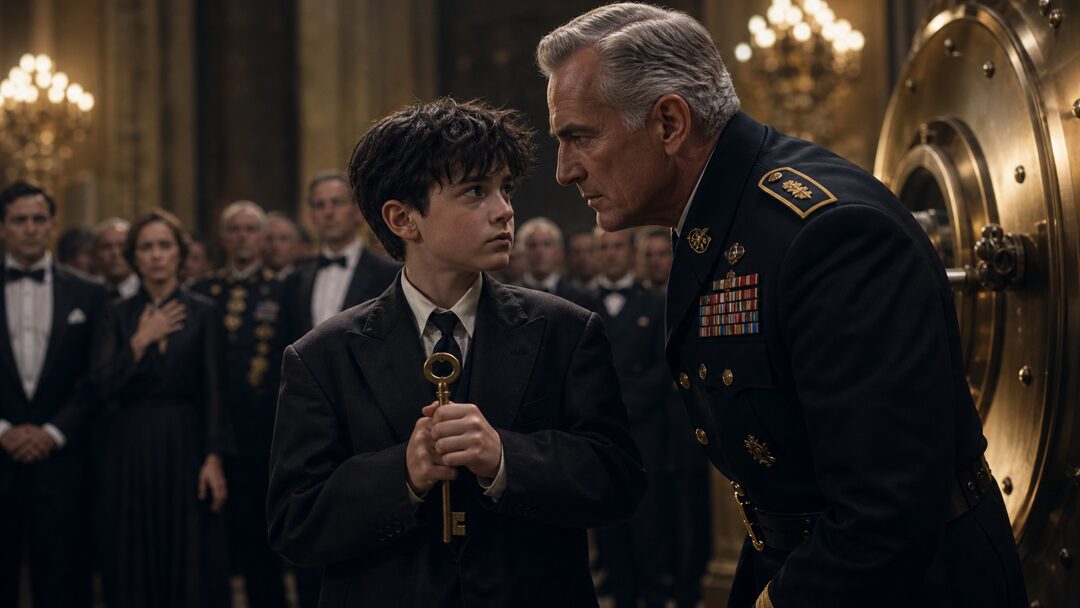
Colonel Carter stood in his dress uniform beside Vault 205, silver hair combed perfectly, back straight, eyes fixed on Samuel like the whole evening had been built to arrive at this one small boy.
“Only one person has the right to open this chamber,” he said. “Captain Walker’s son.”
The applause came again.
Samuel hated it.
Not because it was loud. Not because it was fake. It was not fake. That was worse.
The adults clapped with solemn faces, as if grief could be made respectable by doing it at the same time. Some of them looked at Samuel with pity. Some looked at him with pride. None of them looked at him like a boy whose shoes were too stiff and whose collar scratched his neck.
They kept saying Captain Walker.
They never said Dad.
Colonel Carter stepped toward him, holding a small velvet box.
Inside was a brass key.
It looked old, heavier than it should have been, with a small tag tied to it in faded string.
Samuel did not reach for it.
His mother, Emily, leaned close. “You don’t have to hurry.”
That was when Samuel knew something was wrong.
Because everyone else in the room wanted him to hurry.
Part II — The Key No One Explained
Colonel Carter kept the velvet box open.
Samuel could see the key waiting inside, bright and cold.
“Your father left this for you,” the colonel said.
Samuel looked up at him. “Before he left?”
A few people in the front row went very still.
Colonel Carter’s face did not change. “Before his final mission.”
Samuel hated that phrase too.
Final mission.
It made his father sound like a chapter in a book someone had already finished reading.
His mother’s hand slid from his shoulder to the back of his neck. Her thumb moved once, a small motion no one else would notice.
She had done that at funerals. At school ceremonies. At the grocery store when strangers recognized their last name and said, You must be so proud.
Samuel was proud sometimes.
But mostly he was tired of being handed pride when he had asked for a father.
“What’s inside?” Samuel asked.
A low murmur moved through the hall.
Colonel Carter glanced toward the reporters, then back to Samuel. “Something your father wanted preserved.”
“That doesn’t answer me.”
His mother inhaled softly.
Samuel knew that sound. It meant she wanted to protect him from the room, but she also knew he had finally said the thing she could not stop.
Colonel Carter lowered the velvet box slightly.
“Samuel,” he said, softer now, “some things are better understood by seeing them.”
Samuel looked at the vault again.
The brass door was beautiful in the way expensive things were beautiful when they did not belong to you. It had been built into the front wall of the mess hall like a shrine. There were wreaths on either side. A framed photograph of his father stood on an easel nearby: Captain Michael Walker in uniform, smiling the way people smiled when they knew the photograph was for someone else.
Samuel barely remembered that face moving.
He remembered hands lifting him onto kitchen counters. He remembered the smell of coffee. He remembered his father laughing once because Samuel had put cereal in a coffee mug and called it breakfast for men.
But the man in the framed photograph belonged to everyone.
The man with cereal in his coffee mug belonged to Samuel.
Colonel Carter extended the velvet box.
This time, Samuel took the key.
It was heavier than he expected.
The room became so quiet he could hear the tiny click of his mother’s bracelet against her wrist.
Colonel Carter stepped aside and gestured toward the vault.
Samuel did not move.
Instead, he asked the question he had carried for years, the one adults kept wrapping in soft words until it could not breathe.
“Why didn’t he come home with the others?”
Someone in the room coughed.
A woman near the front bowed her head.
Colonel Carter’s jaw tightened.
“Your father made a sacrifice,” he said.
Samuel looked at the vault. “That’s what everyone says when they don’t want to tell me what happened.”
His mother whispered, “Sam.”
But she did not tell him to stop.
And that was when Colonel Carter’s polished face finally cracked.
Only for a second.
But Samuel saw it.
So did Emily.
Part III — What 205 Meant
The ceremony did not officially pause.
No one announced a pause. No one asked the guests to wait. The pianist in the corner kept his hands folded above the keys, ready to continue whenever the room remembered how to breathe.
But the evening had stopped.
Samuel stood five steps from Vault 205 with the key in his palm while every adult waited for him to become easier.
Colonel Carter came closer to Emily.
“Mrs. Walker,” he said under his breath, “perhaps we should proceed before this becomes difficult.”
Emily looked at him with the tired calm of a woman who had survived too many polite sentences.
“It became difficult seven years ago,” she said.
His eyes moved toward Samuel.
“Not in front of him.”
Samuel heard it.
He was meant to hear none of it, which made every word louder.
Emily’s voice stayed low. “You don’t get to use him as the ending and then decide he’s too young for the middle.”
Colonel Carter looked away.
Samuel closed his fist around the key until the edge pressed into his skin.
“What does 205 mean?” he asked.
No one answered quickly enough.
That was answer enough.
Colonel Carter straightened, returning to the posture everyone trusted. “It was an evacuation route.”
Samuel’s stomach tightened.
“Where my dad was?”
“Yes.”
“Where he died?”
Emily flinched as if the word had crossed the room and touched her.
Colonel Carter closed his eyes for half a second. “Yes.”
A fresh murmur passed through the guests. Some of them knew. Some of them had not known the number meant anything. Samuel watched the knowledge spread across their faces like spilled ink.
Vault 205 was not just a vault.
It was a place.
A place they had polished and engraved and turned into brass.
Samuel looked down at the key.
“Did he mess up?”
“Samuel,” Emily said.
“No.” His voice came out sharper than he expected. “Everyone calls him a hero. But nobody tells me anything. Did he mess up? Did he leave? Did someone leave him?”
Colonel Carter’s mouth hardened.
There it was again. The wall.
Rank had a sound, Samuel realized. It was not shouting. It was silence that expected to be obeyed.
“Your father disobeyed an order,” the colonel said.
The room seemed to tilt.
Emily’s hand dropped from Samuel’s back.
Samuel stared at Carter. “What order?”
“To return.”
“Return from where?”
Colonel Carter did not answer.
Samuel stepped closer. “From Route 205?”
“Yes.”
“Why?”
The colonel’s eyes shifted toward the vault, then toward the reporters.
Because there were still cameras in the back.
Because grown men had built a ceremony around a secret they still wanted to control.
Samuel understood that much.
“He went back for people,” Colonel Carter said at last. “People who would not have made it out otherwise.”
“So he saved them.”
“Yes.”
“But he disobeyed you.”
A muscle moved in the colonel’s cheek.
“Yes.”
Samuel looked at his mother.
Emily’s eyes were bright but dry. She had spent years perfecting dry eyes. Samuel had watched her cry only twice: once when the water heater broke and she found one of Michael’s old shirts in a storage box, and once when Samuel asked if Dad would recognize him now.
“Did you know?” he asked her.
“I knew pieces,” she said.
“Why didn’t you tell me?”
“Because pieces can cut you too.”
The line landed harder than she meant it to.
Samuel stepped back from both of them.
The key felt less like a gift now.
It felt like evidence.
Part IV — The Room That Wanted a Hero
A man from the back approached Colonel Carter and whispered something. Samuel caught only two words.
“Press schedule.”
Colonel Carter nodded once, but his eyes stayed on Samuel.
The room wanted the ceremony back.
The adults wanted the story returned to the shape printed on the program: welcome remarks, tribute, ceremonial opening, closing toast.
Samuel had seen the program in the car. His mother had folded it in half and placed it in her purse without reading it aloud.
Now he understood why.
He looked at the front page on the nearest chair.
HONORING CAPTAIN MICHAEL WALKER
A LEGACY PRESERVED
Samuel hated that too.
Preserved meant someone had chosen what would not rot.
Emily stepped between Samuel and the room, not fully, just enough that the nearest cameras lost a clear angle.
“James,” she said.
The colonel’s eyes flicked at the use of his first name.
For the first time all night, he looked older than his uniform.
“I should have told him differently,” he said.
“You should have told us many things differently.”
“Yes.”
The answer was so plain it startled Samuel.
Colonel Carter turned toward him. “Your father knew what he was doing when he went back.”
Samuel’s face burned. “Then why does everyone look ashamed?”
No one spoke.
That was the worst part. Not the answer. The lack of one.
Emily knelt in front of Samuel, careful in her black dress, lowering herself until she was no longer above him.
“You do not owe this room anything,” she said.
He looked at her.
“You hear me?” Her voice trembled once, then steadied. “You don’t owe anyone your grief. Not for a photograph. Not for a speech. Not for your father’s name.”
“But Dad wanted me to open it.”
“Yes,” she said. “Maybe. But not like this if you don’t want to.”
Colonel Carter looked at the velvet box in Samuel’s hand.
“There is something else,” he said.
Emily turned sharply. “James.”
He did not look at her. “He should know.”
Samuel waited.
The colonel reached into the inside pocket of his jacket and removed a small envelope. Its edges were softened with age. The flap had been opened and sealed again with care.
He held it out, but not to Emily.
To Samuel.
“This did not come from the Army,” Colonel Carter said.
Samuel did not take it yet.
“What do you mean?”
“The key,” Carter said. “The vault. The timing. Those were your father’s instructions. He gave the key to me before the mission. He told me not to deliver it until your twelfth birthday.”
Samuel’s grip loosened.
His birthday had been three weeks ago.
He had eaten chocolate cake in the kitchen with his mother and pretended not to notice the empty chair.
“He said twelve was old enough to choose,” Carter continued. “Not old enough to understand everything. Just old enough to choose whether the world got to see what he left for you.”
The room faded at the edges.
Samuel looked toward Vault 205.
For the first time, it did not look like a monument.
It looked like a question from his father.
Emily stood slowly.
“You knew that,” she said to Carter.
“Yes.”
“And you turned it into this?”
Carter closed his eyes.
The answer was in his silence.
Samuel felt something hot rise in his chest. Not tears. Anger was easier.
“You made it a show.”
“No,” Carter said quickly, then stopped.
Because part of him had.
The admission moved through his face before it reached his mouth.
“I thought,” he said, “I thought if we honored him publicly, it would protect what he did from being reduced to disobedience.”
Emily’s voice was cold. “And who were you protecting?”
Colonel Carter did not answer.
Samuel suddenly understood that adults could carry guilt for so long they decorated it and called it honor.
Part V — The Choice Before the Door
The reporters were no longer waiting quietly.
One lifted a camera.
A flash bounced across the brass vault and vanished.
Emily turned.
“No photographs,” she said.
The photographer lowered his camera halfway, uncertain whether a widow’s command outranked the event schedule.
Colonel Carter stepped forward. “No photographs.”
This time, the camera dropped.
Samuel looked at him differently.
A minute ago, Carter had seemed like the room’s master.
Now he looked like a man standing in the wreckage of a plan he could no longer defend.
He walked toward Samuel, then stopped.
Slowly, with visible effort, Colonel Carter bent one knee and lowered himself until his eyes were level with Samuel’s.
A murmur went through the hall.
The colonel ignored it.
“I built tonight around your father,” he said quietly. “But your father built that vault for you.”
Samuel swallowed.
“The Army can wait,” Carter said. “The guests can wait. The cameras can wait. If you open it, you open it because you choose to. If you don’t, I will clear this room.”
Samuel looked at his mother.
Emily’s face had changed. It was still guarded, still afraid, but there was something else there now.
Permission.
Not pressure. Not protection.
Permission.
“What if I don’t like what’s inside?” Samuel asked.
She reached out and fixed the crooked edge of his tie, the way she had before school pictures.
“Then I’ll stand with you while you don’t like it.”
The answer almost broke him.
He looked at the vault.
For seven years, adults had given him polished versions of his father. Captain Walker. Brave officer. Loyal friend. Decorated hero. Beloved leader.
But Samuel wanted the man who had built pancake towers too high and called them engineering.
He wanted the man who once wrote S.W. on the bottom of Samuel’s toy truck so no one at preschool could claim it.
He wanted proof that the man who belonged to every speech had once belonged to him.
Samuel walked toward the vault.
The room followed him with its silence.
Each step sounded too loud on the polished floor.
At the door, the brass wheel reflected his face back at him, distorted and small. He could see his mother behind him. Colonel Carter farther back. Rows of uniforms. Rows of expectation.
He lifted the key.
His hand shook.
For one terrible second, he thought he could not do it.
Then he saw the tag tied to the key.
There was writing on it, faded but clear.
For Sam.
Not Samuel.
Sam.
Nobody in the room called him that.
Only his father had.
Samuel put the key into the lock.
The vault accepted it with a soft click.
Part VI — What He Was First
The door opened heavier than Samuel expected.
Colonel Carter helped turn the wheel, but he did not pull the door wide. He let Samuel do that.
A seam of darkness appeared.
Then a cool breath of preserved air touched Samuel’s face.
The hall went silent in a way applause could never become.
Samuel pulled.
The brass door swung open.
Inside Vault 205, there were no medals stacked in velvet trays.
No sealed files.
No folded flags.
No display of valor under glass.
There was a single wooden table.
On it sat a framed photograph.
Samuel stepped closer.
His mother made a sound behind him, so small no one else would have known it was pain.
The photograph showed three people in a kitchen.
Michael Walker stood in rolled-up sleeves, one arm around Emily, the other holding a much smaller Samuel against his hip. Samuel was laughing with his mouth open, one hand gripping his father’s collar. Emily was looking at Michael instead of the camera.
Michael’s wedding ring was visible.
So was the coffee mug on the counter.
So was the cereal bowl beside it.
Samuel knew that kitchen.
He knew that mug.
He knew, suddenly and completely, that the man in the frame was not Captain Walker.
He was Dad.
Beside the photograph lay a folded note.
Samuel reached for it, but his fingers would not work.
Emily came beside him.
She did not touch the note. She did not take the moment from him.
“You can read it,” she whispered. “Or I can.”
Samuel opened it himself.
The handwriting was uneven, like it had been written quickly.
Sam,
If they call me brave, let them. Some people need brave words when they are sad.
If they call me a hero, remember I was yours first.
Before any title, before any order, before any medal, I was the man who carried you from the car when you pretended to sleep.
I don’t know what they will tell you about me.
I hope they tell you I tried.
I hope your mother tells you I loved her badly sometimes, because I was gone too much, and completely always, because coming home to you both was the only part of me that ever felt finished.
This vault is not for what I did.
It is for what I never wanted anyone to take from you.
Love,
Dad
Samuel read the note twice.
The second time, the words blurred.
Emily covered her mouth with one hand.
Colonel Carter stood several feet away, face pale, shoulders no longer square.
No one clapped.
No one dared.
Samuel looked at the room outside the vault. The guests could see the table. Some could see the frame. They could not read the note, and he was glad.
For the first time all evening, something belonged to him.
Colonel Carter stepped forward, stopped at the threshold, and removed one medal from his chest.
His hand shook.
He placed it carefully beneath the framed photograph.
Not beside it.
Beneath it.
Then he stepped back.
“I’m sorry,” he said.
He did not say for what.
He did not need to.
Emily looked at Samuel. “Do you want them to see?”
The reporters waited.
The officers waited.
The whole room waited for a boy to decide what kind of memory the world was allowed to have.
Samuel looked at his father’s face in the photograph.
Not the formal one on the easel.
The real one.
The tired smile. The rolled sleeves. The hand holding him close.
He picked up the framed photograph and held it against his chest.
Then he turned to the vault door.
With both hands, he pulled it halfway closed.
Not all the way.
Just enough.
The room could see that there was no treasure inside.
But only those nearest could see what had been left behind.
Emily rested her hand on Samuel’s shoulder.
Colonel Carter bowed his head.
Outside the rope, the cameras stayed lowered.
Samuel stood in the narrow space between the open vault and the waiting room, holding a photograph of a man he had lost before he was old enough to know what loss would ask of him.
The key was still in the lock.
The note was still in his hand.
And for the first time, when someone behind him whispered Captain Walker, Samuel did not feel his father being taken away.
He looked down at the photograph and pressed his thumb against the corner of the frame.
“Dad,” he said softly.
No one corrected him.