The Name She Remembered
Part I — The Room Went Quiet
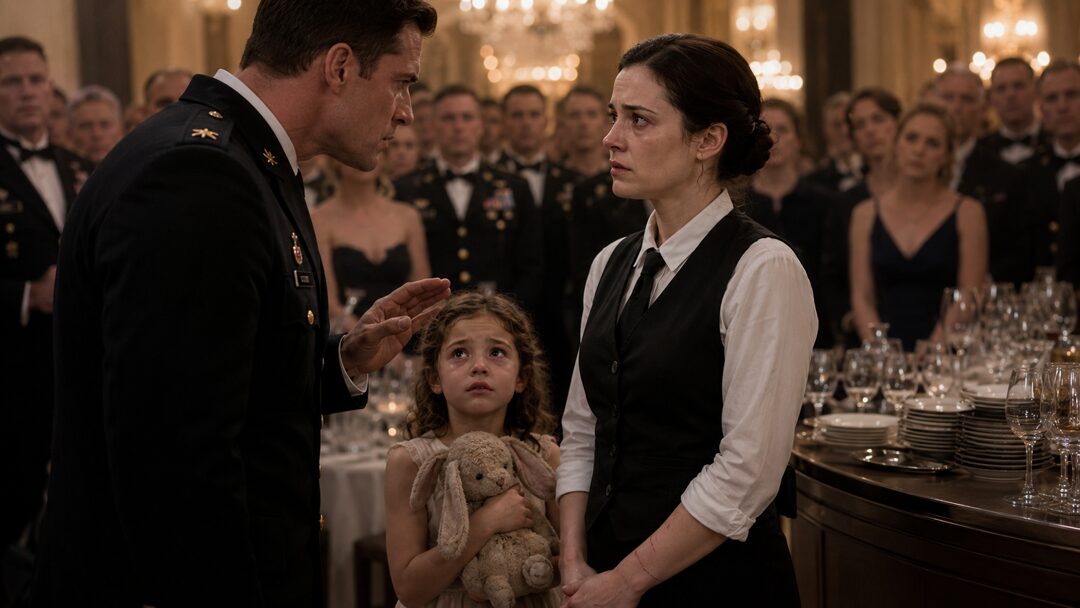
The moment the server bent to refill Emily Grant’s water glass, the little girl stopped breathing like she had seen someone step out of a dream.
The ballroom was full of polished shoes, polished medals, polished smiles. Forks chimed against china. Donors laughed too softly. Officers stood too straight. At the head table, Colonel Michael Grant had spent the evening keeping one hand near his daughter’s chair and the other wrapped around the stem of an untouched glass.
Then Emily reached across the white tablecloth and caught the server’s sleeve.
“You came back,” she whispered.
The server froze.
Not the way a stranger froze when a child made a mistake. Not with surprise, or confusion, or polite embarrassment.
She froze like someone had heard her real name in a place where she had been promised no one would say it.
Michael noticed that first.
He noticed the tightness in her jaw. The way her fingers locked around the water pitcher. The way her eyes moved to Emily’s stuffed rabbit and stayed there one second too long.
The rabbit was old, gray at the ears from years of being carried everywhere. One ear had been repaired with thread that did not match. Emily called him Bunny, as if no other name in the world had ever been necessary.
“Emily,” Michael said quietly.
His daughter did not look at him.
She held the server’s sleeve harder.
The server lowered the pitcher, slow and careful. She was young, maybe early thirties, with dark hair pinned back tightly, a black vest, a white shirt, and a narrow apron tied at her waist. Her face belonged to someone trained to disappear into rooms like this.
But she was not disappearing now.
Her eyes had gone wet.
“Sweetheart,” she said, barely above a breath, “I think you have me mixed up with someone else.”
Emily shook her head. “No.”
Michael felt the first touch of embarrassment. The kind that came before anger. People at the table were starting to notice. A retired captain paused with his fork halfway to his mouth. A woman from the foundation leaned sideways to see.
“Emily,” Michael said again, sharper.
The server tried to step back.
Emily’s hand slid down and caught two fingers.
That was when Michael’s embarrassment turned into alarm.
Because the server did not pull away.
She looked down at Emily’s small hand wrapped around hers and for one terrible second, she looked like she might break.
“I remember your song,” Emily said.
The table went quieter.
Michael stood.
The movement was small, controlled, but everyone near him felt it. His chair scraped only an inch. The room did not stop, not fully, but the space around the head table tightened.
The server gently freed her fingers.
“I’m sorry,” she said. “I should get back to work.”
Emily’s face crumpled.
“No. Don’t go.”
Michael stepped between them.
“Why is my daughter touching you?”
The server lowered her eyes. “Sir, she’s mistaken.”
“She doesn’t usually mistake people.”
The server’s throat moved. “Children do sometimes.”
Emily pushed around her father’s arm, Bunny pressed to her chest. “She sang when it was loud.”
Michael went still.
Across the table, General Robert Hayes looked up.
Emily’s voice grew smaller. “And she gave Bunny back when the ceiling fell.”
No one at the table moved.
Not the donors.
Not the officers.
Not the server.
Michael stared at his daughter, then at the woman in the black vest, and something old and locked inside him shifted.
The server whispered, “Please don’t.”
It was the wrong thing to say.
Michael heard it not as a plea, but as proof.
“Leave the table,” he said.
The server nodded once. She turned toward the service corridor with her water pitcher held too tightly in both hands.
Emily began to cry.
Not loudly. Not the performative cry of a child denied something. It was worse than that. It was a small, shocked sound, as if some part of her had reached across years and been told it had imagined its own rescue.
Michael put a hand on her shoulder.
She flinched.
That hurt more than the whole room watching.
“Emily,” he said, softer.
“She’s Sarah,” Emily said.
Michael’s face changed.
The name passed through the air like a glass breaking.
The server stopped at the edge of the service corridor.
Michael lifted his eyes to her back.
Then, in front of a ballroom built to honor him, Colonel Michael Grant left his daughter with an aide and followed the woman who was not supposed to exist.
Part II — A Name From Before
The service corridor smelled like coffee, lemon cleaner, and hot plates waiting under silver covers.
The music from the ballroom came through the wall as a muffled pulse. Behind Michael, two men from his staff followed without being asked. They had the stiff posture of people ready to turn discomfort into procedure.
The server walked fast.
“Stop,” Michael said.
She did.
Not because she wanted to. Because the old command in his voice still knew where to land.
She stood beside a stack of folded linens, shoulders square, pitcher still in hand. Up close, Michael saw the faint scar along her wrist, half-hidden beneath the white cuff. A small, pale line crossing skin he remembered covered in dust.
He hated that he remembered.
“Turn around,” he said.
She did.
Her face was composed now. Too composed. The wetness in her eyes had been forced back behind something harder.
“What is your name?” Michael asked.
“You know my name.”
One of his staff men shifted.
Michael’s voice lowered. “Say it.”
The server looked past him toward the ballroom doors.
“Sarah Miller.”
The name did not belong in this building. It belonged in a sealed file, in a report written with careful omissions, in a memory Michael had trained himself to step around.
“Sergeant Miller,” he said.
Sarah’s expression tightened at the rank.
“I’m not that anymore.”
“No,” Michael said. “You made sure of that.”
The words struck. He saw it. A flinch so small it could have been missed by anyone who had not once commanded people trained to hide pain.
Sarah set the pitcher on the linen cart.
“I didn’t come here for you.”
“Then why are you here?”
“I work events.”
“At this event?”
“I didn’t know it was your event until I saw the program.”
Michael laughed once, without humor. “You expect me to believe that?”
“I don’t expect anything from you.”
That landed between them, colder than accusation.
Michael stepped closer. “My daughter knows your name.”
Sarah looked down.
“My daughter remembers things she shouldn’t remember,” he said. “Things no one told her. Things from Darrow.”
At the word, the corridor seemed to narrow.
One of the staff men glanced at the other. Darrow was not a word people used casually around Michael Grant. Not at the foundation. Not before the speech. Not within reach of donors who had paid five thousand dollars a plate to celebrate a clean story.
Sarah folded her hands in front of her apron.
“She was there,” she said.
“She was three.”
“She was still there.”
Michael’s jaw tightened. “Careful.”
“For years,” Sarah said, “people have been careful. That’s why your daughter had to say my name for anyone to hear it.”
Michael’s control cracked just enough for anger to show.
“You disobeyed an evacuation order.”
Sarah looked at him then.
Fully.
Not as a server. Not as someone beneath him. Not even as a former sergeant.
As a woman who had carried something heavier than rank for too long.
“Yes,” she said.
The plainness of it startled him.
His staff men heard only admission. Michael heard something worse: no apology.
“You admit it.”
“I never denied it.”
“You left formation.”
“I left the line.”
“You endangered the convoy.”
Sarah’s voice stayed low. “Your daughter was still breathing.”
The corridor went silent.
Behind Michael, someone opened the ballroom door. A bright wedge of music and applause slipped out, then closed again. The event was moving forward without him. His award was waiting. The plaque was onstage. His name was printed in gold on every program.
Leadership Under Fire.
The Darrow Foundation Medal.
Michael Grant, for decisive command during the Darrow Station evacuation.
Sarah watched him read the words in his mind.
“You don’t get to do this tonight,” he said.
“I’m not doing anything.”
“You grabbed my daughter.”
“She grabbed me.”
“She’s a child.”
“Yes,” Sarah said. “That’s what I said then too.”
Michael’s face hardened.
The old images came fast, unwanted: noise, smoke, a radio snapping in and out, too many civilians, too little time, the order to move before the road closed. He had not known Emily was still inside. That was what he told himself. That was what the report said in softer language.
Unconfirmed noncombatant presence.
Operational collapse imminent.
Command decision necessary to preserve evacuation integrity.
He had built years on necessary.
Sarah had built years on one child’s breathing.
A young banquet manager appeared at the far end of the corridor, saw the group, and immediately disappeared again.
Michael took a breath. “You will leave this venue now.”
Sarah nodded slowly.
Not defeated.
Finished.
“I can do that,” she said.
The answer irritated him more than resistance would have.
“You don’t speak to Emily again.”
At that, Sarah’s composure changed.
Only slightly. But enough.
“She thinks she imagined me,” Sarah said. “Don’t do that to her.”
Michael stared at her.
Sarah’s voice softened, and that softness carried more force than anger.
“Tell her I had to leave. Tell her anything. But don’t tell her she was wrong.”
His daughter’s cry reached them from inside the ballroom.
Small.
Unmistakable.
Michael looked toward the door.
When he turned back, Sarah had already picked up the pitcher. Her hand was trembling now.
“Sergeant Miller,” he said.
She stopped again.
“Why didn’t you come forward?”
Sarah’s mouth curved into something almost like a smile.
It had no joy in it.
“To who? The men who wrote me out? The board that needed your rescue clean? The lawyers who said my record was already decided?”
She stepped toward him.
Just one step.
“I was twenty-six. I had no uniform, no references, and no one willing to say I had done anything except disobey.”
Michael did not answer.
Sarah lowered her voice.
“I saved your daughter. And then I learned how to carry plates.”
The ballroom door opened again.
This time General Hayes stood in it.
His silver hair caught the corridor light. His decorated jacket was immaculate. His expression was calm in the way powerful men became calm when a problem needed to be contained.
“Michael,” he said. “They’re ready for you.”
Then he looked at Sarah.
For a fraction of a second, recognition passed over his face.
Michael saw it.
Sarah saw Michael see it.
And the night changed shape.
Part III — The Rabbit
General Hayes stepped into the corridor and let the door close behind him.
The applause vanished again.
“What’s going on?” Hayes asked, though his eyes said he knew enough.
Michael pointed at Sarah. “Did you know she was working this event?”
“No.”
Sarah’s laugh was quiet. “That may be the first honest thing anyone’s said tonight.”
Hayes did not look at her. “Miss Miller, this is not the place.”
“It never is,” Sarah said.
Michael turned on Hayes. “You recognize her.”
Hayes’s face remained still. “I remember the case.”
“The case,” Sarah repeated.
The word seemed to amuse her, or hurt her. Maybe both.
Hayes lowered his voice. “Colonel, the ballroom is full. The foundation chair is asking for you. Your daughter is upset. Let’s not turn a difficult moment into something larger.”
Michael heard the warning beneath the courtesy.
He had used that tone himself.
Sarah took off her server’s badge and placed it on the linen cart. The small plastic rectangle looked absurdly cheap beside the weight of what she had carried into the room.
“I’ll go,” she said. “That solves your difficult moment.”
Before Michael could answer, the ballroom door burst open.
Emily slipped through before the aide could catch her.
Her cheeks were wet. Bunny was crushed against her chest. Her pale dress had twisted at one shoulder. She looked terribly small in the corridor full of adults trying to manage history.
“Emily,” Michael said.
She ignored him.
She ran to Sarah.
The staff men moved. Michael lifted a hand and stopped them.
Sarah dropped to one knee before she seemed to decide to. Her face broke open for one second, raw and unguarded.
Emily pressed Bunny into her hands.
“You kept him safe,” Emily said. “See?”
Sarah stared at the stuffed rabbit.
“No,” she whispered.
The repaired ear sagged to one side. The seam along the rabbit’s back had been stitched and restitched, probably by nannies, by Michael, by someone in every city Emily had carried it through.
Emily turned the rabbit over with serious concentration.
“There,” she said.
Her small fingers worried at a loose place in the seam.
Michael stepped forward. “Emily, don’t tear—”
But the thread opened.
Something flat slipped out and landed against Sarah’s palm.
A faded cloth tag, stiff with age.
Not a toy label.
A medic identification tag.
The lettering had blurred, but Michael could still read enough.
MILLER, S.
FIELD MED.
A strip of handwriting ran along the back in black marker, faded but unmistakable.
GRANT CHILD — ALIVE — KEEP WITH CIVILIANS.
Michael felt the corridor drop away beneath him.
He knew that handwriting.
Not because he had studied it in reports.
Because once, in Darrow, Sarah Miller had written casualty counts on scraps of cardboard when the systems failed. He had seen her hand move fast under bad light, steady while men twice her age shook.
Sarah was not looking at him.
She was looking at the tag as if it had waited years to accuse everyone but her.
Emily touched Sarah’s wrist, just above the scar.
“You put it in Bunny,” she said.
Sarah closed her fingers around the tag.
“I thought if we got separated, someone would know you belonged to the evacuation group.”
“The loud place,” Emily whispered.
Sarah nodded once.
Michael could not speak.
A memory he had not allowed himself to complete arrived anyway.
Darrow Station collapsing into smoke. The western corridor blocked. Civilians still calling from somewhere inside. The order to pull back because the convoy route would close in six minutes. Sarah Miller turning toward the sound.
He had shouted her name.
She had looked back once.
Not defiant. Not heroic.
Just certain.
Then she had gone inside.
And later, when Emily appeared in triage wrapped in a medic blanket and coughing black dust, Michael had been told she came through with the last civilian group. He had not asked the right question. Maybe he had been afraid of the answer. Maybe grief and relief had made cowards of all fathers for one moment.
But the tag lay in Sarah’s hand now.
The answer had a name.
General Hayes spoke first.
“Michael,” he said softly. “We can discuss this after the event.”
Sarah stood, still holding the tag.
Emily clung to her apron.
Michael looked at Hayes. “You knew.”
Hayes’s face tightened. “I knew there were disputed accounts.”
“Disputed?”
“There was no clean way to record what happened without reopening command review.”
Sarah looked at him. “So you closed me instead.”
The line landed hard enough that one of Michael’s staff men looked away.
Hayes drew himself up. “You disobeyed under active orders.”
Sarah nodded. “Yes.”
“And people could have died.”
“They could have,” Sarah said. “One didn’t.”
Emily pressed closer to Sarah.
Michael saw it then, with a clarity so painful it almost made him angry again.
His daughter was not afraid of the server.
She was afraid the adults would take the truth away.
From inside the ballroom, a voice came over the microphone.
“Ladies and gentlemen, please join us in welcoming this year’s Darrow Foundation Medal recipient, Colonel Michael Grant.”
Applause rose.
Bright. Confident. Hungry for the version of him they had paid to admire.
Hayes moved closer. “Go accept the award. We’ll handle this quietly.”
Michael looked at Sarah.
She shook her head once.
Not begging him to speak.
Warning him not to make her part of another performance.
“I don’t want your stage,” she said. “I don’t want your apology in front of rich people.”
Her eyes moved to Emily.
“I just want her not to be told she made me up.”
Michael looked at his daughter.
Emily’s eyes were wide and scared. Not of the crowd. Not of the general. Not even of what she remembered.
Of him.
That was the first time Michael understood the real audience in the room.
Not the donors.
Not Hayes.
Not the foundation.
His daughter was waiting to see whether her father would protect her memory or correct it out of existence.
The applause swelled again.
Michael turned toward the ballroom doors.
Every step back inside felt longer than the corridor.
Part IV — The Speech He Couldn’t Give
The ballroom welcomed Michael Grant like a man already forgiven for things no one had named.
People stood.
The foundation chair smiled from the stage. Cameras lifted. At the head table, Emily’s empty chair sat beside his, a small napkin folded into a swan in front of it. Her glass of water trembled slightly from the movement in the room.
Michael walked to the stage.
He had given speeches under worse pressure. He had spoken at memorials with families in the front row. He had briefed rooms where the wrong word could move men into danger. He knew how to make his voice steady when his hands wanted to shake.
Tonight, the paper on the podium held seven paragraphs.
Gratitude.
Duty.
Sacrifice.
The courage of many.
The burden of command.
He looked down at the first line.
Then he saw Sarah at the back of the ballroom near the service station, one hand around Emily’s Bunny, the other closed around a faded tag.
She was not standing like a woman waiting to be rescued.
She was standing like a woman ready to leave.
Emily stood beside her, small against the black and white uniforms of the service staff, one hand gripping Sarah’s apron as if cloth could hold the past in place.
General Hayes remained near the side wall.
His face gave nothing away.
Michael adjusted the microphone.
“Thank you,” he said.
The room settled.
His voice sounded normal. That almost made him stop.
“I’m honored by the foundation’s generosity, and by the presence of so many people who served at Darrow, supported those who did, or carried its consequences afterward.”
He looked down at the paper again.
The next line was waiting.
Leadership is never the work of one person.
He could still say it. It was true enough. The easiest lies were always built from true pieces.
Michael folded the paper once.
Then again.
The sound of it seemed louder than it should have.
“There is something wrong with this award,” he said.
The ballroom changed temperature.
A few people smiled politely, waiting for the humble turn.
Michael did not give them one.
“The record says I led the final evacuation from Darrow Station. That is true.”
He looked at Emily.
“The record also leaves out a name.”
In the back of the room, Sarah’s face went still.
Michael’s grip tightened on the podium.
“I gave an order that night to withdraw. I believed it was necessary. I believed waiting would cost more lives. I still know what the situation was.”
He paused.
No one moved.
“But there was a child still inside.”
Emily’s hand tightened in Sarah’s apron.
Michael did not look away.
“A medic disobeyed my order and went back.”
The room held its breath.
“She carried that child through smoke and debris. She marked her for the evacuation group when she thought they might be separated. She returned the child’s stuffed rabbit because she understood something the rest of us had forgotten—that survival means more than moving a body out of danger.”
His voice almost failed.
He let it come back smaller.
“That child was my daughter.”
A sound went through the ballroom. Not applause. Not shock exactly. Something more uncomfortable. A room full of people realizing the story under their dinner plates had a floor they had never seen.
Michael turned slightly toward Sarah.
“Her name is Sarah Miller. She served as a field medic. And whatever the record says about her disobedience, my family is alive because she chose not to leave a breathing child behind.”
Sarah closed her eyes.
Michael faced the foundation chair.
“I can’t accept this award as written. Not tonight. Not with her standing in the back of the room wearing a server’s badge while my name is printed on the program.”
The foundation chair’s mouth parted.
General Hayes looked at the floor.
Michael continued before anyone could stop him.
“If the foundation wants to honor Darrow, it should begin by recording her act where it belongs.”
He stepped back from the podium.
For a moment, nothing happened.
Then a chair scraped.
An older woman near the front stood slowly. Michael recognized her as the widow of a Darrow transport officer. Her hands came together once. Then again.
Someone else stood.
Then someone did not.
Then several people did.
The applause that followed was uneven, uncertain, almost painful. Some clapped because they were moved. Some because they did not know what else to do. Some did not clap at all.
That suited the truth better than a standing ovation.
Truth did not always arrive clean.
At the back of the room, Sarah had gone pale.
Emily looked up at her.
“He said your name,” she whispered.
Sarah’s hand covered her mouth.
Michael stepped down from the stage before anyone could intercept him.
Hayes caught his arm near the stairs.
“Do you understand what you’ve just done?”
Michael looked at the general’s hand until Hayes released him.
“For the first time tonight,” Michael said, “yes.”
He crossed the ballroom.
But Sarah was already gone.
Part V — The Door at the End
Michael found her near the service exit.
Not running. Not hiding.
Just standing with her coat over one arm, her server’s badge gone, Bunny held carefully against her chest. The old medic tag rested in her palm.
Outside the narrow glass door, delivery trucks idled in the alley. The night air carried the smell of rain on pavement.
Emily reached her first.
“Don’t go yet.”
Sarah looked down at her.
The controlled face she had worn all evening softened, but only a little. She seemed afraid that too much tenderness would become a promise she had no right to make.
“I have to,” Sarah said.
“You always go.”
Michael stopped a few feet away.
That sentence did what no accusation in the ballroom had done.
It took the story out of medals and reports and placed it where it had always lived: inside a child who remembered a voice disappearing.
Sarah knelt.
“I didn’t want to.”
Emily studied her, solemn and wounded.
“Daddy said I had dreams.”
Michael closed his eyes.
Sarah did not look at him. That was a mercy he had not earned.
“Sometimes dreams remember real things,” she said.
Emily held out her hands for Bunny.
Sarah gave him back.
For a second, Emily hugged the rabbit hard, then pulled away and pointed at the tag in Sarah’s palm.
“You keep that.”
Sarah blinked. “Emily—”
“So you remember me too.”
The words were simple. Child words.
They nearly undid Sarah.
She closed her fingers around the tag, not hiding it this time, but holding it.
“I already did,” she said.
Michael stepped closer.
Sarah rose.
For the first time all night, they stood without rank between them. Not because rank had vanished. It never vanished. It remained in the way Michael chose his words carefully, and in the way Sarah waited for him to prove he understood the difference between apology and command.
“I’m sorry,” he said.
Sarah’s face did not change.
Michael swallowed.
Not the public voice. Not the podium voice.
A father’s voice, stripped down.
“I let them make your name inconvenient.”
Sarah looked at him then.
Rain ticked softly against the alley door.
“I let myself believe the clean version because the dirty one had my daughter in it,” he said. “And you.”
Sarah’s eyes shone, but she did not cry.
“I didn’t need you to be perfect,” she said. “I needed one person to say I wasn’t lying.”
Michael nodded once.
There was no defense left worth offering.
Behind them, the banquet continued in broken pieces. Staff would whisper. Donors would argue. Hayes would make calls. The foundation would decide what kind of truth could be safely printed and what kind needed legal review.
None of that was forgiveness.
None of that gave Sarah back the years.
Emily stepped between them and held Bunny by one repaired ear.
“Can Sarah come to breakfast?”
The question was so ordinary it seemed to belong to another life.
Sarah looked startled.
Michael looked at her, then at Emily.
“That’s up to Sarah.”
Emily turned hopeful eyes on her.
Sarah’s answer took a long time.
Not because she did not care.
Because caring had already cost her once.
“Not tomorrow,” she said gently.
Emily’s face fell.
Sarah touched the rabbit’s repaired ear.
“But maybe someday.”
It was not enough for a child.
It was more than Sarah had allowed herself to promise in years.
Emily accepted it with the seriousness of someone being handed a fragile thing.
“Okay,” she said.
Sarah moved toward the door.
Michael opened it for her.
The gesture was small. Almost nothing. A door held by a man who had once closed a record around her name.
Sarah paused on the threshold.
She looked back at Emily, then at Michael.
“I didn’t go back for the award,” she said.
“I know.”
“I didn’t go back for history.”
“I know.”
Sarah’s hand closed tighter around the medic tag.
“I went back because she answered me.”
Michael looked at his daughter.
Emily was holding Bunny against her heart, watching both adults as if learning a new shape for truth: not clean, not easy, but finally spoken.
Sarah stepped into the rain.
The door eased shut behind her.
Michael did not follow. Some debts were not paid by chasing the person you owed. Some began with standing still and letting them leave on their own terms.
Emily slipped her hand into his.
“Daddy?”
“Yes.”
“You won’t say I dreamed her?”
Michael knelt in the narrow hallway, uncaring now who passed, who looked, who would carry the scene back into the ballroom.
“No,” he said. “You remembered her.”
Emily leaned into him then.
Not fully. Not the way she had before the evening began.
But enough.
At the far end of the alley, Sarah walked beneath the hotel lights with her coat over one arm and the old tag in her hand. She did not look like a hero. She did not look healed.
She looked named.
And inside the building behind her, for the first time in years, the room that had been built around a silence had to make space for the truth.