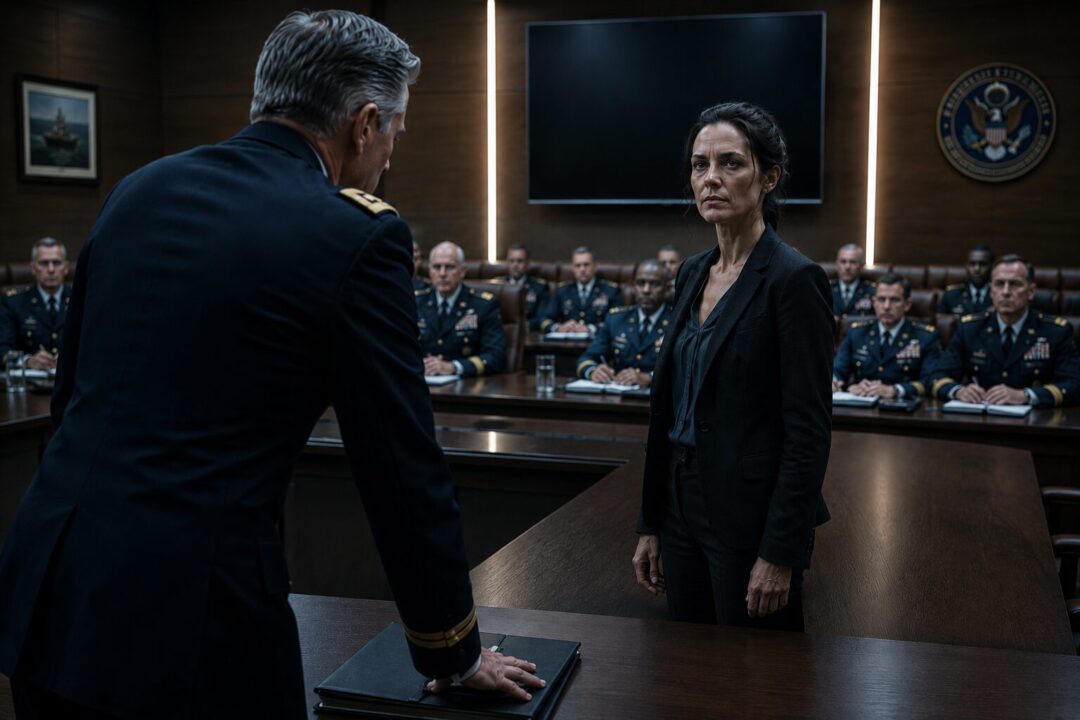
What Remained in the File
Part I — No Video Stream
The file was supposed to show the last twelve seconds of Daniel Hayes’s life, but when Emily Carter opened it, the screen stayed black.
Not dark.
Not damaged.
Black.
A gray diagnostic line appeared in the corner of her monitor.
No video stream detected.
Emily stared at it longer than she needed to. She had read thousands of system errors in her old life, back when her desk sat behind three badge checkpoints and every mistake had a classification stamp. Most errors were boring. Corrupt headers. Missing indexes. Broken timestamps.
This one felt like a door someone had painted over.
The file name sat at the top of the window:
REEL_1778039602466.mp4
Duration: 12.14 seconds.
Audio: AAC.
Video: none.
Frames extracted: zero.
Subtitles: none.
Visual content: not present.
Emily leaned back in her chair and listened to the old pipes in the contractor office tick behind the walls. It was after nine at night. The building had emptied two hours earlier, leaving only fluorescent hum and the low mechanical sigh of the server closet.
She pressed play.
For three seconds, there was static.
Then something clipped and harsh, like wind hitting a microphone too close.
Then the faint thud of movement.
Then a voice buried under distortion.
Emily stopped the file.
She played it again.
Static. Wind. Thud.
A voice.
She dragged the cursor back and increased the volume. The waveform spiked and flattened. She isolated the narrowest band she could without destroying it.
Again.
This time, the words surfaced just enough to hurt.
“Don’t make me leave him.”
Emily took her hands off the keyboard.
For a moment, the office became too quiet.
The official summary sat open on the second monitor. Extraction cleanly ordered. Team withdrew under hostile conditions. Lieutenant Daniel Hayes listed as nonresponsive prior to final movement. No evidence of delayed recovery opportunity. Visual file unusable due to field corruption.
Clean words.
Clean words were dangerous. Emily knew that better than anyone.
Her phone buzzed beside the keyboard.
Mark Reynolds
She let it ring twice before answering.
“Carter,” she said.
“Still at the office?”
Colonel Mark Reynolds had the kind of voice that did not rise because it expected rooms to lower themselves around it. Emily had once trusted that voice. Most of them had.
“I opened the file,” she said.
“Then you saw the problem.”
“I saw there is no video stream.”
“That’s the problem.”
Emily watched the black playback window. The playhead sat at 00:00.
“There’s audio.”
“A corrupted fragment.”
“Usable enough to review.”
A pause.
Not hesitation. Mark Reynolds never gave people the satisfaction of hearing him hesitate. This was calculation.
“The request is narrow,” he said. “Confirm the file contains no recoverable visual information. That’s all command needs from you.”
“Command hired me to review the file.”
“Command hired you because you know the difference between evidence and noise.”
Emily looked at the waveform again.
The smallest sounds always asked the largest questions.
“Sir,” she said, because old habits survived longer than loyalty, “did you listen to it?”
“I read the transcript.”
“There isn’t one.”
Another pause.
This one was shorter.
“Then I read the field note.”
Emily opened the folder again. There were reports, signatures, medical addendums, routing slips. There was no transcript.
“What did the field note say?”
“That the audio was not meaningful.”
Emily clicked replay before she could stop herself. Static filled her ear. Then the plea again, thin and half-buried.
Don’t make me leave him.
Reynolds said, “Some files stay broken because fixing them only breaks more people.”
The line was too polished. Too ready.
Emily closed her eyes.
In the old days, when she still wore a badge on a chain around her neck and believed precision could keep her clean, Reynolds had taught her to ask one question before signing anything.
What does this sentence make easier?
The official sentence made closure easier.
The audio did not.
“I’ll send my review when it’s complete,” Emily said.
“Emily.”
The first name stopped her more effectively than rank.
“You were always good because you knew where the edge was,” Reynolds said. “Don’t mistake a shadow for a body.”
She looked at the black screen.
“No,” she said quietly. “I’m trying not to mistake a missing body for a shadow.”
She ended the call before he could answer.
Then she played the file again.
Twelve point fourteen seconds.
No frames.
No subtitles.
No image.
Only static, a pocket of silence, and one sentence that did not belong in a clean withdrawal.
Part II — The Man Who Wouldn’t Listen
By morning, Emily had listened to the file forty-three times.
At twenty-six, she stopped trying to hear it as a technician.
At thirty-one, she started hearing it as a witness.
At forty-three, she wrote one note in the margin of the official report:
Speaker distressed. Statement suggests resistance to ordered movement. Context [unclear].
Then she deleted the last word and typed it again.
[unclear]
It looked weak. It was honest.
The Kestrel Border file had been dormant for eleven months. The operation itself had lasted under an hour. A small extraction team had been sent to pull three liaison officers from a temporary checkpoint before the route collapsed. Daniel Hayes, twenty-nine, team lead. Brian Miller, thirty, vehicle security. Two others whose names appeared only as initials in the redacted packet.
The report said the team came under pressure, Daniel went down, and Reynolds ordered withdrawal to keep the route open for a civilian convoy behind them.
The report also said Daniel was already gone.
Emily printed that page and circled the word.
Confirmed nonresponsive.
Confirmed by whom?
There was no body camera footage. No drone record in the packet. No helmet feed. No visual from the convoy file except the black MP4 marked unusable.
A video file with no video.
An end without a face.
At ten, Emily called the veterans’ rehabilitation wing outside Fort Vanner and asked for Sergeant Brian Miller.
The nurse on the phone lowered her voice when Emily said the Kestrel file.
“He doesn’t talk about that,” the nurse said.
“I’m not asking him to talk about it,” Emily said.
The nurse waited.
Emily rubbed the bridge of her nose. She hated how much she sounded like every person who had once asked her for something unreasonable.
“I need to know whether he’ll listen to twelve seconds.”
Brian agreed to meet at three.
The rehab wing smelled like disinfectant, burnt coffee, and rain brought in on shoes. Emily found him in a common room by the window, sitting with one leg extended, a cane propped against the arm of his chair.
He was younger than his file photograph made him look and older than thirty-one should have allowed. Stocky shoulders. Close-cropped hair that had grown out unevenly. A faded gray unit hoodie. His left hand was wrapped around a paper cup so tightly the rim had buckled.
He did not stand.
Emily did not offer her hand.
“Sergeant Miller,” she said.
“Not anymore.”
“Brian, then.”
His eyes flicked to her contractor badge, then away.
“You from command?”
“No.”
“That means yes with different paperwork.”
Emily sat across from him.
“I’m reviewing a file from Kestrel.”
The cup bent further in his hand.
“Can’t help you.”
“I haven’t asked anything.”
“You came all the way here to not ask?”
“I came because the file has audio.”
He stared out the window.
“It had a lot of things.”
Emily let that sit.
A groundskeeper pushed a cart across the wet courtyard. Somewhere down the hall, a television laugh track rose and vanished behind a closing door.
Emily took out a small recorder, then paused.
“I can play it, or I can leave.”
Brian’s jaw tightened.
“Leave sounds good.”
She put the recorder back in her bag.
“Before I go,” she said, “there’s a line I need to verify.”
He did not look at her.
Emily kept her voice even.
“Someone says, ‘Don’t make me leave him.’”
Brian’s hand jerked.
Coffee spilled over his thumb and onto the floor.
For one breath, everything human in him disappeared behind training. His shoulders locked. His eyes went flat. Then the mask broke, and he was not a soldier or a patient or a witness.
He was a man back in twelve seconds he had been trying not to survive.
Emily reached for the napkins on the side table.
Brian whispered, “You heard that?”
“Yes.”
“No one was supposed to hear that.”
The sentence struck harder than a confession.
Emily set the napkins beside him.
“Why?”
He stared at the spill spreading dark through the cheap carpet.
“Because then they’d know he wasn’t alone.”
Emily did not move.
Brian closed his eyes, and his face folded in a way that made him look suddenly young.
“Don’t play it,” he said.
“I won’t.”
“I mean it. Not here.”
“I won’t.”
He took one breath. Then another.
“The report says Lieutenant Hayes was nonresponsive before withdrawal,” Emily said.
Brian laughed once. It had no humor in it.
“Reports are good at saying things people can live with.”
“And what can’t they live with?”
He looked at her then.
“You ever sign something and hope no one reads it too closely?”
Emily felt the question find an old place in her.
“Yes,” she said.
Brian nodded like that was the only credential he trusted.
“Then don’t ask me what happened unless you’re ready to put your name under it.”
The nurse appeared at the doorway, watching them both. Emily stood.
Brian looked back at the rain.
As she turned to leave, he said, “There’s a sound before it goes quiet.”
Emily stopped.
“What sound?”
He swallowed.
“Three taps.”
Emily had heard them. She had filed them as contact noise.
“Do you know what they are?”
Brian’s face hardened again.
“Not yet,” he said.
The words did not mean he didn’t know.
They meant she had not earned the answer.
Part III — Three Taps
Reynolds was waiting in Emily’s office when she got back.
He stood by the window in full uniform, silver at the temples, hands clasped behind his back. He looked less like a visitor than a decision the room had already accepted.
Emily shut the door.
“Do you still knock?” she asked.
“When the door is locked.”
“It was.”
He glanced at the contractor badge on her desk. “Your receptionist remembers me.”
“You don’t have a right to this space.”
“No,” he said. “Only a reason.”
Emily dropped her bag into her chair.
“I spoke with Brian Miller.”
Reynolds’s face did not change, which told her enough.
“I assumed you would.”
“You asked me for a narrow review.”
“I hoped you would choose one.”
“There’s audio inconsistent with the report.”
“There is audio inconsistent with certainty,” Reynolds said. “That’s not the same thing.”
Emily turned on her monitor. The black playback window appeared. She saw his eyes move to it before he stopped them.
“Why is there no transcript?”
“Because the fragment was deemed unusable.”
“By whom?”
“The review board.”
“You were on it.”
“I commanded the operation.”
“That wasn’t my question.”
Reynolds took his time before answering.
“Yes.”
Emily opened the packet and clicked through the metadata.
“The file was logged thirty-seven minutes after the team returned. Chain of custody begins after that.”
“You know why field logs slip.”
“I know why they get cleaned.”
His voice lowered. “Careful.”
There it was. The old rank beneath the civilian conversation. The reminder that she had learned under him, that he had lifted her into rooms where younger analysts usually stood against the wall and took notes.
Emily had admired him once. Not blindly. That would have been easier to forgive. She had admired him because he understood cost and still made decisions.
Now she wondered how many costs he had renamed.
“Daniel Hayes,” she said. “Was he alive when you ordered withdrawal?”
Reynolds looked at the black screen.
“I ordered withdrawal because staying would have blocked the route. There was a civilian convoy eight minutes out. Families. Aid workers. Local drivers who trusted our word. If that team stayed pinned, the convoy stopped behind them.”
“That isn’t an answer.”
“It is the answer everyone forgets to ask for.”
Emily felt the room shift. Not toward him. Not away. Just deeper.
“Was Daniel alive?”
Reynolds’s jaw moved once.
“Alive is not always a useful word in those conditions.”
“It’s the only useful word in a death report.”
“He was down, exposed, and beyond safe recovery.”
“Did he speak?”
Reynolds said nothing.
Emily understood then that his silence was not empty. It was guarded.
He walked closer to her desk.
“Emily, if you turn this into a question of one man, you erase the others.”
“If you turn it into a question of numbers, you erase him.”
His eyes sharpened, but his voice stayed calm.
“I saved people that day.”
“I believe you.”
That seemed to unsettle him more than accusation would have.
Emily pressed play.
Static filled the room.
Reynolds did not move.
Wind. Thud. Distortion.
Then the faint voice.
Don’t make me leave him.
Reynolds looked away.
Emily let the file finish.
There was half a second of rough contact noise near the end. Three small metallic taps. Then silence.
She watched Reynolds.
He had heard them too.
“What are the taps?” she asked.
“I don’t know.”
It was the first thing he had said that sounded almost true.
After he left, Emily isolated the end of the audio. She cleaned the high frequencies, reduced the low roar, and played the final second until the sound separated from the static.
Tap.
Tap.
Tap.
Not metal on metal, exactly. Softer. A ring against a hard woven strap, perhaps. Or something worn, striking something carried.
She enlarged Daniel Hayes’s personnel file. Married. Wife: Sarah Hayes. No children listed. Personal effects recovered: watch, identification tags, torn photograph, field notebook.
No wedding ring.
Emily checked the recovery inventory again.
No ring.
She called Brian.
He answered on the fifth ring but said nothing.
“I found the taps,” Emily said.
His breathing changed.
“They’re in the file.”
“Don’t.”
“I need to know what they are.”
“No, you need the file to tell you. That’s safer.”
“It can’t.”
“Then maybe that’s your answer.”
Emily leaned back and shut her eyes.
“Brian, Daniel’s ring wasn’t in his recovered effects.”
The silence on the other end went so complete she checked whether the call had dropped.
Then Brian said, very softly, “He did that when he was thinking.”
“Did what?”
“Tapped his ring against his sling. Three times. Always three.” His voice thinned. “Before he made a call he hated.”
Emily looked at the waveform. Three small peaks before silence.
“You heard it that day?”
“I heard him.”
“What did he say?”
Brian’s breath shook.
“He told me to go.”
Emily waited.
“Then I told him no.”
The room around Emily seemed to recede until there was only the phone, the file, and the black square on her screen.
“Was that your voice?” she asked.
Brian did not answer.
He did not have to.
Part IV — The Missing Image
The next morning, Emily found the remnant by accident.
Not in the obvious metadata. Whoever had stripped the file had cleaned that well enough.
It was in a temporary cache record attached to the first upload, a line fragment most reviewers would have ignored because it pointed to a stream that no longer existed.
video_track_01 initialized
Initialized.
Not absent.
Not failed to capture.
Initialized.
Emily sat very still.
A file that had never contained video would not initialize a video track.
Someone had opened a door, seen what was inside, and removed the room.
She copied the record three times and saved it in three separate places before calling Reynolds.
He did not answer.
Ten minutes later, her office door opened.
No receptionist this time. No courtesy.
“You found something,” he said.
Emily turned from her monitor.
“You knew there was video.”
Reynolds closed the door.
“Do not say that casually.”
“I’m not saying it casually.”
“You found a fragment. Not proof.”
“I found evidence the video stream existed on first upload.”
“Evidence of a technical irregularity.”
“Colonel.”
The title came out colder than she intended.
He stopped.
Emily stood. She was not tall, but she had learned years ago that stillness could take up space.
“Don’t ask me to call a missing image a technical irregularity.”
Reynolds’s mouth tightened.
For the first time, he looked tired.
Not old. Not defeated.
Tired in the way of a man who had been holding a door shut with his back for almost a year.
“You think you want the image,” he said.
“I want the record to stop lying.”
“Images lie too.”
“Then why remove it?”
His eyes met hers.
“Because there are things people do not survive seeing, even if they already survived doing them.”
Emily hated him in that second because the sentence was not entirely false.
He stepped closer to the desk, not threatening, but pressing the room smaller.
“Daniel Hayes was hit before the withdrawal order. He was awake after it. Both can be true. Brian Miller reached for him. Hayes ordered him off. Miller refused. I ordered the driver to move.”
Emily’s throat tightened.
“The convoy?”
“Eight minutes out. Then six. Then four. If we stayed, the road became a wall. If the road became a wall, the people behind us had nowhere to go.”
“And the video showed that?”
“The video showed everything at once,” Reynolds said. “That is the problem with images. They don’t know what to emphasize.”
Emily looked at the black screen. For eleven months, the official record had emphasized what command could bear.
“Who removed it?”
Reynolds looked away.
“Mark.”
His first name changed the room. It pulled them back to briefings after midnight, burnt coffee, maps spread across tables, his voice telling her: Don’t protect me from a bad conclusion. Protect me from a lazy one.
He said, “I allowed the file to be sealed as corrupted.”
“That isn’t an answer.”
“It’s the only one I’m giving.”
Emily felt anger rise, clean and sharp, but beneath it was something worse.
Understanding.
He was not hiding because he thought the order had been wrong.
He was hiding because it had been necessary and unforgivable.
“Sarah Hayes asked twice for the final review,” Emily said.
His expression changed.
Barely.
Enough.
“She was given the report.”
“She was given grammar.”
Reynolds looked at her then, and for a moment the commander fell away. Behind him was a man who had carried a decision until it calcified into policy.
“What do you think truth will do for her?” he asked.
Emily almost answered.
Then she remembered the old reports she had signed. The ones that had used accurate words to avoid honest ones. The ones nobody could call false unless they had been in the room when the sentence was softened.
Truth had not saved anyone then.
But the absence of it had made her useful.
“I don’t know what it will do,” Emily said. “That’s not a reason to bury it.”
Reynolds’s voice dropped.
“If you submit this, you reopen every name in that convoy. You put Brian back inside the worst twelve seconds of his life. You put Daniel’s wife inside an image she can never unsee.”
“There is no image.”
“Exactly.”
The word landed between them.
Emily understood the threat beneath the mercy.
No image meant no proof. No proof meant no clean accusation. No clean accusation meant the institution could survive her report by calling it cautious speculation.
Reynolds put his cap under his arm.
“You are not still one of my analysts,” he said. “But I am asking you as the man who trained you. Let the file be broken.”
Emily looked at the cached line again.
video_track_01 initialized
Some things were not broken.
Some things were made missing.
“No,” she said.
Reynolds did not argue.
That frightened her more than if he had.
Part V — What Brian Kept
Brian met her in the rehab wing chapel because, he said, no one came there unless they had already run out of better rooms.
There were twelve chairs, a fake plant, and a small table with a box of tissues nobody had opened. Rain moved down the narrow window in thin lines.
Brian sat with his cane across his knees.
Emily sat two chairs away.
“I know the video existed,” she said.
His hand tightened on the cane.
“I figured.”
“Did you see it?”
“No.”
“Do you know who removed it?”
He shook his head.
“But you know what it showed.”
Brian gave a small, broken smile.
“I was there.”
Emily let the chapel settle around them.
He reached into the pocket of his hoodie and took out a folded square of cloth. His hands shook so badly that it took him two tries to open it.
Inside was a wedding ring.
Plain gold. Scratched. Smaller than Emily expected.
The sight of it made the whole case become suddenly intimate. Not a file. Not a mission. Not a contradiction.
A ring that had warmed on someone’s hand.
Brian stared at it.
“He used to tap it when he didn’t like a call,” he said. “Three times. Like he was telling himself to shut up and do it anyway.”
Emily did not touch the ring.
“Why do you have it?”
Brian’s mouth worked before any sound came.
“Because I took it.”
He said it like he was waiting for punishment to arrive.
Emily kept still.
“When?”
“Before the blast.”
The chapel air seemed to tighten.
Brian looked up fast. “He was alive. I need you to know that. Not good. Not okay. But alive.”
Emily’s chest ached.
“He told you to go.”
Brian nodded.
“He said, ‘Miller, move.’ Like I was late for formation. Like if he made it sound normal, I’d obey.” His laugh came out rough. “I told him no. I tried to get under his arm. I couldn’t lift him. My hands kept slipping.”
He looked down at his own palms, as if the old dust were still there.
“Then Reynolds came over the comms. Route had to stay open. Driver was screaming that the engine was going. Someone was yelling distance. I don’t know who. Everything was noise.”
“And Daniel?”
Brian rubbed the ring between his thumb and forefinger.
“He tapped three times. Then he looked at me and said, ‘Take it.’”
Emily’s eyes stung, but she refused to look away.
“He meant the ring?”
Brian nodded.
“I said no. He said, ‘Sarah doesn’t get coordinates.’”
The words entered Emily quietly and stayed.
Brian pressed the ring into the cloth as if it could disappear if he held it wrong.
“I took it because he asked me to. Then I said what you heard.” His voice fractured. “‘Don’t make me leave him.’”
Emily could hear it now without the static.
Not a line.
A refusal.
“What happened after?”
“Driver pulled me in. I fought him. That’s the part no one wants in a report. A grown man clawing at his own team because obeying felt like murder.”
Emily said nothing.
Brian’s gaze dropped to his leg.
“Then the blast hit behind us.”
There was no need for more detail. The room already understood.
He closed the cloth around the ring.
“I didn’t give it to Sarah because then I’d have to tell her he was alive when we left.”
“Did she ask?”
“Twice. Wrote me once. I never opened it.”
“Why?”
“Because if she forgave me, I’d have to live. If she didn’t, I’d deserve it.”
The line was too bare to answer.
Emily looked at the folded cloth in his palm.
“Why give it to me now?”
Brian held it out.
“Because you’re going into a room where they’ll make everything sound reasonable.”
Emily took the ring.
It was heavier than it looked.
Brian leaned back, exhausted by the surrender.
“Put it on the table,” he said. “If they want to talk about evidence, give them something that had a pulse.”
Emily closed her hand around the cloth.
“You know this may not give you what you want.”
Brian looked at the narrow window, the rain, the gray afternoon beyond it.
“I don’t know what I want anymore.”
Then he looked back at her.
“I just know he shouldn’t have to stay missing so the rest of us can sleep.”
Part VI — Unresolved
The review hearing was held in a room designed to make emotion feel inappropriate.
Long table. Seal on the wall. Water glasses no one touched. Three officers, two legal advisors, one recorder, Colonel Mark Reynolds at the far end with his hands folded before him.
Brian sat behind Emily, cane planted between his feet.
He had shaved. His unit hoodie was gone, replaced by a blue shirt buttoned wrong at the collar. He looked pale and furious and very present.
Emily placed her folder on the table.
Inside were the official report, the metadata remnant, her audio analysis, the cache record, and Daniel Hayes’s wedding ring wrapped in cloth.
She had not slept.
Reynolds had not called again.
The chair of the board, a woman with rimless glasses and a voice built for endings, began.
“Ms. Carter, you were asked to determine whether file REEL_1778039602466.mp4 contains recoverable visual information.”
“Yes.”
“And your finding?”
Emily glanced at the black screen projected beside the table. Someone had frozen the media player on its first frame.
There was no first frame.
Only black.
“My finding is that the current file contains no recoverable visual stream.”
The legal advisor made a note.
Reynolds did not move.
The chair nodded. “So the prior classification as visually unusable stands.”
“No.”
The pen stopped.
Emily felt Brian shift behind her.
The chair looked up. “Clarify.”
“The current file contains no recoverable visual stream,” Emily said. “But metadata remnants from the first upload indicate a video stream was initialized at the time of capture or transfer.”
One of the officers leaned forward.
“Are you saying the file was altered?”
“I’m saying the absence of video is inconsistent with the first-upload record.”
“That was not the scope of your review.”
“It became the scope when the file contradicted itself.”
A legal advisor looked toward Reynolds.
Reynolds remained silent.
The chair’s expression hardened.
“Ms. Carter, can you testify to the contents of the missing visual stream?”
“No.”
“Can you identify who removed it?”
“No.”
“Can you state with certainty that the removed stream would have changed the operational conclusion?”
“No.”
The questions came clean and fast.
Emily answered each one cleanly.
No.
No.
No.
The room began to relax around her, mistaking honesty for defeat.
Then she opened the audio report.
“The file does contain audio.”
The chair said, “Previously deemed not meaningful.”
“That conclusion is not supported.”
Emily pressed play.
Static filled the hearing room.
It sounded smaller through the speakers. More fragile. Easier to dismiss.
Wind. Impact. Distortion.
Then the voice.
Don’t make me leave him.
Brian made a sound behind her. Not loud. Not even a word. But everyone heard it.
Emily stopped the file before the taps.
“The official report states Lieutenant Daniel Hayes was confirmed nonresponsive prior to withdrawal. The audio is inconsistent with that conclusion.”
The chair said, “Distressed battlefield audio can be misinterpreted.”
“Yes,” Emily said. “Which is why my report does not replace uncertainty with speculation.”
Reynolds looked at her then.
Really looked.
Emily untied the cloth.
The ring sat in the center of it.
Brian stood.
The chair turned. “Sergeant Miller—”
“Not here to testify,” Brian said.
His voice shook. He kept going anyway.
He stepped to the table. Every movement cost him. The room watched the cane, the uneven weight, the effort he refused to hide.
Emily did not help him.
He would not have forgiven her for it.
Brian picked up the ring and set it directly on the polished table.
It made the smallest sound.
Tap.
Once.
No one spoke.
Brian looked at Reynolds, not with hatred, but with the terrible intimacy of two people who had survived the same order from opposite ends of it.
Then he sat down.
Emily continued.
“There are three metallic taps near the end of the audio. Their source cannot be technically confirmed. Their significance remains contextual. The speaker of the audible phrase is not identified in the file. The visual content is unavailable. The circumstances of removal are unresolved.”
She looked at the chair.
“Therefore, my conclusion is not that the file is useless. My conclusion is that the file is incomplete in a way that materially affects the record.”
The chair’s face had gone still.
“What classification do you recommend?”
Emily felt the old fear rise. The fear of being difficult. Of writing the sentence that would make calls start, careers narrow, doors close.
Then she thought of Brian holding the folded cloth.
She thought of Sarah Hayes receiving grammar when she had asked for truth.
She thought of every clean report that had made someone else’s grief easier to file.
“Unresolved,” Emily said.
The word landed harder than accusation.
“Not closed. Not visually recoverable. Not sufficient for full reconstruction. But not meaningless.”
Reynolds lowered his eyes.
The chair turned toward him.
“Colonel Reynolds?”
For several seconds, he said nothing.
Emily watched his hands. They were clasped too tightly.
At last he said, “I have no correction to Ms. Carter’s technical statement.”
It was not confession.
It was not apology.
But it was the first time he did not put his authority between the file and the room.
Brian closed his eyes.
Emily looked at the black square still projected on the wall.
It had not changed.
That was the point.
The image never came back.
But the absence had finally been made visible.
Part VII — What She Sent
Emily wrote the final report alone.
She used precise language.
She refused every adjective that tried to do the work of evidence.
She did not write abandoned.
She did not write saved.
She did not write betrayed.
She did not write forgiven.
She wrote:
The file currently contains audio only.
No video stream is recoverable from the reviewed copy.
A first-upload remnant indicates video_track_01 initialized.
Cause of visual stream removal: [unclear].
Speaker identity: [unclear].
Full visual context: [unclear].
Operational conclusion: unresolved.
The word looked small on the page.
It was not small.
When she finished, she attached the audio as evidence and then copied the file to a private encrypted drive. Not to solve later. Not to expose. Not to keep power over anyone.
To remember what a fragment could ask.
Two weeks passed before Brian called.
“I mailed it,” he said.
Emily knew what he meant.
“To Sarah?”
“Yeah.”
His voice sounded thinner than before, but steadier.
“What did you write?”
He was quiet for a long time.
“Not enough.”
Emily waited.
Then he said, “I wrote, ‘He was not alone.’”
Emily closed her eyes.
For once, she did not ask whether the sentence was complete.
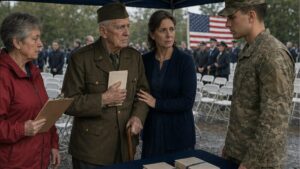
Sarah Hayes received the package on a Thursday morning.
Emily only knew because an email arrived that evening with no subject line.
It contained three sentences.
Ms. Carter,
Brian told me there are things no one can give back. I understand that now.
Thank you for not filling in what you didn’t know.
Emily read it twice.
Then she sat in the dark office with the monitor off and listened to the building settle around her.
Outside, traffic moved through the wet streets. People went home carrying groceries, backpacks, flowers, coffee, bad news, ordinary fatigue. No one passing under her window knew that a twelve-second file had changed classification from closed to unresolved.
No one knew a ring had crossed the country in a padded envelope.
No one knew a widow had finally received a sentence small enough to trust.
Emily opened the file one last time.
The same gray line appeared.
No video stream detected.
She pressed play.
Static.
Wind.
The thud of movement.
The voice, still almost gone.
Don’t make me leave him.
Three taps.
Then silence.
Emily did not try to clean the audio further.
She did not need it clearer.
Some truths did not become stronger when sharpened. Some survived because someone stopped sanding them down.
She closed the file and labeled her copy the only way she could bear.
Hayes_Daniel_Unresolved
Then she shut off the monitor.
In the black glass, for half a second, she saw her own reflection where the missing video should have been.
She did not look away.