What She Carried
Part I — The Corridor
“You can’t be in uniform, ma’am. That’s regulation.”
The words landed hard enough to stop three soldiers walking past the corridor outside the memorial hall. One of them slowed with a paper cup halfway to his mouth. Another looked down at his boots like he had walked into someone else’s trouble.
Sarah Coleman did not move.
The fluorescent lights above her made the hallway look too clean for what waited behind the double doors: folded flags, framed photographs, rows of metal chairs, and six families preparing to hear six names spoken like the world had not already broken around them.
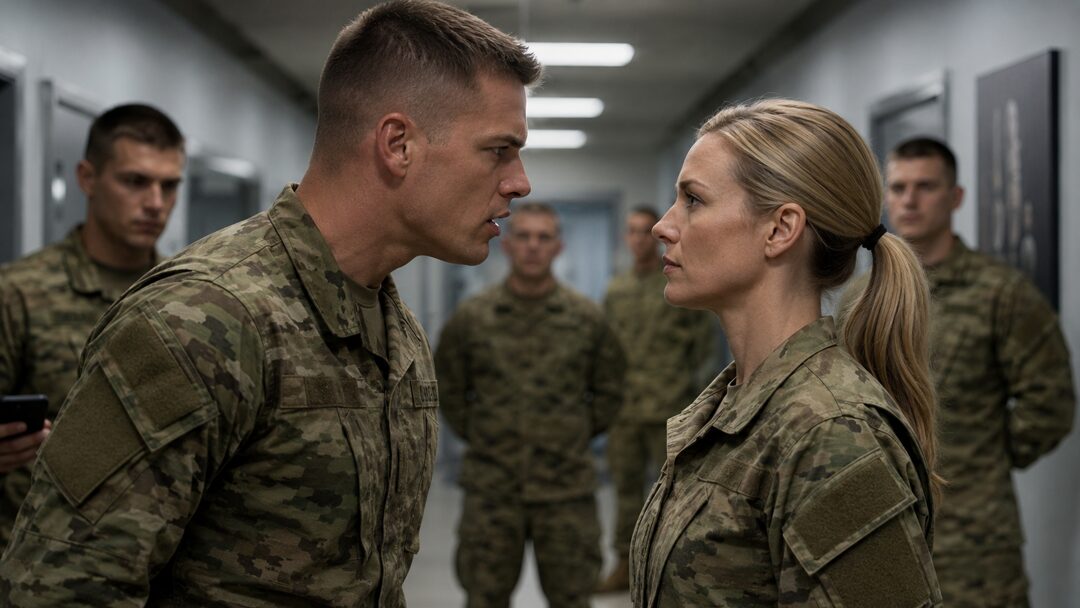
Staff Sergeant Ryan Miller stood in front of her, squared off and certain.
He was young in the way soldiers could be young even when grief had already aged them. Fresh high-and-tight haircut. Sleeves neat. Jaw tight. His uniform looked like it had been measured against a ruler and a threat.
Sarah’s did too.
That seemed to irritate him more.
There was no active rank on her chest. No current unit patch that meant anything to him. Just the OCP jacket sitting over her shoulders with quiet precision, her blonde hair pulled back so tightly that not a strand softened her face.
Ryan glanced at the sleeve, then at the door behind her.
“This rehearsal is closed,” he said. “Authorized personnel only.”
Sarah looked at him as if she had been asked this question in a hundred different rooms by a hundred different men who thought authority began where memory ended.
“Is that what you think this is?”
Something shifted in the soldiers watching. Not enough to break discipline. Just enough.
A small silence.
Ryan heard it and hardened.
“I think you’re wearing a uniform without authorization at a memorial event,” he said. “And I think you know better.”
“I do.”
The answer was calm.
Too calm.
That was what made Ryan step closer.
Behind him, Specialist Kevin Brooks lifted his phone just a little. Not high. Not obvious. But enough. His eyes were already wide with the private thrill of seeing something he knew would travel fast if it broke the right way.
Sarah saw the phone.
She saw the watching faces.
She saw Major Joseph Grant at the far end of the corridor, stopped in front of a glass case filled with unit coins and old plaques. He had recognized her the moment she entered the building. He had not come over.
That told her everything.
Ryan followed her gaze and saw Grant too. Relief flickered across his face.
“Sir,” Ryan called. “I’m handling an unauthorized uniform issue.”
Grant did not answer at once.
He stood there in his dress uniform, silver threaded through dark hair, one hand resting at his side as though it had forgotten how to move.
Sarah watched him choose silence.
Then she looked back at Ryan.
“I’m here for the names,” she said.
Ryan’s eyes narrowed.
“This ceremony is for the fallen. Not personal statements.”
The words found the only soft place left in her.
Her expression did not change much. Only the muscle near her jaw pulled tight.
Kevin’s phone rose another inch.
Ryan saw the movement and lowered his voice, but not enough to make the moment private.
“Ma’am, I’m going to need you to change now.”
“No.”
One word.
Not loud. Not dramatic.
Just locked.
Ryan’s face flushed.
“Ma’am, I said—”
He reached for her sleeve.
Sarah’s hand came up before he touched her. Fast. Controlled. Not a strike. Not even a grab. Just a boundary placed in the air between them.
“Don’t.”
The word emptied the corridor.
Even Kevin stopped breathing for half a second.
Ryan froze with his fingers inches from the fabric.
Sarah lowered her eyes to his hand, then raised them back to his face.
“You have no idea what you’re touching.”
Part II — The Line He Would Not Cross
Ryan should have stepped back.
He knew that later.
In the moment, all he felt was heat climbing his neck and the weight of every stare behind him. A sergeant could not be corrected in front of junior soldiers by a woman with no visible rank and no visible right to stand where she stood.
That was how he told himself the story.
It was easier than admitting something in her voice had scared him.
He pulled his hand back slowly.
“Then explain it.”
Sarah looked past him toward the memorial hall doors.
Inside, someone tested the microphone. A dull thump echoed through the corridor.
Then a voice read, “Private First Class Daniel Reeves.”
Pause.
“Corporal Matthew Lane.”
Pause.
The rehearsal was already beginning.
Sarah’s throat moved once.
Ryan noticed.
It made him angrier, though he could not have said why.
“You don’t get to walk in here like this and refuse to answer basic questions,” he said.
“I answered the only one that mattered.”
“No, ma’am. You didn’t.”
Grant finally approached.
Each step looked measured. Official. Too late.
“Staff Sergeant Miller,” he said.
Ryan straightened. “Sir.”
Grant’s eyes went to Sarah first, then away.
That tiny movement did more damage than any confession could have.
Sarah gave him a look that almost resembled a smile. Not warm. Not cruel.
Tired.
“Major Grant.”
Ryan turned slightly.
“You know her?”
Grant’s mouth tightened.
“Yes.”
The watching soldiers absorbed that.
Kevin lowered the phone a little, then raised it again, unsure which instinct was winning.
Ryan looked from Grant to Sarah.
“Then she’s authorized?”
Grant did not answer fast enough.
Sarah did.
“I didn’t come here for permission.”
Ryan gave a short laugh without humor.
“That’s the problem.”
“No,” Sarah said. “The problem is you think permission is the same thing as honor.”
The corridor went still again.
Ryan stepped closer, voice low now.
“My brother’s name is being read in that room today. So don’t stand here and talk to me about honor like I’m guarding a parking space.”
Sarah’s eyes changed.
It happened so quickly most people missed it. Kevin did not. Grant did not.
Ryan did not understand it yet.
“What was his name?” Sarah asked.
“None of your business.”
Her face went pale under the fluorescent lights.
Grant said, very quietly, “Ryan.”
But Ryan was already moving on anger.
“No, sir. If she wants to make this about honor, then let’s talk about it.” He turned back to Sarah. “This place is for families and people who served with them. Not for someone showing up in a jacket she doesn’t have the right to wear.”
Sarah’s hand curled once at her side.
Something metallic slipped from her fingers and hit the floor.
A coin.
It rolled in a tight silver arc across the tile, struck Ryan’s boot, and spun flat.
No one moved.
Ryan looked down.
The coin was worn at the edges, dark in the grooves. A convoy emblem. A narrow road through wings. Around the rim, small raised letters:
SPARROW LINE.
Ryan bent and picked it up.
For a moment he did not speak.
Then he closed his fist around it.
“Where did you get this?”
Sarah held out her hand.
“Give it back.”
“Answer me.”
Grant said, “Staff Sergeant.”
Ryan did not look at him.
“Answer me.”
Sarah stared at the closed fist holding the coin. Her voice, when it came, had lost all softness.
“You want to see what I carry?”
Ryan should have heard the warning in it.
Instead he said, “I want you to follow regulation.”
Sarah nodded once.
Not agreement.
Decision.
She turned her back to him.
Ryan frowned. “Ma’am—”
Sarah reached for the zipper at her throat.
The sound was small in the corridor.
Metal teeth opening.
Kevin’s phone dipped.
Grant closed his eyes.
Sarah pulled the jacket down from her shoulders.
Not fast. Not theatrical. Deliberate.
The fabric slid low enough to reveal the top of her back beneath the regulation brown T-shirt, then farther, exposing skin, ink, and memory.
The corridor forgot how to make sound.
Across Sarah Coleman’s back, black and gray angel wings spread from shoulder to shoulder. Between them stood a cross, not delicate, not decorative, but carved in heavy lines like something built to withstand weather. Script curved through the feathers. Names.
Six of them.
Ryan saw the first two and felt his irritation collapse into confusion.
Daniel Reeves.
Matthew Lane.
His eyes moved lower.
Anthony Price.
James Walker.
Kevin’s mouth opened.
He no longer looked like a soldier recording gossip. He looked like a boy who had accidentally opened a door in the wrong house and found grief sitting inside.
Ryan’s eyes reached the fifth name.
Thomas Miller.
His own last name stared back at him from Sarah Coleman’s skin.
For one second, the hallway tilted.
Ryan did not remember stepping back.
Sarah turned her head just enough to look over her shoulder.
“Still think it’s just a uniform?”
Part III — The Name in the Wings
Nobody spoke.
Some silences ask for respect.
This one demanded payment.
Ryan stared at his brother’s name as if the letters might rearrange into something else if he looked hard enough.
Thomas Miller.
Tommy, who used to put hot sauce on eggs and call it cooking.
Tommy, who had mailed home a photo of himself standing beside a dust-covered vehicle, grinning like he had talked fear into leaving him alone.
Tommy, whose final official story had been folded into two paragraphs and a folded flag.
Ryan’s hand tightened around the coin until the edge pressed into his palm.
“Why,” he said, but the word came out wrong. Too thin. “Why is his name on your back?”
Sarah pulled the jacket back up over her shoulders.
The names disappeared.
Somehow that made it worse.
She zipped the jacket halfway and faced him.
“Not here.”
Ryan’s laugh broke.
“Not here?”
The soldiers watching shifted, embarrassed now by their own presence.
Kevin lowered his phone all the way.
Ryan pointed toward the doors.
“They are about to read his name in there. My mother is sitting in the second row. My father still keeps his boots by the garage door because he can’t throw them out. And you’re telling me not here?”
Sarah’s eyes flickered.
That landed.
But she did not bend under it.
“Not like this,” she said.
Ryan turned to Grant.
“You knew.”
Grant looked older than he had five minutes ago.
“Yes.”
“You knew she had his name on her?”
“Yes.”
“You knew she was coming?”
Grant looked at Sarah.
“No.”
That answer made Sarah smile again, bitter and small.
“I stopped asking.”
Ryan’s voice dropped.
“What was she to him?”
Grant’s jaw worked.
Sarah answered before he could choose another careful silence.
“I was his convoy commander.”
The words reached Ryan slowly.
He had heard the title before. Not her name. Never her name. The family had been told the commander made a call. The commander withdrew. The commander could not retrieve Thomas.
The commander survived.
That had been the shape of Ryan’s anger for years.
He looked at Sarah as if seeing her clearly for the first time and hating the clarity.
“You left him.”
Grant inhaled.
Sarah did not flinch.
Ryan stepped closer, shaking now.
“You left my brother there.”
Kevin whispered, “Sergeant…”
Ryan swung a look at him so sharp Kevin fell silent.
Sarah’s voice stayed quiet.
“No.”
That one word struck harder than denial should have.
Ryan’s face twisted.
“Don’t.”
“I didn’t leave him.”
“You don’t get to say that.”
“I know.”
“No, you don’t.” Ryan’s fist rose, still holding the coin. “You don’t get to wear him. You don’t get to put his name on your body like you earned it.”
Sarah’s eyes finally broke.
Not with tears.
With something worse.
Agreement.
Grant stepped between them.
“Enough.”
Ryan looked at him.
“Tell me.”
Grant said nothing.
Ryan’s voice became dangerous because it was almost calm.
“Sir. Tell me what happened.”
From inside the hall, the microphone thumped again.
A woman laughed nervously, then stopped.
The ceremony was ten minutes away.
Grant looked toward the doors as if duty might save him from truth.
Sarah looked at Ryan.
Then she held out her hand again.
“My coin.”
Ryan opened his fist.
The imprint of the coin had reddened his palm.
He did not return it.
Instead he looked at the emblem.
“Sparrow Line,” he said.
Sarah’s shoulders dropped a fraction.
“That was the road.”
Ryan’s eyes lifted.
“What road?”
Grant said, “We should move this out of the corridor.”
Sarah gave him a flat look.
“That would have been wise six years ago.”
Grant absorbed it.
Ryan caught that too.
The authority in the hallway shifted, and nobody announced it.
Part IV — The Version They Kept
They moved into a side room used for storing chairs and extra flags.
Not private enough for confession.
Private enough for damage.
Ryan shut the door harder than necessary.
Kevin remained outside with the other soldiers, phone in his hand, screen black now. He could still see Sarah’s back when he closed his eyes. Not the ink itself. The names.
He opened the video.
The clip began with Ryan’s voice: You can’t be in uniform, ma’am.
Kevin watched the phone version of Sarah turn her head, watched the jacket lower, watched his own hand shake.
His thumb hovered over the share icon.
Then he heard Ryan through the door.
“Say it.”
Kevin locked the screen.
Inside, Grant stood near a stack of folded chairs. Sarah remained by the door, as if she did not trust the room to hold her.
Ryan faced them both.
“You told my family Thomas died holding position after the convoy came under attack.”
Grant said, “He did.”
“You told us recovery was impossible.”
Grant’s face tightened.
“It was.”
Sarah looked at him.
“No. It was ordered impossible.”
Ryan turned to her.
“What does that mean?”
Grant said, “Captain Coleman—”
“Former,” Sarah corrected.
The word struck the room.
Grant’s expression flickered.
Sarah continued, “The convoy was hit crossing Sparrow Line. First vehicle disabled. Second pinned. Communications fractured. We had wounded in the open and smoke covering half the road.”
Ryan’s breathing changed.
He wanted details and hated her for giving them.
“Thomas was in the rear security vehicle,” she said. “He saw the route closing before anyone else did.”
Ryan swallowed.
Sarah’s eyes stayed on him.
“He stayed on the radio longer than he should have. He kept calling positions. Kept telling us where to move the wounded. He gave us a path out.”
“That’s not what we were told.”
“No.”
Grant said, “Because the report could not include every field detail.”
Sarah looked at him.
“It included the details that protected you.”
The room went cold.
Ryan turned slowly.
“What did he order?”
Grant’s face had gone still.
Sarah answered.
“Withdrawal.”
Ryan looked from one to the other.
“You ordered them to leave?”
Grant’s voice hardened, but there was no strength behind it.
“I ordered a tactical withdrawal to preserve remaining personnel.”
Sarah said, “You ordered us out while men were still breathing.”
Grant snapped, “And you disobeyed.”
“Yes.”
The word sat there.
Clean. Unadorned.
Ryan stared at her.
Sarah’s voice became lower.
“I turned back with two others. We reached Reeves first. Lane was trapped behind the second vehicle. Price was already gone. Walker died before we moved him.” She stopped. “Thomas was still transmitting.”
Ryan’s face drained.
Sarah went on because stopping would be worse.
“He knew where we were. He knew what we were trying to do. He told us not to come farther.”
Ryan shook his head once.
“No.”
“He said the road would close if we did.”
“No.”
“He said, ‘Tell Miller I finally did something useful.’”
Ryan’s eyes flashed.
“My brother would not say that.”
Sarah nodded.
“He said it like a joke.”
That hurt him more because it sounded true.
The room blurred around Ryan.
Tommy had always joked when things got too serious. At their grandfather’s viewing, he had whispered that the old man would haunt them for letting the funeral home choose that tie. Ryan had laughed into his sleeve and hated himself for it.
Sarah touched the coin at Ryan’s side with her eyes, not her hand.
“I went anyway.”
Grant whispered, “Sarah.”
She ignored him.
“I made it twenty yards before the second blast folded the road behind us. Thomas stopped transmitting after that.”
Ryan pressed his fist to his mouth.
For years he had imagined his brother calling for help and no one coming.
Now he had to imagine something worse.
His brother refusing help so others could live.
Sarah’s voice barely held.
“I carried Reeves out. I carried Lane until my legs failed and one of my medics took him. I did not carry Thomas.”
The room did not move.
“That is why his name is there,” she said.
Ryan stared at her.
“You let us hate you.”
Sarah’s mouth trembled once.
“Your family needed somewhere to put it.”
Grant closed his eyes.
Ryan looked at him.
“And you let them.”
Grant did not defend himself quickly this time.
That was his first honest act.
“The official narrative preserved the ceremony,” he said. “It preserved the mission record. It preserved—”
“Your command,” Sarah said.
Grant’s face tightened.
“Yes.”
One word.
Not enough.
But real.
The loudspeaker outside crackled.
“All participants for the memorial ceremony, please take your positions.”
No one in the room moved.
The past had finally arrived on schedule.
Part V — The Names Waiting
Ryan wanted Sarah gone.
Not because he still believed she had no right to be there.
Because now she had too much right.
Her presence threatened everything he had built around Thomas. The clean anger. The simple villain. The story that let him miss his brother without having to wonder whether grief had made him unfair.
He looked at Sarah’s zipped jacket and hated that the names were hidden again.
He hated that he knew they were there.
“My mother is out there,” he said.
Sarah nodded.
“I know.”
“No, you don’t.”
“I know what room she is in.”
“That’s not the same thing.”
“No,” Sarah said. “It isn’t.”
Grant checked his watch, then seemed ashamed of the gesture.
“Ryan, you are scheduled to read the roll.”
Ryan almost laughed.
Of course he was.
The Army could put grief into alphabetical order and hand it to the nearest steady voice.
“I can’t,” he said.
Grant’s command tone returned by habit. “You can.”
Ryan looked at him.
“Don’t give me that.”
Grant fell silent.
Sarah moved toward the door.
Ryan blocked her again, but differently this time.
Not with authority.
With need.
“Are you going to tell them?”
Sarah looked at him.
“The families?”
“Everyone.”
“No.”
Grant’s relief was visible, and that made Ryan sick.
Sarah saw it too.
“I didn’t come to accuse anyone,” she said. “I came because the names on my back are tired of being spoken like clean marble.”
Ryan’s face changed.
The line went somewhere deep and stayed there.
Grant looked away.
Sarah reached for the door.
Ryan said, “Why didn’t you tell us before?”
She did not turn around.
“Because every truth asks for another body to carry it.”
For a moment, he understood her silence.
Not forgiveness.
Not absolution.
Just the shape of it.
She opened the door.
The corridor had thinned. The watching soldiers had scattered into assigned places, but Kevin was still there.
He stood straighter when Sarah stepped out.
His phone was in his hand.
Sarah noticed.
So did Ryan.
Kevin looked down at the screen, then at her.
“I deleted it,” he said.
No one had asked him to.
Sarah gave him the smallest nod.
It seemed to hit him harder than praise.
Grant stepped out last.
The corridor no longer looked sterile. It looked exposed.
Through the open memorial hall doors, families sat in rows. Some held programs. Some held hands. Some held nothing because holding anything would make them fall apart.
Ryan saw his mother in the second row.
Her hair was pinned the way she wore it to church. Her hands rested flat on her purse. She looked toward the front of the room as though the right posture might keep her from breaking.
His father sat beside her, stiff and gray-faced.
Ryan had not told them about the hallway.
He had no idea what to tell them now.
Sarah paused at the back of the room.
Grant leaned close to her.
“Sarah.”
She did not look at him.
He lowered his voice.
“If this becomes public in the wrong way, it will hurt people who cannot defend themselves.”
She turned then.
“And silence has been gentle?”
Grant had no answer.
Sarah stepped into the hall.
Every instinct in Ryan told him to stop her again.
This time he let her pass.
Part VI — What the Room Heard
The memorial hall was full, but not loud.
Some rooms silence themselves out of respect.
This one felt like it had run out of breath.
Ryan stood at the front with the printed list in his hand. Six names. Six lives compressed into rank, first name, last name, and a pause for the bell.
Sarah stood in the back row near the aisle.
She had zipped her jacket fully again. The tattoo was hidden. No one looking at her would know what Ryan knew.
That felt like the point.
Grant sat near the podium with the other officers, his posture exact, his face unreadable.
Kevin stood against the side wall with two junior soldiers. His hands were empty now. He kept them folded in front of him.
The chaplain spoke first.
Then Grant.
His remarks were polished. Too polished. Words like courage, sacrifice, duty, family. True words. Worn words. Words that could hold meaning or hide from it, depending on who used them.
Ryan heard almost none of it.
He kept seeing the name in the wing.
Thomas Miller.
When Grant introduced him, Ryan walked to the podium on legs that did not feel fully attached to him.
The paper shook once.
He pressed it flat.
The microphone caught his breath.
In the second row, his mother looked up at him with eyes full of pride and worry. His father lowered his chin.
Ryan read the first name.
“Private First Class Daniel Reeves.”
The bell sounded once.
A woman in the front row covered her mouth.
Ryan read the second.
“Corporal Matthew Lane.”
Bell.
Then the third.
“Sergeant Anthony Price.”
Bell.
Each name made Sarah’s back feel heavier under the jacket.
She did not move.
Ryan read the fourth.
“Specialist James Walker.”
Bell.
His voice thinned.
He looked down.
The fifth name waited on the paper.
He had practiced it that morning in the mirror. Thomas Miller. Two clean words. His brother’s name in a room where people expected him to be strong.
Now the words had changed.
They were no longer only his family’s grief.
They were Sarah’s skin.
Grant’s silence.
A road closing.
A joke into the radio.
Tell Miller I finally did something useful.
Ryan gripped the podium.
The room waited.
His mother leaned forward slightly.
Ryan could not say it.
A sound moved through the hall. Not a whisper. Not impatience. Just the collective recognition that someone had reached the edge of what discipline could hold.
Then Sarah stepped out from the back row.
She did not hurry.
She did not take over.
She walked down the aisle and stopped beside Ryan, just close enough for him to see the collar of her jacket shift near her neck.
Just close enough for him to know what was underneath.
She faced the room.
Not his mother.
Not Grant.
The room.
Ryan inhaled.
“Sergeant Thomas Miller.”
The bell sounded.
His mother’s eyes closed.
His father folded forward as if something inside him had finally been allowed to bend.
Ryan read the last name.
“Staff Sergeant Andrew Hayes.”
Bell.
The paper should have been enough.
The script ended there.
Ryan looked at the typed closing line.
We remember them with gratitude and honor.
He could have read it. No one would have blamed him. The room would have moved on. Grant would have nodded. Sarah would have returned to the back row with all six names still hidden.
Instead Ryan looked at his mother.
Then at Sarah.
Then at Major Grant.
“Some of them carried us longer than the records say.”
The room did not understand all of it.
But it felt the shape of it.
Sarah’s eyes lowered.
Grant’s face changed, not dramatically. No collapse. No grand public shame. Just a man hearing a locked door open somewhere inside his own chest.
Ryan stepped back from the microphone.
Sarah stepped back too.
For one second, they stood shoulder to shoulder.
Then she returned to the aisle.
No applause came.
It would have been wrong.
Only silence followed them.
This time, the silence gave something back.
Part VII — The Door Left Open
After the ceremony, people lingered because leaving made things final again.
Families stood in small circles. Officers spoke softly. Programs folded in nervous hands. Someone laughed once in the wrong tone, then wiped their eyes.
Sarah returned to the corridor.
The same corridor.
The same fluorescent lights.
The same floor where the coin had fallen.
She stood near the wall and let her shoulders lower for the first time all morning.
Ryan found her there.
He had removed his cover, though he was still indoors and did not need to. He held the Sparrow Line coin between both hands.
For a moment, neither of them spoke.
Then he held it out.
Sarah looked at it before she took it.
The coin sat in her palm, warm from his hand.
“I thought it was just a uniform,” Ryan said.
Sarah closed her fingers around the coin.
“Most people do.”
He nodded once.
There were a hundred things he might have said. I’m sorry. Tell me more. Did he suffer? Did he know? Did he say my name? Did you hate us for hating you?
None of them made it past his throat.
Sarah spared him the need to choose.
“He sounded brave,” she said.
Ryan looked up.
She swallowed.
“But mostly he sounded like himself.”
That was the sentence that nearly undid him.
Not hero.
Not sacrifice.
Himself.
Ryan turned away for a second, jaw locked, eyes bright. When he looked back, he was still not healed. Healing would have been too simple for what had been taken.
But something poisonous had shifted.
Behind him, Kevin approached, hesitant.
“Ma’am,” he said.
Sarah turned.
Kevin stood at attention so fast it was almost too sharp.
“I’m sorry about the phone.”
Sarah studied his face.
He looked younger without the screen between them and the world.
“Did you delete it?”
“Yes, ma’am.”
“Then don’t be sorry twice.”
Kevin nodded, though he seemed unsure whether he had been forgiven or instructed.
Maybe both.
Major Grant appeared at the end of the corridor.
He had removed his jacket.
Not in surrender. Not in performance. He carried it over one arm, and for the first time all day he looked less protected by the fabric.
Sarah watched him approach.
Ryan did too.
Grant stopped a few feet away.
“Captain Coleman,” he said.
Sarah’s face gave nothing away.
“Former,” she said again.
Grant accepted the correction.
“Sarah.”
That was harder for him.
He looked toward the memorial hall, where the families still stood among the chairs and framed photographs.
“I’m speaking with them before they leave.”
Ryan stiffened.
Sarah waited.
Grant continued, “Not everything. Not today. But enough to stop asking silence to do the work of honor.”
The words were careful.
Still officer’s words.
But they cost him something.
Sarah nodded once.
No absolution.
No embrace.
No clean ending.
Just a door left open.
Grant looked at Ryan.
“Staff Sergeant Miller, you may join us if you wish.”
Ryan looked toward the hall.
His mother was still inside. His father stood beside her, holding a program folded into a narrow white strip.
Ryan turned back to Sarah.
“Are you coming?”
Sarah looked down at the coin in her hand.
Then at the jacket on her shoulders.
For six years, she had carried names no room wanted to fully hear. For six years, she had let people call her silence pride because pride was easier to survive than explanation. For six years, every ceremony had asked her to stand outside the clean version.
This time, no one blocked the door.
She slipped the coin into her pocket.
“Yes,” she said.
They walked back together.
Kevin stayed in the corridor, watching them go. His hand twitched once toward the empty pocket where his phone usually waited.
Then he folded both hands behind his back.
Inside the hall, Grant stepped toward the families without his jacket on.
Ryan moved beside his mother.
Sarah stopped near the back, still in uniform, still carrying what no one could see.
When Grant began to speak, she did not close her eyes.
She stood straight.
Not because the weight was gone.
Because, at last, someone else had reached for one corner of it.