What He Carried Inside
Part I — The Small Silver Star
“Take it off.”
Staff Sergeant David Miller did not raise his voice. He didn’t need to.
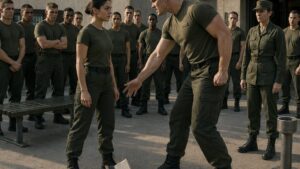
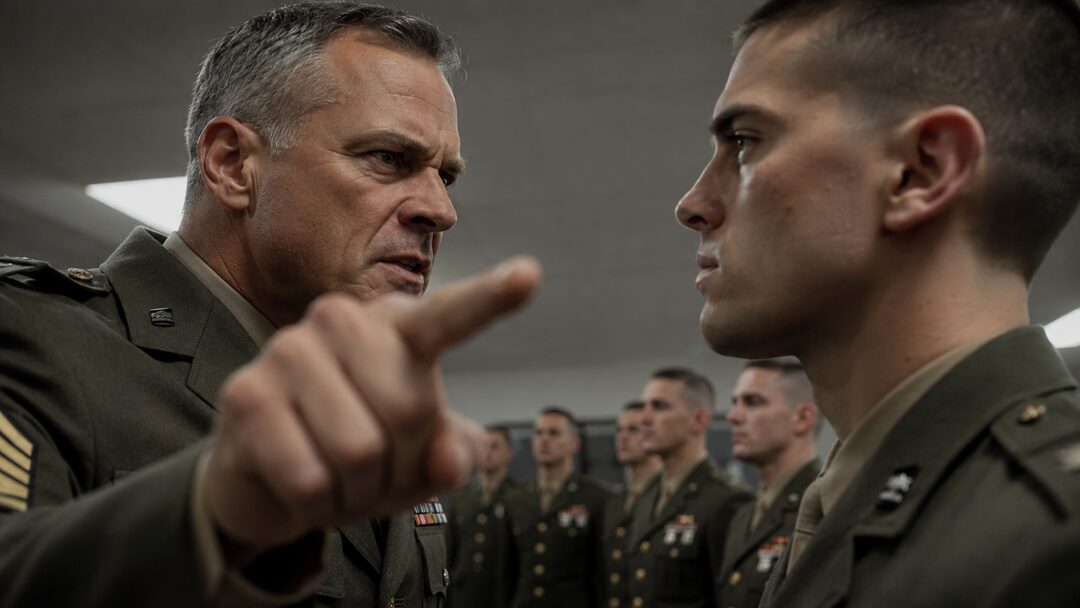
The inspection room went silent so fast it seemed the lights had stopped buzzing. Forty soldiers stood shoulder to shoulder in two clean rows, boots aligned on the pale floor, hands flat against trouser seams, eyes fixed forward as if looking anywhere else might make them responsible.
Miller pointed across the room at Specialist Mark Vance.
Not at his boots. Not at his belt. Not at his shaved jaw or his collar or the name tape pressed clean against his chest.
At the small silver star pinned above Vance’s left breast pocket.
Vance did not move.
That was the first mistake.
Miller’s face tightened, not with surprise, but with something older than anger. He crossed the space between them with slow, deliberate steps. He was broad through the shoulders, gray at the temples, his uniform so precise it looked less worn than assembled. Men like Miller did not walk into a room. They occupied it.
“I said,” Miller murmured, close enough now that only the front rank could hear every word, “take it off.”
Vance stood straight. Lean. Pale. Close-cropped dark hair. Still eyes.
“No, Sergeant.”
The answer was quiet.
It was also impossible.
A few soldiers drew in breath and caught it there. Someone near the rear shifted half an inch before freezing again.
Miller looked almost pleased.
He reached for Vance’s chest.
The silver star was no bigger than a quarter. It caught the fluorescent light once before Miller’s fingers closed around it. There was a small scrape of metal against fabric, then a sharp tug.
The pin came free.
Vance’s body did not flinch.
That was the second mistake.
Miller held the star up between two fingers like a piece of trash he had found in a parade formation.
“Unauthorized,” he said.
No one spoke.
“You all see this?” Miller turned slightly, letting the platoon look. “This is how it starts. Not with a failed order. Not with a broken formation. With one man deciding his feelings outrank the standard.”
His eyes came back to Vance.
“You think you’re above the system?”
Vance’s jaw moved once.
Not enough to count as an answer.
Miller leaned in, his voice dropping.
“You have something to say, Specialist?”
For one second, Vance’s eyes changed. Not softened. Not weakened. Just opened, as if something behind them had almost stepped forward.
Then it was gone.
“No, Sergeant.”
Miller’s mouth curved into a hard, humorless smile.
“Good. Then you can spend the rest of the day packing out Storage Room C. Every crate. Every bag. Every scrap of gear from that little vacation you just came back from.”
Still Vance said nothing.
Miller turned to the room.
“And the rest of you can remember something. Personal symbols do not make you brave. They make you sloppy. Sloppy gets people left behind.”
The words landed harder than they should have.
Vance’s eyes stayed forward.
Miller noticed.
Of course he noticed.
He stepped closer again and pressed the silver star into his own palm until the edges disappeared.
“You hear me, Vance?”
“Yes, Sergeant.”
“What did I say?”
Vance swallowed.
“Sloppy gets people left behind.”
For the first time, Miller’s expression cracked. Not much. Just enough for the soldiers in the front row to understand that he had meant to hurt him.
And that he had.
“Dismissed,” Miller said.
The room exhaled in pieces.
No one looked at Vance as they filed out.
That was the mercy people offered when they were afraid.
Part II — The Room No One Wanted
Storage Room C sat at the end of a corridor nobody used unless ordered.
It smelled like dust, canvas, metal, and old rain.
Vance unlocked it with the key Miller had thrown at him and stood in the doorway for three seconds before stepping inside. On the left wall were stacked crates. On the right, duffel bags tagged with faded numbers. In the center sat the gear from the operation everyone knew about and nobody discussed.
Four black bins.
Two cracked cases.
One folded stretcher.
Vance shut the door behind him.
Only then did he let his hand rise to the place where the star had been.
The fabric was torn. Not badly. Just enough.
He pressed two fingers there, then dropped his hand as if the touch embarrassed him.
“Are you actually going to tell me what that was?”
Vance turned.
Emily Carter stood in the doorway he had just closed, one boot holding it open. She was compact and alert, sandy hair pulled tight, sleeves rolled so neatly they looked measured. She had the expression of someone who had spent her whole life deciding when to speak and usually deciding not to.
Today, apparently, was different.
“You’re not assigned here,” Vance said.
“Neither is half the gear in this room.” She stepped inside and shut the door. “I’m asking anyway.”
“Don’t.”
“That was your plan?” Emily looked at his chest. “Wear something unauthorized in front of Miller, refuse twice, get publicly chewed up, and then spend the day sorting classified leftovers like a punished teenager?”
Vance bent to the first bin.
“Good plan,” she said. “Very efficient.”
He lifted a cracked helmet light from the top layer of gear and set it on the table.
Emily watched him.
The silence in the room changed.
It was not like the silence in formation. That one had been fear. This one had weight.
She came closer, slower now.
“What was it?”
“A pin.”
“No,” she said. “Cheap answer.”
Vance opened a canvas pouch and began sorting its contents: tape, gauze, a dead radio battery, a folded strip of orange marking cloth.
Emily’s gaze caught on the cloth.
“That was from the border team?”
Vance did not answer.
Everyone had heard pieces. A night movement through bad terrain. Bad coordinates. A withdrawal order. Three returned wounded. One medic did not return at all. Afterward, the official report had been short enough to sound clean.
Operational conditions deteriorated.
Withdrawal completed under command guidance.
Sergeant Lisa Brooks rendered aid during movement.
Killed in line of duty.
There were phrases that made death look organized.
Emily picked up the cracked helmet light.
“Was this yours?”
Vance took it from her before she could turn it over.
“No.”
“Brooks’s?”
His hand stilled.
That was answer enough.
Emily’s face changed. Not pity. She was too smart for that. Pity made people close doors.
“I knew her a little,” Emily said. “Not well. She taped my wrist once after I pretended it wasn’t sprained.”
Vance put the helmet light down.
“She called me an idiot,” Emily added.
“She did that.”
The two words came out before he could stop them.
Emily heard the fracture.
“Mark.”
“Don’t use my first name.”
“That’s how bad this is?”
He opened the second bin.
The smell came up first.
Not strong. Not dramatic. Just old fabric and copper and field mud that had dried into seams.
Vance stopped breathing.
Emily saw the blood-stained roll of medical tape at the same time he did.
Neither of them touched it.
Under the tape lay a small field notebook, warped at the edges, its green cover scraped almost white at one corner. A piece of black cord was wrapped around it twice.
Vance reached for it.
The door opened.
Miller stood there.
His eyes moved from Emily to Vance to the notebook in Vance’s hand.
For a moment, nobody performed rank.
They were just three people in a room full of things that had outlived the person who used them.
Then Miller’s face hardened back into place.
“Carter,” he said. “Out.”
Emily straightened. “Sergeant, I was—”
“Out.”
She looked at Vance.
He gave the smallest shake of his head.
Emily left.
Miller stepped inside and closed the door behind him.
The room seemed to shrink.
“Hand it over,” he said.
Vance held the notebook at his side.
“It’s Brooks’s.”
“I can read a name.”
“It should go with her things.”
“It belongs with the report.”
“No, Sergeant.”
Miller stared at him.
It was not the same stare from the inspection room. This one was colder because it was quieter.
“You have developed a dangerous habit today.”
“Yes, Sergeant.”
“You think that sounds disciplined. It doesn’t. It sounds like pride with its mouth shut.”
Vance’s fingers tightened around the notebook.
Miller noticed that too.
He stepped closer.
“I gave an order.”
Vance looked at him then. Fully.
“No.”
The word did not echo.
It didn’t need to.
Miller’s face flushed once, high along the cheekbones.
“You want formal charges?”
“No.”
“Then hand me the book.”
Vance slid the notebook inside his waistband beneath his blouse.
Miller’s jaw clenched.
“You don’t get to carry private versions of what happened,” he said. “That’s not how this works.”
Vance’s voice came out flat.
“That’s exactly how it worked.”
For the first time all day, Miller had no immediate answer.
Then he stepped back, opened the door, and said, “You have until seventeen hundred to make the smart choice.”
Vance stood alone after he left, one hand still pressed against the hidden notebook.
The room smelled like dust.
And something nobody had buried properly.
Part III — What the Mirror Kept
Emily waited until Miller’s boots faded down the hall before slipping back inside.
“That was stupid,” she whispered.
Vance kept sorting gear.
“I know.”
“No. You don’t. Miller doesn’t threaten charges for exercise.”
“I know.”
She stared at him. “Then help me understand why you’re acting like a man trying to lose.”
Vance took the notebook out and placed it on the table between them.
Emily did not reach for it.
On the front, written in black marker and worn by rain, was one name:
BROOKS, L.
Vance untied the cord.
The first pages were normal: inventories, aid counts, radio checks, notes in hard-pressed handwriting. Brooks wrote like she expected paper to argue back.
Emily turned a page.
A pressed photo slipped out.
It showed Brooks sitting on a low concrete wall, one knee up, medic patch faded from sun. She was smiling at someone outside the frame. Her knuckles were taped. Her hair was shoved under a cap. She looked tired and impossible to move.
On the back, in the same hard handwriting, were four words.
Tell it straight someday.
Emily looked up.
Vance’s face had emptied out.
“What happened out there?” she asked.
He closed the notebook.
“Not enough people came back.”
“That’s the official version.”
“That’s the version people can survive reading.”
Emily’s voice softened, but not much.
“And the pin?”
Vance’s hand went to his breast pocket again. Empty.
“Miller has it.”
“I know that. What was it?”
Vance looked at the door, then at the ceiling, then finally at the table.
“It was from a signal mirror.”
Emily waited.
He hated her for that. For being patient. For not filling the silence with a guess he could deny.
“Brooks had it in her kit,” he said. “Emergency panel. Thin metal. Reflective on one side. She cut it down with trauma shears.”
“Into a star?”
He nodded.
“Why?”
His mouth tightened.
Vance was back there for three seconds before he could stop it.
Not the whole place. Not the sound. He did not let himself go that far.
Only Brooks’s hands.
Taped knuckles. Blood under one nail. Trauma shears working through thin silver metal while someone shouted that they had to move.
Her voice, calm like she was explaining how to wrap an ankle.
“Hold still, Vance.”
He had told her it was stupid.
She had said, “Most true things are, at first.”
Emily’s eyes stayed on him.
“She gave it to me before we moved,” he said. “Told me to wear the part they wouldn’t write down.”
Emily absorbed that.
The room felt different now. Not safer. More dangerous.
“The part they wouldn’t write down,” she repeated.
Vance opened the notebook again and turned to the last written page.
Emily leaned close.
The handwriting was worse there. Slanted. Interrupted.
Order came through. Pull back now. Two still down east wash. Interpreter with them. Vance hit bad but breathing. No line of sight. If I follow order, they stay.
Below that, in heavier pressure:
I know what I’m doing.
Emily’s throat moved.
“That doesn’t sound like the report.”
“No.”
“Does Miller know?”
Vance closed the book.
“He thinks he does.”
Emily understood before he said it.
“He thinks you froze.”
Vance did not answer.
“He thinks Brooks went back because of you.”
Vance looked at the blood-stained tape.
“She did go back because of me.”
“That’s not the same thing.”
“It is when you’re the one still standing.”
Emily had no quick answer for that.
Good, Vance thought. Quick answers were how people made themselves comfortable.
She reached for the notebook now, but only touched the edge.
“Why not tell him?”
“Because if this goes official, Brooks disobeyed a withdrawal order.”
“She saved people.”
“She disobeyed an order.”
“So?”
He looked at her sharply.
“So the clean commendation they wrote becomes complicated. So her family gets language instead of honor. So men who weren’t there decide whether the best thing she ever did counts against her.”
Emily’s expression hardened.
“And if you stay quiet?”
Vance laughed once. It had no humor in it.
“Then she died obedient.”
That line sat between them.
Then the door opened again.
Miller stood there, and this time he had heard enough.
Part IV — The Private Version
“Carter,” Miller said, “you will leave this room and forget whatever you think you heard.”
Emily’s shoulders went back.
“No, Sergeant.”
Vance turned toward her.
“Emily.”
She ignored him.
Miller’s eyes narrowed. “Careful.”
“I am being careful.”
“No. You are confusing curiosity with courage.”
Emily’s face flushed, but she did not lower her eyes.
Miller looked at Vance.
“The notebook.”
Vance picked it up.
For half a second, Emily thought he might surrender it.
Instead, he held it against his chest where the star had been.
Miller’s voice dropped.
“You have no idea what you’re handling.”
Vance’s eyes sharpened.
“I was there.”
The words hit harder than shouting would have.
Miller took one step toward him.
“And I was on that channel. I heard Brooks answer the order. I heard the delay. I heard men screaming over broken comms while your team fell apart.”
Vance said nothing.
Miller’s face twisted.
“I heard her say your name.”
The room went still.
Emily looked between them.
Vance’s composure changed again. Not broken. Pressurized.
Miller continued, voice low and rough.
“You came back breathing. She came back in a sealed transfer case. And then you walk into my formation wearing a piece of shine over your heart like you earned something no one else can touch?”
Vance’s eyes finally flashed.
“You think I wore it because I’m proud?”
“I think men wear things on their chest because they want the room to look.”
“No,” Vance said. “You wanted the room to look.”
Miller froze.
The line had found its mark.
Vance opened the notebook with one hand and held it out.
“Read it.”
Miller did not move.
“Read it,” Vance said again.
Miller stared at the notebook like it was a weapon.
Then he snatched it.
His eyes moved over the final page.
Once.
Twice.
His face lost color slowly, almost politely.
Emily watched his thumb press into the paper near Brooks’s last written line.
I know what I’m doing.
Miller shut the notebook.
“She violated a direct order,” he said.
Vance’s voice was quiet.
“She saved three people.”
“She broke the movement plan.”
“She saved three people.”
“That is not how you build a record.”
“That is how you tell the truth.”
Miller turned on him.
“You think truth is just the thing that makes you feel clean? Truth has consequences. Truth goes into files. Truth changes benefits, citations, family briefings. Truth gives strangers permission to take apart one impossible minute from a safe room.”
Vance’s grip tightened.
“Then the record is a coward.”
Emily looked at him, startled.
Miller’s eyes burned.
“The record is how a unit survives itself.”
“No,” Vance said. “Sometimes it’s how a unit lies politely.”
For a moment, it seemed Miller might strike him.
He didn’t.
That restraint was almost worse.
Instead, Miller tucked the notebook under his arm.
Vance moved.
Miller stopped him with a look.
“You want this official? Fine. The review board arrives tomorrow morning. They already have questions about inconsistencies. You can walk in there, put Brooks’s disobedience on the table, and watch men with clean hands decide how much honor she gets to keep.”
He stepped closer.
“Or you can let her remain what she is.”
Vance’s voice came out thinner.
“And what is that?”
Miller’s answer was immediate.
“A good soldier.”
The words should have settled something.
They didn’t.
Vance looked at the notebook under Miller’s arm.
“She was more than that.”
Miller’s face changed, briefly and painfully.
Then he opened the door.
“Tomorrow, you will stand by the report,” he said. “No pin. No notebook. No private version.”
He left with Brooks’s words in his possession.
Emily waited until his steps disappeared.
Then she said, “He’s scared.”
Vance stared at the open doorway.
“So am I.”
Part V — The Table Between Them
The review board used a conference room with no windows.
That felt right to Vance.
There were three officers at the table, two folders, a recorder, and a pitcher of water no one touched. Miller stood near the front, uniform flawless. Vance stood behind him, hands still, chest bare of anything that was not regulation.
Emily waited outside in the hall because no one had asked for her.
That was how institutions kept rooms clean.
Miller began with the official timeline.
His voice was steady. He described conditions, communications difficulty, withdrawal, casualty movement. Every sentence sounded prepared enough to survive being repeated by someone who had not been there.
Vance listened.
The words made a shape. A safe shape. A shape with no hands in it.
One of the officers, a woman with silver glasses, looked up from the folder.
“Staff Sergeant Miller, the timeline shows a nine-minute delay between the withdrawal order and Brooks’s last transmission. Can you account for that?”
Miller did not blink.
“Signal disruption, ma’am.”
Vance stared at the wall.
He could see Brooks’s hands again.
Not the place. Not the end.
Just her hands cutting the mirror.
Her voice: “Wear the part they won’t write down.”
The officer made a note.
“And Specialist Vance’s position during that interval?”
Miller answered too quickly.
“Separated from main movement. Later recovered.”
“By Sergeant Brooks?”
Miller’s jaw worked once.
“Yes, ma’am.”
“Under order?”
There it was.
The room tightened around the question.
Miller looked down at the table.
Vance felt something inside him go cold.
This was the moment. Not the inspection room. Not the storage room. Not Miller taking the notebook.
This.
This was where silence stopped being protection and became consent.
Vance opened his mouth.
Miller spoke first.
“No, ma’am.”
The officer looked up.
Miller reached into his breast pocket.
For one impossible second, Vance thought he was taking out the notebook.
He wasn’t.
Miller placed the small silver star on the table.
It made almost no sound.
But everyone heard it.
“This belonged to Sergeant Brooks,” Miller said.
Vance stopped breathing.
Miller’s eyes stayed on the star.
“Not officially. Not materially, according to inventory. She cut it from a signal mirror during the operation.”
The officer with silver glasses leaned forward.
Miller continued, one sentence at a time, like each cost him something measurable.
“She received a withdrawal order. She acknowledged it. Then she violated it. She returned to recover a local interpreter and two wounded personnel, including Specialist Vance.”
The room was very still.
“The report does not reflect that accurately,” Miller said.
Another officer asked, “Why not?”
Miller’s hand curled once at his side.
“Because the corrected version was less convenient.”
No one spoke.
Vance looked at him then.
Miller did not look back.
He kept going.
“Sergeant Brooks’s action saved lives. It also broke the order she was given. Both statements are true.”
The officer with silver glasses looked at the star.
“And this object?”
Miller’s thumb moved toward it, then stopped.
“Brooks gave it to Vance before final movement. He wore it without authorization. I removed it during inspection yesterday.”
“And your recommendation?”
The question hung there.
Miller finally turned.
His eyes met Vance’s.
For a moment, the inspection room returned: the pointed finger, the public shame, the hard voice asking whether Vance thought he stood above the system.
But Miller looked older now.
Not weaker.
Just less protected by certainty.
“My recommendation,” Miller said, “is that Specialist Vance receive formal reprimand for the unauthorized item.”
Vance absorbed it without expression.
Miller turned back to the board.
“And that Sergeant Brooks’s record be amended to reflect the decision she actually made.”
The officer studied him.
“That amendment may complicate the commendation.”
“Yes, ma’am.”
“You understand that?”
“Yes, ma’am.”
“And you still recommend it?”
Miller looked at the star again.
“Yes, ma’am.”
His voice changed on the last answer.
Not much.
Enough.
Part VI — What Stayed Unseen
The reprimand came printed on white paper and slid across a desk.
Vance signed it.
No speech. No protest. No heroic refusal.
His signature looked smaller than he expected.
Two weeks later, Sergeant Lisa Brooks received a corrected commendation. The language was careful, as language always was when truth made people nervous. It did not call her obedient. It did not call her reckless.
It said she knowingly left covered movement to render aid and recover personnel under collapsing conditions.
It said her decision preserved three lives.
It said enough.
Not everything.
Enough.
Emily found Vance after afternoon inspection, leaning against the wall outside Storage Room C.
“You signed?” she asked.
He nodded.
“That all?”
“No.”
She waited.
Vance looked down the corridor. “Brooks’s family gets the amendment.”
Emily’s shoulders lowered, just slightly.
“And Miller?”
Vance almost smiled.
“What about him?”
“You know what I mean.”
Before he could answer, Miller came around the corner.
Emily straightened instinctively. Vance did too.
Miller stopped in front of them.
His uniform was perfect. His face was unreadable. For a second, it could have been yesterday again. Or the day before that. Or any day in any room where rank decided who got to speak.
“Carter,” Miller said.
“Yes, Sergeant.”
“Give us a minute.”
Emily looked at Vance.
He nodded.
She left, though not far. Vance knew she would remain just around the corner, close enough to be loyal and far enough to deny it.
Miller waited until the hallway emptied.
Then he held out his hand.
The silver star lay in his palm.
Vance did not take it.
Miller looked at the small piece of metal as if it had become heavier since he first ripped it away.
“I was wrong about why you wore it,” he said.
Vance’s throat tightened.
Miller’s voice stayed rough.
“I was not wrong that you couldn’t wear it there.”
Vance almost laughed, but there was no room in him for it.
“No, Sergeant.”
Miller looked at him then.
“Don’t make me kinder than I am, Vance. I still believe order keeps people alive.”
“I know.”
“But I also know what happens when order becomes the only thing allowed to survive.”
The hallway seemed too bright.
Vance looked at the star.
Its edges were uneven. One point was slightly bent from Miller’s grip. One side still held a dull reflection. If Vance tilted his head, he could see only a broken piece of himself in it.
Miller moved his hand closer.
“This is yours,” he said. “Not to display. To carry.”
Vance took it.
Their fingers did not touch.
For a moment, neither man moved.
There were a hundred things Vance could have said. That Brooks had never sounded afraid. That she had called him an idiot while saving his life. That he still woke up hearing the order she chose not to obey. That Miller had made him feel ashamed of the only thing he had left from her.
He said none of it.
Miller had things he did not say either.
That he had blamed the living because the dead would not answer. That he had trusted the report because it asked less of him than the truth. That when he placed the star on the table, he had felt something inside him step off a ledge.
He said none of that.
Some truths did not need to become speeches.
Vance closed his fist around the star.
Miller nodded once and turned to leave.
“Sergeant,” Vance said.
Miller stopped.
Vance opened his hand and looked at the silver shape.
“She told me to wear the part they wouldn’t write down.”
Miller’s back stayed rigid.
Then, quietly, he said, “They wrote some of it.”
He walked away.
Vance stood there until the corridor emptied again.
Then he unbuttoned his breast pocket, slipped the star inside, and fastened it closed.
Not over his heart anymore.
Close enough.
Emily appeared at the corner and saw his hand leave the pocket.
She did not ask.
That was how she honored it.
Vance stepped away from the wall and walked back toward the sound of the unit forming up, the star hidden against his chest, the weight of it no longer asking to be seen.
It was still there.
So was she.