The Sound She Remembered
Part I — The Chair at Center Court
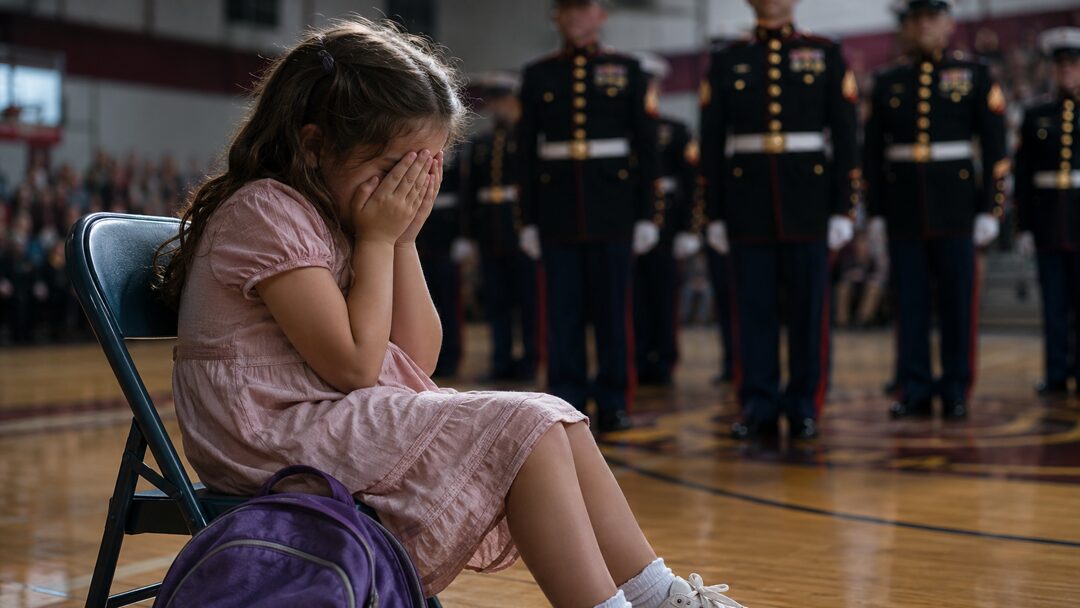
Emily Carter kept both hands over her eyes because everyone in the gym was looking at her.
At least, it felt that way.
She sat alone on a folding chair at center court, her knees pressed together, her pale pink dress scratchy at the waist, her scuffed sneakers barely touching the polished floor. Beside her left ankle, her purple backpack leaned against the chair leg with one broken zipper pull hanging loose.
Behind her, boots struck the gym floor in perfect rhythm.
One step.
Then another.
Then another.
The sound moved closer from the far double doors, steady and hard and impossible to ignore.
Emily squeezed her eyes shut under her palms.
She had promised Mrs. Bennett she would try not to cry.
She had promised the principal she could be brave.
She had promised herself she would not look stupid in front of the whole school.
But promises felt smaller when five hundred people were quiet.
“Emily Carter,” Principal Harris had said into the microphone a minute earlier, his voice bouncing from the rafters, “has been chosen to receive our flag today on behalf of Mrs. Bennett’s fourth-grade class.”
The applause had started then.
Emily had stood because Mrs. Bennett touched her shoulder and whispered, “That’s you, honey.”
She had walked to the chair because everyone expected her to. She had sat because there was nowhere else to go.
Now her hands were over her face.
She could hear the bleachers creak.
She could hear someone cough.
She could hear a younger kid whisper, “Is she crying?”
Emily pressed her fingers tighter against her eyelids until tiny sparks of color appeared.
She hated being watched.
She hated how grown-ups used soft voices when they said her dad’s name.
She hated how proud she was of him, because pride did not sit next to her at dinner. Pride did not check the hallway at night when the house made noises. Pride did not smell like coffee and garage dust and peppermint gum.
The boots came closer.
The sound reached the center aisle now. It did not sound like normal walking. Normal walking had little mistakes in it. A toe dragged. A heel squeaked. Someone moved too fast or too slow.
This was different.
This was one body made of many people.
Emily knew what the grown-ups wanted her to feel. Respect. Gratitude. Honor. Those were the words printed on the red-white-and-blue bulletin board outside the gym.
But under her hands, Emily felt something smaller and messier.
She felt afraid.
Not because of the Marines marching behind her.
Because part of her wanted one of them to be her father so badly that it made her stomach hurt.
And wanting too much was dangerous.
Wanting too much made every phone call feel shorter. Every holiday feel fake. Every seat at the table look louder than the people sitting in the other seats.
Mrs. Bennett crouched beside her chair, close enough that Emily could smell peppermint tea on her breath.
“You can keep your eyes closed,” she whispered. “You’re doing just fine.”
Emily nodded without moving her hands.
She was not doing fine.
The boots kept coming.
Part II — The Letter Table
That morning, Emily had almost refused to wear the pink dress.
“It’s wrinkly,” she told her mother, though it was not.
Her mother, Lisa Carter, had been standing in the doorway with a hairbrush in one hand and the tired smile she used when she was pretending not to be tired.
“You picked it out last night.”
“I changed my mind.”
“It’s picture day for the assembly.”
“It’s not picture day.”
Lisa had not argued. She had just sat on the edge of Emily’s bed and placed the brush in her lap.
“You don’t have to wear it because of the assembly,” she said. “You can wear it because your dad always said you looked like spring in that dress.”
That was not fair.
Emily looked down at the carpet.
The dress had been her father’s favorite because he had bought it too big the summer before he left and told her, “You’ll grow into it by the time I come back.” He had said it like coming back was a normal date on a calendar. Like Tuesday. Like Christmas. Like school starting again.
But he had missed Halloween.
Then Thanksgiving.
Then her piano recital.
Then the day she finally rode her bike without training wheels and crashed into the neighbor’s trash cans because he was not there to run beside her.
She put on the dress.
At school, everything had felt too bright. Paper flags on the walls. Construction-paper stars. Teachers wearing red sweaters. A table near the gym doors stacked with letters in plastic sleeves.
Emily recognized one before she even saw her name.
It had a crooked heart above the i.
Her heart.
She stopped walking.
Mrs. Bennett noticed. She always noticed.
“Those are some of the letters your class wrote,” she said gently. “The principal asked if we could display them.”
Emily stared at the table.
There were letters about thank you for serving and my uncle was in the Navy and my dog’s name is Pickles. There were drawings of flags and tanks and smiling suns. Emily’s letter was not on top, but she could see the corner of her paper under a blue ribbon.
“I thought those got mailed,” Emily said.
“They did. We made copies first.”
“You didn’t say that.”
Mrs. Bennett’s face changed. Just a little.
“I’m sorry. I should have.”
Emily looked toward the gym doors. Students were already filing inside.
“Do people read them?”
“Some people might.”
Emily’s throat tightened.
It was stupid to be upset about a letter. She was nine, not a baby. She knew how assemblies worked. Grown-ups made speeches. Kids clapped when told to clap. Someone would play a song badly on the trumpet. Then everyone would go back to class and eat cafeteria pizza.
But that letter had not been for people.
It had been for her dad.
Or maybe it had been for the space where her dad was supposed to be.
Mrs. Bennett knelt until they were eye level.
“Principal Harris wants you to sit up front because your dad’s unit is being honored today,” she said. “He told me to tell you it’s for your dad.”
Emily’s heart gave one hard knock.
“For my dad?”
“Yes.”
“Is there a video?”
Mrs. Bennett hesitated so briefly that most people would not have seen it.
Emily saw it.
“I don’t know everything,” Mrs. Bennett said.
That was not a no.
That was worse than a no.
A no was a wall. This was a door left open.
Emily looked at the gym again, then at the letter table, then at her purple backpack hanging off one shoulder.
“What if I cry?”
“Then you cry.”
“In front of everyone?”
Mrs. Bennett’s voice softened. “Then everyone will know you love him.”
Emily did not answer.
Love was not the embarrassing part.
Need was.
She went into the gym anyway.
Because the principal had said it was for her dad’s unit.
Because her mother had watched from the hallway with wet eyes and both hands around her phone.
Because part of Emily still believed that if she was good enough, brave enough, grateful enough, maybe wanting would not hurt so much.
Now, at center court, with her hands over her face, Emily wished she had stayed in class.
The boots were almost behind her.
Part III — The Last Man in Line
Staff Sergeant Michael Carter had asked to march at the rear.
Captain James Miller had looked at him for a long second when he made the request.
“You sure?”
“Yes, sir.”
“You understand if you’re at the rear, she may not see you until we’re almost past her.”
“That’s the point.”
Captain Miller had not smiled. He was not the kind of man who wasted expressions.
But his eyes had softened.
“Understood.”
Michael had rehearsed the return for three weeks in his head. He had imagined walking into Emily’s classroom. He had imagined waiting on the porch. He had imagined hiding behind the garage door like he used to do when she was little and jumping out with a stupid growl until she shrieked and laughed.
Every version felt wrong.
Too sudden.
Too private.
Too much like he was sneaking back into a life that had kept moving without him.
Then Lisa had told him about the assembly.
“She wrote a letter,” Lisa said over the phone the night after he landed stateside. “Her class wrote letters. She wouldn’t let me read hers.”
“Did she say why?”
“No.”
He had heard what Lisa did not say.
Emily had become careful.
That was the word that kept following him.
Careful.
Careful on video calls, as if she did not want to ask when he was coming home in case the answer changed again.
Careful with her drawings, holding them up to the camera for only a second before saying, “It’s not that good.”
Careful at bedtime, refusing to say she missed him until she thought the call was about to end.
Once, months ago, he had told her, “I miss you more than anything.”
She had answered, “Then why are you still there?”
No one had trained him for that question.
He could handle orders. He could handle exhaustion. He could handle fear as long as fear had a job attached to it.
But his daughter’s voice through a bad connection had undone him in a way nothing else could.
Now he marched into her school gym in dress blues, white cap low on his head, spine straight, face controlled.
The gym smelled like floor polish, paper decorations, and cafeteria heat.
It smelled nothing like home.
Then he saw her.
Emily sat at center court with both hands over her face.
For one impossible second, Michael forgot the count.
His left foot nearly came down late.
The Marine beside him kept the rhythm, and Michael found it again.
Left.
Right.
Left.
His daughter looked smaller than she had on video calls.
That was the first thing that hurt.
On screens, she was a face. A voice. A forehead too close to the camera. A missing tooth. A drawing shoved into view. A blur of hair as she ran to show him something before the call dropped.
Here, she had knees and shoulders and sneakers and a backpack with a broken zipper.
Here, she was a whole child sitting alone in a huge room.
His child.
His left hand tightened at his side.
Captain Miller marched ahead of him, calm as a locked door. The captain had planned the ceremony so there would be a formal pause. The color guard would halt near center court. Principal Harris would read one letter. Emily would receive the flag. Then Michael would step forward.
Clean.
Dignified.
Controlled.
Michael had liked that word before today.
Controlled meant nothing broke.
But the sight of Emily covering her face made him wonder if the whole plan had been built by adults who had forgotten what it felt like to be small.
She did not look surprised.
She looked trapped.
The formation moved closer.
A few kids in the bleachers leaned forward. Phones rose in the back rows. Teachers pressed their lips together, already knowing more than Emily did.
Michael kept his eyes forward.
If he looked at her too long, he would stop.
And if he stopped too soon, the whole gym would know before she did.
Captain Miller gave the smallest glance over his shoulder.
Not a question.
Not a command.
A reminder.
Hold.
Michael held.
But holding felt less like strength with every step.
Part IV — What She Wrote
Principal Harris had a ceremony voice.
Emily had never liked it. It was too round and too shiny, like the voice he used belonged to a bigger, nicer principal who did not exist on regular school days.
“Before we present the flag,” he said, “I’d like to share a few words written by one of our own students.”
Emily’s fingers froze against her face.
No.
Not hers.
Please not hers.
Paper shifted at the microphone.
Mrs. Bennett’s hand touched the back of Emily’s chair.
Emily lowered her palms just enough to see the polished wood between her sneakers. The gym floor reflected blurry shapes: flags, shoes, legs, the bright stripe of the principal’s tie.
Then Principal Harris began to read.
“Dear Marines,” he said, “my name is Emily Carter. My dad is with you right now, unless he moved somewhere else and cannot say.”
The gym went still in a different way.
Emily’s face burned.
She wanted to disappear under the chair.
“I am supposed to say thank you, so thank you. My mom says you do brave things. My teacher says service means doing something hard for other people. I think my dad is brave, but sometimes I wish he was less brave and more home.”
A sound moved through the bleachers. Not laughter. Not exactly sadness.
Something softer and worse.
Emily stared harder at the floor.
Why would they read that part?
Why would any grown-up read that part?
Mrs. Bennett’s hand tightened on the chair.
At the back of the formation, Michael heard the words and felt them go through his body like cold water.
Less brave and more home.
He kept his jaw still.
Principal Harris continued, slower now, as if he had just realized the letter was not a decoration.
“I don’t remember what Dad’s boots sound like anymore, but I think I would know if they came down the hallway.”
Michael’s left hand twitched.
The gym did not vanish. He wished it would. He wished he could be anywhere private, anywhere without polished floors and folded flags and hundreds of eyes.
Emily had written that.
His little girl had written that she did not remember.
No.
Worse.
She had written that she was afraid she did not remember, and then tried to save them both by believing she still might.
Captain Miller heard it too.
His posture did not change, but Michael saw the captain’s right hand flex once at his side.
Michael thought of the bike chain.
It was a ridiculous memory to come at that moment, but it arrived whole.
Emily at seven, standing in the driveway in star leggings, watching him kneel over her purple bike. Him trying to fix the chain after two cups of coffee and not enough patience. His left hand shaking just enough to make the chain slip twice.
“Your hand is dancing,” she had told him.
“It does that when it has an audience.”
“Tell it to stop.”
“I’m not in charge of everything, Emmy.”
She had laughed like that was the funniest thing he had ever said.
Now, in the gym, Michael’s hand trembled again.
He hated it.
Then he hated himself for hating it.
Maybe she would see it.
Maybe she would know.
Or maybe she would look at him and see only a man in a uniform who had been gone long enough to become a visitor.
Principal Harris reached the end of the letter.
“If my dad gets this, please tell him I am taking care of Mom and I got better at spelling. Also, I still saved him the blue cup. From Emily.”
The blue cup.
Michael closed his eyes for half a second.
At home, Emily had always given him the blue cup for orange juice, even when all the cups were clean. He had never known she noticed. He had never known she saved it.
The applause began gently, uncertain at first, then spreading.
Emily did not lift her head.
Mrs. Bennett leaned in close.
“I’m sorry,” she whispered. “I didn’t know he was going to read that much.”
Emily’s voice came out small and sharp.
“It was private.”
“I know.”
“You copied it.”
Mrs. Bennett did not defend herself.
That made it worse somehow.
The boots had stopped behind Emily.
The sudden silence was louder than the marching.
She could feel people waiting.
She could feel the whole gym leaning toward whatever came next.
And for the first time, she wanted to turn around.
But wanting had fooled her before.
Part V — The Hand at the Brim
Captain Miller called the halt.
The formation stopped as one.
Emily heard the final bootstep land and settle.
She held her breath.
Principal Harris said something about honor, about gratitude, about sacrifice. His words floated over Emily’s head without landing. Adults liked words that made hard things sound smooth.
Emily did not want smooth.
She wanted the blue cup to mean something.
She wanted the hallway at home to make the right sound again.
She wanted to be mad without someone telling her she should be proud instead.
Behind her, Michael stood three paces from the chair and could not move.
Not yet.
His cap felt too heavy. His collar felt too tight. His daughter’s shoulders were shaking, but she was not making any sound.
That was new.
When Emily was little, she cried with her whole body. Big, honest sobs. Angry tears. Dramatic gasps if she scraped her knee or lost a game or could not find the stuffed rabbit she insisted did not matter.
This silence was something she had learned while he was away.
Michael suddenly understood that his return could not be an entrance.
It had to be an apology without the word apology.
Not because he was wrong to serve.
Because love still counted the cost.
Captain Miller turned his head slightly.
The pause had arrived.
This was the place in the plan where Michael would step forward, remove his cap, and let the room see him.
But he did not step forward.
He looked at Emily’s hands covering her face.
He looked at the purple backpack touching her shoe.
He saw the broken zipper pull and had the absurd, fatherly thought that he could fix it.
Not later.
Not someday.
He wanted to fix it now.
His left hand rose to his cap.
At first, Emily saw only the reflection on the gym floor.
A dark sleeve.
A white shape moving.
Then she parted two fingers.
A Marine near the center aisle was removing his cap.
She had seen Marines do that in videos. It could be part of the ceremony. Maybe they all did it before handing over a flag. Maybe she was making things up because she wanted too much again.
Then his left hand trembled against the brim.
Emily stopped breathing.
The hand shook once, just barely.
Not like fear.
Like coffee.
Like a bike chain slipping.
Like a man kneeling in the driveway saying, I’m not in charge of everything, Emmy.
Her hands dropped from her face to her mouth.
She still had not seen his whole face.
Only the hand.
Only the cap.
Only the tiny mistake in the middle of all that perfect ceremony.
But something inside her knew before her eyes were ready.
Mrs. Bennett saw the change.
Emily’s back went still. Her shoulders stopped shaking. Her head tilted, not toward the principal, not toward the crowd, but toward the sound behind her.
Mrs. Bennett stood slowly.
She looked at Captain Miller.
He looked back.
No one said anything.
That was the moment Sarah Bennett understood that helping did not mean touching Emily’s shoulder again. It did not mean whispering instructions. It did not mean guiding her through the reveal the adults had planned.
It meant getting out of the way.
She stepped back from the chair.
The small movement opened a path.
Michael saw it.
Captain Miller saw it too.
The captain’s voice, when it came, was low enough that only the formation heard.
“Staff Sergeant.”
One word.
Permission.
Michael stepped out of line.
The room changed.
There was no big gasp. Not at first. Just a shift, a tiny breaking of the pattern. The eye knows when order bends. The heart knows faster.
Boots that had moved as one now made a single sound.
Michael walked toward the chair.
Emily stared at the floor.
She could see his shoes now. Polished black. Still. Close.
Her fingers curled around the edge of the seat.
If she turned and it was not him, she would not survive it.
That was what it felt like.
Not really. She knew she would still have to go to math and eat lunch and ride home with her mother.
But something in her would fold up and not open again for a long time.
Behind her, the Marine lowered himself to one knee.
The floor creaked softly under him.
His cap was in his right hand now.
His left hand rested open on his thigh, trembling where everyone could see.
Then he spoke.
Not loudly.
Not like a ceremony.
“Emmy.”
The room disappeared.
Emily made a sound that was almost a gasp and almost his name.
“Emmy,” Michael said again, and his voice broke on the second syllable. “It’s okay if you don’t want everyone watching. I’m right here.”
Emily turned.
For one second, she did not move.
Her father was on one knee behind her chair.
His hair was shorter. His face was thinner. His eyes looked tired in a way video calls had hidden. He was wearing the uniform from pictures, the one that made other people stand straighter, but he was looking at her like he had forgotten every rule except the one that mattered.
Be gentle.
Be there.
Emily stared at him.
Michael did not reach for her.
That was what broke her.
He waited.
He had crossed oceans, plans, ceremonies, and the length of the gym, but he did not cross the last few inches without her.
Emily stood so fast the folding chair scraped backward.
The sound cracked through the gym.
Her purple backpack tipped over and fell flat on the floor.
She ran.
Not far.
Only three steps.
But to Emily, it felt like every hallway she had waited in, every call that had frozen, every night she had pretended not to listen for the front door.
She hit him with both arms around his neck.
Michael caught her and folded around her like his whole body had been waiting to remember this shape.
The gym erupted.
Bleachers thundered. People stood. Teachers clapped with their hands over their mouths. Someone cried openly. Principal Harris stopped speaking because there was nothing useful left to say.
Emily heard none of it clearly.
Her face was pressed into her father’s collar. The fabric was stiff and unfamiliar. Under it, he smelled like soap, airport air, and something that was simply him.
She clung harder.
Michael held her with one arm across her back and one hand at the back of her head, careful of the pins her mother had put in her hair.
“I’m here,” he whispered.
Emily shook her head against him.
Not no.
Not yes.
Just too much.
He held her through it.
The cap lay on the floor beside his knee.
Part VI — The Purple Backpack
The applause lasted longer than Emily wanted, but shorter than it would have if Captain Miller had not turned toward the crowd and lifted one hand.
Not sharply.
Not unkindly.
Just enough.
The gym quieted in waves.
Michael did not stand right away. Emily was still wrapped around him, and he seemed to understand that if he moved too soon, the moment would become public again.
So he stayed on one knee.
A Marine in dress blues kneeling on an elementary school gym floor, holding a girl in a pink dress while a purple backpack lay behind her chair.
That was how the room remembered it.
But Emily remembered something else.
His heartbeat.
Fast.
Her father was nervous.
That stunned her.
Somewhere in her mind, she had made him too brave to be nervous. Too busy to be lonely. Too trained to be scared. The adults had helped. They called him strong so often that Emily had started to think strong meant not needing anybody.
But his heart was racing under her cheek.
“You came,” she whispered.
Michael’s face twisted.
“I came.”
“You said spring.”
“I know.”
“It’s almost winter.”
“I know.”
She pushed her forehead harder against his shoulder, as if punishing him and forgiving him with the same movement.
He accepted both.
“I saved the blue cup,” she said.
A sound came out of him that was not quite a laugh.
Lisa Carter stood near the gym doors with one hand pressed to her mouth. She had promised Michael she would let Emily have the first moment. She had promised herself she would not run across the gym before her daughter did.
Now she stayed where she was, crying quietly, because some reunions had an order of their own.
Mrs. Bennett wiped under one eye and pretended she was fixing her lanyard.
Captain Miller stepped back into formation, but he did not call Michael back.
Some orders could wait.
Emily finally leaned away enough to look at her father’s face.
Really look.
There were lines near his eyes she did not remember. A small nick near his jaw. His smile was careful, like he was afraid any sudden happiness might scare her.
“Your hand still dances,” she said.
Michael looked down at his left hand.
It was still trembling.
He closed it once, then opened it.
“Yeah,” he said. “It does.”
“You drank too much coffee?”
“Probably.”
She narrowed her eyes through tears.
“That means yes.”
“That means yes.”
For the first time all morning, Emily smiled.
Small.
Unsteady.
Real.
The principal tried to restart the ceremony after that. He said a few words about service and family. A student choir sang one verse of a song. The flag was presented, though Emily barely understood when someone placed it in Michael’s hands and then he gently guided it into hers.
The flag felt heavier than she expected.
Michael did not let go until she had it.
Then he let go.
That mattered too.
After the assembly, people wanted pictures. They wanted handshakes. They wanted to say thank you. Michael answered each person with the same quiet courtesy, but his eyes kept returning to Emily.
She stood beside him, one hand gripping two of his fingers.
Not his whole hand at first.
Just two fingers.
Enough to know he was there.
Mrs. Bennett approached slowly.
“Emily,” she said, “I’m sorry about the letter.”
Emily looked at her teacher.
There were many things she could have said. She could have said it was okay, because that was what children were often expected to say when adults apologized.
But it had not been okay.
So she said, “You should ask next time.”
Mrs. Bennett nodded.
“You’re right.”
Michael looked down at Emily, and something like pride moved through his face. Not the flag kind. Not the assembly kind.
The father kind.
Lisa reached them then.
For a moment, Emily thought her mother might fall apart. Instead, Lisa touched Michael’s cheek with one hand, like she needed proof, and then leaned her forehead against his for one second.
No speech.
No perfect family photograph.
Just breath.
Just arrival.
When the gym began to empty, Emily returned to the folding chair.
Her purple backpack was still on the floor where it had fallen. One pencil had slipped out of the front pocket. A corner of her math homework peeked from under the flap.
The ordinary things had waited too.
Michael picked up the pencil first and slid it into the pocket. Then he lifted the backpack and frowned at the broken zipper pull.
“This still broken?”
Emily looked at him.
“You noticed?”
“Of course I noticed.”
“You were gone when it broke.”
“I can still notice.”
She did not answer right away.
The sentence settled between them.
He could still notice.
That was not the same as never leaving. It did not fix Halloween or the recital or the bike crash or all the nights her mother had looked tired in the kitchen.
But it was something.
Michael crouched, turning the backpack so the straps faced her.
“May I?”
Emily turned around.
He helped her into the straps carefully, one shoulder, then the other, smoothing the dress where the backpack bunched it at the waist.
It was such a normal thing that Emily almost cried again.
Not because everyone was watching.
Most people had gone.
Not because she was sad.
Not exactly.
Because her father, who had entered the gym in perfect step with other Marines, was now fussing with a fourth-grade backpack and pretending the broken zipper was a serious engineering problem.
“There,” he said. “Temporary fix.”
“You didn’t fix anything.”
“I adjusted it.”
“That’s not fixing.”
“It’s the first phase of fixing.”
She rolled her eyes.
He smiled like he had been waiting a year to be insulted by her.
At the gym doors, Captain Miller waited with the remaining Marines. Michael looked toward him, and for a moment Emily felt the old fear rise again.
Someone would call him back.
Someone would say there had been a mistake.
Someone would need him more than she did.
Captain Miller seemed to understand. He gave Michael a small nod, not the kind from the ceremony, not the kind that belonged to rank.
This one meant go.
Michael looked down at Emily.
“Ready?”
She slipped her hand into his.
Not two fingers this time.
His whole hand.
Her palm was small and warm, and she held on hard enough to tell the truth without saying it.
As they walked out of the gym, Emily listened.
Her mother’s steps on one side.
Her father’s on the other.
The polished shoes did not sound exactly like she remembered. The hallway was louder. The floor was different. She was different too.
But she knew them.
Halfway to the doors, she looked up at him.
“I knew your shoes,” she said.
Michael stopped walking.
Only for a second.
Then he bent his head, and his face did the thing adults tried to hide when their feelings got too big.
“I was hoping you would,” he whispered.
Emily leaned against his arm.
Outside the gym, the bulletin board still said honor and gratitude and service in paper letters.
Emily passed it without looking.
She had better words now.
His hand.
Her backpack.
The sound beside her.
And the slow, careful walk home from waiting.