What the Silence Kept
Part I — The Missing Sentence
David Carter heard the voice three times before he let anyone breathe.
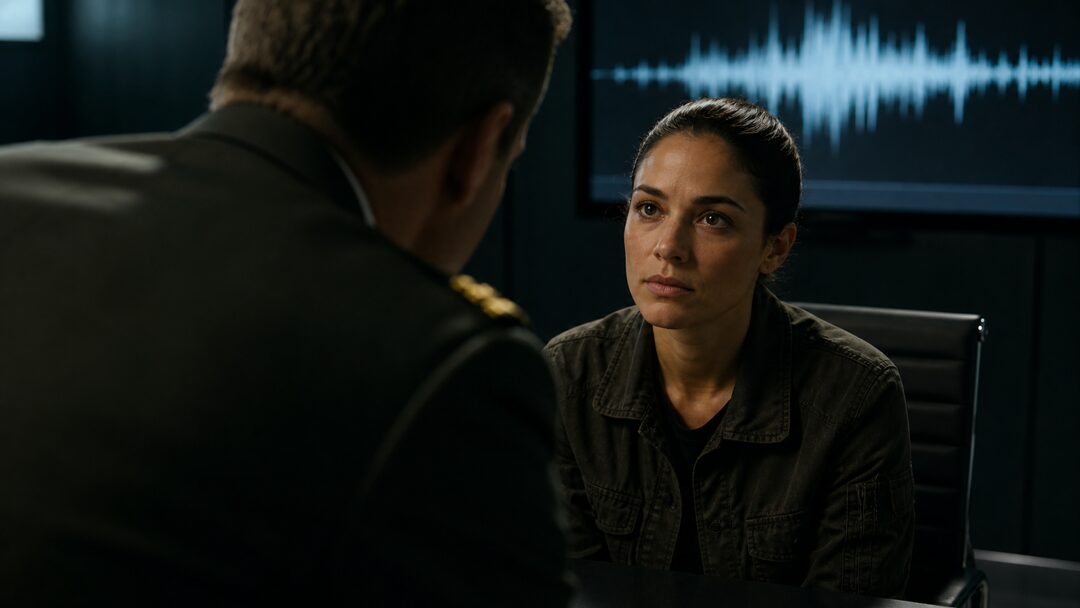
The room was dark except for the blue line of the audio file crawling across the screen. Six officers sat around the table, still as furniture, watching the waveform break into static.
A man’s voice came through the speakers, strained and close.
“This isn’t what we were told—”
Then nothing.
No gunfire. No scream. No final order.
Just a cut so clean it felt deliberate.
David lifted one hand.
The technician stopped the playback.
Nobody moved.
Across from him, Jessica Miller sat with her hands folded in front of her, her sleeves buttoned to the wrist, her face unreadable. She was the only person in the room who had been there when the recording was made.
She did not look at the screen.
She looked at David.
“That’s all?” he asked.
The technician swallowed. “That’s all we recovered, sir.”
David’s jaw shifted once.
“Everyone out.”
Chairs scraped. Papers closed. The room emptied with the quiet discipline of people grateful not to be questioned first.
Jessica remained seated.
David waited until the door sealed behind the last officer. Only then did he press play again.
“This isn’t what we were told—”
Silence.
He stopped it.
“Tell me what came next.”
Jessica’s eyes did not change. “I already submitted my statement.”
“No,” David said. “You submitted a timeline.”
“It was accurate.”
“It was incomplete.”
For the first time, something moved across her face. Not anger. Not fear.
Recognition.
David leaned back, studying her the way he studied maps, intercepted messages, thermal images, patterns of movement over hostile ground.
“You were the last one transmitting from the site,” he said. “The original field report was never filed. Three people from your unit are unaccounted for. The asset vanished. Civilians were caught in the event. Command wants a reconstruction by tomorrow evening.”
Jessica’s voice stayed flat. “Command wants a clean version.”
David did not answer.
That was the problem with silence.
Sometimes it accused you before anyone else did.
Jessica looked at the black speaker in the center of the table.
“He didn’t finish the sentence,” she said.
David folded his hands. “Then finish it for him.”
She gave him a tired smile without warmth.
“Sir, if you wanted the truth, you wouldn’t have called it a reconstruction.”
Part II — The Official Version
Twenty-six hours earlier, Robert Hayes had handed David the assignment in a room with no windows.
Hayes was the kind of man who made stillness feel like rank. Late fifties, pressed uniform, silver hair, eyes trained by decades of command to reveal nothing until revealing something became useful.
“The report is missing,” Hayes said.
David stood at attention because Hayes had not told him to sit.
“Missing, sir?”
“Never submitted.”
David kept his expression neutral. “From Miller’s team?”
Hayes slid a folder across the desk.
David opened it.
The operation had been marked successful at planning stage, compromised in execution, and unresolved in aftermath. That was the kind of language headquarters used when people were gone and nobody wanted to decide what to call it yet.
A covert extraction. A human asset. A target building. An unexpected civilian presence. A communications break.
No completed field report.
No clean casualty statement.
No verified chain of events.
David read the first page twice.
Hayes watched him. “We need an official reconstruction.”
“Accurate or defensible?”
Hayes’s mouth tightened.
David already knew he had gone too far.
“Both,” Hayes said.
There it was. The word that made men like Hayes believe they were still telling the truth.
David closed the folder. “Why me?”
“Because you’re precise.”
That was one answer.
The other sat buried somewhere in the file.
David had spent most of his career being useful because he did not flinch at distance. He could read disaster from above. A roadblock. A crowd pattern. A failed evacuation route. A heat signature gone still. He had built a life out of seeing consequences without having to stand inside them.
Jessica Miller had stood inside this one.
Now she sat across from him in the briefing room, refusing to give him what he needed.
He opened her statement.
It was exactly what he expected from a trained operative: concise, chronological, clean. Too clean.
Arrival at staging point. Confirmation of asset location. Obstruction near east access road. Communications interruption. Visual contact with unidentified civilians. Deviation from planned route. Extraction attempt unsuccessful. Team separation. Emergency withdrawal.
No emotion. No hesitation. No explanation for why her route changed forty-two seconds before the command feed went dark.
David tapped the page.
“You deviated before the break in communication.”
Jessica’s gaze dropped to the document. “Yes.”
“Why?”
“There was movement on the east side.”
“Your report says unidentified civilians.”
“That is what they were.”
“How many?”
A pause.
“Two.”
David marked the pause.
“Your first statement says one.”
“My first statement was taken while I was under sedation.”
“You were treated for smoke exposure, not sedation.”
Her eyes lifted.
There it was again. That thin line of resistance.
David turned another page. “The drone footage shows three heat signatures outside the building.”
“Then the drone saw three.”
“You saw two.”
“I saw what I could reach.”
That sentence stayed in the room longer than it should have.
David watched her.
Jessica looked exhausted in a way sleep would not fix. Her hair was pulled back tight. There was a faint line near her temple where a cut had healed badly. Her posture was perfect, but too perfect, as if collapse had become a thing she controlled by muscle memory.
He had interviewed frightened people, guilty people, loyal people, dishonest people.
Jessica looked like someone who had already lost the argument and refused to help him write it down.
David slid a second document toward her.
“Your route change put you outside the approved corridor.”
“Yes.”
“You broke from mission structure.”
“Yes.”
“You did not request authorization.”
“No.”
“Why?”
She stared at the paper.
He waited.
The old David would have filled the silence with pressure. The better version of him, the one command trusted, let silence do the work.
Jessica finally said, “Because authorization would have taken too long.”
“To do what?”
“To make the wrong thing official.”
David’s pen stopped.
Jessica stood.
“I’ve answered everything I’m required to answer.”
“You are still under review.”
“So are you,” she said quietly.
David looked up.
For the first time since she had entered the room, her expression changed.
Not enough for anyone else to notice.
Enough for him.
“What does that mean?” he asked.
Jessica pushed the statement back toward him.
“It means you should read the file you didn’t sign.”
Part III — The Line That Moved
David did not sleep that night.
He told himself that was normal. Reconstruction work required repetition. One transcript became three timelines. Three timelines became a contradiction map. Contradictions became pressure points. Pressure points became truth.
That was the theory.
By 0300, the theory had begun to turn against him.
The drone footage showed the target building from above, white shapes moving against black ground. Jessica’s team entered on schedule. The asset signal pinged from the rear structure. The planned extraction route remained clear for six minutes.
Then a vehicle appeared on the east access road.
Then another shape.
Then a third.
David watched the footage again.
A child-sized heat signature moved out from the shadow of the wall.
He froze the frame.
Not a child, he corrected himself.
Unknown civilian.
The language arrived automatically, cold and clean.
Jessica’s team split. One member continued toward the target structure. Two shifted east. Jessica moved toward the smaller figure.
Forty-two seconds later, the command feed lost synchronization with field audio.
David opened the comm log.
Parts were intact. Most were broken. Some had been redacted, then restored badly by a technician who had probably assumed nobody would notice the time stamps were uneven.
David noticed.
He always noticed.
At 21:14:08, Jessica transmitted: “Civilian presence confirmed, east road.”
At 21:14:16, command responded: “Proceed to objective.”
At 21:14:22, Jessica: “Negative. Civilian in path.”
At 21:14:31, command: “Proceed.”
At 21:14:40, an unidentified male voice cut in.
“This isn’t what we were told—”
Then the gap.
David replayed the recovered fragment.
The voice was not Jessica’s.
It belonged to Mark Ellis, the team lead.
David pulled Mark’s file.
Thirty-eight. Two daughters. Commendations. Clean discipline record. Known for caution under pressure.
Known for caution.
David sat back.
Men like Mark Ellis did not say sentences like that unless something had already gone wrong.
At 0417, David found the encrypted packet.
It had been attached to a pre-mission exchange and flagged as corrupted. The file name was meaningless. The routing label was not.
It had passed through command review.
David decrypted it manually.
Jessica’s voice appeared first, typed into a field note eighteen hours before the operation.
Asset location remains unverified. Civilian traffic pattern inconsistent with original assessment. Recommend delay or route reassessment.
Below it, Mark Ellis had added:
Concur. Ground indicators do not match planning brief.
Then came the command response.
Proceed under original parameters. Window will not reopen.
No signature.
Only an authorization code.
David stared at it.
He knew that code.
Not by memory.
By the feeling in his chest before recognition became thought.
He opened the mission authorization chain.
There were twelve names on the planning distribution. Four analyst initials. Two legal checks. One command approval.
And there, beside final route validation, sat his own digital mark.
D.CARTER.
David did not move.
For years, he had believed there were two kinds of responsibility: direct and theoretical. Direct was the order spoken into a headset. The hand on the door. The person who chose left instead of right.
Theoretical was paperwork.
A file reviewed at 2300. A risk note compressed. A route approved because the intelligence window was closing and command wanted certainty before the facts had earned it.
He remembered that night.
Not the mission.
The night.
Cold coffee. Twenty-three open files. Hayes standing behind him, saying, “We don’t need perfect, Carter. We need workable.”
David had seen the civilian traffic note.
He remembered it now because he had dismissed it with one sentence.
Pattern inconclusive.
Two words had helped move a team into the dark.
Two words had become silence.
His phone vibrated.
Hayes.
David answered.
“Where are we?” Hayes asked.
David looked at the frozen screen.
“Behind,” he said.
“You have until tomorrow at eighteen hundred.”
“I need full access to pre-mission review.”
“You have what you need.”
“No, sir. I have what survived.”
Hayes went quiet.
Then he said, “Be careful how you phrase that.”
David looked again at his authorization mark.
“Is that an order?”
“It’s advice.”
From anyone else, it might have meant mercy.
From Hayes, it meant threat.
Part IV — What She Changed
Jessica returned at 0900.
David had not left the room. The lights were brighter now, but the room felt smaller. On the wall screen, three timelines sat beside one another: Jessica’s statement, drone feed, recovered comms.
They did not match.
Jessica noticed before she sat down.
“You found it,” she said.
David did not ask what.
He pointed to the empty chair.
She sat.
He played the first clip.
“Civilian presence confirmed, east road.”
He stopped it.
“You objected before the mission.”
Jessica’s face closed.
“Mark objected too,” David said.
She looked at him then.
A small movement. Sharp.
“You didn’t put that in your statement.”
“No.”
“Why?”
“Because Mark isn’t here to defend what he meant.”
David absorbed that.
“Did he say this?” He pressed play.
“This isn’t what we were told—”
Jessica’s jaw tightened.
“Yes.”
“What came next?”
She looked at the table.
David waited.
“You already know enough,” she said.
“I know the recording cuts off.”
“You know someone approved bad information.”
“That is not the same as knowing what happened.”
Her hands folded tighter.
The room hummed around them.
Finally, she said, “Mark saw the west entrance blocked from the inside. Not abandoned. Blocked. The asset wasn’t waiting for extraction. Someone had moved people in.”
“Civilians.”
“Yes.”
“How many?”
Jessica’s mouth opened.
Then closed.
“How many?” David repeated.
“More than the file says.”
David felt the sentence land in him without sound.
Jessica continued, voice steady but thin. “The plan assumed an empty corridor, one asset, fast movement. But there were people there. Families. Someone had used the building because it looked safe.”
David looked at the map.
Safe.
A word the file had never used.
“Mark wanted to abort.”
“And you?”
“I wanted to get the kid off the road.”
David looked at her statement.
Unidentified civilian.
That was what she had written.
Not child.
Not boy.
Not someone small enough to carry.
“You altered your report,” he said.
Jessica’s eyes flashed.
“I altered one line.”
“You changed the number.”
“I changed who could be identified.”
“Why?”
“Because if I named him, they would look for him.”
David frowned.
Jessica leaned forward. For the first time, the fatigue in her eyes became something harder.
“He survived because I broke route. He survived because I ignored the second proceed order. If I put him in the report, command would call him a loose end with a face.”
David said nothing.
Jessica’s voice dropped.
“I didn’t lie to protect myself.”
“You lied.”
“I chose the only person in that file who still had a chance.”
The words struck harder because she did not raise her voice.
David looked down at her statement. He had read it as evasion. Then as guilt. Now it was something worse for him.
It was judgment.
Not spoken at him.
Built into the shape of what she refused to say.
“What happened to the asset?” he asked.
“I don’t know.”
“What happened to Mark?”
She closed her eyes once.
When she opened them, they were clear.
“He stayed to redirect the team. He knew the comms were compromised. He knew command wasn’t hearing us right, or wasn’t listening. He said, ‘This isn’t what we were told.’ Then he looked at me and said, ‘Take him.’”
“The boy.”
Jessica nodded.
“What was the rest of the sentence?”
She looked at the speaker.
David did too.
For nearly a minute, neither of them spoke.
Then Jessica said, “He said, ‘This isn’t what we were told. But it’s what’s here.’”
David felt something inside him shift, not break.
Breaking would have been easier.
“What’s here,” he repeated.
Jessica’s face tightened.
“That’s what reports are supposed to be, aren’t they?”
Part V — The Version They Wanted
Hayes arrived at 1700 with two aides and no patience.
David met him in the briefing room. Jessica was not present. The reconstructed packet sat on the table in front of David, unsigned.
Hayes glanced at the wall screen and saw too much.
The three timelines.
The restored objection.
The authorization chain.
His expression did not change, but one of the aides looked away.
“Clear the room,” Hayes said.
The aides left.
David stayed standing.
Hayes looked at the packet. “You were instructed to produce a reconstruction.”
“I did.”
“This includes pre-mission dissent.”
“It is relevant.”
“It includes incomplete intelligence analysis.”
“It shaped the route.”
“It implies command negligence.”
David met his eyes.
“It documents command sequence.”
Hayes’s mouth tightened. “Don’t play language games with me.”
David almost smiled.
Not because anything was funny.
Because he finally heard it.
The whole institution was made of language games. Neutralized. Compromised. Unconfirmed. Collateral. Unresolved. Words built to carry weight without leaving fingerprints.
Hayes stepped closer.
“You think this makes you clean?”
“No, sir.”
“Good. Because it does not.”
“I know.”
“You authorized route validation.”
“I did.”
“You accepted the assessment.”
“Yes.”
“You had access to the objection.”
David felt the room narrow.
“Yes.”
Hayes lowered his voice. “Then understand what you are doing. If this version goes forward, it does not just damage the command structure. It damages you.”
David looked at the file.
For twenty years, he had thought integrity meant not falsifying facts.
He had been wrong.
Sometimes integrity meant refusing to arrange facts so they could no longer accuse anyone.
Hayes continued, softer now, almost kind.
“There is a way to phrase this. Communication degradation. Field-level deviation. Unknown civilian interference. Loss of asset confidence. We protect the living. We honor the missing. We preserve operational capacity.”
David heard the offer inside the words.
A clean version.
A defensible version.
A version where everyone could stand at ceremonies and speak in sentences that did not bleed into the next room.
But Jessica had said: It’s what’s here.
David picked up the packet.
Hayes watched him.
“Carter.”
David paused.
Hayes’s voice hardened. “This command will not carry a report written like an apology.”
David turned back.
“It isn’t an apology.”
“Then what is it?”
David thought of the broken sentence. The child on the road. Mark Ellis seeing what the plan refused to see. Jessica changing one line because the truth, written carelessly, could become another weapon.
He thought of his own mark on the file.
D.CARTER.
“It’s a report,” David said.
Hayes stared at him for a long moment.
Then he smiled without warmth.
“You always were precise.”
After Hayes left, David sat alone and rewrote the final section.
He removed every phrase that performed certainty.
He restored Jessica’s objection.
He restored Mark’s concurrence.
He included the flawed civilian assessment.
He included the command response: Proceed under original parameters.
He included his own authorization.
He did not dramatize it.
He did not defend it.
He did not hide it in passive construction.
At 23:11, Jessica entered without knocking.
David looked up.
“I was told you wanted me to review the final version,” she said.
He turned the screen toward her.
She stood behind the chair instead of sitting.
For five minutes, she read.
David watched her face. Nothing changed until she reached the final page.
There, he had written:
The operation did not fail because one field operative deviated from the route. The route failed before execution because the conditions on the ground no longer matched the assumptions preserved in planning. Field deviation resulted in one confirmed civilian survival. The consequences of original authorization remain subject to command review.
Jessica’s hand moved to the back of the chair.
She read it again.
Then she looked at the authorization line.
At his name.
David waited for anger.
He deserved at least that.
Jessica only said, “You put yourself in it.”
“I was already in it.”
Her eyes stayed on him.
For a second, he saw how young she was under the discipline. Not innocent. Not unbroken. Just young enough that she might have believed, once, that the chain of command was a chain because it held things together.
Then she nodded once.
Not forgiveness.
Not gratitude.
Recognition.
Sometimes that was the only mercy adults could offer each other.
“Submit it,” she said.
David did.
Part VI — What Remained
The report moved faster than David expected.
By morning, his access to two databases had been suspended. By noon, he received notice of reassignment to a training division three states away. The message contained no reprimand, no accusation, no explanation.
That was how institutions punished cleanly.
They moved you until your absence sounded administrative.
Jessica’s resignation came two weeks later.
David learned about it from an internal personnel update he was not supposed to see anymore. She had declined an exit ceremony. Declined counseling follow-up through command. Declined to leave a forwarding address in any field visible to him.
That suited her.
Some people survived by becoming impossible to file correctly.
On his last evening before reassignment, David returned to the briefing room alone.
The building had already emptied into weekend quiet. His badge still worked on that door, though he suspected it would not by morning.
He sat where he had sat before.
The speaker remained in the center of the table.
He opened the recovered audio one last time.
“This isn’t what we were told—”
The silence followed.
But now it was not empty.
Now David could hear what the file had not held.
Mark’s unfinished warning.
Jessica’s refusal.
Hayes’s careful phrases.
His own tired hand approving a line he had not questioned hard enough because pressure had made almost-right feel close enough to true.
He played it again.
“This isn’t what we were told—”
He stopped the recording before the cut.
For a long moment, he sat with the sentence unfinished.
Then he opened the final report and read the line that would likely end whatever future he had imagined for himself.
Field deviation resulted in one confirmed civilian survival.
He did not know the boy’s name.
Jessica had kept that from everyone.
For the first time since the operation file had landed on his desk, David was grateful for something missing.
His phone buzzed once.
An unknown number.
The message contained no greeting.
Only a photograph.
A small backpack sat on a kitchen chair beside a window. The image was slightly blurred, as if taken quickly by someone who did not want to be noticed. There was no face in the frame. No location marker. No proof anyone else would recognize.
Then another message came.
He has started drawing roads.
David stared at the words until the screen dimmed.
He did not reply.
There was nothing safe to say. Nothing large enough. Nothing clean enough.
Instead, he saved nothing, deleted nothing, and placed the phone face down on the table.
Outside the room, the hallway lights clicked off in sections.
David remained seated in the dark.
The final report was gone now, traveling through channels that would bend it, challenge it, bury it, or preserve it in some locked archive where truth became accessible only to those with the right clearance and the wrong conscience.
He could not control that.
He had controlled enough.
At the door, he paused and looked back at the room.
For years, he had believed the truth was something you found by removing noise.
Now he understood it was often the opposite.
Truth was what remained after everyone had taken out the parts that made them uncomfortable.
David turned off the speaker.
The silence stayed.
This time, he did not try to fill it.