The Coastal Rescue Ramp Blocked by the Vain Social Influencer
CHAPTER 4: THE OCEAN YOUTH ILLUSION
Inside the processing room of the Dare County Sheriff’s Substation in Buxton, the fluorescent lights buzzed with a dull, clinical hum. The room smelled of industrial floor disinfectant, stale coffee, and damp marine canvas. Savannah Cross sat on a backless metal bench bolted to the concrete floor, her wrists still handcuffed behind her back, her bare feet tucked under the bench to avoid the cold tile floor.
On the laminate table across from her sat Detective Marcus Reed of the Dare County Financial Crimes Unit, alongside Sergeant Holloway. Spread out across the table were the contents of Savannah’s confiscated designer beach tote: five high-limit commercial credit cards, three encrypted flash drives, an unfiled corporate checkbook, and a thick leather organizer filled with banking receipts. Every single financial document bore the name of her shell corporation, detailing luxury shopping sprees across Miami, Beverly Hills, and the Bahamas.
“Miss Cross,” Detective Reed said, tapping a freshly printed corporate filing with the tip of his ballpoint pen. “For the past eighteen months, your social media accounts have promoted the AuraFlow Ocean Youth Foundation. You claimed to your two million followers that ten percent of all subscriber revenue and one hundred percent of your special livestream donations were deposited into an escrow account to fund free surf survival and swim lessons for underprivileged children in coastal communities across North Carolina.”
Savannah lifted her chin, attempting to summon her trademark camera-ready confidence. “That is a legitimate charitable initiative! I am a philanthropist! My team organizes workshops all over the country!”
Reed pulled an eight-page banking audit from a manila folder, sliding it directly in front of her. “According to your foundation’s primary depository account at First Atlantic Bank, over the last twelve months you collected seven hundred and forty-two thousand dollars from private donors and small-dollar subscribers.”
Reed leaned forward, his eyes locking onto hers with unsparing scrutiny. “Do you know how many swim lessons your foundation paid for in that entire twelve-month period, Miss Cross?”
Savannah’s lips pressed together in a tight, defensive line. She said nothing.
“Zero,” Reed stated flatly. “Not one dollar went to a municipal pool, a YMCA, a surf instructor, or a lifeguard academy. Instead, our forensic accountants traced three hundred and twenty thousand dollars directly to the lease payments on your three-million-dollar waterfront home in Wrightsville Beach. Another eighty-five thousand dollars went to the down payment on a Porsche Cayenne registered to your personal LLC. And last month, forty thousand dollars was wired directly to an offshore holding account in the Cayman Islands under the name Aura International Holdings.”
Savannah’s breath hitched. The arrogant sneer vanished from her face, replaced by a sudden, sickening paleness that spread down her neck. “Those were… those were legitimate administrative expenses! Influencers have operating costs! I have to maintain my public image to attract corporate sponsors!”
“Soliciting charitable donations under false pretenses across state lines using the internet is not an operating cost, Miss Cross,” Reed said with icy finality. “That is federal wire fraud. It is mail fraud. And it is aggravated charitable fraud under North Carolina General Statutes.”
The door to the processing room opened, and Chief Petty Officer Megan Vance walked in, carrying a certified medical status report from Children’s Hospital of The King’s Daughters in Norfolk.
“Chief,” Holloway said, standing up. “How is the boy?”
Megan smiled—a genuine, warm expression that completely transformed her tired face. “Noah Jenkins is off the ventilator. His lung x-rays are clear, his neurological vitals are normal, and he’s asking for a cheeseburger. The doctors said if the ATV had arrived forty seconds later, the brain hypoxia would have been permanent and catastrophic.”
Savannah looked up from the table, her voice trembling with rising desperation. “See? He’s fine! The kid didn’t even get hurt! So why are you treating me like a criminal?! You can’t charge me with child endangerment if he survived!”
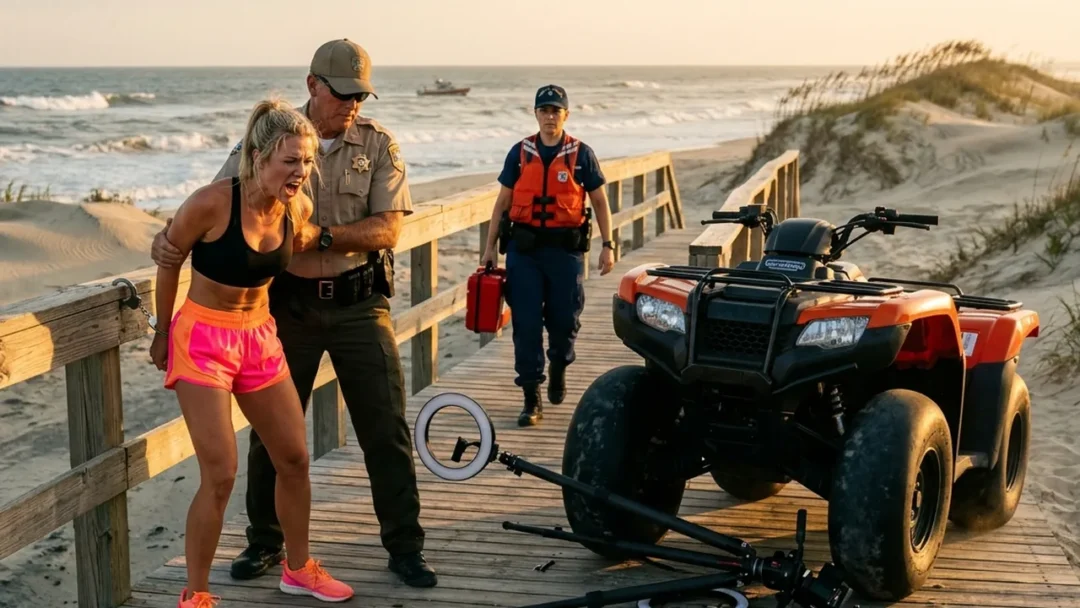
Megan walked over to the metal bench, looking down at the handcuffed woman with cold, unyielding disgust. “Noah Jenkins survived because three trained rescue professionals risked their lives in twelve-foot breakers while you stood on a wooden ramp crying over an LED light. You didn’t save that child, Savannah. You did everything in your power to stand between him and the hospital.”
Detective Reed’s desk phone rang. He answered it, listened for thirty seconds, and scribbled several notes on his pad before hanging up.
He looked at Savannah. “Miss Cross, that was the United States Attorney’s Office in Raleigh. Because your livestream was broadcast across interstate computer networks and involved a physical assault on an active-duty member of the United States Armed Forces during a maritime rescue, the Department of Justice has officially assumed jurisdiction of your case.”
Savannah’s eyes went wide with pure terror. “The… the federal government?”
“Two federal marshals are en route from Elizabeth City right now,” Reed said. “You won’t be sleeping in our county lockup tonight.”