The Contaminated Diesel Lot And The Ocean Of Giant Sunflowers
CHAPTER 5: THE MIDNIGHT OIL SPILL
Defeated, humiliated, and facing the immediate collapse of his $50,000 municipal hauling contract, Roger Vance drove away from the property in a cloud of bitter, sulfurous exhaust.
By seven o’clock that evening, the sun had set behind the western treeline, casting long, purple shadows across the twelve-foot golden canopy. Inside the small wooden workshop at the back of the lot, Frank and Maya sat at the workbench, sharing a thermos of hot coffee, reviewing the final clearance paperwork that would be filed with the county recorder in the morning.
“The biofuel refinery in Lima has already offered three hundred and twenty dollars a ton for the harvested sunflower stalks,” Maya smiled, showing Frank the preliminary purchase contract on her tablet. “Because the heavy metals are bound permanently inside the plant’s structural cellulose, the stalks can be processed into industrial ethanol and bio-char without releasing the contaminants into the atmosphere. You’re not just debt-free, Frank. You’re going to make thirty-five thousand dollars on this harvest.”
Frank looked down at Bruno, who was lying peacefully across his boots, his tail thumping softly against the wooden floorboards. “We couldn’t have done it without you, Maya. My grandfather always said that if you treat the earth with respect, it will give you back tenfold.”
At 9:15 PM, the quiet of the night was shattered by a soft, urgent electronic chime from Frank’s smartphone resting on the workbench.
Frank picked up the phone. The screen flickered to life, displaying a live 4K infrared night-vision video feed from a high-resolution cellular trail camera he had concealed in the branches of the ancient walnut tree overlooking the central furrow.
Frank’s eyes narrowed into razor-sharp slits of steel.
The tactical security setup around the perimeter had been designed by Frank using surplus military sensor hardware and commercial cellular trail cameras. Knowing that an eighty-pound guard dog could not monitor five acres simultaneously without clear line-of-sight, Frank had positioned four solar-powered thermal motion sensors along the boundary fence lines, networked to a local radio frequency transmitter in the barn. When Clint Vance stepped through the broken chain-link fence, the silent electronic alert had registered on Frank’s screen before the saboteur had taken three steps into the furrow.
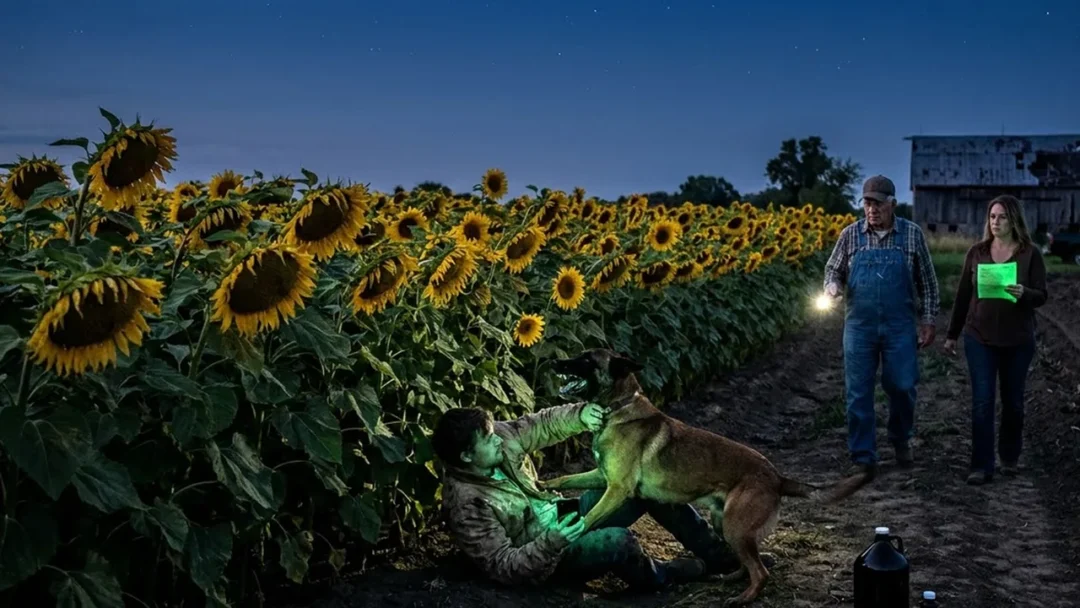
Out in the dark, twelve-foot-tall sunflower rows, fifty yards from the road, a shadowy figure in a dark hooded jacket was creeping along furrow nine. The trespasser was carrying a five-gallon commercial plastic jug and an iron trenching spade.
The camera zoomed in with thermal clarity.
The man knelt down beside the central inspection borehole where Dr. Hayes had pulled his certified state soil core hours earlier. The trespasser unscrewed the cap of the heavy jug, tipped it forward, and began deliberately pouring thick, black, viscous industrial crankcase oil directly into the state sample hole.
Beside the man on the ground lay an unsealed manila envelope containing pre-printed forged laboratory labels and a copy of the state inspection certificate.
It was Clint Vance—Roger Vance’s younger brother and the scrap yard foreman for Vance Environmental Hauling.
“That miserable bastard,” Frank whispered, his voice deadly quiet. “They’re salting the inspection hole so they can call in an emergency re-test before the county recorder opens at eight AM.”
The working-dog heritage of the Belgian Malinois was bred for high-velocity protection and uncompromising tactical precision. Developed in the late nineteenth century around the city of Mechelen, the breed combined the explosive acceleration of a greyhound with the bone-crushing jaw pressure and relentless courage of an imperial mastiff. Unlike common police German Shepherds that relied on heavy body checks, a trained Malinois operated with razor-sharp agility, capable of changing direction in mid-air at thirty miles an hour and executing silent, low-trajectory takedowns in pitch-black darkness. Bruno was not a pet; he was a disciplined eighty-pound counter-strike asset trained to protect Frank’s perimeter with absolute fidelity.
Beside the workbench, Bruno stood up instantly. The eighty-pound Belgian Malinois did not bark. He did not growl. He locked his golden eyes onto Frank’s face, his muscular body vibrating with taut, coiled kinetic energy, waiting for the single command he had been trained to obey since puppyhood.
Frank slipped his phone into his pocket, stepped over to the kennel door, and took a deep, steady breath.
He reached down, flipped the heavy steel latch, and pointed his hand directly through the darkness toward furrow nine.
Waiting in the darkness of the workshop, watching the night-vision feed flicker on his phone, Frank felt the familiar, cold tactical focus that had carried him through desert ambushes thirty years before. In combat, panic was a fatal luxury; you observed the adversary, identified their primary line of advance, and allowed them to commit themselves fully to their objective before executing a decisive counter-stroke. By allowing Clint Vance to unscrew the cap and pour the oil directly into the state sample borehole on camera, Frank had ensured that the crime was completely consummated and incontrovertibly documented before a single paw touched the grass.
“Bruno,” Frank commanded in a sharp, quiet whisper. “Packen! Go!”