The Contaminated Diesel Lot And The Ocean Of Giant Sunflowers
CHAPTER 2: THE WHITE FUNGAL BLANKET
The following morning at dawn, the sound of an approaching four-cylinder diesel engine rattled down Blackfork Road. A battered flatbed farm truck pulled through the gate, loaded with sixty plastic totes filled with five hundred pounds of pasteurized, colonized grain spawn, alongside an ancient rear-tine Howard rototiller.
Maya Lin hopped down from the running board, adjusting the straps of her canvas field overalls. Maya was twenty-two, an honors senior in environmental biochemistry and agronomy at Ohio State University, with bright, intense dark eyes and an infectious, unstoppable scientific energy. Her undergraduate thesis was focused on mycoremediation—the targeted use of fungal mycelium to break down complex industrial hydrocarbons in degraded agricultural soils.
“Mr. Miller?” Maya asked, extending a dirt-stained leather work glove. “Dr. Aris Thorne at the extension office called me last night. He said you had five acres of high-molecular-weight polycyclic aromatic hydrocarbons and the stubbornness to let me test an enzyme protocol.”
Frank shook her hand with a warm, approving nod. “I have five acres of pure poison, Maya, and a crooked councilman trying to steal it from me in fifty-eight days. What can your mushrooms do?”
“Fungi are the planet’s premier digestive system, Frank,” Maya said, walking over to the nearest oily puddle and kneeling in the clay.
She dipped a glass pipette into the greasy black water, pulling up a sample of the oily residue. “Diesel fuel and engine oil are complex hydrocarbons—long chains of carbon and hydrogen bonded into benzene rings. They don’t break down naturally because native soil bacteria lack the specialized enzymes to crack those rings open. But wood-decaying white-rot fungi, specifically Pleurotus ostreatus—the common oyster mushroom—evolved over hundreds of millions of years to decompose lignin, which has an almost identical chemical ring structure to crude oil.”
The biochemical mechanics of mycoremediation represented one of the most promising frontiers of modern environmental biotechnology. Wood-rotting fungi like Pleurotus ostreatus were primary decomposers in terrestrial ecosystems, possessing unique, non-specific enzymatic systems designed to dismantle the complex, recalcitrant structure of wood lignin. Because the chemical bonds holding synthetic petroleum hydrocarbons together—specifically long-chain alkanes and toxic polycyclic aromatic hydrocarbons like benzo[a]pyrene—closely resembled the randomized carbon-carbon and ether linkages in natural lignin, the fungal mycelium did not need to adapt or mutate. It simply perceived the heavy diesel spill as an immense fallen hardwood log, releasing gallons of extracellular peroxidases that dismantled the toxins at the molecular level.
Maya opened one of the plastic totes, revealing a thick, snowy-white blanket of fibrous fungal mycelium growing through sterilized rye grain. It smelled fresh, rich, and clean, like damp woods after an autumn rain.
“Oyster mushroom mycelium produces three extraordinary extracellular enzymes,” Maya explained, holding up a clump of the white grain. “Lignin peroxidase, manganese peroxidase, and laccase. When we till this mycelium into the top six inches of oily clay, those enzymes act like molecular scissors. They cleave the carbon-hydrogen bonds in the petroleum, converting the toxic diesel into simple sugars, water, and carbon dioxide. In fourteen days, the oil isn’t just neutralized; it’s converted into rich, dark organic humus.”
The agricultural chemistry of spent coffee grounds and straw mulch was a crucial co-substrate in the mycoremediation design. While the white-rot fungus was capable of surviving on pure diesel hydrocarbons, the introduction of easily digestible cellulose and trace nitrogen from coffee waste provided the initial metabolic priming needed for the mycelium to establish a dense, three-dimensional vegetative network throughout the compacted clay. The coarse straw particles also acted as mechanical spacers, aerating the dense soil matrix and allowing oxygen to penetrate eighteen inches below the surface, which prevented the formation of toxic anaerobic fermentation zones.
Maya’s passion for bioremediation was rooted in her childhood on the shores of Lake Erie, where she had watched toxic algal blooms and industrial runoff poison community drinking water intakes. Mentored by Dr. Aris Thorne, a legendary retired state agronomist who had pioneered biological pest suppression across the Midwest, Maya had rejected lucrative corporate consulting internships with agrochemical giants in order to conduct field trials with working-class landowners. She believed passionately that scientific knowledge was useless unless it could be deployed directly into the hands of ordinary people fighting to defend their homes and livelihoods against corporate exploitation.
For forty-eight continuous hours, Frank and Maya turned the five-acre lot into a biological bioreactor. Using Frank’s vintage Massey Ferguson tractor and the heavy Howard tiller, they ripped through the compacted gray clay, breaking the hardpan into loose, crumbly beds. Behind the tiller, Maya walked with a broadcast seeder, spreading five hundred pounds of the white mushroom grain spawn across the furrows, sealing the inoculated beds with a thin top dressing of clean straw and spent agricultural coffee grounds donated by local roasters.
By day twelve, a biological miracle had unfolded across the gray lot.
Under the warm August sun, the black, foul-smelling oily puddles had completely vanished. In their place, a dense, continuous web of brilliant white mycelium had colonized the entire top eight inches of soil. Thousands of clusters of pearlescent gray oyster mushrooms were erupting through the straw, looking like sea coral in a woodland tide pool. When Frank knelt down and scooped up a handful of the dirt, the foul, sulfurous stench of diesel was gone. The soil smelled sweet, deep, and rich, crumbly as baker’s chocolate.
On day fourteen, Maya brought out a six-row agricultural precision drill seeder, hitching it to the tractor.
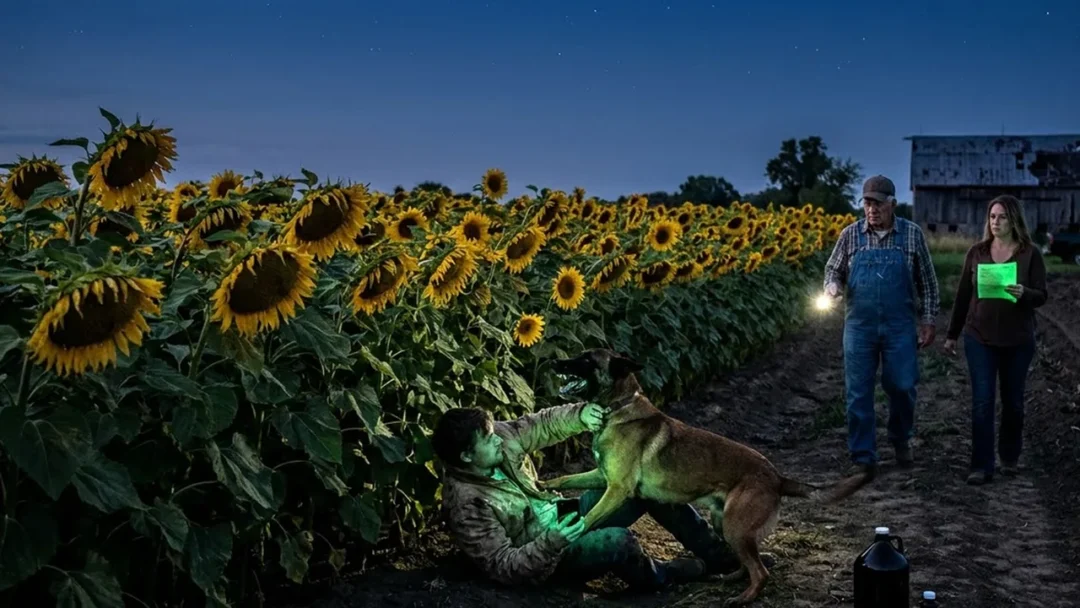
Into the hopper went one hundred thousand seeds of Helianthus annuus—Russian Mammoth sunflowers, an antique heritage variety bred to produce twelve-foot-tall fibrous stalks and two-foot-wide heavy seed heads.
“The mushrooms ate the diesel,” Maya said, pulling the lever to engage the seed coulters. “Now the sunflowers eat the heavy metals.”
Just as the first row of seeds entered the dark loam, the wail of a municipal siren split the afternoon silence. A black-and-white township police cruiser skidded through the gate, followed closely by Roger Vance’s town sedan.