The Cracked Renaissance Canvas In The Marble Auction Vault
CHAPTER 2: THE SOUND OF FRACTURING POPLAR
The shrill, mechanical shriek of the crate’s emergency alarm continued to pierce the subterranean quiet, but inside Julian Kensington’s mind, the only sound that echoed was the sickening, brittle snap of ancient timber splitting under atmospheric shock.
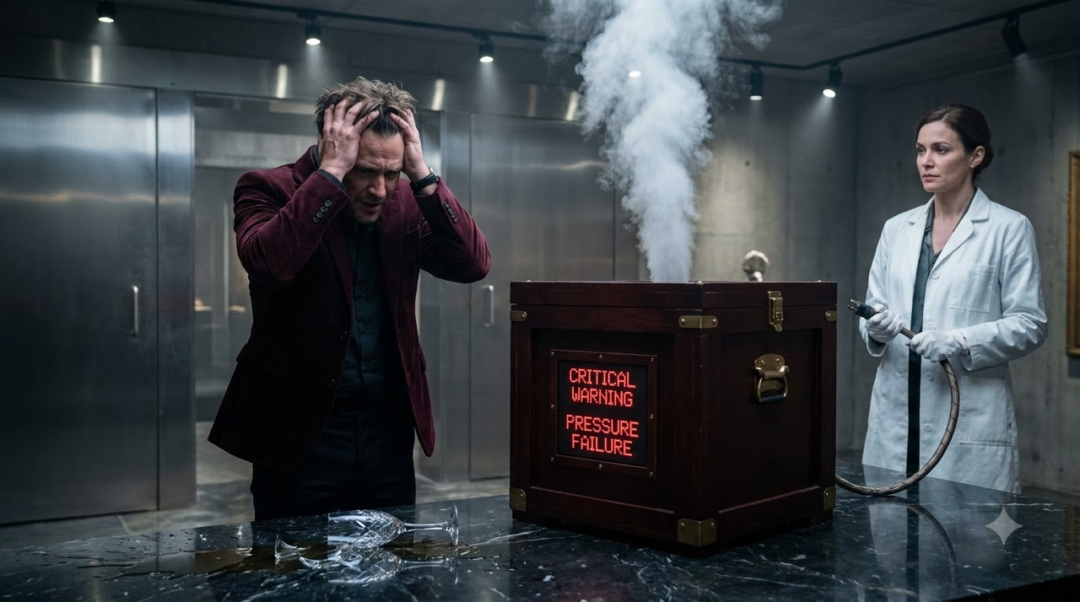
The white condensation mist had settled into a damp frost across the mahogany lid, melting into oily beads under the harsh 4000K track lights. Charles Moreau stood frozen in his tracks ten paces away, his golden auction paddle trembling in his hand, his aristocratic jaw slackened in an expression of pure, unadulterated horror. The bill of sale slipped slightly in his fingers, its gold-embossed edges catching the flashing red strobe light that transformed the serene art vault into a chaotic chamber of disaster.
“Gabriel…” Moreau breathed, his voice trembling so violently he could barely form the syllables. He stepped forward with uncharacteristic clumsiness, his leather tuxedo shoes splashing heedlessly through the spilled champagne. “Tell me you’re mistaken. Tell me the shock absorbers held. We had six inches of high-density neoprene lining the cradle!”
“The shock absorbers protect against kinetic impact during transport, Charles,” Gabriel replied calmly, tossing his discarded cotton gloves onto the stainless-steel console. “They do not protect against thermodynamic collapse. Poplar wood absorbs and releases ambient moisture through microscopic capillary action. When that cable was severed, the positive-pressure nitrogen barrier vented in less than three seconds. The dry air of this gallery, held at thirty-five percent relative humidity, rushed into the vacuum. The gesso ground, composed of calcified gypsum and rabbit-skin sizing, contracted faster than the seasoned wood beneath it could flex. The wood fought the paint, and the wood split.”
Gabriel stepped up to the control module on the side of the mahogany crate. He pulled an auxiliary lithium-polymer battery pack from his coat pocket and plugged it into the diagnostic port. The cracked liquid crystal screen rebooted with a faint, low-frequency chime, displaying an automated internal telemetry log recorded by the high-precision acoustic sensors inside the foam core:
TIMESTAMP 19:42:11 – PRIMARY LINE POWER LOSS DETECTED.
TIMESTAMP 19:42:12 – CAVITY HUMIDITY: 52.4% -> 21.8% IN 800MS.
TIMESTAMP 19:42:13 – ACOUSTIC SENSOR 2: STRUCTURAL FAILURE CONFIRMED (1,400 HZ SHEAR EVENT).
TIMESTAMP 19:42:14 – TRANSVERSE DEFLECTION: 4.8 MILLIMETERS ALONG CENTRAL GRAIN.
Kensington stumbled forward, his polished loafers splashing through the spilled champagne and broken crystal. He grabbed Gabriel’s lapel with trembling, desperate fingers, leaving dark stains on the pristine white lab coat. His breath smelled heavily of expensive alcohol and blind terror.
“Open the crate!” Kensington shrieked, his face mottled red and white with frantic hysteria. “Open it right now! It might just be a surface scratch! We can glue it! We can hire the best restorers from the Metropolitan Museum! I know people at Christie’s and Sotheby’s—they fix hairline fractures every single day! I’ll pay fifty thousand dollars for a rush restoration! I’ll pay a hundred thousand!”
Gabriel looked down at Kensington’s hand on his collar with cold, clinical detachment.
“Remove your hand from my person, Mr. Kensington,” Gabriel said softly, every word enunciated with surgical precision. “Before I instruct security to document your physical assault alongside your criminal destruction of cultural property.”
Kensington recoiled as if burned by white phosphorus, staggering backward until his spine struck the cold marble pillar. “You… you were negligent! You were supposed to safeguard the art! Charles, tell him! This is Vance & Moreau’s responsibility! Your staff failed to maintain the safety perimeter! I am not paying five million two hundred thousand dollars for a box of broken kindling!”
Charles Moreau slowly lowered his golden paddle, his face hardening from shock into the sharp, predatory mask of an international art broker whose entire career was built on the unyielding language of high-end contract law. In the high-stakes world of blue-chip auctions, fortunes were won and lost on commas and indemnification clauses.
“Julian,” Moreau said, his voice dropping into a register of icy, aristocratic formality. “Did you, or did you not, sign the Vance & Moreau Private Acquisition Master Agreement at four o’clock this afternoon in our executive lounge?”
“Of course I signed it!” Kensington shouted wildly, his voice bouncing off the titanium vault walls. “To secure the bid! To ensure the panel wouldn’t go to that Japanese consortium! That was a preliminary bidding agreement!”
“It was a binding purchase instrument, Julian,” Moreau continued, stepping forward and opening the leather-bound bill of sale to a highlighted section stamped in blue corporate ink. “Paragraph Fourteen, Clause C. Quote: The buyer acknowledges that high-value antiquities and Renaissance panel paintings are subject to acute environmental vulnerability. The buyer expressly waives all warranties of physical condition and assumes all risk of loss or damage occurring upon the drop of the auctioneer’s hammer. End quote.”
Moreau pointed an immaculate, manicured finger toward the ceiling, where a dome-shaped 4K security camera was aimed directly down into Bay Four.
“Furthermore, Julian,” Moreau added, his eyes narrowing into cold slits, “that lens captured you kicking Dr. Ross’s calibration equipment and physically yanking the power cable out of the wall while shouting that you didn’t care about the crate. Your wire transfer cleared Chase Manhattan Bank twenty-two minutes ago. The money is in an irrevocable escrow holding account. As a matter of law, you did not destroy our painting, Julian. You destroyed your own.”
Kensington sank down against the marble pillar, sliding until his velvet blazer was soaked in the puddle of champagne on the floor. His manicured hands clawed at his silk tie, loosening it with frantic, choking jerks as beads of sweat dripped from his chin.
“Five million dollars…” Kensington whimpered, staring at the floor with hollow, unseeing eyes. “My investors… that wire was collateralized against my private equity fund’s offshore liquidity reserves. If the audit committee finds out the collateral is worthless wood, my fund will face immediate redemption calls… I’ll be ruined before the markets open tomorrow…”
“They won’t just find out the wood is broken, Mr. Kensington,” Gabriel Ross said, stepping over to the heavy glass doors of the vault and keying the emergency security lock.
The heavy laminated glass doors slid shut with a heavy, magnetic thud, the electronic bolt throwing deep into the reinforced steel frame.
“They are also going to find out where you stole it.”