The Cracked Renaissance Canvas In The Marble Auction Vault
CHAPTER 3: THE FIVE-MILLION-DOLLAR INVOICE
Twenty minutes later, the executive boardroom on the fourth floor of Vance & Moreau Fine Arts felt like a fortified command bunker.
Outside the towering mahogany-framed windows, the lights of Madison Avenue glittered through the freezing rain, streetlights reflecting off the wet black roofs of passing town cars. But inside the soundproofed chamber, the air was thick with the scent of bitter black coffee and expensive legal cologne.
Julian Kensington sat at the center of the thirty-foot glass conference table. He had wiped the champagne from his trousers, but the velvet of his blazer was rumpled, his hair disheveled, his breathing shallow and rapid. Across from him sat his personal attorney, Arthur Vance-Sterling—a silver-haired litigator with a reputation for ruthless corporate defense—flanked by two private security aides who looked distinctly uncomfortable in the presence of the building’s armed security guards standing at the doors.
At the head of the table sat Charles Moreau, his face impassive, reading glasses perched on his nose as he reviewed a five-page electronic summary. Standing beside the projection screen, still wearing his white laboratory coat, was Dr. Gabriel Ross.
“This is an administrative ambush, Charles!” Attorney Vance-Sterling snapped, slamming a leather-bound briefcase onto the glass table with theatrical indignation. “My client is a premier patron of the arts, a founding trustee of three cultural foundations, and one of your most lucrative private accounts. To detain him in your lower vault and threaten him with criminal allegations over an unfortunate mechanical malfunction is actionable defamation and unlawful imprisonment!”
“An unfortunate mechanical malfunction?” Gabriel Ross asked, his voice cutting through the lawyer’s bluster like a diamond stylus through soft wax.
Gabriel tapped the remote control in his hand.
The eighty-inch high-definition monitor on the wall illuminated, displaying a crystal-clear 4K video feed recorded forty minutes earlier in Bay Four. The audio played with terrifying, high-fidelity clarity through the ceiling speakers:
“…I don’t care about your cheap box! Move it or I’ll buy this gallery and throw you onto Madison Avenue!…”
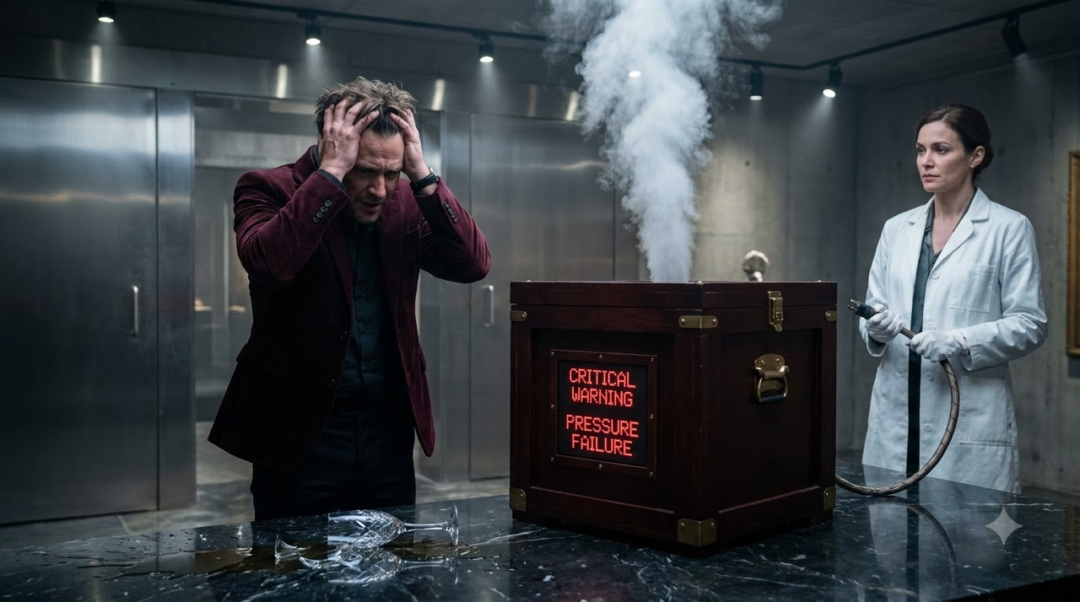
On the screen, every frame was timestamped down to the millisecond. The video showed Kensington’s foot striking the aluminum instrument case, sending it spinning into the pillar. Then, with unmistakable clarity, it showed Kensington’s fingers gripping the heavy yellow braided cable, yanking it from the wall, and the bright blue arc of electrical discharge that followed.
Simultaneously, a high-resolution telemetry overlay appeared on the right side of the screen, tracking the crate’s internal pressure sensors:
VOLTAGE DROP: 0.0 SECONDS.
SEAL INTEGRITY COLLAPSE: 1.8 SECONDS.
ACOUSTIC STRUCTURAL FRACTURE: 2.4 SECONDS.
Kensington flinched, shrinking back into his leather chair as his attorney stared at the screen in stunned, open-mouthed silence. The litigator’s mouth opened, but no words came out; the forensic evidence was so clean, so direct, and so incontrovertible that no court in the state could dismiss it.
“That video has already been copied to an immutable off-site server certified by the New York State Department of Financial Services,” Charles Moreau said, closing his leather folder with a soft, final snap. “Under the Uniform Commercial Code and New York General Business Law, Mr. Kensington’s actions constitute gross negligence and intentional physical spoliation of goods. The five-million-two-hundred-thousand-dollar purchase price is non-refundable, non-negotiable, and fully earned by this house.”
“You can’t enforce a contract on a destroyed asset!” Kensington cried, leaping to his feet, his hands shaking violently as he pointed at Gabriel. “He’s an employee! He provoked me! He deliberately stood in my way to trigger an incident!”
“Dr. Ross is not an employee of this auction house, Julian,” Moreau countered with chilling composure.
Kensington stopped dead, his mouth hanging open. “What?”
Gabriel Ross reached into the breast pocket of his white lab coat, pulled out a credential wallet bound in dark blue leather, and flipped it open on the glass conference table.
Resting on the velvet lining was a gold federal shield bearing an eagle and an engraved legend:
SPECIAL CONSULTANT – FEDERAL BUREAU OF INVESTIGATION – ART CRIME TEAM.
Beside the badge was an official credential card identifying Dr. Gabriel Ross as a Senior Conservator for the International Council of Museums and an accredited forensic expert for the United States Department of Justice.
“I was not hired by Vance & Moreau to stabilize that crate, Mr. Kensington,” Gabriel said, his voice dropping into a cadence of absolute authority. “I was appointed three weeks ago by the United States District Court for the Southern District of New York to serve as the court-appointed forensic monitor for Lot One Hundred and Eight.”
Kensington sank back down into his seat, the last vestige of color draining from his face until his lips looked blue.
“The… the Southern District?” Kensington whispered, his voice trembling.
“The Madonna of the Pomegranate was looted from the private chapel of the Villa Corsini outside Florence during the chaos of the summer of 1944,” Gabriel said, leaning forward across the table. “For eighty years, it was believed lost. Six months ago, it resurfaced in an unlisted freeport vault in Geneva, purchased by an offshore entity registered in the British Virgin Islands called Kensington Heritage Holdings.”
Gabriel stepped closer, his eyes locked on Kensington’s trembling gaze.
“You knew the painting carried a red notice from Interpol. You knew the Italian Ministry of Cultural Heritage had filed an active international restitution claim. And you rushed this auction through Vance & Moreau before federal customs could inspect the crate.”
Gabriel tapped the conference table with his knuckle.
“Now, Mr. Kensington, we are going back down to Vault B3. And you are going to watch us open that crate in front of federal agents.”