The Cracked Renaissance Canvas In The Marble Auction Vault
CHAPTER 6: THE RESTITUTION CHAMBER
By midnight, the primary auction amphitheater of Vance & Moreau was cleared of its celebrity patrons, leaving behind an empty expanse of blue velvet seats, abandoned champagne flutes, and the quiet dignity of a historic legal confrontation. The golden chandeliers had been dimmed to twenty percent, focusing all illuminating power onto the elevated stage.
At the center of the auction stage sat three presentation tables draped in heavy black velvet.
On the left table lay the two fractured halves of The Madonna of the Pomegranate, protected within a sealed acrylic nitrogen micro-dome that maintained a steady fifty percent relative humidity to prevent further degradation. On the center table sat the sixty-eight forged export certificates, foreign banking ledgers, and forensic UV photographs recovered from Kensington’s briefcases. On the right table sat a formal treaty document bearing the raised wax seals of the United States Department of State and the Embassy of Italy in Washington, D.C.
Seated behind the table was Dr. Marco Moretti, Cultural Attache to the Italian Embassy, who had flown up from Washington on an emergency military shuttle. Beside him sat Charles Moreau, looking exhausted but resolute, and Assistant United States Attorney David Vance.
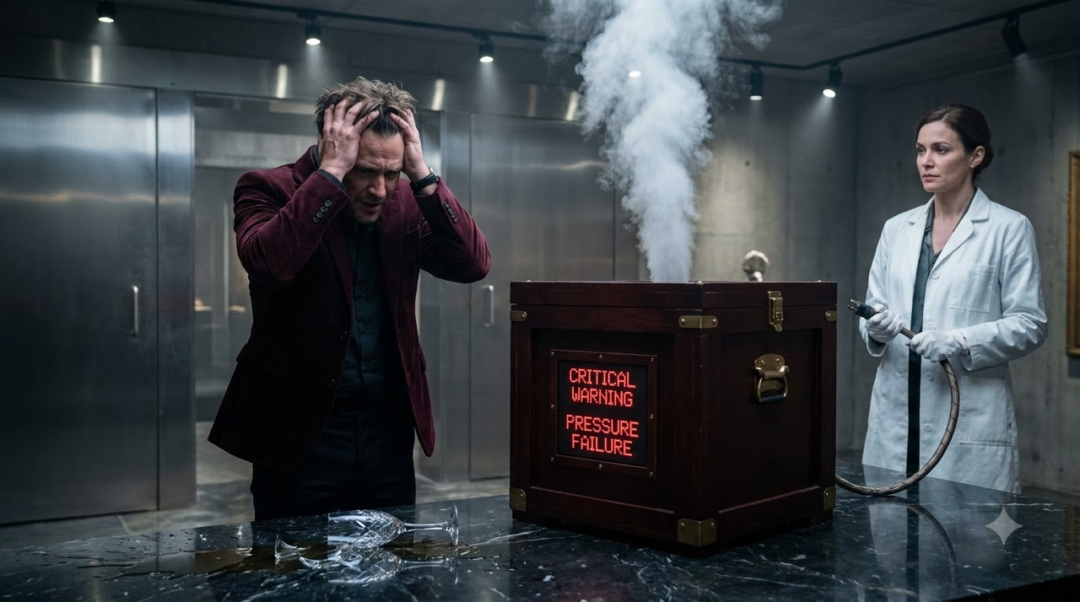
Julian Kensington was led into the hall by two federal marshals, his handcuffs replaced with soft security zip-ties that allowed him to sit at the defense table. He looked twenty years older than the man who had strutted through the vault four hours earlier. His burgundy velvet blazer was rumpled and stained, his eyes sunken and vacant, his hands trembling as he stared at the treaty on the center table.
“Mr. Kensington,” AUSA Vance began, stepping to the podium with a stack of signed plea agreements. “The government has completed its preliminary inventory of your private collection in Greenwich. In addition to Lot One Hundred and Eight, our investigators have recovered four Etruscan terracotta vases looted from Cerveteri, a 15th-century Sienese altarpiece panel stolen from a convent in Lucca, and two Roman marble busts smuggled through Geneva.”
AUSA Vance dropped the thick ledger onto the table with a resonant thud.
“Under Title Eighteen of the United States Code, each count of international trafficking in stolen cultural patrimony carries a maximum statutory penalty of ten years in federal prison. Concurrently, the IRS Criminal Investigation Division has initiated civil forfeiture proceedings against your hedge fund assets, totaling forty-two million dollars in unpaid import tariffs and criminal penalties.”
Kensington looked toward his attorney, Arthur Vance-Sterling, who merely shook his head with grave, definitive finality. “Julian, there is no defense. The forensic telemetry from the crate confirms you broke the seal. The audio records confirm you threatened the federal monitor. If we go to trial before Judge Sterling, you will spend the rest of your life in a federal penitentiary.”
Kensington swallowed hard, his throat dry as desert sand. “What… what do you want from me?”
Dr. Marco Moretti leaned forward, his dark eyes burning with the quiet, righteous pride of a nation reclaiming its stolen soul. Behind him, the gallery lights reflected off the gold-embossed consular seal of the Italian Republic.
“We want justice, Mr. Kensington,” Dr. Moretti said, his voice quiet, cultured, and unyielding. “We want the unconditional surrender and repatriation of all eighteen cultural masterworks in your possession. We want every shipping manifest, every customs clearance form, and a full, unredacted accounting of every black-market art dealer and corrupt restorer you employed in Zurich, London, Geneva, and New York. Furthermore, we demand an immediate, irrevocable six-million-dollar civil restitution endowment deposited directly into the conservation trust of the Uffizi Gallery and the Opificio delle Pietre Dure to finance the reconstruction of this canvas, cover the specialized chemical analysis, and endow a permanent research chair dedicated to combating the illicit antiquities trade.”
Moretti paused, his gaze sweeping over the crumpled figure of the disgraced billionaire.
“For centuries, men of unearned wealth have looked upon the heritage of sovereign nations as trophies to be plundered, traded in secret rooms, and hoarded behind private security gates. You believed that because you had amassed hundreds of millions of dollars through speculation, the patrimony of human civilization was subject to your whims. Tonight, you learn that beauty and history belong to the people who cherish them, not to the predators who exploit them.”
Moretti slid the formal restitution agreement across the black felt table.
“Sign the surrender, Mr. Kensington. Or prepare for federal indictment at dawn.”
Kensington stared at the document. His signature would strip him of his entire art empire, wipe out his personal liquidity, and reduce his name from an elite cultural benefactor to a disgraced, convicted international smuggler.
He looked across the stage at the two halves of The Madonna of the Pomegranate. Through the clear acrylic dome, the Virgin’s face looked back at him—timeless, serene, and unbothered by the petty greed of the men who had sought to possess her.
Kensington reached out with a trembling hand, picked up the silver fountain pen, and pressed the nib to the parchment.
With three jagged, breathless strokes, he signed away his fortune, his freedom, and his pride.