The Cracked Renaissance Canvas In The Marble Auction Vault
CHAPTER 4: THE SMUGGLER’S SEAL
The elevator ride back down to Subterranean Level B3 was conducted in absolute, suffocating silence.
Standing in the rear of the titanium elevator cab were two armed Special Agents from the FBI’s New York Field Office, wearing dark suits with gold lapel pins. Flanking them was Special Agent Claire Bennett, a thirty-eight-year-old veteran investigator with the Art Crime Team whose reputation for recovering looted European masterworks was legendary among international curators. Julian Kensington stood between his defense attorney and the agents, his hands clasped tightly in front of him, his head bowed, the sweat from his temples dripping onto the collar of his velvet blazer.
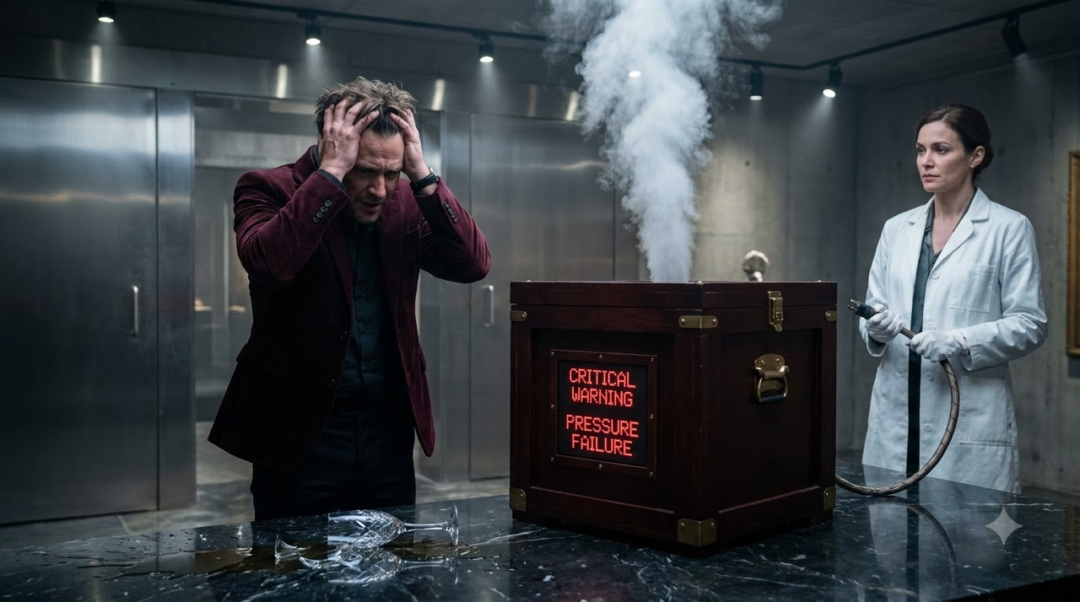
When the glass doors parted, Bay Four had been transformed into an active federal crime scene.
A portable sterile tent made of antistatic polyethylene sheeting had been erected over the damaged mahogany crate. Inside the tent, three conservators in white protective Tyvek suits, hairnets, and surgical masks hovered over the crate with high-intensity ultraviolet forensic inspection lamps and digital fiber-optic endoscopes.
Dr. Gabriel Ross pulled on a fresh pair of white lint-free cotton gloves, adjusting his wire-rimmed glasses as he unlatched the heavy titanium locking hasps on the mahogany lid.
CLACK. CLACK. CLACK.
The three heavy mechanical latches released with dull, hollow clicks that sounded like gunshots in the quiet room.
Gabriel and a senior assistant gripped the handles, lifting the heavy insulated lid straight up. A faint, residual puff of chilled nitrogen gas hissed from the rubber gaskets, smelling of aged rabbit-skin sizing, ancient walnut oil, and damp wood fibers.
Inside the custom high-density foam cradle lay The Madonna of the Pomegranate.
The painting was breathtaking, painted by a master of the Florentine High Renaissance. The Virgin’s face was rendered with exquisite, ethereal sfumato, her lapis lazuli mantle gleaming beneath the forensic lights. But running diagonally from the lower left corner directly through the Virgin’s hands and splitting the infant Christ’s figure in two was a jagged, horrifying fracture in the poplar wood. The four-hundred-year-old gesso ground had shattered like brittle ice, tiny flakes of priceless lapis and vermilion pigment scattered across the gray velvet foam like colorful dust.
Charles Moreau closed his eyes, turning his head away in physical pain. “Dear God in heaven…”
Julian Kensington stared into the crate, his throat clicking as he choked back a ragged, breathless sob. “It’s… it’s completely split. The entire board is divided.”
“Poplar wood has a memory, Mr. Kensington,” Gabriel said softly, his voice devoid of anger, filled only with the profound, solemn grief of an artist beholding a murdered masterpiece. “It was felled in a Tuscan forest in 1508. For four centuries, the cellulose fibers maintained their equilibrium. You killed it in two seconds with the heel of your shoe.”
Special Agent Claire Bennett stepped inside the sterile enclosure, holding a specialized high-output 365nm ultraviolet lamp. “Dr. Ross, turn the panel to expose the verso.”
With surgical, trembling precision, Gabriel and his assistant lifted the two separated halves of the painting, turning them over onto a padded felt examination table to expose the bare, unfinished wood on the back.
Under the standard gallery lights, the back of the poplar panel appeared weathered, gray, and innocuous, marked only by faint saw cuts from the 16th century.
Agent Bennett clicked the ultraviolet lamp on.
A brilliant, deep violet luminescence washed over the ancient wood. Instantly, across the center of the upper panel, a glowing rectangular scar became visible where the top millimeter of wood fibers had been aggressively sanded and scraped away with a mechanical rotary tool.
“Look at the chemical residue,” Gabriel pointed out, tracing the outline with a non-conductive plastic probe. “A circular wax seal was removed here using trichloroethylene solvent. But the wax penetrated deep into the porous poplar grain.”
Under the UV beam, the ghost of an embossed emblem emerged from the wood like a glowing phantom: a five-pointed crown above the crest of the Royal Italian Ministry of National Education, dated 1939, stamped with the unmistakable words: ESPORTAZIONE VIETATA – BENI CULTURALI.
Agent Bennett looked up from the table, her eyes locking onto Kensington like twin gun barrels.
“Export prohibited by law,” Bennett stated with chilling finality. “This painting was registered on the Italian National Patrimony Ledger before the war. The export documentation you submitted to U.S. Customs in Newark claimed this panel was purchased from a private Swiss estate with a clear provenance dating back to 1890.”
Kensington backed away toward the tent entrance, his voice cracking into pure hysteria. “I didn’t forge those papers! My art adviser handled the import manifest! I bought it in good faith!”
“Your art adviser is currently sitting in a federal interrogation room in Lower Manhattan, Julian,” Agent Bennett said, pulling an official blue warrant from her trench coat. “And he just gave us the encrypted keys to your private cloud storage. You personally approved the chemical removal of that seal in a Geneva warehouse three weeks ago.”