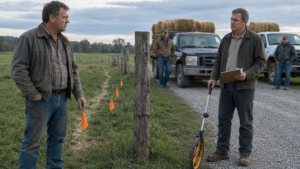
The Deep Wet Concrete Trench Trapped the Arrogant Mansion Neighbor
CHAPTER 5: THE INJUNCTION AT THE FRANKLIN COURTHOUSE
The following morning at nine o’clock, the historic third-floor courtroom of the Williamson County Chancery Court in downtown Franklin was packed to the doors with county residents, military veterans, and local business owners. Above the carved oak bench hung the Great Seal of Tennessee, framed by tall arched windows that overlooked the historic town square.
Sitting at the defense table was Richard Vance, flanked by two high-priced corporate litigation attorneys in pinstripe suits. Richard’s appearance was radically different from his country club persona of the previous afternoon. He wore an ill-fitting dark blue suit, his hands were red and raw from scrubbing the caustic concrete lime off his skin, and his feet were clad in cheap black orthopedic slip-on shoes because his chemical burns were too severe to wear dress leather.
At the plaintiff’s table sat Staff Sergeant Daniel Cole, dressed in his formal Army Service Uniform, his combat ribbons and Purple Heart medal gleaming on his chest. He sat upright in his specialized wheelchair, his wife Sarah beside him, holding his hand. Flanking them were Captain Thomas Vance and Chief Inspector David Keller.
Presiding from the bench was Chancellor Rebecca Thornton, a sharp, no-nonsense jurist known throughout Middle Tennessee for her unwavering enforcement of municipal integrity and property rights.
Chancellor Thornton adjusted her reading glasses, looking through a thick stack of engineering reports, dye-trace photographs, and municipal dispatch logs that had been admitted into evidence.
“Before the court considers the emergency injunction,” Chancellor Thornton said, her voice echoing clearly across the silent courtroom, “I will hear from Chief Building Inspector David Keller regarding the environmental findings at Lot 14.”
Inspector Keller stepped up to the podium, placing an enlarged photographic board on an easel facing the bench.
“Your Honor,” Keller testified, “yesterday afternoon, following a physical trespass incident at the construction site, county engineers conducted an exhaustive dye-trace test of the drainage infrastructure on Richard Vance’s estate. We introduced five gallons of non-toxic fluorescent red dye into Mr. Vance’s private swimming pool backwash drain and his upper terrace collection basins.”
Keller pointed to the high-resolution photograph on the board, showing bright crimson dye pouring directly out of the severed PVC pipe into the excavated culvert at Lot 14.
“The test confirmed absolute, one-hundred-percent hydraulic connectivity,” Keller continued. “Furthermore, county investigators executed an administrative subpoena on Mr. Vance’s local landscaping contractor. We recovered text messages and email correspondence dating back eight months, wherein Mr. Vance explicitly instructed the contractor to: ‘Bury the pipe four inches beneath the hedge line. Ensure all water flows into the center of Lot 14 so the foundation fails the county compaction test. I don’t want disabled veterans living outside my gate.’“
A collective, furious gasp erupted from the gallery. Spectators turned their heads to glare at Richard Vance, whose chin sank down toward his chest in silent, burning humiliation.
Richard’s lead attorney stood up, adjusting his tie nervously. “Your Honor, while the communication is regrettable, my client has already agreed to pay for the removal of the pipe. This matter should be handled as a minor civil drainage dispute, not an emergency chancery injunction.”
Chancellor Thornton removed her glasses, her face set in a mask of absolute moral outrage.
“Minor civil dispute, counselor?” Chancellor Thornton’s voice cut through the courtroom like an icy wind. “Your client used his immense wealth, his legal influence, and deliberate environmental sabotage to attempt to drive a wounded combat veteran off land that was legally purchased and permitted by a charitable coalition. He filed fraudulent municipal petitions, submitted false noise complaints, and then had the unmitigated gall to physically march onto a permitted job site, destroy warning markers, and throw tools at off-duty police officers.”
Chancellor Thornton leaned forward, fixing her gaze upon Richard Vance.
“Mr. Vance, your conduct in this matter is among the most despicable displays of petty, malicious entitlement I have ever witnessed in twenty years on the bench. You attempted to use the municipal apparatus of this county as a weapon to dispossess a man who gave his limbs for this nation.”
The testimony of county building officials was corroborated by sworn affidavits from three local contractors who had turned down Richard Vance’s under-the-table cash offers to trench the illegal drainage conduit. One commercial excavator testified that Vance had explicitly offered him a five-thousand-dollar cash bonus to ‘route the trench deep enough so the building inspector never sees it before the foundation slab is poured.’ The evidence of premeditated, malicious intent was overwhelming, leaving Vance’s corporate defense team with no viable factual or legal defense.
The Chancellor picked up her wooden gavel, her knuckles white.
“The court issues an immediate permanent injunction. You are barred from entering within five hundred feet of Lot 14 under pain of immediate incarceration for criminal contempt. Furthermore, under equitable chancery jurisdiction, this court orders an immediate freeze on all private improvement permits for your estate until full remediation is completed.”
Chancellor Thornton struck the gavel with a loud, ringing crack that silenced the courtroom. “We will reconvene at two o’clock for the final assessment of damages and civil penalties.”