The Deep Wet Concrete Trench Trapped the Arrogant Mansion Neighbor
CHAPTER 3: THE GOLD SHIELD UNDER THE WORK SHIRT
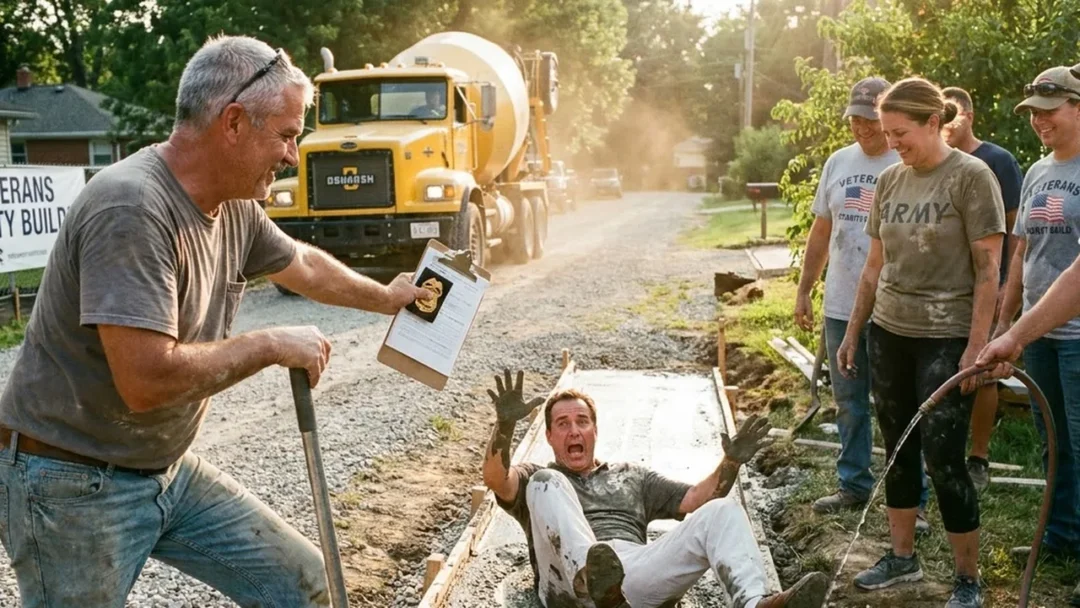
Richard Vance’s breath came in ragged, wheezing gasps as he stared up at the gold badge in Captain Thomas Vance’s hand. The reality of his predicament was settling in with terrifying physical clarity. The exothermic reaction of the Portland cement—the chemical curing process in which calcium silicate hydrates generate intense internal heat—was rapidly warming the slurry around his calves. The heavy mortar was no longer liquid; it had transitioned into a stiff, clay-like consistency that clamped around his shins like twin blocks of granite.
“Thomas… Captain Vance,” Richard pleaded, his voice trembling, all traces of his former boardroom swagger vanished. “Listen to me… we have the same last name! We’re probably related! This was a complete misunderstanding! I thought you were unauthorized day laborers blocking the road! I didn’t see the badge! Please, my legs are going numb from the pressure—tell your men to dig me out!”
Marcus Bell walked over carrying a yellow industrial garden hose connected to the temporary water meter at the street, testing the brass nozzle with a sharp hiss of pressurized spray.
“You can’t just dig him out with shovels, Captain,” Bell observed with dry, military technical accuracy. “The aggregate has locked around his ankles beneath the structural rebar grid. If we pull him with a truck winch, we’ll dislocate his knees. We have to flush the wet paste with high-pressure water before the lime sets hard enough to cause third-degree chemical burns on his skin.”
Thomas Vance didn’t flinch. He clicked his pen against the citation clipboard. “We’ll wash him out, Marcus. But not until he signs the municipal acknowledgment for the criminal damage.”
Thomas leaned down, holding the yellow citation sheet three inches from Richard’s nose. “Sign the citation, Richard. You agree to pay full restitution for the two yards of damaged high-early concrete, the cost of the replacement rebar, and forty dollars for my finishing trowel sitting in those briars.”
Richard Vance’s hands were shaking so violently that he could barely grip the pen. He scribbled his signature across the bottom line with trembling strokes, leaving a wet smudge of grey concrete on the carbon paper.
“Now pull me out!” Richard wept. “Please!”
Marcus Bell engaged the brass nozzle, directing a powerful, focused jet of cold well water down into the narrow crevice between Vance’s shins and the stiffening mortar. The high-pressure stream blasted the loose aggregate and liquefied the curing lime, churning the grey mud into a milky froth.
Two burly off-duty sheriff’s deputies stepped up to the edge of the trench, grabbed Richard Vance under his armpits, and hauled upward with a synchronized heave.
With a loud, wet squelch that sounded like a boot being wrenched from a deep swamp—SHLUUUUCK—Vance’s legs popped out of the concrete trench.
He was dragged backward onto the dry grass shoulder, collapsing onto his back like a beached fish. His white linen trousers were torn, soaked through, and coated in three inches of hardening grey mortar from his thighs to his ankles. His feet were bare, scraped raw from the aggregate, his twelve-hundred-dollar Italian golf shoes lost forever at the bottom of the two-foot culvert.
As Richard lay panting on the grass, clutching his bruised shins, Master Sergeant Marcus Bell stepped back to the edge of the excavated trench to inspect the displaced concrete.
Bell’s eyes narrowed. He knelt on the dry plywood form, pointing down into the dark cavity where Vance’s feet had been lodged.
“Captain,” Bell called out, his voice suddenly sharp and devoid of humor. “Take a look at what our neighbor uncovered when he kicked up the bottom of that sump.”
Thomas Vance walked to the edge of the pit, looking down into the slurry.
Protruding from the dirt sidewall beneath the property line—directly beneath Richard Vance’s manicured privet hedge—was the freshly exposed collar of a heavy, six-inch corrugated PVC drainage pipe. From the mouth of the unpermitted pipe, a steady trickle of dark, chemical-smelling runoff was discharging directly into the veteran’s foundation footing, completely hidden beneath the root line of the hedge.
The municipal citation was not merely a local administrative summons; under Tennessee municipal code, intentional damage to an active public safety or charity infrastructure project during construction carries mandatory Class-A misdemeanor penalties. The replacement high-early concrete had to be batched and delivered by a second dispatch mixer within forty-five minutes to prevent cold-joint seam failure along the structural apron line. The driver of the Oshkosh mixer leaned out of his cab, recording the entire confrontation on his commercial dashboard camera, establishing an unedited, time-stamped digital record of Vance’s trespass, verbal threats, and the physical destruction of the site warning markers.
Thomas Vance looked from the illegal pipe to Richard Vance’s pale, trembling face. “Well, Richard. Looks like kicking down that warning stake just exposed an unpermitted environmental crime.”