The Deep Wet Concrete Trench Trapped the Arrogant Mansion Neighbor
CHAPTER 4: THE PIPE BENEATH THE PRIVET HEDGE
The discovery of the six-inch corrugated PVC pipe transformed Lot 14 from a humorous scene of small-town comeuppance into an active environmental and civil fraud crime scene.
Captain Thomas Vance pulled his department radio from his truck cab, switching to the municipal administrative frequency. “Dispatch, this is Unit One. Contact the Williamson County Codes Enforcement Division and the County Stormwater Management Bureau. Request an immediate emergency site inspection and environmental testing unit at Lot 14, Old Hillsboro Road. We have an unpermitted, concealed drainage diversion discharging hazardous runoff across a property boundary.”
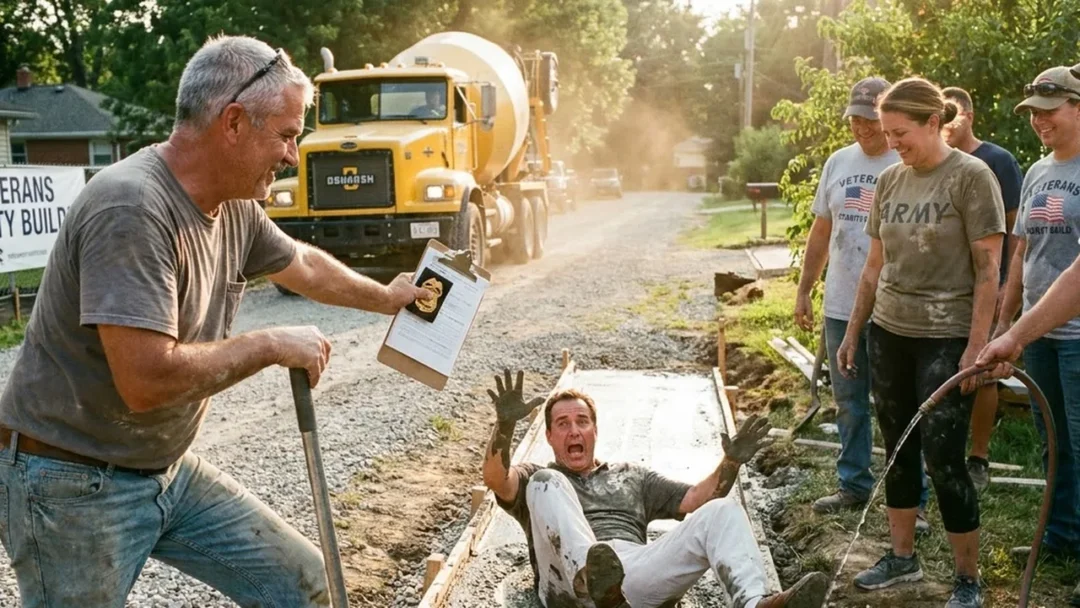
Richard Vance scrambled onto his elbows on the grass, his bare, concrete-coated feet kicking weakly in the air as he tried to wipe the hardening grey paste from his skin. “That’s… that’s just a standard French drain! It’s for lawn sprinkler overflow! Every home in the subdivision has surface drains!”
Master Sergeant Marcus Bell, who held a civil engineering degree from the University of Tennessee alongside his combat engineer qualifications, climbed down onto the dry form boards with an inspection flashlight. He knelt beside the exposed pipe, pulling out a pocket sampling vial and collecting a volume of the dark, oily liquid discharging from the opening.
“Sprinkler overflow doesn’t smell like chlorine and copper sulfate, Mr. Vance,” Bell said, holding the vial up to the afternoon sun. “This is backwash from a commercial swimming pool filtration system, mixed with concentrated storm runoff from your three-car garage apron.”
Bell pointed his flashlight along the trench wall. “The natural grade of this hill slopes south toward the state creek. But this pipe was cut deliberately through the limestone shelf at a fifteen-degree reverse angle, routed straight through the property line into Daniel Cole’s foundation footing. You weren’t draining your lawn. You were using this charity parcel as an illegal runoff dump to keep your own lower terrace from flooding.”
Ten minutes later, a white county municipal truck bearing the seal of the Williamson County Department of Codes Enforcement arrived at the driveway, followed by two marked sheriff’s patrol cruisers.
Out of the truck stepped Chief Inspector David Keller, a veteran building official who had served Williamson County for twenty-five years. Keller carried a high-resolution laser transit and a set of official architectural plat maps for the Old Hillsboro subdivision.
“Captain Vance,” Keller said, greeting Thomas with a firm handshake before looking down at the concrete-covered executive sitting on the grass. “We received your dispatch call. What do we have?”
Thomas pointed down into the excavated culvert. “Take a look at the boundary line, David. Our neighbor took a plunge into our wet concrete and knocked the sub-base loose. Look what was buried beneath his privet hedge.”
Inspector Keller knelt beside the trench, shining his flashlight into the opening. His expression darkened instantly. He unrolled the official county subdivision drainage map across the hood of his truck, tracing the blue easement lines with a yellow grease pencil.
“Lot 14 is zoned as a dry residential parcel,” Keller said, his voice hard with administrative fury. “Six months ago, Mr. Richard Vance filed a formal petition with the county zoning board, claiming that Lot 14 was an unbuildable natural wetland prone to catastrophic flooding. He attempted to condemn this property under county health codes so the Veterans Coalition couldn’t build here.”
Keller walked over to where Richard Vance lay on the grass, holding the map three inches from his face. “You didn’t file an unbuildable wetland report, Richard. You manufactured a wetland. You buried an unpermitted six-inch commercial drainage line under your hedge to pump ten thousand gallons of your own runoff onto Daniel Cole’s foundation, hoping the soil would fail the load-bearing compaction test so the county would revoke his building permit.”
Richard Vance swallowed hard, his bloodshot eyes darting toward his mansion gates. “I… I hired a landscape contractor! I don’t know the technical details of the drainage work! It was done by third-party workers!”
“Well, you signed the county zoning appeal under penalty of perjury, Richard,” Keller said coldly. “And under Tennessee Environmental Protection statutes, unpermitted toxic discharge onto private property carries a mandatory fine of fifty thousand dollars per day, plus mandatory restoration of the natural watershed.”
The Harpeth River Basin Conservation Act enforced strict criminal and civil penalties for any unauthorized modification of natural stormwater flow lines. Because the limestone karst topography of Williamson County features complex subterranean sinkholes and interconnected aquifers, dumping untreated swimming pool chlorine and motor oil runoff into an open ditch was a direct violation of both state and federal clean water standards. Inspector Keller took GPS-tagged digital photographs of the unpermitted PVC outlet, noting that the pipe had been freshly coated with black asphalt sealant to conceal it beneath the hedge roots.
Keller turned to Captain Thomas Vance. “Captain, I’m issuing an immediate Stop-Work and Cease-and-Desist order on Richard Vance’s entire estate. And I’m notifying the County Chancery Court to schedule an emergency injunction hearing for tomorrow morning.”