The Faded Midnight Train Ticket And The Missing Shipping Tycoon
CHAPTER 2: THE BRASS KEY ON THE DAMASK LINEN
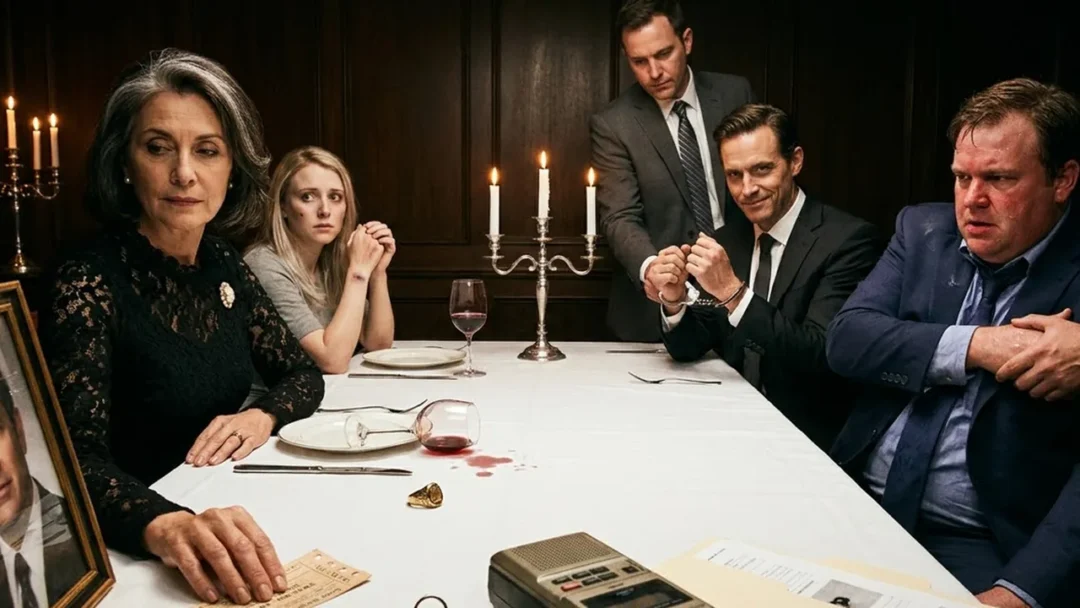
The crimson wine spread across the white damask tablecloth, seeping into the heavy cotton fibers, slowly staining the hem of the oil portrait’s black mourning ribbon. Gerald gritted his teeth, his face mottled red with humiliation and fury as he pulled his wrist against the sharp, unyielding steel ferrule of Irene’s umbrella.
“Let go of me, you old lunatic!” Gerald hissed, his breath coming in ragged gasps.
Across the table, Hugo Mercer was mopping his forehead with a monogrammed linen napkin, his hands trembling violently. “Irene, please! We are in the Duquesne Club! There are city councilmen and federal shipping commissioners in this room! If this is about your trust disbursement, Gerald and I will double your monthly stipend tomorrow morning—”
“Shut up, Hugo,” Irene said without looking at him. Her voice was level, carrying the terrible, quiet weight of a woman who had spent twelve years peeling away the layers of a corporate lie.
With a flick of her wrist, Irene lifted the umbrella from Gerald’s sleeve. Gerald stumbled backward, clutching his bruised wrist, his chest heaving beneath his tailored tuxedo.
Irene reached down with her gloved fingers and turned the faded train ticket over upon the table.
On the back of the heavy cardboard stub, written in dark, faded fountain-pen ink that had bled slightly into the fibrous grain, was a line of handwriting:
Locker 44 — Eastbank. If I disappear, trust Lila.
The handwriting was unmistakable. Every member of the executive board had seen that bold, forward-slanting cursive on thirty years of river contracts, dock deeds, and dry-dock construction permits. It was the handwriting of Richard Vance.
At the far end of the banquet table, sitting in the shadows beyond the third candelabra, sat Lila Vance. At thirty-four, Gerald’s wife was a quiet, slender woman with shoulder-length chestnut hair and large, expressive green eyes. She wore a simple, unadorned muted silver silk dinner dress. For three hours, she had sat in absolute silence, her hands folded in her lap, her head down as Gerald and Hugo toasted their commercial triumphs.
Now, as the words on the ticket were read aloud, Lila lifted her head.
Gerald spun on his wife, his gray eyes bulging with feral paranoia. “Lila! Don’t you dare look at her! Get up and wait in the limousine right now!”
Lila did not stand up. Instead, she slowly raised her right arm onto the table, pushing back the three-quarter sleeve of her silver silk dress.
Resting across her pale wrist, raw and unmistakable against the delicate skin, was a dark, purple-black contusion—the fresh, violent imprint of four fingers and a thumb where Gerald had wrenched her arm behind her back the previous evening.
A collective gasp of disgust rippled through the assembled guests. A female county commissioner pushed her chair back from the table, staring at Gerald in open horror.
Lila opened her small, closed right fist.
Resting in the center of her trembling palm was a small, heavy piece of stamped yellow brass—an antique luggage locker key stamped with the numerals EB-44.
Lila reached forward and set the brass key squarely onto the blood-red pool of spilled wine, right beside the faded train ticket.
“Gerald kept this key locked inside his private wall safe in our Sewickley home,” Lila said, her voice trembling slightly before finding a clear, resonant strength that cut through the room like a bell. “I found it three nights ago when he was in New York meeting with the bond underwriters. When I asked him why he kept a baggage key from the night his father died, he forced me down onto the marble foyer floor and threatened to put me in the same cold water he put his father.”
Gerald took two aggressive strides toward his wife, his fists clenched, his composure completely shattered. “You lying little tramp! You stole that from my personal office! That key has nothing to do with this company!”
Before Gerald could reach the chair where Lila sat, the heavy double doors of the Founders Room were thrown wide open.
Stepping into the dining room were two detectives from the Allegheny County Police Homicide Division. In the lead was Detective Thomas Cole, a fifty-year-old veteran investigator with twenty-five years on the riverfront squad, his heavy gray trench coat dripping rain onto the carpet, his gold badge gleaming on his lapel. In his gloved right hand, Cole carried a sealed, transparent evidence pouch containing an old, battered microcassette voice recorder, its small digital red LED light pulsing intermittently in the candlelight.
Detective Cole stepped between Gerald and his wife, planting his heavy boots on the parquet floor with absolute, immovable authority.
“Gerald Vance,” Detective Cole said, his voice gravelly, dry, and flat as a slate shingle. “Step back from Mrs. Vance. We just cleared Locker 44 at the Eastbank Station fifteen minutes ago.”
Irene watched the color drain from her son’s face, feeling the chill of twelve years of isolation settle into a hard, diamond-sharp clarity. She remembered the day Gerald had sat in Richard’s mahogany study in their Sewickley manor, calmly announcing that the memorial trust would be managed exclusively by the corporate board, reducing Irene to a spectator in her own home. She had known then that Gerald had a predator’s heart. But she had waited, gathering receipts, tracking the river manifests, and watching the silent terror in Lila’s eyes grow with every passing season. Tonight, the balance of power had shifted forever.