The Fermented Fish Emulsion Sprinkler And The Obstructed Speed Trap
CHAPTER 2: THE WALL OF STEEL
The driver was Tyler Vance. At twenty-six years old, Tyler was the pampered, arrogant son of the majority owner of Vance Cold-Chain Logistics, a regional freight trucking company headquartered in the lower valley. Known throughout the county court system as a chronic speeder with three suspended licenses already dismissed through high-priced corporate traffic attorneys, Tyler was also the lead coordinator for the ‘Valley Midnight Run’—the illegal racing club that used Orchard Ridge Road as its primary quarter-mile testing strip.
“Afternoon, officers!” Tyler crowed, leaning his back against the side panel of the box-van and crossing his arms with exaggerated casualness. “Nice day for some fresh air on the public easement, isn’t it?”
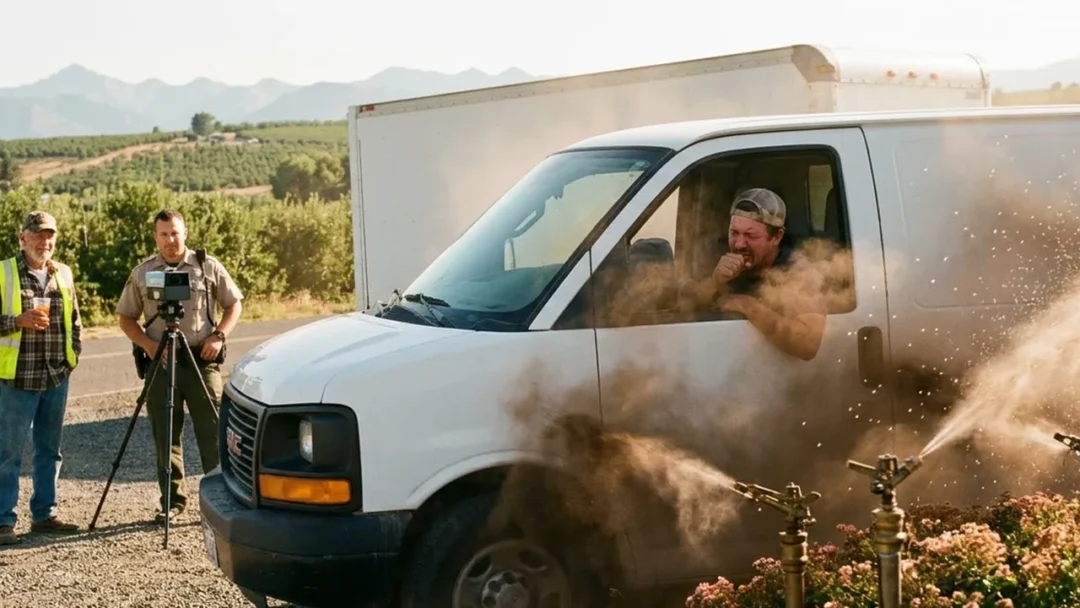
Officer Cooper took a deep, measured breath, his jaw tightening as he stepped around the rear bumper of the van. He knew that Tyler Vance was attempting to bait him into an unlawful vehicle search or an unauthorized physical confrontation. In the digital era of online provocations, an officer who lost his temper for three seconds could face internal affairs investigations, civil lawsuits, and mandatory administrative leave. Cooper had two teenage sons preparing for college; he was not about to jeopardize his career over an entitled young provocateur hiding behind commercial trucking exemptions. The lidar unit—which had taken ten minutes to level, calibrate, and optically align with the distant highway milepost—was completely blinded. Lidar speed measurement operates on the principle of time-of-flight laser telemetry: emitting continuous pulses of infrared light at nine hundred and five nanometers and measuring the nanosecond reflections off a vehicle’s retroreflective license plate or headlamp lens. To maintain statutory admissibility in Washington district court, the optical path had to be completely unobstructed by heat distortion, particulate matter, or physical barriers. By planting sixteen vertical feet of corrugated fiberglass three inches from the objective glass, Tyler had effectively erected a mobile fortress against municipal traffic law. All its laser sensor could see was sixteen vertical feet of corrugated white fiberglass siding.
“Sir,” Officer Cooper said, his voice flat, formal, and authoritative, “you have parked a commercial motor vehicle within inches of an active law enforcement traffic-safety checkpoint. You are directly obstructing the optical line of sight of a certified speed enforcement operation. Move this vehicle immediately.”
Tyler let out a loud, theatrical burst of laughter, pulling his designer sunglasses down the bridge of his nose to stare Cooper in the eye. Tyler lived in an insulated bubble of inherited wealth, corporate litigation shields, and social media validation. He operated under the belief that statutes existed only as puzzles to be exploited by clever defense lawyers, and that working-class officers and elderly farmers were powerless obstacles in the path of his adrenaline. In his mind, humiliating a sheriff’s deputy on the public shoulder was a badge of supreme honor that would earn him legendary status in the underground racing community. “Move it? On what statutory authority, Deputy? There’s no yellow curb painted here. There are no ‘No Parking’ signs posted on this shoulder. Washington State Revised Code section forty-six-sixty-one allows commercial vehicles to park on any unposted public road shoulder for up to four consecutive hours during daylight hours for cargo rest periods. I’m an independent contractor on a mandatory federally mandated rest break. My logbook is running, my parking brake is set, and this van isn’t moving an inch until four o’clock.”
To punctuate his defiance, Tyler drew back his heavy athletic sneaker and kicked the orange reflective traffic safety cone that Officer Cooper had placed ten feet down the shoulder.
The heavy vinyl cone tumbled violently into the weeds of the irrigation ditch with a hollow thud.
Officer Cooper’s hands tightened against his utility belt. As a county traffic officer, he knew the frustrating loopholes of rural parking codes. Unless a vehicle was directly blocking an emergency vehicle lane or physically blocking a private driveway apron, writing a non-emergency parking citation required a twenty-minute administrative summons, and requesting a heavy-duty commercial flatbed tow truck from Yakima would take at least forty-five minutes.
Tyler knew it too. He tapped the side of his nose, pulled a high-end smartphone from his pocket, and began rapidly typing a message into an encrypted chat group.
‘Radar post neutralized on Orchard Ridge,’ Tyler typed with a grin. ‘Big white van is parked right in their faces. Clear to run the three-mile time trials. Hammer down, boys.’
“Guess your little speed trap is officially out of business for the afternoon, Deputy,” Tyler sneered, pocketing his phone. He leaned back against the van’s side panels, tapping his fingers against the fiberglass in a rhythmic, insolent beat. He pictured the high-fives and congratulations awaiting him at the clubhouse that evening. In the digital chat rooms of the street-racing circuit, this video clip—which he had set his dash camera to record—would become legendary. He saw himself as an outlaw hero, standing up to the oppressive machinery of traffic safety with impunity. “Why don’t you two go down to the gas station and get yourselves some donuts?”
Officer Cooper reached for his shoulder radio microphone, his face flushed with professional frustration. “Dispatch, this is Unit Twelve. Request a priority heavy-wrecker to Orchard Ridge Road for intentional obstruction of—”
“Hold on a minute, Dan,” Arthur Campbell said softly, rising from his canvas chair.
Curiosity Lock: Arthur laid a gentle, calloused hand on the deputy’s forearm, glanced down at the ticking brass pocket watch in his vest, and looked over at the massive exterior refrigeration intake grille humming on the van’s roof just three feet from his rose hedge.