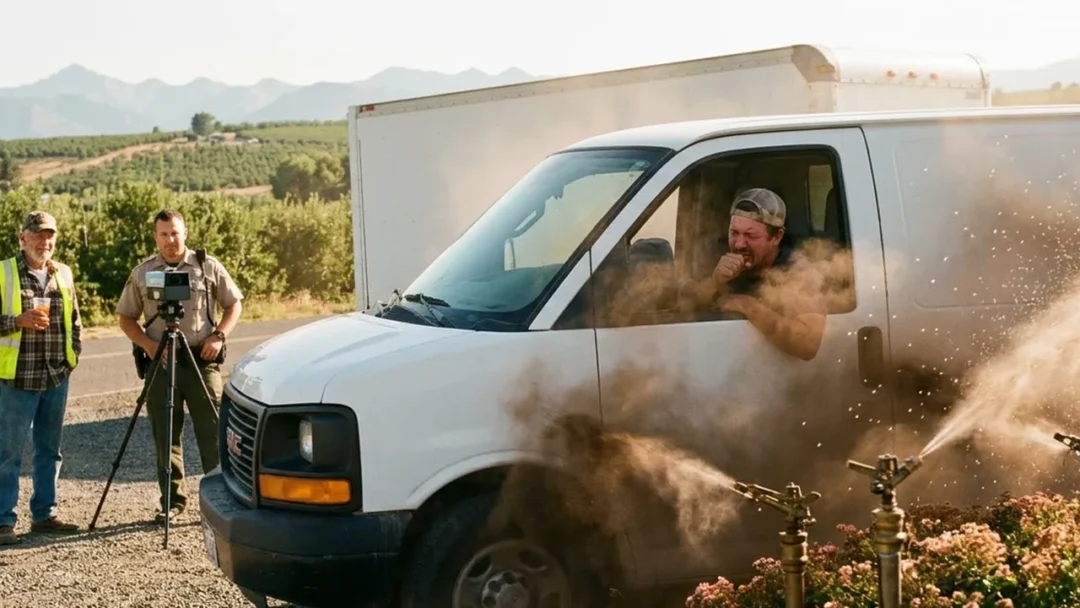
The Fermented Fish Emulsion Sprinkler And The Obstructed Speed Trap
CHAPTER 7: THE SWEET SMELL OF JUSTICE
By five o’clock that evening, the golden hour had arrived over Yakima County, painting the snow-capped peak of Mount Adams in shades of rose and amber. The gentle breeze had shifted, carrying away the last remnants of the organic fertilizer and leaving only the sweet, delicate perfume of blooming hybrid roses drifting across Orchard Ridge.
At the bottom of the hill, where Orchard Ridge Road intersected State Route 24, the street-racing syndicate had met its catastrophic Waterloo. All three sports cars had been cleanly boxed in by four county cruisers and a state patrol interceptor. The drivers—three young men who had terrorized the local orchard workers for months—stood handcuffed along the guardrail, their high-dollar vehicles loaded onto flatbed tow trucks for mandatory thirty-day impoundment under Washington’s street-racing forfeiture laws. Their sports coupes had been modified with illegal straight-pipe exhausts, nitrous oxide injection systems, and disabled catalytic converters. The state patrol commercial enforcement officers were writing additional mechanical safety violations that carried thousands of dollars in restoration penalties, ensuring that none of the three vehicles would be back on the street for months.
A quarter-mile further down the shoulder sat Tyler Vance’s sixteen-foot refrigerated box-van.
Tyler was sitting on the grass shoulder wrapped in a paper contamination suit provided by the county hazmat response team. His designer clothes had been sealed in double-thick hazardous waste bags in the back of an environmental utility pickup. His eyes were swollen, his face streaked with tears, and every time the evening breeze stirred the grass, he flinched, terrified that the ghostly scent of rotten mackerel was still clinging to his skin. The arrogance that had fueled his confrontation three hours earlier had vanished completely, leaving only a dazed, utterly defeated young man. Two professional automotive detailers from Yakima were standing ten feet back from the open cab door, shaking their heads in absolute disbelief.
“Total loss, Deputy,” the lead detailer was explaining to Sergeant Frank Keller. “Fish emulsion contains heavy organic lipids that soak through automotive foam padding like motor oil into cardboard. Once those fatty acids penetrate the seat cushions and the sound-deadening felt beneath the carpeting, bacteria begin feeding on the organic proteins. The second this van sits in the summer sun with the windows closed, the interior temperature will hit one hundred and twenty degrees, and the biological decomposition will start all over again. You couldn’t sell this truck to a junkyard for scrap metal without Hazmat certification.” “That’s cold-pressed fish emulsion. It’s got organic sulfur compounds and fish oil that penetrate straight through the foam cushioning and the duct insulation. Even if we replaced the seats, the dashboard, and the entire HVAC evaporator core, the second the heater turns on next winter, this cab will smell like a dead whale. The insurance company will total this interior before sunset.”
Tyler sat with his head between his knees, crying softly in utter humiliation. He had already received citations for reckless driving, improper lane usage, and tampering with traffic safety markers, while his father was on his way from the logistics office, furious beyond words that his five-thousand-dollar company refrigeration unit had been destroyed in a petty street stunt.
Up on the tranquil crest of the hill, Arthur Campbell was walking along his rose hedge with a pair of clean pruning shears, inspecting the thick green foliage. The fish emulsion had already soaked deep into the sandy loam, feeding the roots with rich organic nutrients that would produce champion blooms for the autumn county fair. The deep root systems of the Grandiflora roses drank in the marine minerals, their dark green foliage glistening in the warm evening light. In agricultural communities, life was built on cycles of honest labor, patient nourishment, and mutual defense; when arrogance intruded, the land itself had a way of asserting its ancient, unshakeable sovereignty.
Officer Dan Cooper walked over from his cruiser, holding two cold bottles of local apple cider. He handed one to the old orchardist with a broad, respectful grin.
“The sheriff called me ten minutes ago, Arthur,” Cooper said, leaning his hip against his patrol fender. “He said in twenty-three years on the force, he’s never seen a radar checkpoint cleared faster or with more devastating efficiency.”
Arthur popped the cap off his cider bottle with a pocket tool, taking a slow, refreshing sip before looking out over the peaceful valley.
“A good orchardist respects the tools he has, Dan,” Arthur smiled gently, his gray eyes sparkling with quiet, rural humor. “People who spend their lives behind glass screens and fast engines always think the world is something you conquer with speed and noise. They forget that the roots beneath our feet have been here for generations, and that patience, good water, and honest soil will always outlast arrogance.” “Young fellows like Tyler think horsepower and arrogance make them kings of the road. But they forget that around here, the earth has its own ways of keeping the peace.”
Officer Cooper laughed aloud, raising his cold glass bottle of local cider in a warm, respectful toast. “To certified organic agricultural exemptions and master orchardists.”
“And to clean roads,” Arthur chuckled, bumping his bottle against Cooper’s with a crisp, ringing clink.
Behind them, the three heavy brass sprinklers along the curb gave a final, gentle hiss of clean drainage water, standing guard over the blooming roses under the vast, quiet western sky.