The Fermented Fish Emulsion Sprinkler And The Obstructed Speed Trap
CHAPTER 3: THE THREE O’CLOCK SCHEDULE
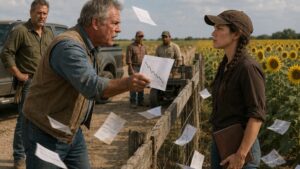
Tyler Vance turned his gaze toward Arthur, his upper lip curling in dismissive amusement as he took in the seventy-six-year-old orchardist in his faded work clothes. “What’s the matter, grandpa? Want to show me your garden club badge? Why don’t you sit back down in your lawn chair before you throw your hip out?”
Arthur did not respond to the insult. His weathered face remained entirely expressionless, his pale blue eyes reflecting the calm, unshakeable certainty of a man who had weathered fifty Washington winters. He slid his silver pocket watch back into his flannel shirt pocket and adjusted the collar of his safety vest.
“Mr. Vance,” Arthur said, his voice quiet, conversational, and carrying a distinct rural drawl, “I’m sure your father runs a very profitable freight logistics business down in the valley. But growing up around refrigerated diesel rigs doesn’t seem to have taught you much about how thermal air intakes operate.”
Tyler scoffed, rolling his eyes. “I know plenty about trucks, old man. That Thermo-King unit on the roof moves twelve hundred cubic feet of filtered outside air every sixty seconds to keep the cargo bay at thirty-four degrees. And the cab climate control is running on full blast right now through the cowl vents because it’s eighty-five degrees outside. So if you think you’re going to complain about the engine noise, save your breath. It’s completely legal under OSHA decibel standards.”
“I wasn’t going to complain about the noise, son,” Arthur said mildly, walking slowly toward the gravel boundary of his driveway. “I was going to remind you about the calendar.”
Arthur pointed a finger toward a weathered wooden signboard posted at the edge of his orchard gate. The green metal sign, stamped with the official seal of the Washington State Department of Agriculture, read: CAMPBELL COMMERCIAL BOTANICAL NURSERY — REGISTERED AGRICULTURAL PRODUCTION FACILITY — RCW 7.48.305 RIGHT-TO-FARM IMMUNITY APPLIES.
“Under the Washington Right-to-Farm Act,” Arthur explained with polite precision, “active commercial agricultural operations have an absolute, statutory exemption from local nuisance ordinances when applying certified organic fertilizers, pest management sprays, and soil conditioners to boundary windbreaks. The Washington state legislature enacted Chapter 7.48 to protect multi-generational family farms from urban encroachment and litigious suburbanites who buy houses next to orchards and then complain about tractors, dust, and fertilizer sprays. Under the statute, as long as an agricultural producer uses approved organic substances and sprays within their legal boundaries, no municipal ordinance, no civil nuisance suit, and no code complaint can touch them.” We spray our perimeter hedges on a strict schedule every Tuesday and Thursday at exactly three o’clock.”
Tyler looked at his expensive gold wristwatch. It read 2:58 PM.
He burst into another mocking laugh. “What are you going to do, grandpa? Water your pretty little roses with a garden hose? Go ahead! My van has an industrial ceramic clear-coat! Spray all the tap water you want!”
Arthur walked past the rear of the van, stepped onto his concrete driveway apron, and walked straight to the cedar siding of his two-car garage.
Mounted on the exterior wall was an antique, heavy-duty industrial knife-switch enclosure fabricated from cast brass and fitted with a massive, insulated black-rubber throw handle. The switch was an industrial relic from the late nineteen-fifties, salvaged from an old fruit cold-storage warehouse along the Northern Pacific rail line. It featured heavy spring-loaded copper contacts, an arc-chute suppressor box, and solid four-gauge commercial wiring running directly to a dedicated 240-volt single-phase breaker box. When thrown, the switch didn’t merely close a circuit; it engaged an industrial magnetic starter with a heavy, satisfying metallic thud that vibrated through the timber studs of the garage wall. Stenciled in bright red industrial paint across the brass cover were the words: HIGH-PRESSURE AG-FERTILIZER DISTRIBUTION PUMP — 500 GALLON BOUNDARY MANIFOLD.
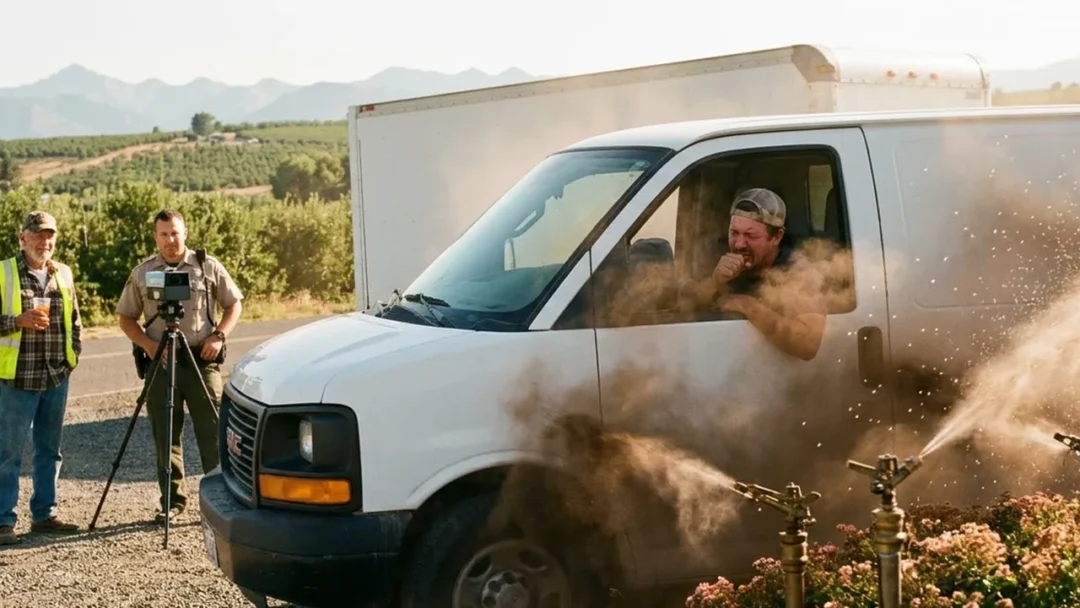
Arthur rested his calloused palm against the cold rubber handle. He had wired the system himself with heavy industrial contactors and time-delay fuses, designing the circuit so that the three boundary sprinklers received maximum hydraulic volume without starving the lower orchard drip headers. To his neighbors, Arthur was a quiet old man who spent his afternoons tending roses; to those who knew his history as an orchard engineer, he was a master of mechanical systems who never installed a pipe without knowing precisely how much pressure it could deliver. He looked across the gravel toward the white box-van, where Tyler stood grinning smugly with his arms crossed, the van’s cabin windows rolled completely down to catch the cross-breeze while the heavy roof intake fans roared with immense suction.
“Mr. Vance,” Arthur called out, giving him one final, neighborly courtesy, “you might want to close your cabin windows and shut down your climate compressor. Those vents sit about four inches inside my spray radius.” Arthur spoke with the quiet, grandfatherly calm of a man offering an umbrella before a rainstorm. He was not an aggressive man; he held no personal hatred for the young driver. But Arthur believed deeply that when an individual chooses to throw stones into a hornets’ nest, they have an absolute moral obligation to experience the full consequence of the sting.
Curiosity Lock: Tyler sneered, reached inside the driver’s door, and deliberately turned the cabin fan control up to maximum speed, shouting, “Throw your little switch, farmer! Let’s see what you’ve got!”