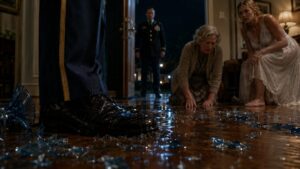
The Handcuffs On The Lawn And The General’s Medal
CHAPTER 5: THE PENTAGON AUDIT
By two o’clock that afternoon, Harold Sterling and Julian Drake had been transported in separate federal marshal vans to the United States District Court on Constitution Avenue, booked on multiple counts of grand larceny, trafficking in stolen military decorations under the Stolen Valor Act, and interstate wire fraud. Julian Drake’s entire Georgetown gallery had been sealed with yellow federal crime scene tape, while forensic investigators seized over forty stolen historical artifacts and ledgers of black-market overseas transactions.
Back at the Pentagon, inside the high-security executive conference suite of Army Cyber Command, General Marcus Vance and Darius sat with United States Secretary of the Army David Campbell and the Chief of Staff of the Army, General Raymond Scott. Resting in the center of the polished mahogany conference table, placed upon a fresh velvet cushion, was General Elijah Vance’s recovered Medal of Honor.
Secretary Campbell leaned over the table, inspecting the medal with deep, emotional reverence before looking up at Darius with profound respect.
“Cadet Vance,” Secretary Campbell said, his voice full of warmth and gravity. “Your grandfather was one of the finest tactical commanders this nation ever produced. The Department of the Army owes you and your uncle an immense debt of gratitude for preserving his memory and breaking this criminal syndicate.”
General Raymond Scott pulled up an encrypted file on the conference room display screen. “We ran a comprehensive forensic audit on Harold Sterling’s defense logistics firm this morning, Marcus. The stolen medal was merely the tip of the spear. Over the past five years, Sterling used fraudulent Department of Defense housing transfer forms to force eighteen elderly military widows out of their private residences along the Fort Meade corridor, declaring their homes delinquent under fabricated base security regulations and seizing the properties through predatory auctions.”
“And Gwen Sterling was running the local neighborhood associations to enforce the lockouts,” Darius noted, his jaw setting hard.
“Exactly,” General Scott nodded. “They were flipping the properties to private defense cybersecurity contractors for millions in corporate kickbacks. Harold Sterling had already wired twelve million dollars into offshore dummy corporations in Belize and Cyprus.”
Secretary Campbell turned to Darius, his eyes shining with pride. “Cadet Vance, the Superintendent of the United States Military Academy called my office thirty minutes ago. Your conduct on that lawn—maintaining absolute physical discipline, refusing to escalate violence, and upholding the honor of a military officer under humiliating provocation—reflects the highest traditions of the Corps of Cadets. You have been officially nominated for the West Point Superintendent’s Medal for Exemplary Character.”
Darius stood at rigid attention, snapping a crisp, textbook salute to the Secretary and the Chief of Staff. “Thank you, Mr. Secretary, General. I was only upholding the standards my grandfather taught me at this table.”
General Marcus Vance smiled, standing beside his nephew and returning the salute with a proud, loving gleam in his dark eyes. “Cadet Vance, you are dismissed to accompany Army CID back to Patriot Way. We have one final piece of business to settle on that lawn.”
Inside the Pentagon’s secure briefing facility, Secretary Campbell reviewed the preliminary digital evidence recovered from Sterling’s seized servers, shaking his head in profound disgust. The conspiracy had systematically targeted surviving spouses of deceased veterans, exploiting delays in Department of Veterans Affairs survivor benefit disbursements to claim that estate taxes were delinquent. Harold Sterling used forged Department of Defense letterhead to send intimidation notices, convincing terrified widows in their eighties that their pensions would be frozen unless they signed over their homes to his private investment trust. General Marcus Vance took careful notes on his tablet, coordinating with federal prosecutors to ensure that every single home stolen by the syndicate would be returned to the surviving families with full statutory restitution.
The Pentagon briefing room fell into a respectful silence as Darius stood beside his uncle, watching the digital presentation of his grandfather’s combat citations. Secretary Campbell recalled serving as a young staff officer under Elijah Vance during NATO maneuvers in West Germany during the Cold War. “Your grandfather was a man who never asked a soldier to take a position he wouldn’t hold himself, Cadet Vance,” Campbell said softly. “He understood that true leadership is rooted in moral courage and selfless service. What happened on that lawn was an insult to his memory, but the way you conducted yourself proved that his spirit lives on in you.”