The Iron Bridge Plate Across The Washed Out Orchard Road
CHAPTER 6: THE 1948 CHARTER
By midnight, the canyon was alive with the flashing amber lights of heavy industrial recovery equipment.
A specialized ninety-ton commercial rotator crane from Santa Maria had arrived at the lower creek gate, accompanied by two heavy-duty recovery flatbeds and an emergency environmental cleanup crew from the county health department. The twenty-five passengers had been safely evacuated down the canyon road in three CHP transport vans, escorted personally by Officer Marcus Boyd to a five-star hotel in Solvang, leaving only the legal teams and property owners at the scene.
Mateo and Lucia stood in the warmth of the Alvarez packing barn, where the scent of ripe citrus and cedar shavings provided a comforting anchor against the chaos outside. Spread across the long redwood sorting table were the original, yellowed parchment documents of the 1948 Canyon Ranch Charter, signed by the California State Land Commission and stamped with the Great Seal of the State of California.
Deputy District Attorney Elena Torres, who had driven up from Santa Barbara to personally supervise the impoundment of the corporate fleet, reviewed the ancient deeds under the barn’s fluorescent lights.
“This is one of the cleanest agricultural charters in the entire county, Mr. Alvarez,” Torres said, running a finger along the faded copperplate handwriting. “Your family purchased this land directly from the state homestead trust after World War Two. Section 14 grants the Alvarez family absolute, unchallengeable dominion over Canyon Ranch Road, including the right to remove any temporary bridges or crossings at your sole discretion for flood control and erosion management.”
“We never wanted any trouble with the neighbors,” Mateo said softly, holding a cup of black coffee in his hands. “We just wanted to grow our lemons, pick our fruit, and keep the canyon safe. When the rains come down from the mountains, this creek doesn’t care about tourist schedules. It takes everything in its path.”
“Well, Mr. Kessler’s buses won’t be taking anything anymore,” Torres replied with a grim smile. “The California Public Utilities Commission issued an emergency cease-and-desist order two hours ago. Vista Crest’s entire commercial fleet of fourteen motorcoaches has been impounded at the Santa Maria depot. State inspectors found illegal brake bypasses on nine of their vehicles. They were running a systematic fraud to avoid hundreds of thousands of dollars in mandatory hydraulic repairs.”
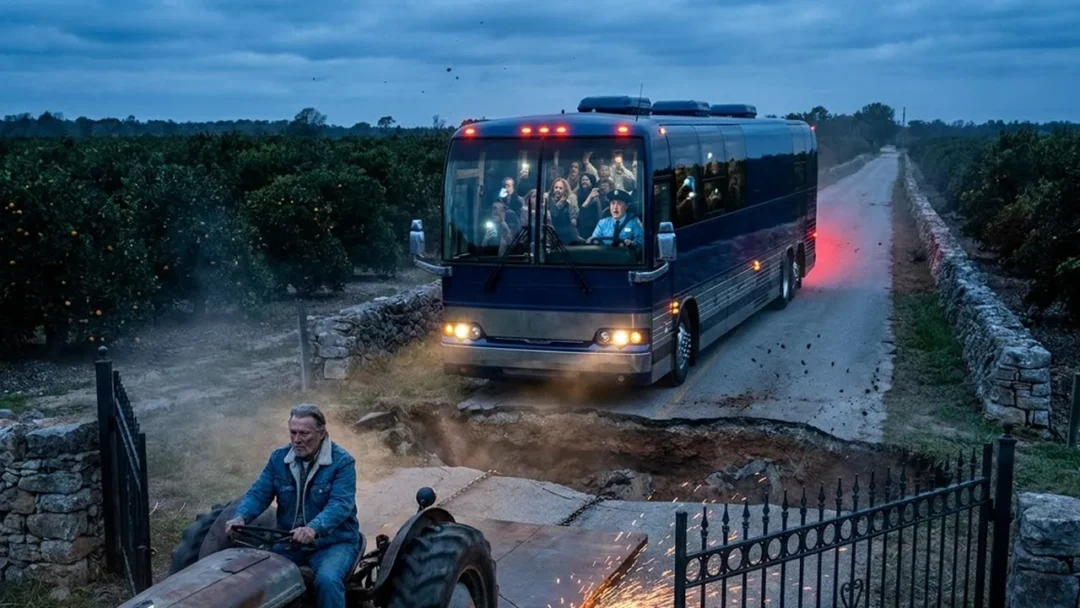
Outside, the massive diesel engines of the rotator crane roared as the recovery crew prepared to winch the stranded luxury bus backward away from the twenty-foot gorge. Steel cables hummed with tremendous tension as the coach was slowly, inch by inch, dragged back along the stone retaining wall toward a wide turnout half a mile down the canyon.
Gary Hatcher, the county road supervisor who had accompanied the recovery convoy, walked into the barn, carrying a rolled blueprint and a hard hat.
“Mateo,” Hatcher said, nodding with deep, genuine respect. “We just finished inspecting the washout. That flash flood carved out twenty feet of bedrock right down to the aquifer. If you hadn’t pulled your steel plate, that forty-foot bus would have driven straight onto the unsupported crust. The road would have collapsed under the front axle, and all twenty tons would have rolled right into Sycamore Creek.”
“I told him the road had no bottom,” Mateo said simply.
“Well, the county is stepping in under emergency flood remediation,” Hatcher said, unrolling the engineering prints. “Starting Monday morning, our civil crews will install a permanent, heavy-duty reinforced concrete box culvert with six-foot steel guardrails. And as part of the public safety decree, the county will install a state-certified automated hydraulic security gate at the lower highway intersection. You’ll hold the master transponder. Nobody enters Canyon Ranch Road without your personal authorization.”
Lucia leaned against her father’s shoulder, a wave of exhaustion and deep relief washing over her face. “No more tour buses speeding past the lemon groves.”
“No more tour buses,” Torres confirmed. “And Mr. Kessler’s luxury development across the ridge is being placed into court-ordered receivership to satisfy the millions in safety fines and passenger lawsuits. The state forestry service has already submitted a bid to acquire the parcel as a permanent wildlife sanctuary.”
Mateo looked out through the open barn doors at the high ridge of the Santa Ynez mountains. The stars had come out, cold and brilliant in the clear coastal air, shining down on the dark, quiet rows of citrus trees that his father had planted sixty years before.
He took a slow sip of his coffee, feeling the warmth spread through his chest.
“A good fence makes good neighbors,” Mateo murmured. “But an honest road keeps everyone alive.”