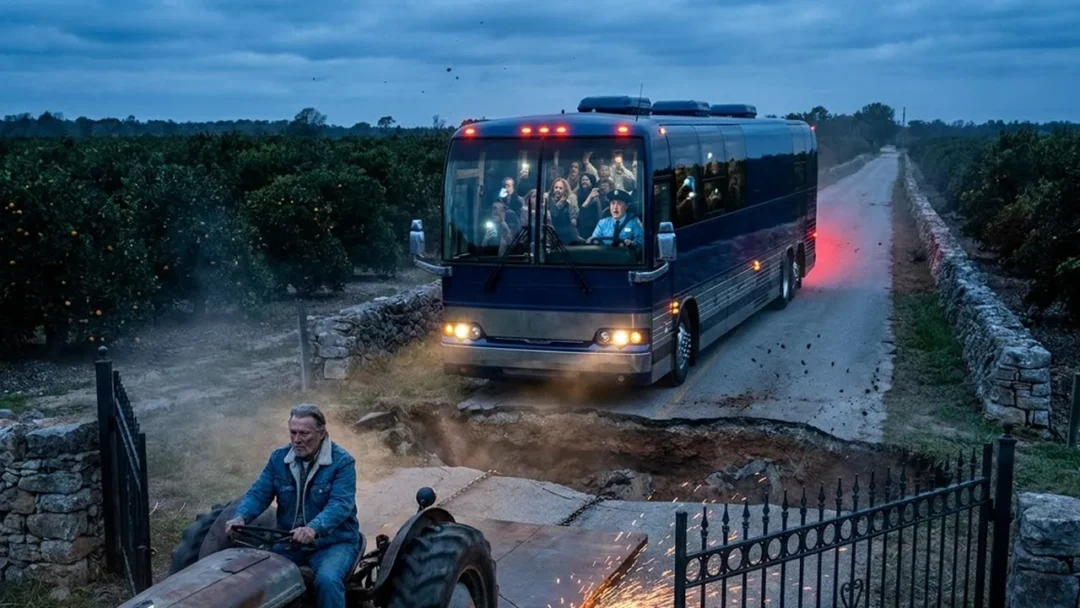
The Iron Bridge Plate Across The Washed Out Orchard Road
CHAPTER 5: DISPATCH FROM THE RIDGE
The Maybach pulled to an aggressive stop behind the CHP cruiser, its low-profile performance tires crunching over the loose shale. Raymond Kessler, managing director and majority owner of Vista Crest Cellars, stepped out into the night.
He was a man in his early fifties who spent thousands of dollars to appear effortlessly youthful, wearing a tailored Italian sport coat, open-collared silk shirt, and polished crocodile-skin boots. His silver hair was perfectly coiffed, his posture straight and confident as he walked into the center of the flashing emergency lights as if entering a private boardroom.
“Officer Boyd,” Kessler said, extending a manicured hand with an easy, practiced smile. “I came as soon as I heard about this unfortunate misunderstanding. Driver Sterling clearly suffered an acute psychological breakdown on the road. I assure you, Vista Crest Cellars holds our passenger safety to the absolute highest standard. We have already dispatched three luxury passenger vans to transport our valued guests to the estate.”
Officer Boyd did not take Kessler’s hand. He stood tall, his thumb hooked into his utility belt, looking down at the executive with cold, unblinking eyes.
“Step back from my vehicle, Mr. Kessler,” Boyd said. “This is an active criminal investigation scene. Driver Sterling is currently in custody on felony charges.”
Kessler’s smile tightened, the charm slipping from his face like grease on hot glass. “Officer, let’s be reasonable. Craig panicked. But the real issue here is this farmer.” Kessler turned and pointed an accusing finger through the gate at Mateo Alvarez. “This man illegally obstructed a recognized commercial transportation route. My company holds an active agricultural and utility right-of-way across Canyon Ranch Road dated 1974. I have my corporate attorney on the phone right now, and we are prepared to file an immediate multi-million-dollar federal injunction for unlawful restraint of commerce.”
Mateo took off his straw hat, smoothed his gray hair, and stepped closer to the heavy gate.
“Mr. Kessler,” Mateo said quietly. “My father, Tomas Alvarez, signed that 1974 utility agreement with the Southern California Edison power company. It allowed them to inspect high-voltage electric transmission lines twice a year using four-wheel-drive service pickups. It explicitly prohibits commercial passenger transport, heavy vehicles exceeding five tons, and any non-emergency access without seventy-two hours written notice.”
“That agreement was amended in 2012 when we acquired the ridge parcels!” Kessler snapped, pulling a folded legal document from his breast pocket and waving it against the bars. “We hold an unencumbered easement for all commercial activities supporting agricultural tourism!”
“That amendment is a forgery, Mr. Kessler,” Lucia Alvarez’s voice cut in, sharp and clear as a magistrate’s gavel.
She held up her tablet, illuminating the screen with high-resolution scans of the Santa Barbara County Recorder of Deeds ledger.
“I spent six months working with the county land commission after your first bus tried to force its way through our gate last harvest,” Lucia said, her voice steady and implacable. “The 2012 amendment you filed was signed by an entity called ‘Canyon Ridge Holdings’—a shell corporation registered in Nevada that never held title to a single square foot of Parcel 12. My grandfatherTomas Alvarez died in 2008. The deed passed into the Alvarez Family Trust, with my father as the sole managing trustee. You never had a legal signature, you never paid a dollar in consideration, and your filing was flagged as fraudulent by the county auditor three years ago.”
Kessler’s face went rigid. His eyes darted between Lucia, Mateo, and the digital documents displayed on the screen.
“That’s an administrative clerical error,” Kessler blurted, though his voice had lost its smooth cadence. “It has no bearing on our common-law prescriptive right of access!”
“Mr. Kessler,” Victoria Caldwell’s voice rang out from the darkness beside the bus, cold, mocking, and utterly devastating. “Would you like to explain that to our audience?”
Victoria stepped into the beam of Kessler’s headlights, holding her phone aloft.
“We have been live for the past forty-five minutes,” Victoria said, her eyes locked on Kessler like a hawk watching a field mouse. “Every word of your radio transmission ordering Driver Sterling to bypass the CHP scales, every word of your order commanding him to ram this family’s gate, and every document this young woman just presented has been broadcast to over three million people across North America. The California Department of Justice, the Public Utilities Commission, and the Santa Barbara District Attorney’s office have all posted public notices confirming they have opened concurrent criminal fraud and racketeering investigations into Vista Crest Cellars.”
Kessler staggered back half a step, as if struck in the chest by a physical blow. The polish, the arrogance, and the calculated executive veneer collapsed entirely, leaving a desperate, frightened man standing on a dark dirt road in the mountains.
“Victoria… please,” Kessler pleaded, his voice breaking into a whimper. “We can settle this privately. I can arrange an equity stake in our vineyard portfolio… a full refund of your corporate retreats…”
“Keep your money, Raymond,” Victoria said with icy disgust. “My attorneys will see you in superior court on Monday morning.”
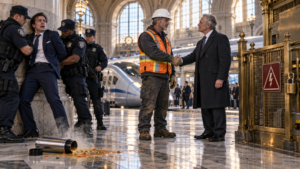
Officer Boyd stepped forward, pulling a second pair of handcuffs from his belt. “Raymond Kessler, turn around and place your hands behind your back.”
“On what grounds?” Kessler yelled, backing toward his Maybach. “I wasn’t even driving the bus!”
“Conspiracy to commit reckless endangerment, solicitation of property destruction, and tampering with commercial safety telemetry,” Boyd said, grabbing Kessler’s arm and pinning him against the sedan’s hood. “You have the right to remain silent. Anything you say can and will be used against you in a court of law.”