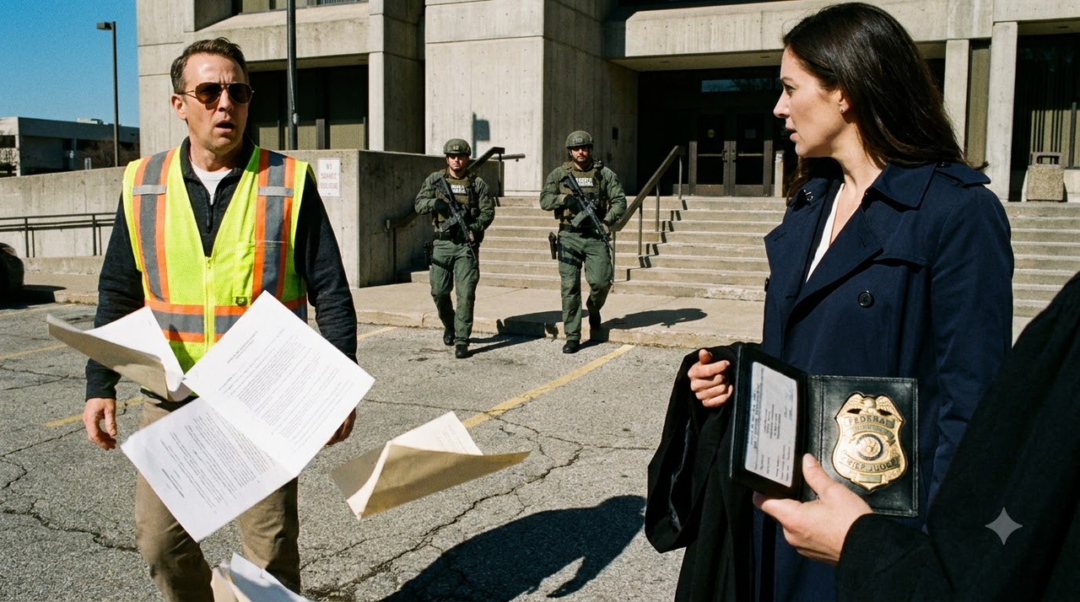
The Judge In Navy Wool And The Courthouse Parking Lot
CHAPTER 5: THE LEDGER OF CASH KICKBACKS
By three o’clock that afternoon, Courtroom 4A was completely packed to standing-room capacity.
The air in the gallery was electric with anticipation and the sharp smell of wet wool coats drying in the heated room. Every wooden bench was occupied by local investigative journalists, civil rights attorneys, and dozens of citizens whose lives had been disrupted by the predatory towing racket. In the well of the court, federal forensic accountants from the Internal Revenue Service’s Criminal Investigation division had set up three large presentation easels displaying massive, full-color financial flowcharts documenting two years of illicit transactions.
Arthur Pendelton sat at the defense table in handcuffs, his expensive Italian suit spattered with Delaware Avenue mud, looking like a drowned rat. Beside him, Gary Vane slumped in his chair, completely broken, his green enforcement vest finally removed by court order, his eyes fixed on the grain of the defense table.
Assistant U.S. Attorney David Vance stood before the easels, pointing a red laser pointer at a complex network of shell corporations, offshore bank accounts, and local political campaign committees.
“Your Honor,” Vance presented, his voice commanding absolute silence across the vast room. “The preliminary forensic review of the seized Delaware Avenue servers reveals that Apex Towing generated over seven point eight million dollars in unauthorized towing revenues over the past twenty-four months. More than two point four million dollars of that sum was disbursed in direct, untaxed cash payments.”
Vance moved the laser pointer to a bold red box at the top of the chart.
“And forty percent of those cash payments—amounting to nearly one million dollars—were hand-delivered to the private office of City Councilman Donald Hatcher, Chairman of the Municipal Transportation Committee.”
A collective gasp echoed through the courtroom gallery. Reporters scribbled frantically in their notebooks. Donald Hatcher was one of the most powerful politicians in Philadelphia, a veteran municipal boss who had controlled the city’s transit budget and parking appointments for nearly two decades.
At that moment, the heavy rear courtroom doors burst open with a loud, theatrical bang.
City Parking Authority Executive Director Warren Holt strode down the center aisle, flanked by two private attorneys in bespoke pinstripe suits. At fifty-five, Holt carried himself with the haughty, untouchable arrogance of a political insider who believed his personal connections to City Hall insulated him from federal authority.
“Your Honor!” Holt called out loudly, ignoring the wooden security rail as he stepped directly into the well of the court. “I am Warren Holt, Executive Director of the Philadelphia Parking Authority! This entire proceeding is an unprecedented federal overreach! You have unlawfully seized municipal property, detained municipal personnel, and disrupted the essential administrative functions of this city! I demand the immediate release of Supervisor Vane and the restoration of our impound facility!”
Judge Evelyn Sterling did not raise her voice. She did not strike her gavel. She merely took off her reading glasses, set them neatly on her leather desk blotter, and looked down at Warren Holt with eyes like twin searchlights.
“Mr. Holt,” Judge Sterling said, her voice dropping into a register of cold, terrifying serenity. “You are out of order. You are not counsel of record in this proceeding, and you have stepped past the bar of this court without permission.”
“I am an executive officer of this municipality!” Holt shouted, his face turning an angry, mottled crimson. “You are a district judge, not a monarch! You cannot usurp municipal jurisdiction over municipal asphalt!”
Judge Sterling reached for a single sheet of paper resting beside her gavel.
“Mr. Holt, thirty minutes ago, Assistant United States Attorney Vance presented a supplemental affidavit executed by Mr. Pendelton during his preliminary interrogation at the federal building.”
Judge Sterling lifted the paper, looking directly into Holt’s eyes.
“In that affidavit, Mr. Pendelton testified under penalty of perjury that every Friday afternoon at three o’clock, you personally met him at the Union League on Broad Street to collect a manila envelope containing twelve thousand dollars in unmarked cash. In exchange, you altered the automated dispatch algorithms to direct all downtown parking enforcement to private lots managed by his firm.”
Holt’s jaw went completely slack. His hands, which had been resting aggressively on the wooden railing, suddenly jerked back as if the mahogany had been wired to high voltage.
“That’s… that’s an uncorroborated accusation from a desperate felon,” Holt stammered, looking frantically at his two attorneys, who were already taking two steps back from him into the gallery.
“It is corroborated by four separate wiretap recordings authorized by the Chief Judge of the Third Circuit Court of Appeals,” Judge Sterling countered smoothly.
She looked up at Supervisory Deputy Marshal Marcus Cole, who had moved silently into position directly behind Holt’s shoulder.
“Marshal Cole,” Judge Sterling ordered. “Serve the supplemental bench warrant. Place Mr. Holt in custody.”
With a crisp, definitive motion, Marshal Cole seized Holt’s arms, pulling them behind his back. The heavy steel handcuffs clicked shut around the executive director’s wrists.
“Court is in recess for fifteen minutes,” Judge Sterling announced, rising gracefully from her leather chair. “When we return, we will address the restitution of every vehicle currently detained on Delaware Avenue.”