The Judge In Navy Wool And The Courthouse Parking Lot
CHAPTER 4: THE IMPOUND YARD RAID
Three miles south, along the frozen industrial waterfront of Delaware Avenue, the freezing sleet had turned into driving sheets of icy rain that drummed relentlessly against five acres of rusted corrugated sheet metal and razor wire.
The Apex Towing and Recovery impound facility was a grim, heavily fortified compound wedged between the concrete pillars of the Interstate 95 overpass and the gray, murky waters of the Delaware River. Behind an eight-foot chain-link fence topped with three strands of rusted concertina wire sat more than four hundred confiscated vehicles, parked bumper-to-bumper in muddy, unpaved rows. At the center of the yard stood a weathered modular office trailer that served as the cash-collection center, its bulletproof glass windows reinforced with heavy steel burglar bars.
Inside the trailer, forty-eight-year-old Arthur Pendelton—a stocky, thickset man with a receding hairline, a heavy gold signet ring on his pinky, and nicotine-stained fingers—was screaming into a landline telephone while shoving armfuls of paper invoices into an industrial cross-cut shredder.
“I don’t care what Vane’s dispatcher said!” Pendelton roared, the heavy shredder chewing through municipal receipts with a frantic, metallic grinding whine that filled the cramped room with paper dust. “The federal marshals are crawling all over Arch Street! Clear the cash drawers! Take the hard drives out of the dispatch server and throw them directly into the steel burn barrel out back! If those electronic logs leave this trailer, every one of us is doing ten years in federal prison!”
Outside the trailer, two burly yard workers in oil-stained hoodies were hurriedly loading three heavy steel safe boxes into the bed of an unmarked Dodge Ram pickup truck.
Suddenly, the front perimeter gates of the compound exploded inward with the force of an artillery shell.
A massive, black armored BearCat tactical vehicle belonging to the FBI’s regional SWAT unit smashed through the heavy steel chain-link gates with an ear-splitting screech of twisting metal and snapping padlocks. Following immediately behind the tactical ram, four black Chevrolet Suburbans and six marked Philadelphia Police cruisers roared into the muddy yard, their high-intensity LED light bars and flashing blue-and-red strobes turning the gray rain into a blinding storm of emergency illumination.
“FEDERAL AGENTS! DROP THE TOOLS! DOWN ON THE GROUND!”
Heavily armed federal tactical operators in olive-drab Nomex flight suits, tactical helmets, and ceramic body armor poured from the vehicles, their carbines held in high-ready positions as they fanned out across the mud.
The two yard workers instantly dropped the heavy safe boxes into the mud, falling to their knees with their hands clasped tightly behind their heads, terrified of the laser sights dancing across their chests.
Inside the trailer, Pendelton slammed the shredder lid down, spinning around and lunging toward his desk drawer for a snub-nosed .38 revolver.
Before his fingers could touch the walnut grip, the reinforced steel door of the trailer was blasted off its hinges by a heavy tactical battering ram.
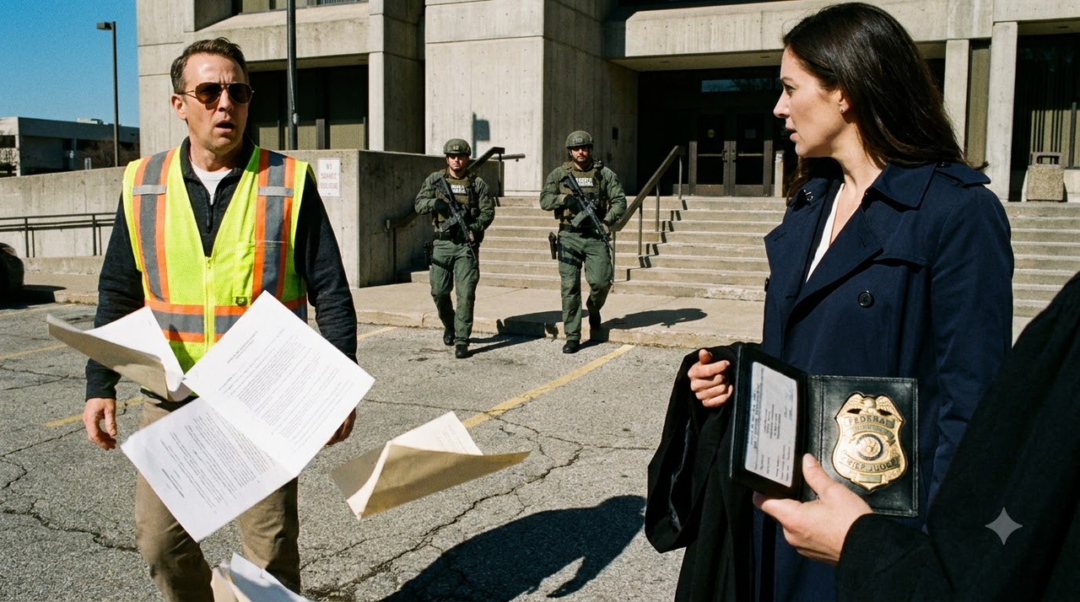
Supervisory Deputy Marshal Marcus Cole surged through the shattered doorway like an avalanche, his service weapon drawn, followed by three federal tactical agents. “DON’T TOUCH THE WEAPON! STEP AWAY FROM THE DESK! HANDS WHERE I CAN SEE THEM!”
Pendelton froze. He looked up into the cold, unblinking eyes of Marshal Cole, seeing the heavy brass star of the United States Marshals Service gleaming against the tactical chest harness.
The revolver remained untouched in the drawer. Pendelton slowly raised his trembling hands into the air, his knees shaking so violently that he had to lean against the hot steel body of the shredder for support.
“Hands behind your back! Now!” an agent barked, grabbing Pendelton’s arms, spinning him around, and forcing him face-down onto the worn industrial carpet.
The cold steel handcuffs snapped around Pendelton’s wrists with brutal, professional efficiency.
Marshal Cole stepped over to the industrial shredder, hitting the red emergency power cutoff switch. The mechanical grinding died instantly, leaving only the sound of rain lashing against the thin metal roof. Cole reached into the collection bin, pulling out a handful of tangled paper ribbons. Sticking out of the feeding mechanism was an un-shredded invoice carbon slip bearing the unmistakable printed heading: CITY COUNCIL DISCRETIONARY TOW FUND – ENVELOPE ALLOCATION.
Cole pulled his tactical radio from his vest, keying the microphone.
“Command, this is Cole. Delaware Avenue facility is secure. One primary target in custody. We’ve secured three safes, the dispatch servers, and forty banker boxes of unaltered municipal kickback logs.”
Through the radio speaker, Judge Evelyn Sterling’s calm, unmistakable voice replied from the courthouse bench:
“Exceptional work, Marshal. Bring Mr. Pendelton to Courtroom Four-A. The grand jury has a few questions about where the rest of the money is buried.”