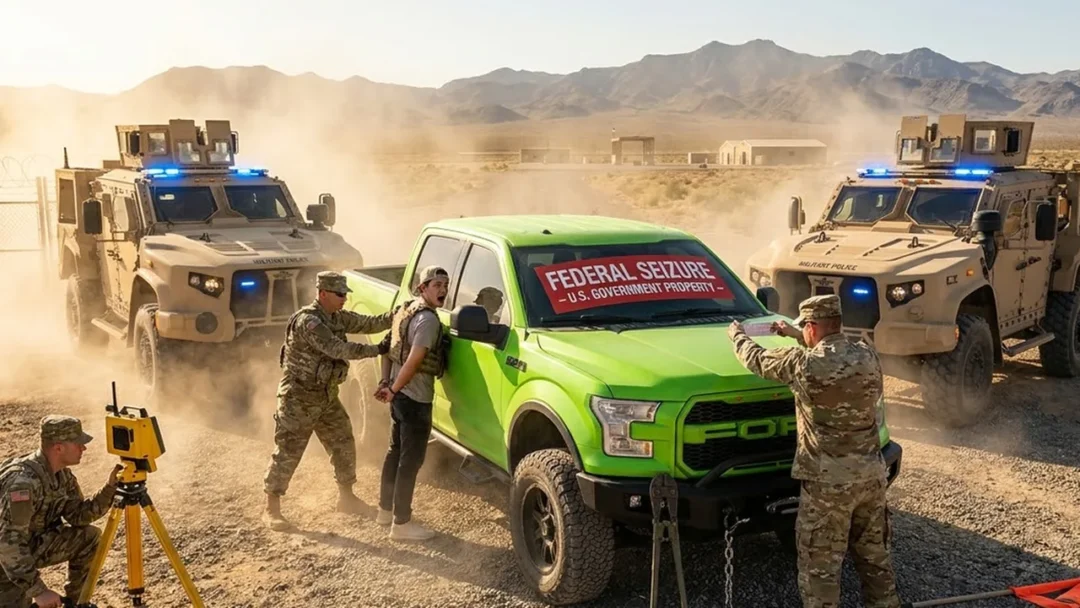
The Neon Green Lifted Truck Seized on the Desert Range
CHAPTER 8: THE FORFEITURE OF THE GREEN RIGTwo weeks later, the morning sun rose bright and warm over Range Control Post Stallion at the northern entrance of White Sands Missile Range.
In the administrative building, the United States District Court for the District of New Mexico concluded its emergency preliminary forfeiture hearings. Jaxson Drake, stripped of his designer tactical gear and wearing an orange federal detention jumpsuit, stood before the federal magistrate alongside Victor Cole.
The evidence presented by Major Hayes and the Army CID was overwhelming: the severed chain, the forensic match on the bolt-cutters, the GPS coordinates, the bank wire receipts, and the recorded radio communications on 123.45 megahertz.
The court accepted Victor Cole’s guilty plea to federal espionage conspiracy, sentencing him to eighteen years in a maximum-security federal facility. Jaxson Drake, pleading guilty to felony destruction of military property and trespassing on a national defense installation, was sentenced to thirty months in federal prison, assessed a twenty-five-thousand-dollar environmental remediation fine for damaging the desert habitat, and ordered to perform five hundred hours of community service.
Furthermore, under the final decree of civil forfeiture, legal title to the eighty-thousand-dollar neon-green Ford Super Duty was permanently transferred to the United States Department of Defense.
At ten o’clock that morning, Corporal Eli Vance walked out onto the motor pool apron at Post Stallion.
Parked in the maintenance bay was the custom truck. The flashy four-foot LED light bar had been uninstalled, the chrome decals peeled away, and the offensive electric neon-green wrap stripped completely off the body panels, revealing the factory-standard dark gray industrial paint underneath. Stenciled in clean white lettering across the driver and passenger doors was the official military emblem: U.S. ARMY – WHITE SANDS MISSILE RANGE – RANGE CONTROL UNIT 14.
A set of standard commercial radial tires replaced the noisy forty-inch mud rubbers, and a heavy-duty yellow radio transit case was bolted securely into the steel bed rack.
Staff Sergeant Cross walked out of the garage office, tossing the truck’s master ignition key across to Vance with a wide grin.
“She’s all yours, Corporal,” Cross said. “The Major authorized this rig as your primary perimeter survey patrol vehicle. Seems fitting that the truck that cut Gate Fourteen now spends the next ten years guarding it.”
Vance caught the key in his palm. He walked around the truck, running a hand over the clean steel bumper where the bolt-cutters had once rested. A faint, quiet smile touched his lips.
“It rides a lot smoother without the influencer stickers, Sergeant,” Vance said.
“Get on the trail, Vance,” Cross replied with a laugh. “The perimeter wire at Gate Fourteen needs a new chain.”
Corporal Vance climbed into the cab, fired the big diesel engine, and steered the gray truck through the motor pool gate. Out on the desert horizon, the white gypsum sands of White Sands stretched clean, vast, and silent beneath the endless New Mexico sky, guarded by men and machines that answered only to duty, honor, and the unbending rule of law.
The legal forfeiture process under Title 18, Section 981 moved with relentless federal efficiency. At the federal courthouse in Las Cruces, the magistrate signed the summary decree transferring absolute ownership of the 2024 Ford Super Duty, all installed aftermarket modifications, and all associated electronics to the United States Department of Defense.
In the motor pool at Post Stallion, the military mechanics took immense pride in their work. Over four days of intensive labor, they stripped away every vestige of civilian vanity: the oversized neon-green vinyl wrap was peeled and discarded, the loud light bars and subwoofers removed, and the chassis treated with military-grade rustproofing. Painted in matte olive drab with desert tan accents, the truck emerged as a formidable, functional sentinel of the range.
The truck was officially designated as Range Patrol Mule 14, equipped with high-output military communication transceivers, brush guards, a front-mounted winch, and heavy-duty tool racks capable of hauling emergency boundary repair supplies across the harshest terrain in North America.
Standing on the caliche road beside the newly strung, heavy-gauge steel chain at Gate 14, Corporal Vance tightened the final bolt on a brand-new, reflective federal warning placard. The desert wind blew softly through the creosote bushes, carrying the distant, reassuring rumble of an F-16 passing high overhead. The boundary was sealed, the perimeter was whole, and the vast silence of the desert belonged once again to those who guarded it.