The One Hundred Fifty Kilogram Winch Cable And The Well Vault
CHAPTER 5: THE SUBTERRANEAN VAULT
By midnight, the emergency threat had been completely neutralized. Federal marshals and state investigators had secured the scene on County Road B, taking six armed syndicate operatives into custody and seizing two commercial transport trucks loaded with illegal surveillance gear and high-powered underwater cutting torches.
Back at the Vance farmstead, the historic well curb was illuminated by the powerful halogen light arrays of the United States Navy Mobile Underwater Salvage Unit and the Wisconsin Maritime Archaeology Division.
Dr. Raymond Miller, wearing a specialized communication headset, stood at the well rim beside Arthur, monitoring the live video telemetry fed from a remote-operated submersible camera that was descending through sixty feet of crystal-clear artisan aquifer water.
On the high-resolution digital monitor in the forensics trailer, the subterranean architecture of the well was displayed in stunning, three-dimensional clarity.
Beneath the vertical forty-foot shaft of Prairie du Chien dolomite blocks, the well opened into a natural, vaulted limestone cavern fifty feet in diameter, fed by a rushing, gravel-bedded underwater spring that flowed with pristine purity.
Resting on an elevated, submerged limestone ledge fifteen feet above the cavern floor was an extraordinary nineteenth-century masonry structure: an intact, dry-laid vault of dressed sandstone blocks, sealed with hydraulic natural cement and branded with the official naval anchor insignia of the Union Army Quartermaster Corps.
Inside the open archway of the vault, resting beneath sixty feet of cold spring water, sat not just one chest, but sixty intact, iron-strapped white-oak kegs, their timber staves preserved in near-perfect condition by the anaerobic, mineral-rich mountain water.
Dr. Raymond Miller stared at the screen, tears of historical awe welling in his eyes.
“It’s the entire missing federal specie reserve of the Department of the Northwest,” Dr. Miller whispered, his voice trembling through the headset. “When the War Eagle was sabotaged by confederate sympathizers in May eighteen-sixty-five, the military escort didn’t just hide one payroll chest. They secured sixty kegs of gold specie—over one point two million dollars in nineteenth-century gold value, worth upwards of two hundred million dollars today. They placed it inside your grandfather’s spring vault to prevent it from falling into the hands of post-war guerrilla raiders.”
Arthur nodded slowly, his weathered hand resting on the cool stone rim of the well that his family had tended for one hundred and sixty-six years.
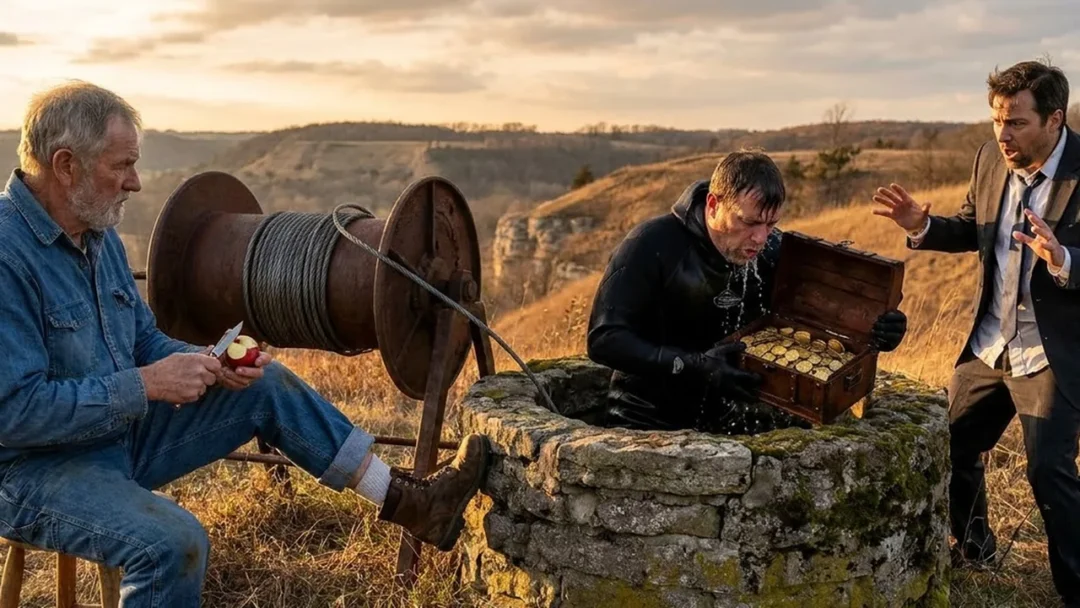
“My grandfather never touched a single coin, Dr. Miller,” Arthur spoke, his voice carrying the deep, unshakeable integrity of the Driftless hills. “During the Great Depression in nineteen-thirty-two, when the banks were foreclosing on every dairy farm in Vernon County, my father had three dollars in his pocket and six children to feed. He came out to this well in the middle of the night with a crowbar in his hand. He sat on that three-legged stool for four hours, looking down into the water.”
Arthur looked out across the dark pastures where three generations of his family had worked and sweated beneath the sun.
“He told me the next morning that an honest man can eat dry crusts and sleep like a king,” Arthur continued softly. “But the man who reaches his hand into the dark to steal from the past will spend the rest of his life looking over his shoulder. He put the crowbar back in the machine shed, hitched his draft horses, and plowed thirty acres of stony ridge by hand. That’s how we saved the farm.”
Deputy Megan Cole stepped forward, holding an official confirmation from the United States Department of Justice and the federal district court in Madison.
“Arthur,” Megan said, her voice filled with deep, emotional pride. “The United States Attorney has just executed an emergency order declaring this well and the surrounding six hundred acres a National Historic and Environmental Sanctuary. Thomas Sterling’s fraudulent lien has been vacated with prejudice, and under federal maritime salvage statutes, your family trust will receive a ten-percent statutory preservation award—twenty million dollars—to be held in public trust for the agricultural and historical preservation of the Driftless Area.”
Arthur looked down at the dark, gleaming water in the well, where the reflection of the morning stars was beginning to glitter as the night mist lifted.
He smiled faintly, a warm, quiet expression that softened every weathered line on his face.
“We don’t need twenty million dollars to be happy on this ridge, Megan,” Arthur said softly. “Just clear water in the bucket and honest neighbors down the road.”
The legal and maritime precedents governing the recovery of historical sunken cargo and abandoned military specie in inland waterways are anchored in the historical principles of admiralty law and the federal Abandoned Shipwreck Act of nineteen-eighty-seven. Under traditional maritime salvage doctrine, a salvor who recovers property from marine peril is entitled to a liberal salvage award, but ownership of the underlying cargo remains vested in the original titleholder unless unequivocal abandonment is established. In the historic case of the steamboat War Eagle, an un-inspected commercial packet chartered by the United States Quartermaster Department in the closing days of the Civil War, the gold double-eagles represented official federal military appropriations intended to pay mustered-out Union regiments in Minnesota and the Dakota Territory. Because the funds had been covertly transferred inland by military officers to prevent guerrilla looting and cached in a private subterranean vault on patented civilian soil, the legal status of the cache fell under the dual jurisdiction of federal maritime antiquity protection and Wisconsin state property law. The forensic chain of custody documented by Dr. Raymond Miller and Deputy Megan Cole demonstrated that Arthur Vance’s family had functioned not as unauthorized treasure hunters, but as unbroken involuntary bailees who had preserved federal cultural assets with complete fiduciary fidelity across five generations.