The Painted Motorcycle Tank And The Fallen Biker’s Legacy
CHAPTER 2: THE FORFEITED POLICY
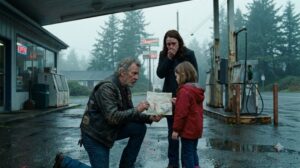
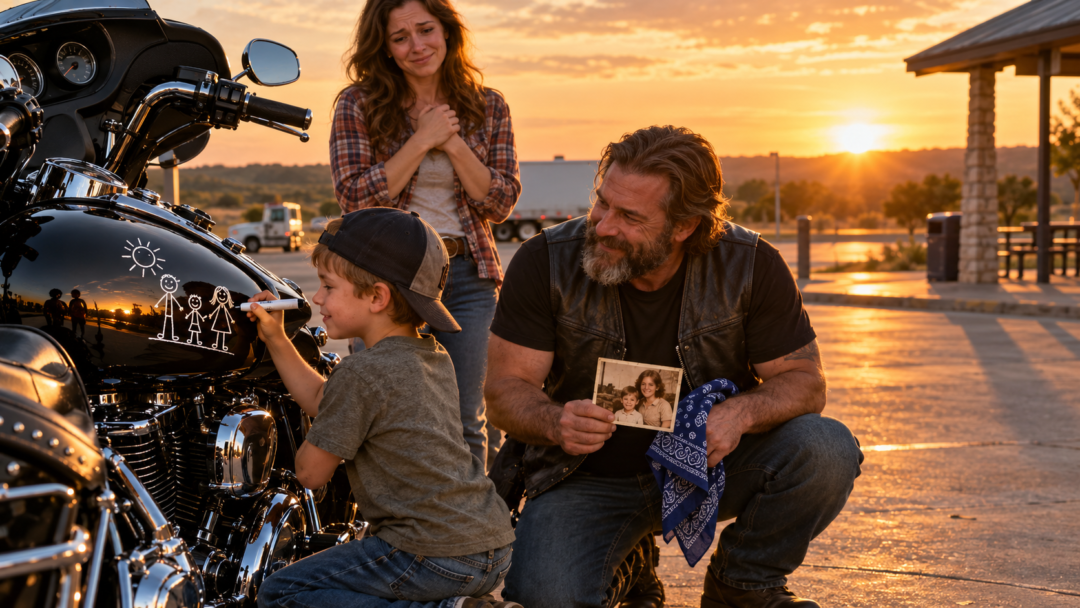
Sarah Carter sat on the stone bench beneath the rest-stop pavilion, her trembling hands wrapped around a warm paper cup of black coffee that Dutch, the club sergeant-at-arms, had fetched from their support van. Toby sat securely wedged between Hank and his mother, munching quietly on a fresh ham-and-cheese biscuit, looking in awe at the heavy silver skull rings on Hank’s calloused fingers. The child’s white paint marker lay resting on the redwood table between them, its plastic casing smeared with oil and chalk dust.
The golden light of the panhandle had faded into a cool violet twilight, the desert wind carrying a sharp chill across the plains as the first stars began to pierce the wide, western sky. In the distance, the endless line of freight trains rolled along the Santa Fe tracks, their diesel engines thrumming like a slow heartbeat against the earth.
“Daniel died three years ago on State Highway 207 outside Claude,” Sarah said, her voice hollow with lingering trauma as she wiped away fresh tears with a paper napkin. “It was a Tuesday afternoon, perfectly clear skies. The state troopers told me his front fork locked up at sixty miles an hour on a sweeping curve, throwing him violently over the handlebars into a steel cattle guard. He suffered catastrophic internal injuries and died before the medevac helicopter could touch down in the pasture.”
Hank’s jaw set into hard, unyielding granite. His knuckles whitened as he placed his massive hand on the table. “Daniel was the finest motorcycle frame builder in West Texas, Sarah. He built the custom steering heads and chassis for half the professional drag racers in Lubbock and Dallas. A triple-tree assembly that Daniel fabricated didn’t just lock up on an open highway. That man torqued every bolt with a calibrated micrometer wrench and safety-wired every critical fastener. What happened with his shop? What happened to the five-hundred-thousand-dollar accidental death policy we helped him set up through the regional fabricators’ union?”
Sarah let out a bitter, exhausted sigh, pulling a worn, accordion-style manila folder from her canvas tote bag. She opened the elastic band, revealing a thick stack of formal letters printed on heavy corporate stationery embossed with the gold eagle seal of PANHANDLE PACIFIC ASSURANCE CORP.
“Six weeks after the funeral, while Toby and I were still trying to figure out how to pay for heating oil, an insurance claims investigator named Victor Sterling came to our house in Amarillo,” Sarah explained, her voice trembling with indignation. “He wore a thousand-dollar suit and carried a leather briefcase. He sat at my kitchen table, looked me in the eye, and told me that the county coroner’s toxicology screen found trace amounts of industrial hydrocarbons in Daniel’s blood. He classified it as self-inflicted chemical intoxication under the reckless conduct exclusion clause. They claimed it voided the entire policy. They refused to pay a single nickel of his life insurance.”
Hank took the denial letter, his eyes scanning the dense corporate legalese with razor-sharp intensity. “Daniel never drank alcohol on the road, Sarah. He never touched narcotics in his entire life. He spent twelve to fourteen hours a day cleaning custom carburetors with mineral spirits and aerosol degreaser in an enclosed ventilation bay. Of course he had trace petroleum vapors in his skin and bloodstream. That wasn’t chemical intoxication; that was his livelihood! Every machinist in the country has mineral spirits in their pores!”
“It got far worse, Hank,” Sarah whispered, looking down at her son’s dusty sneakers. “Daniel had taken out an eighty-thousand-dollar equipment loan from an investment trust two years before the accident to purchase a specialized five-axis CNC milling machine for his shop. It was his dream to manufacture proprietary titanium frame components. Six months after Daniel died, Victor Sterling’s corporate investment group bought that promissory note from the local bank at a deep discount. Last week, they filed an expedited judicial foreclosure action against our family home.”
Hank reached into the folder, pulling out the formal notice of trustee sale with a bright yellow legal summons attached to the face. At the bottom of the document, listed as the authorized managing agent for the creditor holding company, was a name printed in bold black ink: VICTOR STERLING, ESQ. – MANAGING TRUSTEE, LONE STAR ASSET RECOVERY LLC.
Hank’s scarred hands gripped the paper so tightly that the edges tore slightly. “The same claims adjuster who denied your husband’s life insurance policy bought the debt on your family home?”
Sarah nodded slowly, fresh tears glistening on her eyelashes. “I went to three different attorneys in Amarillo. Every single one of them told me that without fifty thousand dollars in cash for independent forensic crash reconstruction and forensic accounting, there was nothing they could do against Panhandle Pacific’s legal team. I had to pack our clothes into my station wagon this morning because the collection agents have been circling my driveway in an unmarked tow truck since Wednesday. They threatened to impound my car with Toby’s car seat inside.”
Hank looked over at his Heritage Classic, where Toby’s white paint portrait of Daniel Carter was drying into an indestructible enamel crest on the black fuel tank under the rest-stop lights. He stood up, towering over the picnic pavilion, his buffalo leather cut creaking with heavy authority.
“You’re not packing your life into an old wagon, Sarah,” Hank said, his gravelly voice echoing off the concrete pavilion with the finality of iron. “And you’re sure as hell not running from Victor Sterling. Daniel took a bullet for me in the Persian Gulf thirty years ago, and I swore on his grave that his family would never walk alone. You and Toby are coming with us to the club compound in Amarillo. We’re going to tear Mr. Sterling’s paperwork apart tonight.”