The Secret Barbecue Behind The Cedar Fence And The Chief’s Ledger
CHAPTER 2: THE DISPATCH TRAIL
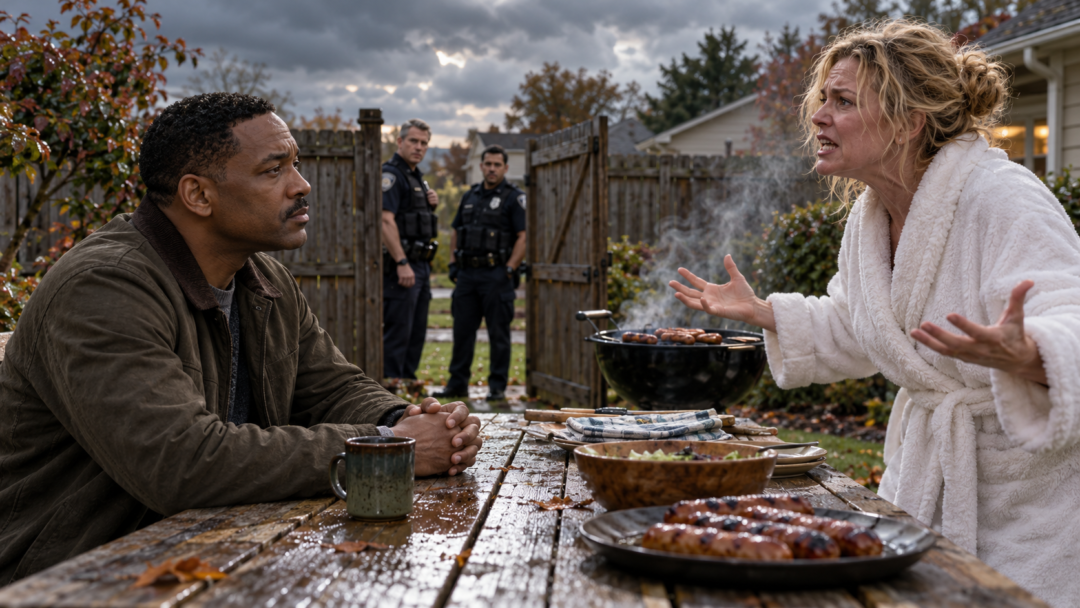
The silence in the backyard was heavy enough to smother the sizzle of rendering fat on the charcoal coals. Officer Miller stood frozen at attention, his Adam’s apple bobbing as he swallowed hard, while his older partner, Officer Hendricks, kept his gaze fixed strictly on the toe of his own polished boots. A damp autumn gust shook the dripping boughs of the loblolly pines, sending a shower of yellow pine needles across the lawn. Linda Sterling’s hand trembled against the collar of her white bathrobe, her knuckles whitening as she looked between the county police chief and Marcus Vance.
“Miller,” Chief Rhodes said, his tone dry as kiln-dried oak. “Explain to me how a priority-two gang disturbance dispatch gets routed to Marcus Vance’s personal residential address on an overcast Saturday afternoon.”
Miller cleared his throat twice before managing a squeak. “Sir, the call came through county dispatch at fourteen-forty. The dispatch ticket indicated an escalated priority code forty-one. Caller stated multiple hostile subjects drinking alcohol in plain view of minors, obstructing emergency access, and refusing to disperse. Standard operational protocol for an escalated trespassing call is an immediate two-unit response.”
“Standard protocol,” Rhodes repeated, taking a measured sip from his water glass. “And who authorized the priority flag on this carbon sheet, Miller? Because last time I reviewed county dispatch regulations, an unverified noise complaint from a neighbor doesn’t warrant an expedited squad response while two priority burglary reports sit queued on the eastern sector board. Nor does it justify officers entering a private fenced curtilage without a verified exigent circumstance.”
Linda stepped forward, trying to reconstruct her haughty posture, though her voice wobbled noticeably at the edges. “Calvin, as coalition treasurer, it is my sworn civic duty to maintain the safety and integrity of Whispering Pines. Marcus has consistently resisted our neighborhood association rules. He works on heavy machinery in his garage until all hours. He has foreign industrial equipment parked along the driveway. We received multiple complaints from families on the cul-de-sac. This isn’t personal; it’s about neighborhood preservation.”
“Marcus and I served aboard the USS Grapple during Operation Southern Watch when you were still organizing bake sales in Chesterfield County, Linda,” Chief Rhodes said without raising his voice. “He was cutting through twisted steel hull plates in eighty feet of murky water while you were learning how to misread tax assessments. You know every officer on the county roster because your husband Harold used to handle magistrate bail bonds. But using emergency communications to harass a law-abiding citizen on his own property is a Class One misdemeanor under Virginia Code Section 18.2-461.”
Linda’s breath hitched in her chest. She clutched the lapels of her robe together, stepping back until her shoulder hit the weathered cedar fence. “Calvin, you don’t know the whole situation. Whispering Pines is in transition. The county has declared this corridor—”
“Get off his property, Linda,” Rhodes interrupted with cold finality. “Before I instruct Officer Hendricks to take you into custody for criminal trespass and filing a false emergency report. And if I see you near this fence again without an official warrant, you will spend forty-eight hours in a holding cell at Henrico Jail East.”
Linda gasped, her face flushing crimson with humiliation. She glared at Marcus with pure venom, spun around in her soggy slippers, and hurried through the gate. The wooden latch clicked shut behind her like the cocking of a hammer.
Chief Rhodes waited until the sound of her hurried footsteps faded completely from the driveway gravel. Then he turned his gaze upon Miller. “Leave the carbon on the table, officer. Return to your patrol sector. And if another dispatch regarding 1422 Whispering Pines Lane crosses your mobile terminal, you call my personal line before you put a single tire on this street. Understood?”
“Yes, sir. Understood, Chief,” Miller stammered. He laid the pink slip beside Marcus’s brisket tray, rendered a crisp nod, and followed Hendricks out through the cedar fence.
Marcus picked up the pink carbon paper. His calloused fingers traced the smeared purple typeface across the header. In the top right margin, handwritten in blue ballpoint ink beneath the official Henrico County Police Division seal, were the letters AP-REV-09 alongside a six-digit municipal tax parcel number.
“What is this code, Calvin?” Marcus asked, sliding the paper toward his friend. “I know county ticket numbering. We don’t use AP prefixes in this district.”
Chief Rhodes leaned both forearms on the picnic table, the easy familiarity of their naval days giving way to the dark gravity of a veteran detective. “That code isn’t standard Henrico police shorthand, Marcus. That’s a municipal planning commission docket tag. AP stands for Apex Parkway. The county’s been quietly conducting feasibility studies for a new commercial expressway connecting Interstate 295 directly to the regional distribution hub off Route 360.”
Marcus felt a cold prickle of awareness travel up his spine. “My property sits directly on the rear boundary line of the county forest preserve.”
“Not just your property,” Rhodes replied grimly. “This entire side of Whispering Pines backs up to the drainage easement the county needs to widen the road. If the county has to buy you out through standard fair-market negotiations, it costs the developer thirty million dollars in homeowner compensations. But if an area is certified as blighted, delinquent, or crime-ridden by local neighborhood associations and police incident logs, the condemnation payout drops to twenty cents on the dollar. The state eminent domain statute allows an expedited commercial buyout if there’s an established pattern of municipal delinquency.”
Before Marcus could answer, the kitchen screen door cracked open again. His sixteen-year-old daughter, Maya, stepped onto the porch. She was clutching a thick manila envelope that had arrived in that morning’s certified mail—an envelope Marcus had tossed onto the kitchen counter unopened before firing up the grill.
“Dad,” Maya said, her voice shaking slightly as she held out a document embossed with an official gold seal. “This came from the Henrico County Chancery Court. It says our property has already been placed into an emergency receivership trust for failure to satisfy a private municipal drainage assessment—and the hearing was held two weeks ago.”