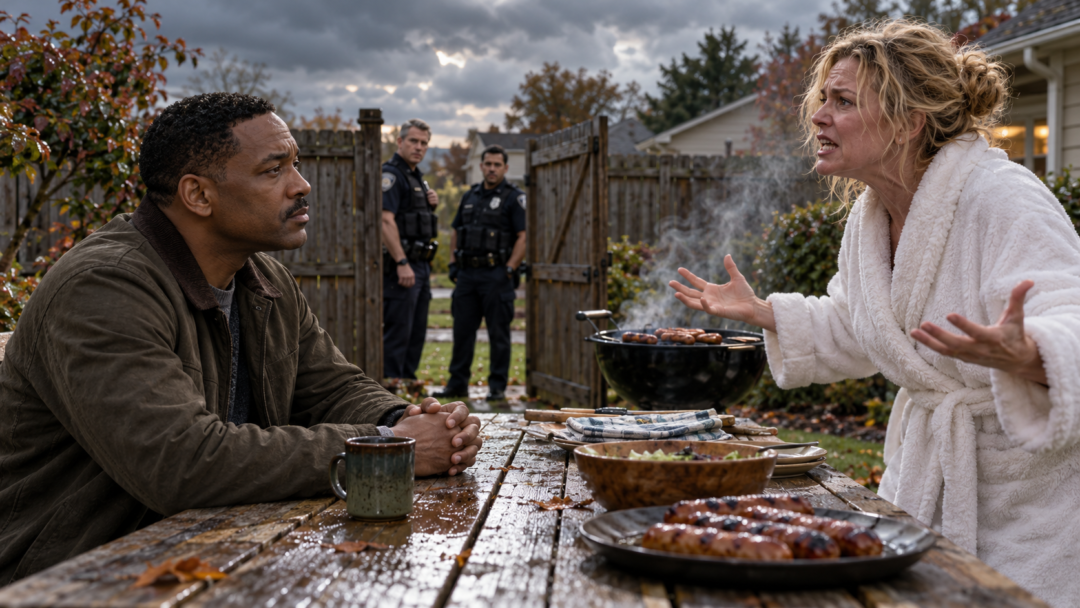
The Secret Barbecue Behind The Cedar Fence And The Chief’s Ledger
CHAPTER 4: THE FORGED LEDGER
Marcus stood in the quiet corner of Ray Henderson’s porch, the microcassette tape resting in the palm of his hand like a lump of cold lead. Down on the asphalt, Chief Rhodes stood by his unmarked sedan, speaking into a secure county satellite phone while watching the cul-de-sac with sharp, vigilant sweeps. The wind had picked up, driving cold mist through the porch screens.
“Ray,” Marcus said, kneeling beside the old conductor’s wheelchair. “Did you sign any paperwork with that Apex representative? Did you give them power of attorney or sign any quitclaim receipts?”
“Not yet,” Ray said, his jaw tightening with stubborn railway pride. “Told him I was born in this hollow and I’d die under these oaks before I let a corporate front man steal the roof over my head. But my daughter in Roanoke is scared, Marcus. She says if the sheriff comes, they’ll freeze my pension accounts and attach a judicial lien to my hospital supplemental.”
“They won’t freeze anything,” Marcus said with steady, unshakeable conviction. “Hold on to your deed. Don’t open the door for anyone without Chief Rhodes or me standing right beside you. Lock your deadbolts, and keep your phone on your lap.”
Marcus walked back down the porch steps and rejoined Rhodes at the curb. The chief snapped his phone shut, his face cast in hard, predatory angles. “I just ran Derrick Cole’s name through the state criminal justice registry. He’s not a licensed process server in the Commonwealth of Virginia. His private investigator license was revoked four years ago in Hanover County for fabricating witness affidavits in insurance fraud cases.”
“And Linda hired him to manufacture fraudulent service documents,” Marcus said. “To create the paper trail of abandoned homes.”
“Worse than that,” Rhodes said. “My contact in the county recorder’s office pulled the master deed filings for Whispering Pines. To create an infrastructure improvement district, state law requires a signed petition representing sixty percent of the recorded property owners. Linda submitted thirty-four signed petitions to the Board of Supervisors last May. That met the statutory requirement for mandatory assessment authority.”
“There are only forty-eight homes in Whispering Pines,” Marcus noted. “And half the people on this street haven’t spoken to Linda Sterling in ten years. Nobody would give her permission to levy an infrastructure surcharge against their own deeds.”
“Then let’s go see whose names are on those petitions,” Rhodes said.
Forty minutes later, Marcus and Chief Rhodes entered the Henrico County Public Records Annex on Parham Road. The basement archive was chilled and smelled of dry paper pulp, aged glue, and ammonia toner. Behind the long laminate counter, an elderly clerk named Evelyn—who had attended church with Marcus’s late wife for two decades—pulled the heavy cloth-bound ledger containing the Whispering Pines Special Improvement District charter.
Marcus turned the oversized pages under the hum of fluorescent lighting until he reached the signature annex. The document was titled Petition for Annexation and Drainage Rehabilitation: Whispering Pines Corridor.
Marcus’s eyes scanned the first column of signatures. His breath caught in his throat, and the blood drained from his face.
“Look at entry number twelve,” Marcus whispered, pointing a trembling finger at the cursive handwriting.
Evelyn Vance. 1422 Whispering Pines Lane.
“That’s my wife,” Marcus said, his voice dropping into a register so dark it made the clerk look up in alarm. “Evelyn died of leukemia four years ago. She was buried at Oakwood Cemetery in November 2022. This petition was signed and notarized in May of this year. She signed the name of a dead woman.”
Chief Rhodes leaned over the counter, inspecting the notary stamp pressed over Evelyn’s forged signature. The notary seal belonged to Linda Sterling, Commission Number 784219, registered in the Commonwealth of Virginia.
“She used dead residents to fabricate the sixty percent threshold,” Rhodes said, his voice trembling with quiet, righteous fury. “She signed Evelyn’s name, she signed old man Miller’s name who passed in the veterans hospice last winter, and she notarized her own criminal forgery. That is four counts of Class Four felony forgery per document.”
Before Marcus could turn the page, the glass entrance doors of the archive banged open against the wall.
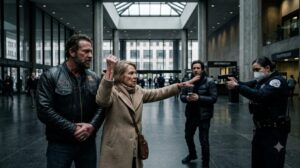
Derrick Cole stepped into the records room. He was a thick-necked man in his late thirties, wearing a leather bomber jacket, heavy work boots, and mirrored sunglasses hooked over his collar. In his right hand, he carried a rolled set of architectural blueprints; tucked into his belt was a heavy contractor’s clip-on radio. Behind him stood two burly men in fluorescent safety vests bearing the Apex Parkway Holdings logo.
Cole stopped dead in his tracks when he saw Marcus Vance standing beside the uniform-clad Chief of Police. His hand instinctively reached toward his jacket pocket, but froze instantly when Chief Rhodes stepped out from behind the counter, clearing his holster with deliberate slowness.
“Derrick Cole,” Rhodes said, each syllable snapping like dry kindling. “You’re thirty miles outside your jurisdiction, carrying stolen county surveyor blueprints, and standing in front of the chief of police while a grand jury warrant for perjury is being drafted in the commonwealth attorney’s office.”
Cole swallowed hard, taking a half-step back toward the glass exit doors. “Chief… we’re just here on official business for Apex. We got permits to begin preliminary clearing along the rear easement on Whispering Pines. We have an active grading license from the county engineer.”
“What clearing?” Marcus demanded, stepping forward until his chest was inches from Cole’s face.
Cole’s radio suddenly squawked to life with static and a frantic voice: “Derrick, get back to the site! The contractor brought the heavy D9 dozer onto lot 1422! They’re taking down the back fence right now!”