The Shattered Exhibition Bonsai And The Banned Fitness Livestream Influencer
CHAPTER 6: THE EMERGENCY REPOTTING OF THE MAPLE
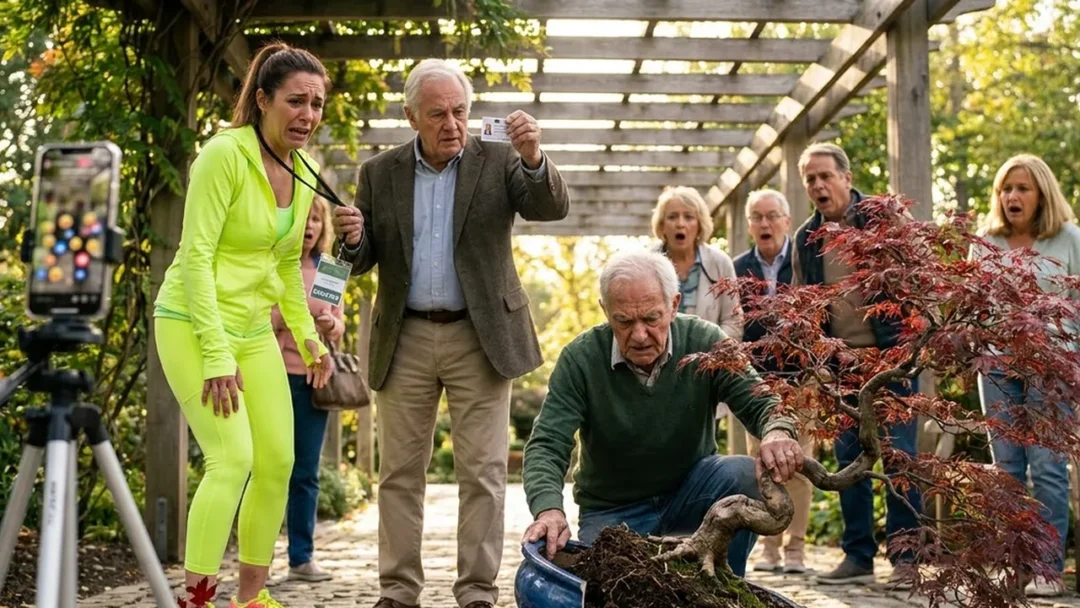
While Officer Miller escorted the weeping, handcuffed influencer down the public gallery toward a waiting patrol cruiser, Chief Conservator Maya Lin and her technical team went to work with the desperate urgency of trauma surgeons on an operating table.
Maya knelt beside Kenji Sato, opening a heavy aluminum horticultural field trunk filled with sterilized pruning shears, copper training wire, powdered hormone stimulants, and specialized unglazed Japanese training boxes.
“Kenji-san,” Maya said softly, resting a hand on the old master’s shoulder. “We have thirty minutes before the fine feeder roots suffer irreversible vascular collapse from atmospheric desiccation. Let us save your father’s tree.”
Together, the two master horticulturists worked in complete, synchronized harmony.
Kenji took a pair of surgical bonsai shears, carefully trimming the jagged, torn ends of the broken root branches to prevent fungal pathogens from penetrating the damaged vascular tissue. Maya mixed a specialized slurry of liquefied humic acid, kelp meal, and finely ground volcanic pumice, gently bathing the exposed root mass to restore its osmotic balance.
From the storage vault, two assistants brought a deep, unglazed cedar training box filled with fresh, moisture-retaining sphagnum moss and coarse Japanese akadama clay.
With infinite, reverent care, Kenji lifted the seventy-year-old maple by its root flare, gently placing the tree into the deep cedar box. He worked the fine clay granules between the delicate roots with a bamboo chopstick, ensuring zero air pockets remained around the fragile root hairs. Maya watered the soil with pure, temperature-controlled rainwater enriched with vitamin B-1 root shock preventatives, watching with immense relief as the water drained smoothly through the bottom mesh.
The crimson maple stood once again upright, supported by soft bamboo splints and copper guy wires. Nearly thirty percent of its foliage had been stripped away, and its magnificent Meiji-era pot was gone forever, but the structural core of the tree remained alive. The sap was flowing, the cambium was green beneath the bark, and the ancient spirit of the tree held fast to the earth.
Kenji bowed deeply to Maya Lin and her team, pressing his palms together in profound gratitude.
“Domo arigato gozaimasu, Maya-san,” Kenji whispered, his eyes shining with peaceful tears. “Life is fragile, but it is stubborn. The tree will remember this day, but it will grow beyond it.”
Outside the glass pavilion gates, a spectacle of modern public justice was unfolding in the autumn rain.
News vans from Seattle television stations had pulled to the curb, their broadcast cameras trained on Chloe Davenport as she was escorted into the back seat of Officer Miller’s patrol car in full view of the public. Her sponsored workout brand was officially dead; her management agency had scrubbed her profile from their website; and the video of her arrogant destruction of the seventy-year-old bonsai had already amassed four million views across global news platforms, branding her permanently as the symbol of reckless social media narcissism.
The emergency horticultural surgery performed on the seventy-year-old Japanese maple was a masterclass in living tissue preservation. Kenji Sato and Maya Lin understood that a tree in traumatic shock must be stabilized with absolute precision. When the fine feeder roots were torn away from the main root flare, the tree lost its primary mechanism for absorbing moisture and translocating essential minerals to the foliage. If left untreated for even an hour, the vascular tension inside the xylem vessels would snap under transpirational pull, causing irreversible embolism and complete crown desiccation.
Working with quiet, reverent focus, Maya Lin misted the exposed cambium with a specialized electrolyte solution while Kenji applied natural wound sealants containing pine resin and organic fungicides to the broken root ends. The deep cedar training box, constructed from rot-resistant western red cedar, provided the necessary depth and aeration to encourage rapid regeneration of adventitious roots. As the fresh akadama soil was gently settled around the root flare, Kenji placed his palm against the rough, mossy bark of the trunk, feeling the faint, vital pulse of living sap beneath his fingers. Against all odds, the seventy-year-old tree was fighting to survive.
The emergency repotting procedure continued with meticulous, breathless care. Kenji Sato’s hands moved with the gentle grace of a surgeon, his fingers threading the soft copper training wire through the drainage holes of the cedar box, securing the root flare firmly against the fresh moss bedding. Maya Lin applied organic rooting hormones to the severed feeder roots, watching the absorption rate with a digital moisture probe. Together, they coaxed the wounded tree back from the threshold of desiccation, providing it with the structural support and biological nutrients needed to initiate cellular repair.
As the cedar box was secured on the exhibition bench, a quiet sigh of relief passed through the pavilion. The tree was wounded, but its spirit remained unbroken. The crimson leaves that had fallen to the stone were gathered by Kenji and placed in a small wooden bowl—a poignant reminder of a day of trial, and a testament to the enduring resilience of living art.