The Shattered Exhibition Bonsai And The Banned Fitness Livestream Influencer
CHAPTER 2: THE FRACTURE OF THE BLUE KYOTO BOWL
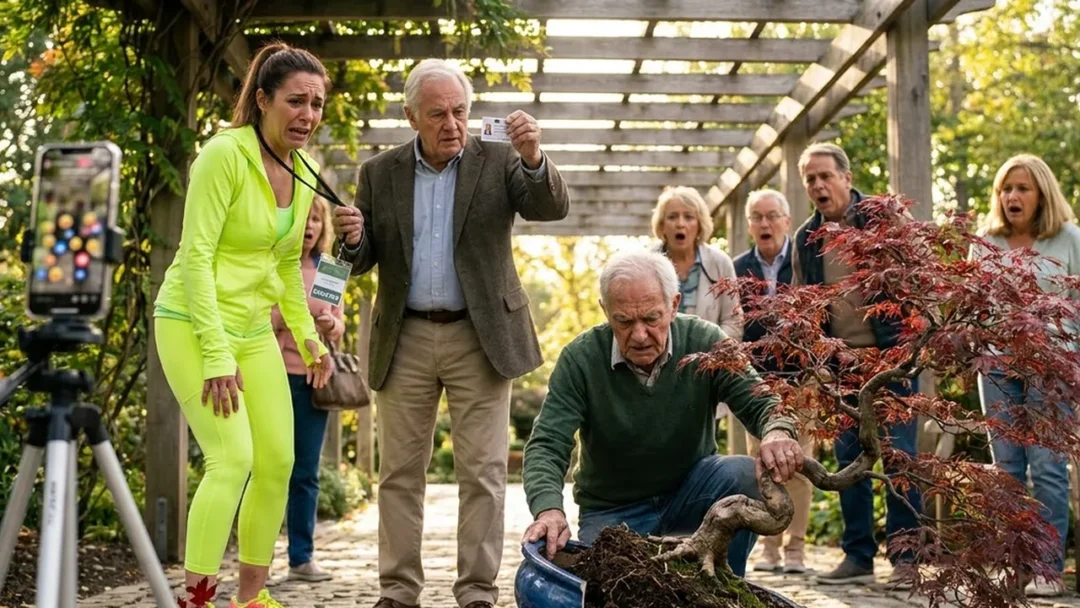
“Do not touch that tree!” Kenji warned, his voice rising with a rare, sharp edge of commanding urgency. “That ceramic dish was fired in Kyoto during the Meiji era! The root ball is delicate! If you displace that container, you will cause fatal shock to the vascular cambium!”
Chloe didn’t even pause. Her mind was blinded by the absolute, unchecked narcissism of an online content creator who had spent five years surrounded by sycophantic assistants and virtual adulation. In her world, rules were suggestions for people without followers, and any obstacle that delayed a scheduled brand broadcast was an intolerable insult to her celebrity. She had already tapped the red broadcast toggle on her iPhone screen; her multi-lens camera rig, mounted atop the carbon-fiber stabilizer, was already transmitting high-definition video directly to forty-two thousand live viewers across North America.
“Watch me clear my soundstage!” Chloe sneered, her voice carrying crisply into her high-gain lavalier microphone.
She swung the heavy metal foot of the tripod sideways with brutal, dismissive force.
The solid aluminum leg struck the outer lip of the antique ceramic bowl with a sickening, hollow crunch.
The impact was catastrophic.
The century-old Meiji-era porcelain bowl, hand-thrown with delicate walls of high-fire cobalt-glazed clay, was engineered to withstand centuries of gentle root pressure and seasonal watering, but it possessed zero tensile resistance to focused blunt-force trauma from industrial carbon fiber.
The ceramic bowl shattered into five major pieces and dozens of sharp, razor-thin porcelain shards.
Deprived of its container, the heavy seventy-year-old bonsai slid off the polished cedar exhibition bench.
Kenji Sato lunged forward with outstretched hands, but he was two feet away. The miniature maple, with its twenty-six-inch canopy of vibrant red leaves and its dense, moss-covered root ball, plummeted from the three-foot pedestal and struck the unyielding granite flagstones of the pathway with a brutal, concussive thud.
The impact pulverized the delicate root mass.
The rich, specialized akadama and pumice soil mix—painstakingly cultivated over decades to maintain the tree’s delicate fungal mycorrhizal network—exploded outward across the stone floor in a cloud of dry, dark earth. Dozens of delicate, hair-thin feeder roots, which took twenty years of careful pruning to develop, were violently sheared from the primary root flare. Several lower structural branches snapped with sharp wooden cracks, and an explosion of brilliant crimson leaves showered through the air, fluttering down like bloody raindrops to litter the damp cobblestones and stick to the neon-pink rubber soles of Chloe’s running shoes.
Kenji Sato froze. His hands remained extended in midair, his breath catching in his throat as his eyes widened in profound, agonizing grief.
He did not scream. He did not curse. He slowly sank to his knees on the cold granite stones, his trembling, calloused hands gently cradling the exposed, broken roots of the living masterpiece his father had planted before he was born.
Beside the ruined tree, on the heavy carbon-fiber tripod that had delivered the fatal blow, the iPhone 15 Pro continued to stream in unblinking, crystal-clear 4K resolution.
The wide-angle lens captured everything: the shattered blue porcelain fragments glinting on the stone, the broken red branches, the elderly master kneeling in the dirt with tears in his eyes, and Chloe Davenport standing above the wreckage with an arrogant, smirking expression frozen on her face.
Kenji looked up from the soil, his voice dropping to a whisper that cut through the silence like a scalpel:
“That tree… was seventy years old.”
In specialized horticultural conservation, the root ball of an antique bonsai represents a fragile, micro-biological universe that cannot withstand sudden environmental shock. Inside the ceramic container, the root matrix had achieved a delicate ecological equilibrium through the interaction of three specialized mineral components: hard-fired Japanese akadama clay, volcanic pumice, and crushed river grit. This porous substrate allowed atmospheric oxygen to circulate freely around the tender root hairs while retaining microscopic water films enriched with beneficial mycorrhizal fungi. When the heavy carbon-fiber tripod struck the container, the concussive energy did not merely fracture the ceramic; it shattered this living soil ecosystem, tearing the root hairs away from their fungal partners and exposing the tender vascular tissue to dry, ambient air.
The destruction of the Meiji-period ceramic bowl was a tragic cultural loss in its own right. Manufactured during the golden age of Kyoto ceramic exports, the container had been fired in traditional wood-burning climbing kilns (noborigama) at temperatures exceeding twelve hundred degrees Celsius. The luminous cobalt glaze had been formulated using natural iron and cobalt minerals, aged through over a century of outdoor seasonal weathering to develop a soft, satin patina that modern electric kilns cannot replicate. Hand-carved onto the underside of the base were the stamped seal of the artist and the imperial crest of the Kyoto Horticultural Guild. In an instant of arrogant petulance, seventy years of living art and a century of ceramic craftsmanship were reduced to sharp shards and scattered dirt.
The physical shockwave of the tripod’s impact resonated through the dense porcelain walls of the Meiji bowl, fracturing the antique clay along its original firing stress lines. As the pot fell, the sound of the ceramic shattering on the hard granite flagstones was sharp and final—a sound that made every bird in the wisteria arbor fall silent. The seventy-year-old maple, balanced for decades in its shallow tray, hit the stone with a dull, hollow thud that scattered seven decades of carefully cultivated root mass across the wet stones.
Beside the fallen tree, Chloe’s production assistant, Tyler, dropped the second lighting stand in absolute horror, his face draining of all color. “Chloe, what did you just do?” Tyler whispered, his hands trembling as he stared at the shattered pieces of blue porcelain. “That was an antique… look at the seal on the base!” Tyler knew that his name was on the production permit; he knew that being an accomplice to the destruction of a museum-grade botanical specimen could destroy his nascent career in film production before it had even begun.